
Every case team that works regularly with expert witnesses eventually rediscovers the same five or six communication problems, over and over, in case after case. The mandate was not documented clearly enough. Nobody agreed in advance who the expert's point of contact would be. A joint conference happened without a clear understanding of who could and could not be present. Each time, someone drafts language to solve the problem, usually under time pressure, usually starting from scratch, because the language developed for the last case was never saved anywhere useful. This is an entirely avoidable inefficiency, and the fix is straightforward: a small set of reusable clauses, drafted once, thoughtfully, and kept on file for every future engagement involving expert evidence.
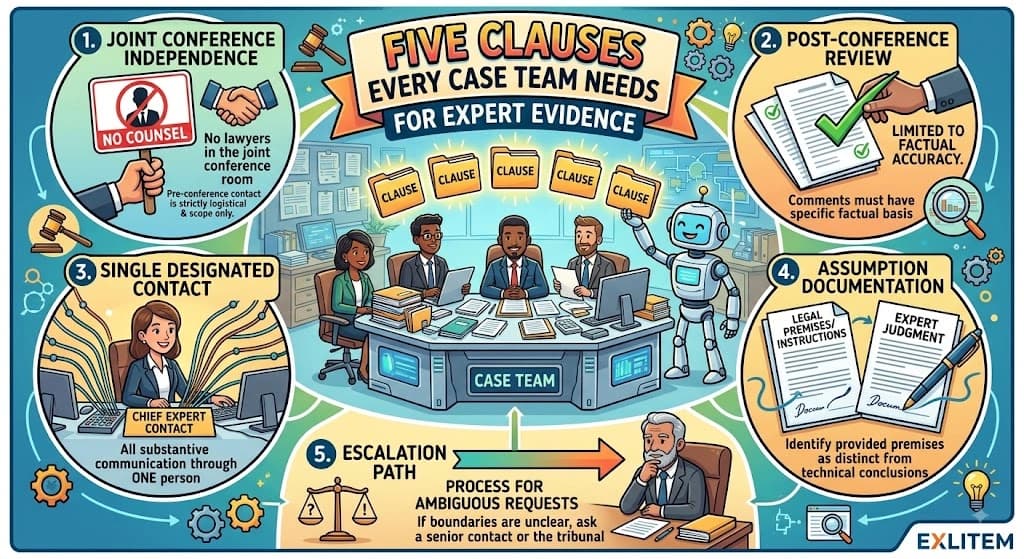
What follows are five specific clauses worth having ready before the next engagement begins, along with the reasoning behind each one. These are offered as illustrative starting points reflecting practical, defensible drafting choices, not as universally applicable legal language, and any case team should adapt them to fit the specific procedural framework, jurisdiction, and institutional rules governing a particular matter before relying on them.
Why Off-the-Shelf Clauses Save Meaningful Time and Reduce Risk
The value of having this language ready in advance is not primarily about saving drafting time, though that benefit is real. It is about consistency and quality of drafting under pressure. Language drafted calmly, in advance, with time to consider the reasoning behind each specific provision, is reliably better than language drafted quickly in response to an immediate, live situation, when the person drafting it is also managing several other pressing demands on the same case.
There is also a quality-control benefit that compounds over time. A firm or practice group that maintains and periodically refines a small set of standard clauses, incorporating lessons learned from how those clauses actually performed across several matters, ends up with meaningfully better language after a few years than a firm that redrafts from scratch each time, since each redraft starts from zero rather than building on accumulated experience. This is the same underlying insight discussed elsewhere in this content series regarding why workflow-embedded tools tend to outperform standalone guidance documents: language embedded directly in a firm's standard engagement materials gets used consistently, while language that exists only as a general recollection of what worked last time does not.
Finally, having ready language reduces the risk of an important protection being skipped entirely simply because nobody thought to raise it under the pressure of a live engagement. A clause sitting in a standard template gets included by default; a protection someone would otherwise have to remember to draft from scratch, under time pressure, is considerably more likely to be quietly omitted.
There is a further benefit specific to junior lawyers managing an expert relationship for the first time. A junior associate handling expert logistics without a template to work from has to independently judge, often without much direct experience to draw on, exactly where the boundaries of appropriate communication sit, precisely the kind of judgment call discussed elsewhere in this content series as most likely to go wrong when left to individual instinct rather than clear reference material. Ready-made clauses give that junior lawyer a concrete, defensible starting point rather than requiring them to reconstruct good practice entirely from first principles.
Clause One: Joint Conference Independence
The single most important clause any case team should have on file addresses the independence of the joint expert conference itself, an issue discussed at length elsewhere in this content series. Illustrative language: "The experts shall confer without the presence, whether in person, by telephone, or by video, of counsel for either party. Pre-conference communication between counsel and the instructed expert shall be limited to confirming the scope of issues to be addressed and logistical arrangements for the conference. Neither party's counsel shall communicate with its instructed expert during the conference by any means, including written messages."
This clause matters because leaving the independence of the conference to informal understanding, rather than explicit written agreement, creates exactly the ambiguity discussed elsewhere in this content series that allows drift to develop gradually and, in most cases, without any deliberate intent to interfere. Having this language ready and proposing it as a matter of routine, rather than only when a specific concern arises, normalizes the practice and removes any implication that raising it reflects distrust of the opposing side in a particular case.
It is worth noting explicitly that this clause addresses remote participation directly, since video conferencing has introduced genuine ambiguity about what "presence" actually means in practice, an issue discussed in more detail elsewhere in this content series. Language that only addresses physical, in-person presence leaves an obvious gap for exactly the kind of remote, informal contact that has become considerably easier and less visible since virtual conferencing became standard practice across the profession.
Clause Two: Post-Conference Review Limited to Factual Accuracy
The second clause addresses what happens after the joint conference, specifically limiting counsel's review of any draft joint statement to factual accuracy. Illustrative language: "Following the conference, the experts shall prepare a joint statement reflecting the discussion. Counsel for either party may review the draft solely to identify factual inaccuracies, including errors in the description of documents, dates, or procedural history, and shall communicate any such concerns to the relevant expert directly and in writing, with an explanation of the specific factual basis for the concern. Comments directed at the substance, wording, or emphasis of any point of agreement or disagreement recorded in the statement are not permitted."
This clause closes a gap discussed at length elsewhere in this content series: the difference between legitimate factual review and substantive reshaping is well understood conceptually but often poorly defined in practice, leaving room for exactly the kind of gradual wording pressure that erodes a joint statement's credibility over several rounds of seemingly minor edits. Explicit language requiring any comment to identify a specific factual basis makes the boundary considerably harder to drift across accidentally.
Clause Three: Designated Point of Contact and Communication Channel
The third clause addresses a more mundane but genuinely consequential issue: ensuring an expert receives consistent guidance from a single, clearly designated source rather than through multiple, uncoordinated channels, a risk discussed elsewhere in this content series. Illustrative language: "[Name/role] shall serve as the sole point of contact for all substantive communications with the instructed expert regarding scope, assumptions, and instructions. Other members of the legal team may communicate with the expert regarding purely administrative or logistical matters, but any communication touching on the scope of the mandate, underlying assumptions, or the technical approach to be adopted shall be directed through the designated point of contact."
This clause is particularly valuable in larger case teams, where an expert might otherwise receive input from several different lawyers, each operating with a slightly different, individually reasonable understanding of the case, producing inconsistent guidance that no single person on the legal team may even realize has occurred. A single point of contact considerably reduces this risk and gives the expert a clear, reliable channel for raising questions or concerns.
Clause Four: Assumption and Instruction Documentation
The fourth clause addresses the documentation of assumptions and instructions provided to the expert, an issue discussed in detail elsewhere in this content series regarding how undocumented legal premises can distort comparability between opposing experts' conclusions. Illustrative language: "Any factual or legal assumption provided to the expert as a premise for analysis, rather than left to the expert's independent determination, shall be communicated in writing and shall be clearly identified as an assumption provided by instructing counsel in the expert's report, distinct from conclusions reached through the expert's own independent technical judgment. Any material change to a previously communicated assumption shall likewise be documented in writing, with a brief explanation of the reason for the change."
This clause protects both the expert and the instructing party. It gives the expert a clear, defensible record of exactly what was provided as assumption versus determined independently, which matters considerably if the expert's independence or the basis for a specific conclusion is later challenged. It also protects the instructing party by ensuring the eventual report clearly distinguishes assumption-dependent conclusions from independently reasoned ones, reducing the risk of the entire report being unfairly discounted because a single assumption-dependent point was successfully challenged.
This clause pairs particularly well with a related practice worth adopting alongside it: requesting, where practical, that the expert include a brief sensitivity analysis showing how a conclusion would shift under an alternative assumption the opposing side is likely to advance, an approach discussed in more detail elsewhere in this content series. Documented assumptions and sensitivity analysis together give the tribunal a considerably clearer picture of exactly how much of any eventual divergence between opposing experts traces back to differing legal premises rather than differing technical judgment.
Clause Five: Escalation for Ambiguous Requests
The fifth clause addresses what happens when a request or communication seems to sit near, but not clearly across, the boundaries established by the other four clauses, a genuinely common occurrence that benefits from a clear, agreed process rather than case-by-case improvisation. Illustrative language: "If either the expert or instructing counsel believes a specific communication or request may exceed the boundaries set out above, that concern shall be raised promptly and directly with [designated senior contact]. If the concern remains unresolved, either party may raise the matter with the tribunal or case manager for guidance."
This clause matters because the boundary between appropriate and inappropriate communication, however carefully defined in the first four clauses, will still occasionally produce genuine edge cases that reasonable people could read differently. Having an agreed, low-friction escalation path removes the pressure to resolve these edge cases informally and inconsistently, which is exactly the condition under which drift tends to develop, as discussed at length elsewhere in this content series.
A well-drafted version of this clause also specifies a reasonably short timeframe for escalation, since ambiguity left unresolved for an extended period tends to be resolved eventually by default, usually in favor of whichever informal practice happens to have developed in the meantime. Specifying that a concern should be raised promptly, ideally within a short, defined window of it arising, keeps the escalation mechanism genuinely functional rather than becoming a theoretical option nobody actually exercises in practice.
Adapting These Clauses to a Specific Case
These five clauses are a starting point, not a finished product, and each should be reviewed against the specific institutional rules, jurisdictional requirements, and procedural posture of the actual matter before being used. Some institutional frameworks already address certain elements directly, in which case the corresponding clause may need to be shortened to avoid duplicating or conflicting with existing procedural directions rather than supplementing them.
It is also worth reviewing these clauses periodically against how they have actually performed in practice, incorporating specific lessons from real cases where a particular formulation proved ambiguous or where a genuinely new scenario arose that the existing language did not clearly anticipate. A firm that treats these clauses as a living resource, refined over time based on real experience, ends up with considerably stronger language after a few years than one that adopts a fixed version once and never revisits it.
A practical way to build this review process into standard practice is to designate a specific person or small group responsible for maintaining the clause library, similar to the ownership role discussed elsewhere in this content series regarding institutional protocols more broadly. Without a clear owner, even a well-drafted initial set of clauses tends to become stale over time, since no one has a specific responsibility to update it as new scenarios and lessons accumulate across the firm's growing body of matters.
Where a case involves multiple parties or a jurisdiction with procedural conventions the drafting team is less familiar with, it is particularly worth having these clauses reviewed by local counsel or someone with direct experience in that specific setting before relying on them, since language that works well in one procedural tradition may need meaningful adaptation to fit comfortably within another.
It is also worth building a short internal note alongside each clause explaining the specific reasoning behind it, not just the language itself. A future user of the clause library who understands why a particular provision exists, not just what it says, is far better positioned to adapt it sensibly to an unusual case than one working purely from the clause text without any context for the underlying concern it was designed to address.
Frequently Asked Questions
Should these clauses be proposed to the opposing party, or kept purely internal? Several of these clauses, particularly those addressing joint conference independence and post-conference review, work best as clauses proposed jointly to both parties or incorporated into the tribunal's procedural order, since their value depends partly on both sides' experts operating under the same understood rules.
What if opposing counsel resists agreeing to language like this? Resistance is worth taking seriously as information, though it is often simply unfamiliarity with the practice rather than any specific objection. Raising the request through the tribunal, framed as a routine step toward protecting the credibility of both sides' expert evidence, tends to be effective even where informal agreement between the parties proves difficult.
Should these clauses be included in the engagement letter with the expert, in a procedural order, or both? Ideally both. Including the relevant language in the engagement letter establishes it as agreed terms of the engagement from the outset, while incorporating it into a procedural order, where possible, gives it additional institutional weight, discussed elsewhere in this content series as considerably stronger than a voluntary arrangement alone.
How often should these clauses be reviewed and updated? At minimum annually, and always after any matter where a specific ambiguity or gap in the existing language became apparent, rather than waiting for a scheduled review to address a known issue.
Are these clauses appropriate for tribunal-appointed experts as well as party-appointed ones? Largely yes, though the point-of-contact and escalation clauses may need adjustment to reflect that a tribunal-appointed expert typically reports to the tribunal rather than to either party's counsel, and the underlying principles of clear scope, documented assumptions, and limited review still apply with only modest adaptation.
Conclusion
A small set of well-considered, reusable clauses addressing joint conference independence, post-conference review, designated points of contact, assumption documentation, and escalation for ambiguous cases closes most of the recurring communication risks examined throughout this content series, before they have a chance to develop into genuine problems on a live case. Having this language ready in advance, rather than drafting it fresh under pressure each time a specific issue arises, produces more consistent, higher-quality protection and removes much of the risk that an important safeguard simply gets forgotten in the pressure of an active matter. The specific wording matters less than having something ready to adapt, refine, and use as a genuine starting point rather than facing a blank page each time a new engagement begins.
Key Takeaways
● A small set of reusable clauses, drafted calmly in advance, reliably outperforms language drafted under the pressure of a live, active case.
● The five highest-value clauses address joint conference independence, limited post-conference review, a designated point of contact, assumption documentation, and a clear escalation path for ambiguous requests.
● These clauses work best when reviewed and adapted to the specific institutional rules and jurisdiction governing each matter, rather than used unmodified as a one-size-fits-all template.
● Incorporating this language into both the engagement letter and, where possible, the tribunal's procedural order gives it considerably more practical weight than relying on either alone.
Position yourself where the legal industry looks for expertise - sign up on exlitem.com to get discovered by leading lawyers and high-value clients.