
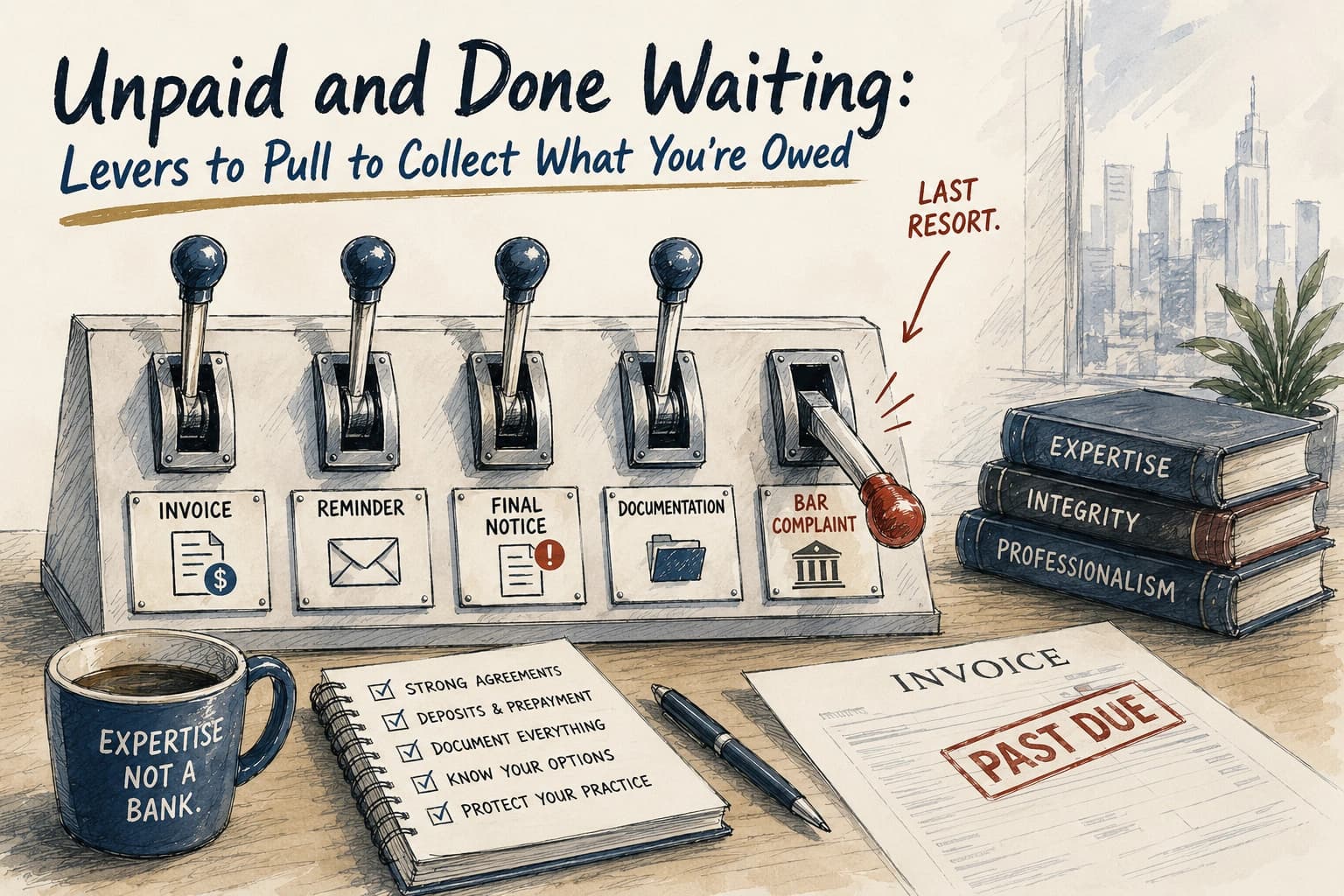
For expert witnesses, few situations are as frustrating as a "deadbeat" attorney who ignores invoices and stops communicating after you complete the work. When stern emails and phone calls go unanswered, some expert witnesses escalate the issue by filing a complaint with the state’s bar or attorney disciplinary agency.
The Power of the Disciplinary Complaint
While litigation is an option for any unpaid bill (more on that later), reporting an attorney for unprofessional conduct may get better results:
A Proven Catalyst: After months of being ignored, some experts find that filing a bar complaint can "miraculously" result in a paid invoice.
Specific Entities: Depending on the state, these complaints are handled by bodies such as the Attorney Registration and Disciplinary Commission.
Standard of Conduct: One rationale for these disciplinary agencies is to ensure that lawyers do not "rip off" contractors and clients, maintaining the profession’s integrity.
Navigating Pitfalls of "The Threat"
One debated aspect of this strategy is whether to warn the attorney beforehand. Some factors to weigh:
The Risk of Extortion: Some legal professionals warn that threatening to file a bar complaint unless they pay you may invite a claim of extortion.
Risk of a countersuit for alleged E&O (errors or omissions). In hospital and doctor settings, many malpractice claims result from collection actions against patients. Reasoning that the best defense is a good offense, patients may countersue the provider, alleging medical malpractice. An expert witness must weigh the possibility that the “deadbeat” attorney may countersue, alleging, however speciously, that the expert was negligent in handling the engagement.
Even if a countersuit lacks merit, it will be part of the expert's “permanent record” and may require reporting to one’s professional liability insurance carrier, with the associated downstream pricing impact and stigma.
Remember the adage, “When you wrestle with a pig in the mud, you both get dirty — but the pig likes it!”
Ask yourself: “How much of my life and time do you I want to spend dealing with litigation against me and the accompanying angst?”
Direct Approach: To manage these risks, some suggest filing a complaint directly without a "courtesy heads-up," sending the disciplinary body with all documentation, including a copy of the retention agreement the lawyer signed, Invoice dates, and a log of ignored or unsatisfactory communication attempts.
Formal Notice: Some experts find success by sending a final, formal notice—for example, giving the attorney a two-week window to pay before they submit a “deadbeat” complaint for unprofessional conduct.
Alternative Strategies and Future Prevention
Beyond bar complaints, experts can use other methods to thwart non-payment:
Prepayment and Deposits: Require from retaining counsel prepayment for depositions or utilize a deposit system to ensure you aren't left empty-handed.
Late Fees and Private "Don't Work With" Lists: Implementing late fees can sometimes prompt payment when retaining counsel ignores invoices. Additionally, some experts maintain private "Don't Work With" lists to protect themselves from similar experiences. (Careful on disseminating or broadcasting the names of your blacklisted attorneys or firms, lest you invite a defamation claim.)
Legal Action: If a case is currently "in suit," an expert may file a motion within that lawsuit to request a hearing on the non-payment.
While reporting lawyers to their licensing board is a tough decision that may likely end the professional relationship, some would counter that it’s a legitimate tool to ensure fair treatment by the legal industry. If they turn out to be a dead-beat client, consider whether this is truly a law firm with whom you want to build a long-term relationship. It is a “break glass in case of emergency” remedy to consider, and an expert witness's version of the nuclear option.
What follows is a draft "Final Notice" email. It aims to be professional, firm, and cautious—specifically, avoiding the "threat" of a complaint to mitigate any extortion claim, while still establishing a clear path to resolution.
Subject: FINAL NOTICE: Past Due Invoice for [Case Name/Matter Number]
Dear [Attorney Name],
I write to you regarding the outstanding balance of $[Amount] for expert witness services rendered on [Date of Service]. As of today, this invoice is [Number] days past due.
Despite my previous attempts to reach your office via [email/phone] on [list dates of previous contact], I have not received a response or a status update regarding the payment.
Recall that my professional standards and the engagement letter you signed on [INSERT DATE] require that all accounts be settled within [Number, e.g., 14] days of the original invoice date. This is my final attempt to resolve this matter directly with your firm.
If payment is not received or a payment plan is not established by [Specific Date, e.g., Friday, February 6th], I will be forced to take further action to protect my professional interests. This may include, but is not limited to:
Formal Disciplinary Filing: Submitting a report of unprofessional conduct to the [State Bar Association/Regulatory Body, e.g., Illinois ARDC].
Legal Recovery: Filing a small claims lawsuit or a motion within the underlying case to request a payment hearing.
Professional Reporting: Adding your firm to my "non-payment" registry.
I hope to avoid these measures and resolve this oversight immediately. You may remit payment via [Payment Method] or contact me at [Phone Number] to discuss this balance.
Sincerely,
[Your Name]
[Your Professional Title]
To boost the odds that a fee-based bar complaint is handled efficiently and provides needed proof of unprofessional conduct, include the following documentation:
Evidence of the Engagement
Signed Retainer or Fee Schedule: A copy of the agreement that outlines your rates, payment terms, and any agreed-upon late fees.
Work Product: Proof that the services were rendered, such as a copy of your final report, deposition transcript, or the specific "matter name" for which you were retained.
Financial Documentation
Invoices: The initial bill sent to the attorney, with the date clearly marked.
Updated Statements: Any subsequent invoices showing the accrual of late fees as outlined in your fee schedule.
The Exact Amount Owed: A clear summary of the total outstanding balance, including the dates of all relevant invoices.
Communication Log (The "Paper Trail")
Email Correspondence: Copies of every email sent requesting payment, including the "stern emails" or "final notices".
Phone Records: A log of dates and times you attempted to reach the attorney by phone without receiving a response.
Certified Mail Receipts: If you sent a final notice via certified mail, include the delivery confirmation to prove they received the demand.
Disciplinary Context
Regulatory Body Information: The specific name of the state's attorney discipline entity.
Attorney Details: The attorney's full name and, if possible, their state bar license number to ensure the complaint is filed against the correct individual.
Non-payment by attorneys isn’t just an inconvenience — it is a breach of professional conduct that undermines the integrity of the expert witness relationship. Watching retaining counsel sit on legitimate bills represents an interest-free loan to the law firm or the ultimate client. Subject matter specialists intend to be experts for their clients, not a bank for them. The tools outlined here, from formal final notices to bar complaints, exist precisely because the legal profession holds its members to enforceable standards.
Before writing off that unpaid invoice, exhaust all options. Before your next engagement, update your retainer agreement, require a deposit, and document everything. The best collection strategy is the one implemented BEFORE the work is done. Review your fee agreements today, and ensure your next engagement is protected from the start!