
Case Background
Sure Business Corp., a Florida for-profit corporation owned by its president and sole owner, Miriam Poggio, sued The Justin Maderia Trust and Justin Maderia, both as trustee and individually, in the United States District Court for the Southern District of Florida. Poggio runs an interior design, decoration, staging, concierge, and property management business and is a licensed Florida real estate broker. The dispute grew out of work her company performed on a Miami condominium that Maderia and the trust bought as an investment, plus a short-term apartment rental the company arranged for Maderia while that work was underway.
Cause
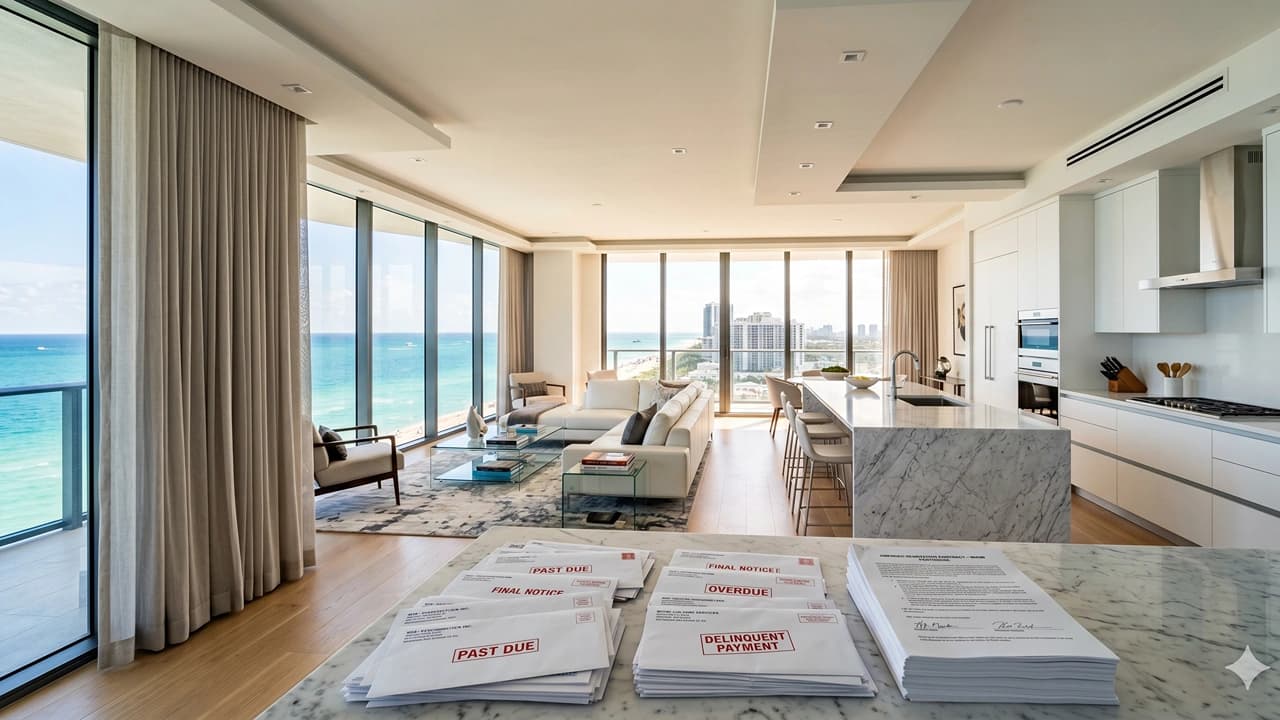
In August 2020, the trust paid $1,900,000.00 for a penthouse unit at the Gran Paraiso condominium, intending to upgrade it and resell it at a profit. On the recommendation of the Defendants' real estate agent, the Defendants hired Sure Business Corp. On September 2, 2020, the parties signed a contract under which the company would handle the remodeling, interior design, staging, and furnishing of the unit for a contract price of $138,000.00. The contract stated that any alterations or extra work had to be ordered in writing and would be billed on top of that price. Sure Business Corp. claimed that as the project went on, the Defendants kept requesting upgrades that went well beyond the original budget, including automated curtains and lights, a control system run through an iPad, new white kitchen cabinets, a redesigned foyer, an upgraded terrace ceiling, higher-end closets, wood paneling in the master bedroom, seventeen replacement doors instead of the two budgeted, an extra sprinkler system, custom furniture, and city permits the contract said the Defendants were supposed to cover. The company said it performed all of this work with the Defendants' approval, sent an updated invoice on October 10, 2021, and then could not get paid in full once the unit sold.
Injury
Sure Business Corp. said the Defendants paid only part of what they owed and left it out of pocket. The company calculated that the Defendants had paid $92,500.00 through late September 2021 and another $46,000.00 out of a closing escrow, but still owed a $223,500.00 balance tied to the renovation invoice, which started from a $269,500.00 unpaid figure. The company also said it advanced its own money for furnishings, including roughly $8,500.00 for a sofa that had been budgeted at $3,000.00, and that the Defendants sold the unit fully furnished to a buyer, Jessica Cohen, for $2,990,000.00 while keeping items the company had paid for. On top of that, the company said the Defendants never paid a separate $14,433.79 invoice for renting an apartment at the Epic condominium, where Maderia lived from September to November 2021 while the renovation continued and where Poggio covered the utilities and cleaning.
Damages Sought
Sure Business Corp. asked the Court for the unpaid balance on the renovation work and for the unpaid apartment rent, plus interest, costs, and attorney's fees under the invoice. On its civil theft claim, the company demanded $138,382.35 tripled to $403,147.00 under the Florida civil theft statute, after sending two demand letters that the Defendants did not pay. The company also reserved the right to seek punitive damages.
Key Arguments and Proceedings
Legal Representation
Plaintiff: Sure Business Corp., a Florida for-profit corporation.
· Counsel for Plaintiff: Michael J. Schlesinger | John Evron Kirkpatrick | Ronald M. Rosengarten
Defendants: The Justin Maderia Trust | Justin Maderia, as trustee and individually.
· Counsel for Defendants: Renee M. Smith of Jupiter, Florida.
Key Arguments or Remarks by Counsel
The two sides told very different stories about the same project. Sure Business Corp. argued that the Defendants knowingly ordered upgrade after upgrade, accepted the work, and then refused to pay once the unit sold for far more than they paid for it. The Defendants answered with two affirmative defenses. They raised unclean hands, claiming the company itself broke the written contract by failing to perform the services it promised, and they argued full payment, telling the Court they had already paid the entire agreed contract price. The documents reviewed do not contain a transcript of the lawyers' trial remarks, so this account reflects the written positions in the filings rather than spoken argument.
Claims
In its amended complaint, Sure Business Corp. brought eleven counts. It sued for breach of the written contract and, as an alternative, breach of a contract implied in fact. It pursued civil theft under the Florida statute and a related conversion claim, both built on the argument that the Defendants sold furnishings the company had paid for and kept the proceeds. It also raised unjust enrichment, quantum meruit, and promissory estoppel as alternative theories for recovering the value of its work, along with a claim for breach of the implied duty of good faith and fair dealing. Finally, the company brought two account-stated claims, one for the $269,500.00 renovation invoice and one for the $14,433.79 apartment invoice, and a claim for fraud in the inducement, arguing the Defendants promised to pay for extras while never intending to do so.
Defense
The Defendants kept their defense short and direct. In their amended affirmative defenses, filed on September 24, 2025, they argued unclean hands, claiming Sure Business Corp. breached the written contract by failing to deliver the services it agreed to provide. They also argued that they had already paid the full contract price the parties agreed on. In short, the Defendants told the Court the company had no right to collect anything more, both because the company itself fell short and because the bill had already been settled in full.
Jury Verdict
The jury reached a unanimous verdict, dated May 22, 2026, and the Court entered the verdict form on the docket on May 27, 2026. The jury sided with Sure Business Corp. on most of its claims, rejected its theft-based claims, and awarded a single damages figure that it repeated across several questions.
On the breach of contract claim, the jury found the Defendants breached the written contract and set damages at $81,492.87, noting that the figure included $14,433.79 for the Epic rent. On the breach of implied contract claim, the jury again found for the company and listed the same $81,492.87, again including the $14,433.79 for the Epic rent.
The jury then turned to the theft-based claims and ruled for the Defendants. It found that Sure Business Corp. did not prove its civil theft claim, and it found that the company did not prove its conversion claim. Because the jury answered no on both, it left the related damages questions blank.
On the remaining theories, the jury came back for Sure Business Corp. It found for the company on unjust enrichment, on promissory estoppel, and on quantum meruit, and it listed the same $81,492.87, including the $14,433.79 for the Epic rent, on each one. Across these questions the jury kept repeating the same total rather than stacking separate awards.
The verdict form closed with the two account-stated questions. On the invoice for the renovations to the condominium, the jury was asked whether the Defendants were liable for $269,500.00, and it answered no for the Defendants. On the invoice for the rental of the Epic apartment, the jury was asked whether the Defendants were liable for $14,433.79, and it answered yes for Sure Business Corp.
Court documents are available upon request at [email protected]