
Case Background
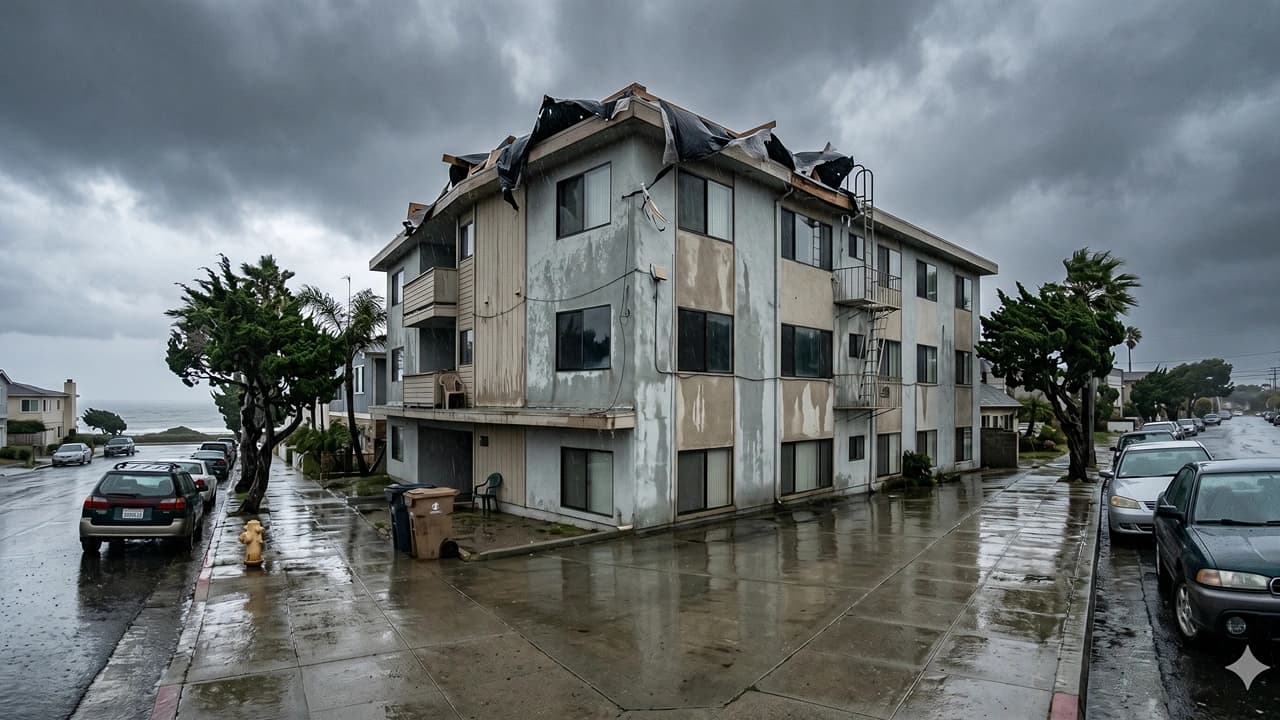
Anacapa Marine Street, LLC owned a three-story apartment building with 17 units located at 3104 4th Street in Santa Monica, California. The company purchased an Apartment PAC insurance policy from Travelers Casualty Insurance Company of America to cover commercial liabilities and property risks. The policy ran from January 9, 2023, to January 9, 2024. This contract required Travelers to pay for direct physical losses or property damage that resulted from any covered cause. The coverage also protected Anacapa against actual losses of business income and extra expenses that built up if operations faced a necessary suspension for repairs.
In December 2023, a rainstorm hit Santa Monica while a roofing contractor worked on the building. The contractor failed to place an adequate cover over the exposed roof during the repairs. Rainwater entered the unprotected areas and intruded deep into the building interior. The water caused severe physical damage across the structural elements and individual apartment units. Anacapa filed an insurance claim with Travelers to pay for the recovery. Travelers denied the claim and refused to fund the restoration, which prompted Anacapa to file a federal lawsuit.
Cause
The property loss occurred because a roofing contractor failed to shield the roof properly during maintenance, which allowed rainwater from a December 2023 storm to flood the interior rooms.
Injury
The water intrusion physically ruined structural sections of the three-story complex, damaged multiple rental units, and temporarily made apartment spaces unlivable for the residents.
Damages Sought
Anacapa demanded full policy compensation for property restoration, business income losses, and extra expenses. The company estimated total losses above $3,000,000. It also requested pre-judgment interest, legal costs, and punitive damages for bad faith.
Key Arguments and Proceedings
The litigation began when Anacapa filed its formal complaint against Travelers. Travelers filed an answer that denied liability and asserted several affirmative defenses. The case moved to a jury trial before U.S. District Judge R. Gary Klausner on April 13, 2026. Both companies presented evidence, introduced contract text, and detailed the physical financial impacts of the storm.
Legal Representation
Plaintiff(s): Anacapa Marine Street, LLC.
· Counsel for Plaintiff(s): William S. Bennett | James L. Goldman | Michael J. Fisher | Jacob Wade
Defendant(s): Travelers Casualty Insurance Company of America.
· Counsel for Defendant(s): James B. Glennon | Edward P. Murphy | Ashley C. Vicere
Key Arguments or Remarks by Counsel
Claims
Anacapa argued that the insurance policy explicitly covered all risks of direct physical loss unless a specific exclusion restricted that coverage. The attorneys asserted that the contractor's failure to shield the building created a covered loss under California law. Anacapa pointed out that the physical wreckage inside the building required immediate structural repairs, forced tenant displacement, and destroyed rental operations. The Plaintiff contended that Travelers breached the explicit terms of the apartment policy by rejecting the emergency claim. Anacapa argued that Travelers acted in bad faith to avoid a major payout, which justified additional punitive damages under the state civil code.
Defense
Travelers argued that it had no legal duty to pay because the specific circumstances of the water intrusion fell outside the scope of the policy. The insurance company maintained that the policy wording, limitations, and standard exclusions barred recovery for this type of construction-related water damage. Travelers contended that its claim investigation and eventual denial remained entirely reasonable under the policy definitions. The defense asserted that Anacapa failed to satisfy all conditions required to trigger the business income and extra expense coverages. Finally, Travelers argued that the state rules for punitive damages were unconstitutionally vague and could not legally apply to this contract dispute.
Jury Verdict
A federal jury in the Central District of California returned a unanimous verdict on April 16, 2026, in favor of Anacapa Marine Street, LLC, a property owner that sued its insurer, Travelers Casualty Insurance Company of America, over a water intrusion incident that damaged its building in December 2023. The jury answered five separate questions and awarded money on every one of them.
Cost of Repairs
The jury found that the December 2023 water intrusion caused damage that required the Plaintiff to repair the building. The jury awarded $2,200,000 for the cost of those repairs.
Ordinance or Law Compliance Costs
The jury found that, on top of the basic repair costs, the Plaintiff incurred additional expenses because the repairs had to meet ordinances or laws that were different from what applied to the building before the loss. The jury awarded $300,000 for those compliance costs. However, the Travelers policy included a cap of $75,000 for ordinance or law coverage, so the Court reduced that award to $75,000.
Lost Business Income
The jury found that the December 2023 water intrusion caused the Plaintiff to lose business income. The jury awarded $240,000 for that lost income.
Extra Expenses
The jury found that the Plaintiff spent extra money trying to limit its losses after the water damage left it unable to rent units at the property. The jury awarded $257,000 for those extra expenses.
Tenant Displacement and Relocation Expenses
The jury found that the Plaintiff spent money temporarily housing, moving, or relocating tenants because of the water intrusion. The jury awarded $200,000 for those displacement and relocation costs. The Travelers policy, however, capped tenant relocation coverage at $25,000, so the Court reduced that award to $25,000.
How the Policy Caps Cut into the Verdict
The jury's original total came to $3,097,000. Because two of the five award categories were subject to policy sublimits that Travelers wrote into the insurance contract, the Court reduced the overall judgment to $2,797,000.
Prejudgment Interest and Costs
On top of the $2,797,000 judgment, Judge Klausner ordered Travelers to pay $22,222.74 in prejudgment interest. The Court calculated that figure by applying a 10% annual rate to the $2,797,000 judgment, which worked out to $766.30 per day, and then multiplying that daily rate by the 29 days that passed between the April 16, 2026, verdict and the May 14, 2026, judgment date. The Court also allowed the Plaintiff to recover its litigation costs from Travelers in accordance with applicable law. Judge Klausner signed the final judgment on May 14, 2026.
Court documents are available upon request at [email protected]