
Case Background
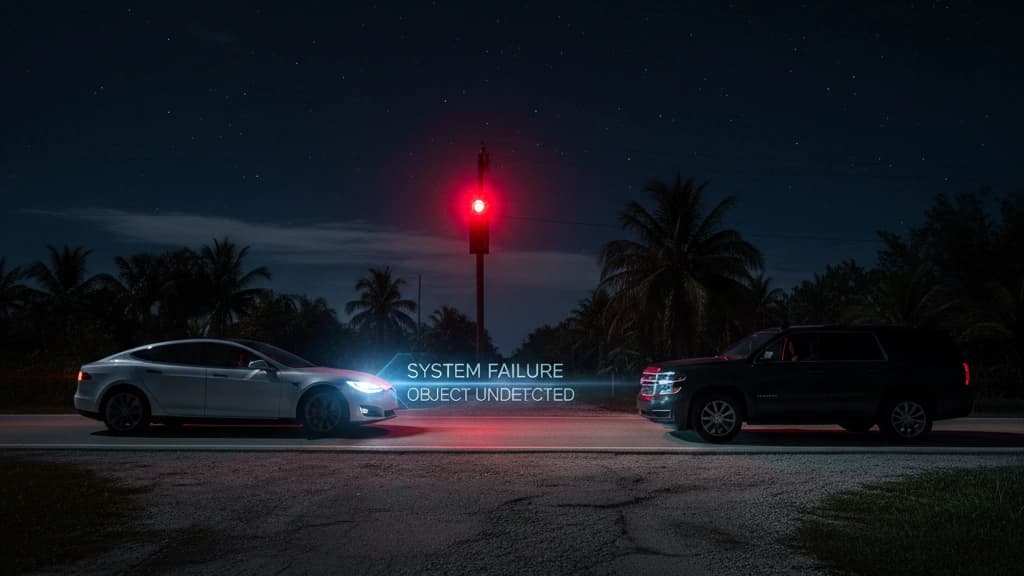
On a clear afternoon in April 2019, 22-year-old Naibel Benavides Leon stood with her friend Dillon Angulo near a parked Chevrolet Tahoe on the shoulder of a road in Key Largo, Florida. At the same time, George McGee drove his 2019 Tesla Model S toward them. McGee had engaged the car’s "Autopilot" system and, trusting the technology to monitor the road, looked down at his phone. The Tesla sped toward a T-intersection at nearly 70 miles per hour. The car's sensors and cameras failed to detect the large SUV parked directly in its path. Without slowing or braking, the Tesla slammed into the Tahoe. The force of the impact threw Naibel 75 feet into a wooded area, killing her instantly.
Cause
The crash happened because the Tesla’s Autopilot software failed to recognize a stationary object in the road. While the driver’s distraction played a role, the legal claim focused on a specific design flaw in Tesla's driver-assistance technology. The system was supposed to provide automatic emergency braking and collision avoidance, yet it did not react to the Tahoe's substantial profile.
Injury
Naibel Benavides Leon suffered fatal blunt-force trauma from the high-speed collision. Her friend, Dillon Angulo, survived but sustained severe, life-altering physical injuries and permanent disability.
Damages Sought
Neima Benavides, acting as the representative for Naibel’s estate, sued for the loss of the young woman’s future earnings and the immense emotional pain and suffering of her parents, Lilia Marilin Leon Jimenez and Guillermo Benavides. Dillon Angulo sought compensation for his extensive medical bills, physical impairment, disfigurement, and the loss of his ability to enjoy a normal life.
Key Arguments and Proceedings
Legal Representation
Plaintiff(s): Neima Benavides (Estate of Naibel Benavides Leon) and Dillon Angulo.
· Counsel for Plaintiff(s): Todd Poses | Adam T. Boumel | Douglas Fredric Eaton | Brett Schreiber | Carmela Birnbaum | David W. Terry | Donald H. Slavik | Elise R. Sanguinetti | Nicole L. Judge | Satyasrinivas Hanumadass
Defendant(s): Tesla, Inc.
· Counsel for Defendant(s): Henry Salas | Sean Hernandez | Whitney V. Cruz | Drew P. Branigan | Hilarie Bass | Joel H. Smith | Julian W. Poon | Miguel A. Estrada | Paul D. Clement | Sahily Ortega | Cole, Scott | Theodore J. Boutrous, Jr. | Thomas P. Branigan | Thomas H. Dupree, Jr. | Wendy Frank Lumish | Henry Salas
· Experts for Defendant(s): David M. Cades | James Edward Walker
Key Arguments or Remarks by Counsel
The Plaintiffs' legal team argued that Tesla had marketed a "fatally flawed" product. They contended that Tesla knew its Autopilot system struggled to detect stationary objects but failed to warn the public or install better monitoring technology, like driver-facing cameras. Tesla’s defense team countered that the car was safe when used correctly. They argued that George McGee was the primary cause of the accident because he had completely abdicated his duty to watch the road.
Claims
The estate filed counts of strict liability and failure to warn. They alleged the 2019 Model S was defective because its forward-looking sensors could not differentiate a parked vehicle from background scenery. Furthermore, they claimed Tesla should have used LIDAR or better radar technology to prevent such collisions.
Defense
Tesla denied any defect existed in the vehicle. The company asserted that Autopilot is a "driver-assist" feature, not an autonomous system, and that every owner is warned to keep their hands on the wheel and stay alert. They also pointed to the negligence of George McGee as a superseding cause of the tragedy.
Jury Verdict
After hearing the evidence, the jury reached a landmark decision on August 1, 2025. They found that Tesla had indeed placed a defective product on the market and that this defect was a legal cause of the crash. However, the jury also assigned a significant portion of the blame to the driver, George McGee.
Apportionment of Fault
The jury determined that Tesla was 33% responsible for the damages, while George McGee carried 67% of the blame.
Awarded Damages
The jury awarded a total of $59,000,000 to Naibel’s parents for their pain and suffering: $35,000,000 to her mother and $24,000,000 to her father. For Dillon Angulo, the jury awarded $70,000,000 to cover his past and future suffering and disability.
Punitive Damages
In a rare move, the jury found by clear and convincing evidence that punitive damages were warranted against Tesla. They ordered the company to pay an additional $200,000,000 as punishment for its conduct and to deter similar negligence in the future. The Total Verdict Amount awarded by the jury was $329,000,000.
Court documents are available upon request at [email protected]