

The Stakes
India processes billions of dollars of commercial and infrastructure disputes every year - yet the overwhelming majority of high-value international arbitrations involving Indian parties are still seated in Singapore or London. The reason, consistently cited by practitioners, is institutional credibility: the predictability of SIAC’s rules, the depth of LCIA’s arbitrator panel, and the enforceability of awards in courts that do not second-guess them.
That is changing, faster than practitioners based outside India may realise. In 2025, MCIA’s caseload grew by nearly 80 percent. An expert committee has published a full blueprint for an Alternative Dispute Resolution Centre at GIFT IFSC, modelled on SIAC. The Arbitration and Conciliation (Amendment) Bill 2024 proposes further legislative reform. And the government has issued clear signals that Central Public Sector Enterprises should resolve their disputes institutionally, in India.
For attorneys writing arbitration clauses today, or advising parties already in a dispute, the question is no longer whether Indian institutional arbitration works - it is which institution, and why.
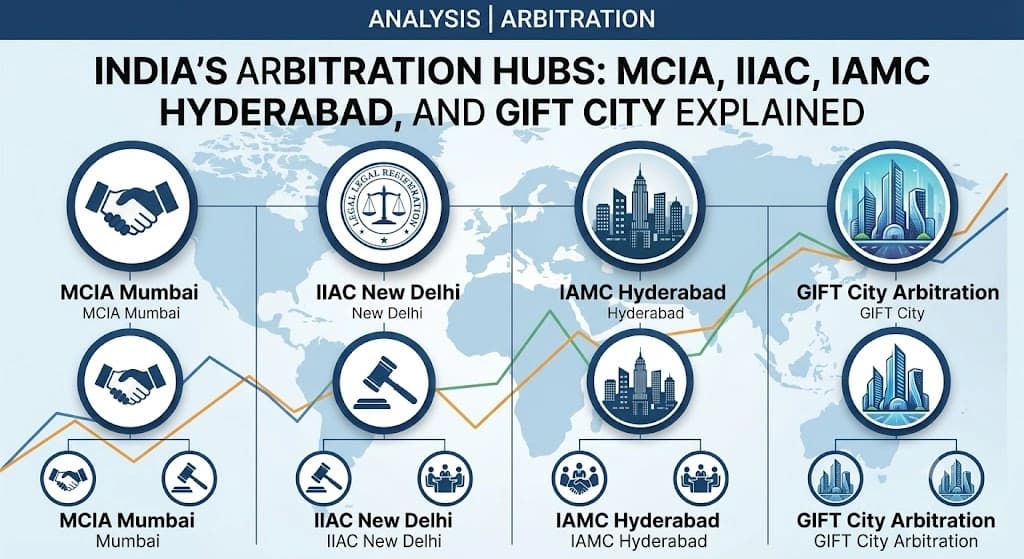
Hub | Best for | Founded | 2025 Highlight |
MCIA | Commercial, cross-border, JV, M&A | 2016 | 79.5% caseload rise; new 2025 Rules |
IIAC | Public-sector, CPSE, infrastructure | 2019 | Government push for CPSEs to use IIAC |
IAMC Hyderabad | South India, Gulf trade, mediation | 2021 | MoUs with T-Hub & HAMPS; tribunal secretary training |
GIFT City ADRC | Cross-border finance, FinTech, maritime | Proposed | Expert committee blueprint published; governing law flexibility |
MCIA: The Commercial Benchmark
The Mumbai Centre for International Arbitration, established in 2016, is the closest thing India has to a private-sector international standard. It is not government-controlled, its arbitrator panel is international, and its rules - now in their third edition - benchmark against SIAC and ICC.
The 2025 MCIA Rules, which came into force in May 2025, are the most substantive overhaul since the Centre’s founding. The rulebook has expanded from 36 to 49 provisions. Claimants can now file a single Request for Arbitration spanning multiple arbitration agreements in related disputes (Rule 5). Non-parties can be joined to proceedings, either by a party’s application or by the non-party itself where they are prima facie bound by the relevant arbitration agreement (Rule 8). Early dismissal and summary determination mechanisms - long available at SIAC and ICC - are now embedded in the MCIA framework. Publication of redacted awards (Rule 47) will gradually build a body of MCIA jurisprudence.
90% of MCIA-administered awards in 2024 were delivered within 18 months. None were set aside by Indian courts. |
The numbers support the institutional maturation story. MCIA’s 2024 annual report recorded a 48 percent caseload increase - from 23 cases in 2023 to 34 in 2024 - with total dispute value reaching approximately USD 257 million and an average case value of USD 11.4 million. The 2025 annual report recorded a 79.5 percent increase, with 61 new matters filed. More than 90 percent arose from contracts that had incorporated MCIA arbitration clauses organically, not from court referrals or ad hoc conversions.
The case mix remains predominantly domestic, though international participation is growing: approximately 18 percent of matters now involve foreign parties. Sectors include commercial disputes (34%), share purchase agreements (27%), employment (14%), and construction (7%).
For commercial disputes, joint ventures, M&A, and finance, MCIA is the default institutional choice for sophisticated parties who want an Indian seat without sacrificing procedural rigour.
IIAC: The Government’s Flagship
The India International Arbitration Centre in New Delhi is a statutory body, created by an Act of Parliament in 2019 and declared an Institution of National Importance. That status matters: it means IIAC has government backing, a mandate to handle public-sector disputes, and a specific policy purpose - to make Delhi a credible international arbitration seat.
The government has been pushing this mandate with increasing directness. A conference in June 2025, organised in collaboration with ONGC, was aimed at educating Central Public Sector Enterprises (CPSEs) about the benefits of institutional arbitration - and IIAC specifically. CPSEs collectively represent some of the largest infrastructure and energy disputes in India, and redirecting even a fraction of that caseload into IIAC would materially transform the Centre’s volume overnight.
IIAC updated its regulations in 2025, including revised criteria for arbitrator empanelment (last amended December 2025). The Centre has also been building visibility through events such as an Oxford-style debate at the Delhi High Court on institutional arbitration, held in September 2025.
One development that parties should note: in May 2026, IIAC temporarily suspended receipt of new applications for arbitrator empanelment on its panel. The Centre has not publicly stated a timeline for reopening. Attorneys selecting IIAC in an arbitration clause should verify current panel status before filing.
IIAC’s value proposition is clearest for disputes involving public-sector counterparties, infrastructure contracts with central government entities, and matters where parties prefer a government-supervised institution. Lawyers structuring contracts with CPSEs, or handling disputes arising from them, should consider IIAC the natural institutional home.
IAMC Hyderabad: The Challenger from the South
The International Arbitration and Mediation Centre in Hyderabad launched in 2021, positioning itself as India’s first institution combining international arbitration with formal mediation services under one roof. Its geographic base in Telangana gives it proximity to South India’s energy, pharmaceutical, and infrastructure sectors. Its stated focus includes trade disputes with Gulf and Middle Eastern counterparties - a natural fit given Hyderabad’s commercial links with the region.
IAMC has been building its institutional infrastructure through collaboration. In June 2025 it signed a Memorandum of Understanding with T-Hub, Hyderabad’s flagship innovation hub, and in July 2025 with the Hyderabad Academy of Mediation and Peace Studies - signalling a particular focus on mediation and hybrid dispute resolution modes. IAMC’s Registrar participated in the launch of the Mediation Association of India at Bharat Mandapam in May 2025. In February 2026, IAMC launched a Tribunal Secretary Training Programme in collaboration with the Asian Institute of Alternative Dispute Resolution (AIADR), building the human capital that any serious arbitration institution requires.
IAMC is earlier in its institutional lifecycle than MCIA or IIAC. Attorneys considering it should evaluate IAMC primarily for disputes where the parties have a natural connection to Hyderabad or South India, where mediation is a realistic parallel track, or where the counterparty is in the Gulf region. As caseload and jurisprudence develop, its profile will become clearer.
GIFT City: The International Play
The most consequential development in India’s institutional arbitration landscape is not yet an institution - it is a blueprint. In July 2024, IFSCA’s expert committee published its report on the proposed Alternative Dispute Resolution Centre (ADRC) at GIFT IFSC in Gujarat. The concept is broader than arbitration alone: the ADRC is designed to offer arbitration, mediation, Arb-Med-Arb, and online dispute resolution under a single framework, modelled explicitly on Singapore’s approach.
Two features of the design stand out for international counsel.
First, governing law flexibility. Users of the ADRC - whether Indian entities or foreign parties - will be able to select any governing law in their contracts, including foreign law, and resolve disputes at GIFT IFSC. This addresses a persistent complaint: Indian-seat arbitrations have historically required Indian governing law for domestic parties, making them less attractive for cross-border transactions where parties prefer English or New York law. The GIFT IFSC framework removes that constraint.
Second, judicial architecture. All court matters arising from IFSC-seated disputes will go to a specially designated bench of the Gujarat High Court - a fast-track channel designed to reduce the risk of judicial delays that have historically undermined confidence in Indian-seat arbitrations.
The governance model explicitly replicates SIAC’s design: an autonomous Board, independent from government control, with advisory councils blending Indian and international expertise. GIFT City is also home to GIMAC, the Gujarat International Maritime Arbitration Centre, a specialist institution for shipping and maritime disputes developed under an MoU between Gujarat Maritime University and IFSCA.
The ADRC’s governing law flexibility — allowing parties to select English or New York law for GIFT IFSC-seated disputes — addresses the single biggest objection international counterparties have to an Indian seat. |
The ADRC is not yet operational. Attorneys cannot yet specify GIFT IFSC as their seat in the way they can specify MCIA or IIAC. But for long-term infrastructure contracts, joint ventures with international counterparties, and financial services disputes, GIFT City is the development to watch. The policy momentum is significant.
How to Choose: A Practical Framework
The four hubs are not competing for the same disputes in the same way. A working framework for attorneys:
• Commercial, cross-border, or M&A disputes where both parties want Indian seat with international procedural standards: MCIA is the current best fit. Its 2025 Rules, independent panel, improving efficiency record, and award enforcement results make it the closest India has to a domestically-seated SIAC equivalent.
• Contracts involving a CPSE, central government entity, or public infrastructure project: IIAC is the natural choice, and increasingly the expected one given policy signals from the Ministry of Law and Justice. Verify current panel status before filing.
• Disputes with a natural South India connection, Gulf counterparties, or where mediation is a serious parallel track: IAMC Hyderabad warrants consideration, particularly as its institutional capacity and caseload develop.
• Cross-border finance, FinTech, and transactions requiring governing law flexibility or an IFSC seat: monitor the ADRC at GIFT City. For maritime disputes specifically, GIMAC is operational and sector-specific.
No Indian institution yet matches SIAC or ICC for brand recognition among international counterparties. Attorneys negotiating with foreign parties who resist an Indian seat should focus their advocacy on demonstrable metrics - MCIA’s 18-month award timeline and zero set-aside record are genuinely competitive arguments.
Takeaway
India’s arbitration infrastructure has advanced materially in the past three years. The question is no longer whether to use an Indian institution - it is which one, and how to structure the clause to maximise efficiency and enforceability. The right expert witness is the next decision that follows: quantum, construction, forensics, or technical evidence can determine whether a well-reasoned case succeeds or fails at the tribunal.
"Position yourself where the legal industry looks for expertise - sign up on exlitem.com to get discovered by leading lawyers and high-value clients."