
A judge or arbitrator working through a technical dispute has a narrow, genuine question about an expert's methodology, the kind that would take five minutes to answer directly, and no comfortable way to ask it. Picking up the phone and calling the expert feels efficient and, to many decision-makers, obviously reasonable in the moment. It is also, in most systems, exactly the kind of contact that fairness protections in dispute resolution are built to prevent, and the tension between those two instincts is the entire subject of this piece.
This is a genuine trade-off rather than a question with an obvious answer, which is precisely why it keeps recurring across cases and jurisdictions despite decades of procedural practice addressing it. Weighing the benefits of direct clarity against the real risks to party control and perceived fairness, honestly and without pretending the answer is simple, is more useful than either reflexively defending the practice or reflexively condemning it.
The question also matters more than its occasional, informal nature might suggest. A single instance of private contact, discovered after the fact, can become the central issue in a challenge to an otherwise sound decision, consuming far more time, cost, and reputational risk than the original five-minute conversation was ever worth. Understanding where the real risk lies, and how to capture the underlying benefit without it, is worth the deliberate attention this piece gives it.
The Case for Direct Contact
The efficiency argument is real and should not be dismissed too quickly. A decision-maker with a specific, narrow technical question, why was one data point excluded, what would change under a slightly different assumption, often has a genuine need for a quick, direct answer that a formal written question-and-response cycle, or worse, waiting for the point to surface at a hearing months later, handles clumsily by comparison. Direct contact, in principle, closes an information gap fast and lets the decision-maker move forward with genuine clarity rather than a lingering uncertainty they carry all the way to the hearing.
There is also an argument rooted in respect for the expert's independent professional standing. An expert is, after all, meant to be a broadly neutral technical resource in many respects, not simply a mouthpiece for the instructing party, and a decision-maker treating the expert as approachable for genuine clarification can be understood as a form of professional courtesy consistent with that independence, rather than an improper intrusion into party control.
There is a related, more practical argument about time pressure. Decision-makers managing demanding caseloads sometimes face a genuine choice between a quick clarifying conversation and simply proceeding without the clarity that conversation would have provided, if no formal mechanism for obtaining it exists. Framed this way, the alternative to direct contact is not always a more careful process, it is sometimes a decision made with less information than a brief conversation would have supplied, which is a real cost worth acknowledging even while ultimately weighing against the practice.
Proponents of more direct engagement also point to how communication norms function well in some inquisitorial systems, where structured direct questioning by the decision-maker is an accepted, transparent part of the process precisely because it happens openly, in the presence of both parties, rather than through undisclosed private contact. The efficiency benefit these systems capture is genuine, which is precisely why it is worth separating from the specific practice of undisclosed, private contact discussed below.
Taken together, these arguments support a real and defensible instinct: that decision-makers should not be forced to proceed with unresolved, resolvable confusion about an expert's methodology simply because no convenient mechanism exists for asking a direct question. The instinct is sound. What requires scrutiny is the specific form that instinct often takes in practice.
The Case Against Direct Contact
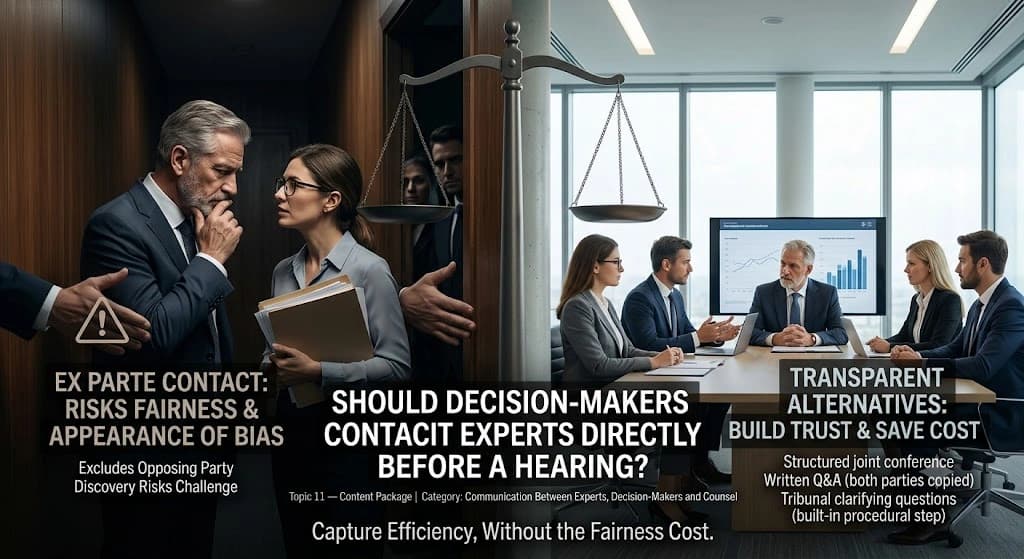
The core objection is not efficiency, it is fairness, both the reality of it and, just as importantly, the appearance of it. Private contact between a decision-maker and one party's expert, even contact limited to a narrow, genuinely neutral question, excludes the opposing party from a conversation that may influence the decision-maker's thinking. That exclusion is the problem regardless of how careful or well-intentioned the question actually was, because the opposing party has no way to verify what was actually discussed, no opportunity to respond, and no ability to correct a misunderstanding that might have arisen during the exchange.
There is a second, subtler risk specific to expert evidence: private contact can inadvertently signal to the expert, and by extension to the instructing party once the expert reports back, something about how the decision-maker is currently leaning, a signal that undermines the adversarial or properly structured inquisitorial process the parties are entitled to rely on. Even a genuinely neutral clarifying question, once relayed back to the instructing legal team, can be read, rightly or wrongly, as a hint about which way the tribunal's thinking is trending, information the opposing party never had equal access to.
A third risk is procedural: private contact, once discovered, becomes a live ground for challenge to the ultimate decision, regardless of how innocuous the actual conversation was. A party seeking to overturn an unfavorable outcome has a genuine, sometimes decisive procedural argument available if private expert contact occurred, and defending against that challenge consumes exactly the kind of time and cost that the original direct contact was meant to save.
There is a fourth risk worth naming, specific to the expert rather than the tribunal: an expert who receives private contact from a decision-maker is placed in a genuinely difficult position, uncertain whether disclosing the contact to instructing counsel will itself be read as improper, or whether responding without disclosure creates an even greater risk. This ambiguity is unfair to the expert, who did not initiate the contact and has limited practical ability to decline a decision-maker's direct approach gracefully, and it is one more reason the burden should fall on building transparent channels in advance rather than leaving experts to navigate an awkward private approach in the moment.
What "Direct Contact" Actually Covers
Much of the disagreement around this question dissolves once "direct contact" is defined more precisely, because the term covers a spectrum of practices with very different fairness implications. Undisclosed, private contact, a call or email between a decision-maker and an expert that the opposing party never learns occurred, sits at the clearly problematic end of that spectrum regardless of the question's content or intent.
It is worth being explicit that intent does not rescue an instance of private contact from this concern. A decision-maker who reaches out with a genuinely innocent, narrowly technical question and no strategic motive whatsoever has still created the structural problem described above, an exchange the opposing party cannot verify, respond to, or correct. The fairness concern attaches to the structure of the contact, not to whether anyone involved acted with anything other than good intentions.
Contact that is disclosed after the fact, where the decision-maker informs both parties that a conversation occurred and summarizes its content, is meaningfully less problematic but still leaves the opposing party unable to have shaped the original exchange or corrected a misunderstanding in real time, which is why disclosure after the fact is generally treated as a mitigation rather than a full solution.
Contact that is transparent from the outset, written questions posed to an expert with both parties copied simultaneously, or oral questions asked at a hearing or case management conference with both parties present, sits at the clearly acceptable end of the spectrum, because it captures the efficiency benefit of direct engagement without any of the exclusion problem that makes private contact objectionable in the first place.
A useful way to test where a given instance of contact falls on this spectrum is to ask a simple question: could the opposing party learn what was said, from either party, without relying on the goodwill of the party who initiated or received the contact. Transparent mechanisms pass this test by design, the information is available to both sides as a matter of course. Private contact fails it, the opposing party's access to what occurred depends entirely on voluntary disclosure by someone with no formal obligation to provide it promptly or completely.
Where the Line Actually Sits
The practical distinction that resolves most of the tension in this debate is not whether a decision-maker may engage directly with an expert at all, it is whether that engagement happens transparently, with both parties aware and able to participate, or privately, with one party excluded from a conversation that may shape the outcome. Nearly all of the legitimate efficiency benefit described earlier survives this distinction intact. Nearly all of the fairness risk described in the objection section is eliminated by it.
This reframing is useful because it moves the conversation away from a binary choice between rigid non-contact and unrestricted access, toward a more precise question: how can a decision-maker's genuine desire for direct clarity be channeled through transparent mechanisms rather than suppressed entirely or indulged privately. Once framed this way, the practical answer becomes considerably more actionable than the original binary question suggests.
This also explains why jurisdictions and institutions that permit relatively active decision-maker engagement with experts, structured questioning within an inquisitorial tradition, for instance, are not actually in tension with the fairness concerns raised by private common law-style contact. The active engagement in those systems is transparent by design, conducted in the presence of both parties or through a formally documented process, which is precisely the feature that private, informal contact lacks.
Safer Alternatives That Capture Most of the Benefit
Written questions submitted formally, with both parties copied and the expert's written response also shared with both parties, capture most of the speed and clarity benefit of a direct phone call while eliminating the private-contact problem entirely. This mechanism works particularly well for narrow, genuinely clarifying questions, exactly the kind that motivate the impulse toward direct contact in the first place.
Building an explicit window for tribunal-posed clarifying questions into the procedural directions, specified in advance rather than improvised mid-case, normalizes this kind of exchange as a transparent, expected part of the process rather than an exceptional or awkward request. A decision-maker who knows this mechanism exists and is expected to be used is considerably less likely to default to a quicker, private alternative out of simple convenience.
This is one of the clearest points of connection to how procedural directions are drafted at the outset of a case: a first case management order that explicitly anticipates and welcomes tribunal clarifying questions through a defined, transparent channel removes the ambiguity that otherwise pushes a time-pressed decision-maker toward whatever informal option feels fastest in the moment. Building the safer alternative into the process from the start is considerably easier than trying to redirect an established habit of informal contact once it has already taken hold in a given tribunal's practice.
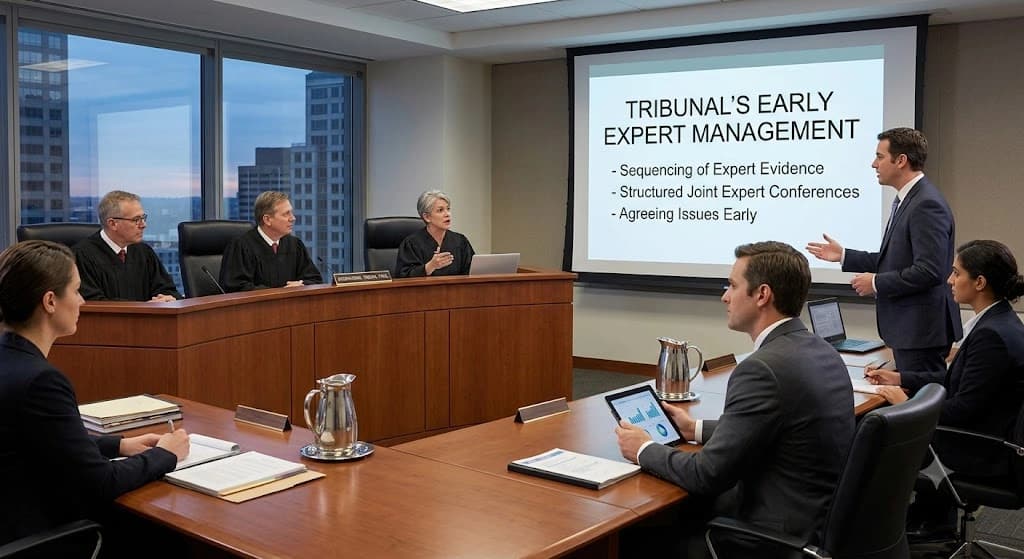
A brief, structured case management conference where both experts are present and the decision-maker can pose questions to either or both in real time, with both parties' counsel also present, delivers much of the immediacy of a private conversation while preserving full transparency. This format has the added benefit of surfacing, in real time, whether opposing counsel has a concern about how a question is framed, allowing that concern to be addressed on the spot rather than discovered later.
A fourth alternative, useful specifically when a decision-maker's question is more about understanding general technical background than about the specific disputed facts, is a jointly arranged technical briefing session with both experts present, addressing foundational concepts rather than contested conclusions. This distinguishes clearly from private contact because its purpose is orientation rather than case-specific clarification, and because both parties participate in shaping and attending it from the outset.
What This Means for Tribunals, Counsel, and Experts
For tribunals, the practical implication is to resist the impulse toward private, undisclosed contact even when a question feels entirely innocuous, and to build the transparent alternatives described above into standard practice so that the efficiency benefit of direct engagement remains available without the fairness cost. The habit worth building is treating any urge toward a quick private conversation as a signal that a transparent channel is missing from the case's procedural design, rather than as a decision to make case by case in the moment.
For counsel, the implication is to proactively propose these transparent mechanisms, a written clarifying-question process, a structured joint conference, rather than leaving a decision-maker to default to whatever feels most convenient in the moment. Offering a well-designed transparent alternative removes the temptation toward a private shortcut far more effectively than simply objecting to private contact after it has already occurred.
For experts, the implication is to treat any direct approach from a decision-maker, however informal it may seem, with the same procedural care as any other communication in the case, flagging it to instructing counsel immediately and encouraging that any substantive response happen through a transparent channel rather than a private one, protecting both the integrity of the process and the expert's own position.
For institutions drafting procedural rules and model directions, the implication is to make transparent clarification mechanisms a visible, default feature of standard case management guidance, rather than leaving individual tribunals to construct them from scratch or default to informal habit in the absence of clear guidance either way.
Frequently Asked Questions
Is any direct contact between a decision-maker and an expert improper? Not inherently. The concern is specifically with private, undisclosed contact that excludes the opposing party. Transparent contact, questions posed with both parties present or copied, captures the same benefit without the fairness problem.
What should an expert do if a decision-maker contacts them directly and informally? Flag the contact to instructing counsel immediately and encourage that any substantive response occur through a transparent channel, protecting the integrity of the process and the expert's own credibility.
Does disclosing a private contact after the fact fully resolve the fairness concern? It mitigates the concern but does not eliminate it, since the opposing party still had no opportunity to shape the original exchange or correct a misunderstanding in real time.
What is the most practical alternative to informal direct contact? A formal written question-and-response process, with both parties copied throughout, captures most of the speed and clarity benefit of direct contact while remaining fully transparent.
Does this concern apply equally in both common law and civil law systems? The underlying fairness principle is broadly shared, but civil law and hybrid arbitral systems more often build transparent, structured decision-maker engagement with experts directly into the process, which is a meaningfully different practice from the informal, undisclosed contact this piece is primarily concerned with.
Does good intent excuse an instance of private contact that later comes to light? Not in terms of the fairness concern it raises. The structural problem, the opposing party's inability to verify or respond to what occurred, exists regardless of how well-intentioned or narrowly technical the original question actually was.
Conclusion
The instinct toward direct contact between a decision-maker and an expert is understandable and often well-intentioned, driven by a genuine desire for clarity rather than any wish to undermine fairness. But the risk that instinct creates, to party control, to perceived neutrality, and to the ultimate durability of the decision itself, is real and largely avoidable. The answer is not to suppress the underlying desire for direct engagement but to channel it through transparent mechanisms that capture nearly all the same benefit without any of the same cost. Decision-makers who build these mechanisms into their practice as a matter of course rarely feel the pull toward a private shortcut in the first place, because the transparent alternative is just as fast and considerably safer, and it never has to survive the scrutiny of a challenge built specifically around what happened in a conversation nobody else was present for.
Key Takeaways
● The core objection to direct expert contact is fairness, both the reality and the appearance of it, not efficiency, and most of the efficiency benefit survives when contact happens transparently rather than privately.
● Undisclosed private contact, after-the-fact disclosed contact, and fully transparent contact sit on a spectrum with meaningfully different fairness implications, and most of the practical debate collapses once this distinction is made explicit.
● Written questions with both parties copied, and structured joint conferences with both experts present, capture nearly all the benefit of direct contact without the exclusion problem.
● Experts who are approached directly and informally should flag the contact to instructing counsel immediately and encourage a transparent channel for any substantive response.
Position yourself where the legal industry looks for expertise - sign up on exlitem.com to get discovered by leading lawyers and high-value clients.