
Strip away the specific procedural rules of any given jurisdiction, and expert witness practice today looks recognizably similar to how it looked a generation ago: an independent specialist retained to explain something technical to a decision-maker who cannot evaluate it directly, tested through some combination of written analysis and questioning. What has changed, and continues to change quickly, is almost everything around that basic relationship, how experts are found and instructed, how their evidence gets tested, how much technical fluency a tribunal is expected to bring to the process, and how much technology now sits between an expert's raw analysis and the finished report a decision-maker actually reads.
Understanding where these changes are heading matters less as speculation and more as practical orientation. Practitioners who recognize the direction of travel early adjust their habits accordingly. Those who wait for change to become mandatory tend to adopt it reactively, under worse conditions, after competitors or counterparts have already normalized it.
None of what follows should be read as confident prediction of specific timelines or outcomes. Procedural change in dispute resolution tends to move slowly and unevenly across jurisdictions and institutions, shaped by local rules, professional culture, and the particular preferences of individual tribunals and courts. What is offered here instead is a read of the directional trends already visibly underway, trends worth tracking and preparing for even though their pace and ultimate shape remain genuinely uncertain.
What Has Stayed the Same
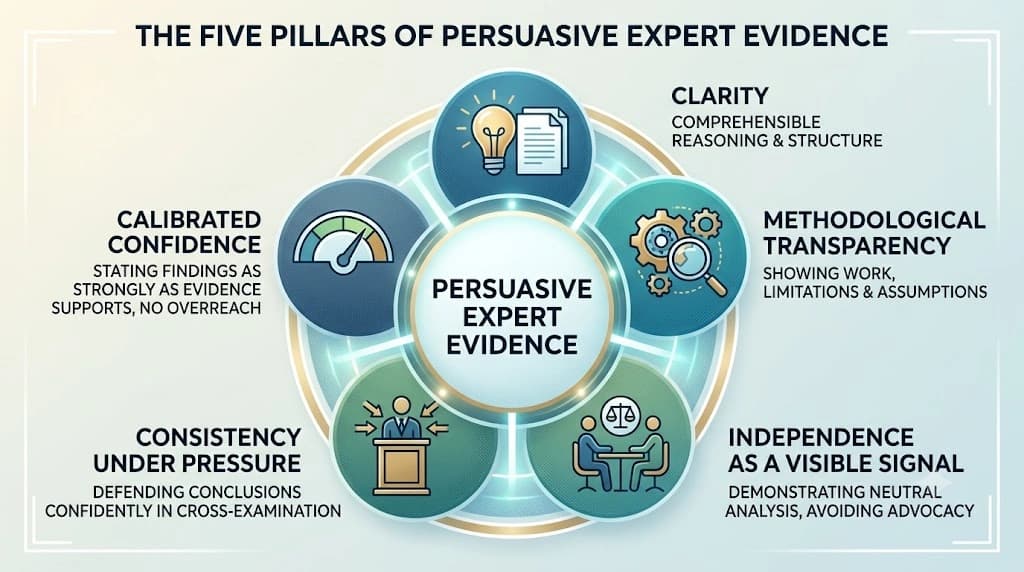
It is worth naming the constants clearly before discussing what is shifting, because the temptation in any forward-looking piece is to overstate disruption. The core obligation of independence, that an expert's analysis must be defensible without regard to which party is paying, has not changed and shows no sign of changing, regardless of what tools or procedures surround it. The value of clear, methodologically transparent reasoning, the qualities that make expert evidence persuasive to a decision-maker, remains as central now as it has ever been. And the fundamental tension between assisting a legal team and drifting into advocacy is a permanent feature of the role, not a problem any procedural reform is likely to eliminate entirely.
What this means practically is that the future of expert witness practice is not a story of the fundamentals being replaced. It is a story of the fundamentals being tested by new tools, new expectations, and new pressures, in ways that reward practitioners who hold the fundamentals steady while adapting everything around them.
This distinction is worth dwelling on because it cuts against a common but misleading framing of change in professional practice, the idea that new tools and new procedures inevitably erode traditional standards. The more accurate pattern, at least so far, is closer to the opposite. New tools tend to raise the bar for what rigorous, well-communicated expert evidence looks like, which makes the underlying fundamentals more important to master well, not less.
Technology's Growing Role: From Document Review to Analysis to Presentation
The most visible change already underway is the expanding role of technology across the entire lifecycle of an expert engagement. Document review and data analysis, historically among the most time-consuming parts of preparing expert evidence, increasingly rely on tools that can process large volumes of material faster than manual review alone, freeing experts to spend proportionally more time on judgment and analysis rather than mechanical extraction. This shift is genuinely useful, but it also raises a discipline question that the profession is still working through: an expert relying on a tool to surface patterns in data has an obligation to understand and be able to explain the tool's methodology and limitations as rigorously as they would explain their own manual analysis, because a decision-maker testing that evidence will expect exactly that level of command regardless of how the underlying processing was performed.
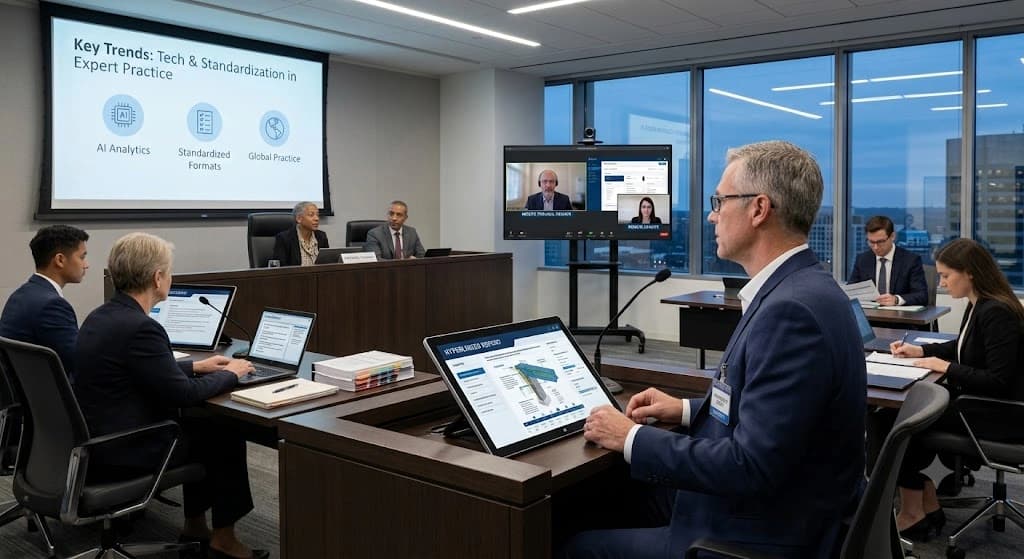
Presentation technology is advancing in a more visible, less contested direction. Hyperlinked reports that let a reader navigate directly between a finding and its supporting exhibit, interactive timelines for complex causation arguments, and demonstrative visuals designed for genuine clarity rather than decoration are becoming a meaningfully higher baseline expectation than they were even a few years ago. Experts who continue to rely on static, text-only reports and unstructured exhibit bundles are likely to find their evidence reads as comparatively harder to use, not because the underlying analysis is weaker, but because the format increasingly lags what decision-makers have come to expect.
The underused presentation technology described elsewhere in this content series, graphics, timelines, interactive exhibits available but rarely deployed well, is likely to become progressively less optional as digital-native decision-makers move through the ranks of tribunals and courts. An arbitrator or judge who has spent an entire career reading and navigating digital documents in every other professional context brings a correspondingly lower tolerance for expert evidence that is harder to navigate than a well-designed report needs to be.
Remote and hybrid hearing formats, adopted widely and rapidly out of necessity in recent years, appear likely to remain a permanent feature of the landscape rather than a temporary accommodation. This has practical implications for how experts prepare for testimony, presenting confidently and clearly through a screen requires a somewhat different skill set than presenting in a physical hearing room, and experts who have not deliberately practiced this format may find it exposes gaps that would not have shown up in a traditional setting.
The Push Toward Standardisation
A second significant trend is the slow but steady movement toward more standardized frameworks for expert evidence, model procedural clauses, structured issues schedules, template joint statement formats, and clearer guidance on what a report should contain regardless of technical discipline. This trend responds directly to a well-documented frustration across the profession: existing guidance on expert conduct and process often goes underused simply because it is scattered, inconsistently adopted, or unfamiliar to practitioners encountering a given tribunal or institution for the first time.
Standardization carries real trade-offs worth acknowledging honestly. A template that works well for a moderately complex commercial dispute may fit poorly against a highly technical, multi-expert construction claim, and the risk of over-standardization is a return to the kind of generic, one-size-fits-all procedural approach that already frustrates practitioners in less specialized systems. The more promising version of this trend treats standardization as a flexible starting point, a default that can be tailored to a specific dispute's genuine complexity, rather than a rigid requirement applied uniformly regardless of what a case actually needs.
The clearest sign that this trend is maturing well, rather than calcifying into rigid uniformity, will be whether the resulting frameworks remain genuinely adaptable in the hands of practitioners who actually use them, adjustable to a specific dispute's complexity rather than treated as a checklist to complete mechanically. Standardization that survives contact with real, varied practice tends to look less like a fixed template and more like a well-organized set of defaults that experienced practitioners know when and how to depart from.
Better-Prepared Tribunals: A Slow but Real Shift
A third trend, less visible but genuinely underway, is a gradual increase in the baseline technical fluency that tribunals and courts bring to disputes involving expert evidence. This shows up in several forms: growing institutional emphasis on early substantive engagement with expert issues rather than purely procedural case management, more frequent use of pre-hearing briefings to bring a tribunal up to speed on unfamiliar technical terrain, and, in some venues, the development of specialist panels or lists intended to match disputes with decision-makers who already have relevant subject-matter familiarity.
This shift matters because tribunal technical fluency has a direct, measurable effect on how well expert evidence actually gets used. A more technically confident decision-maker asks sharper clarifying questions, engages more substantively with competing methodologies, and is less likely to default to credentials or presentation style as a proxy for technical merit. The trend is uneven across jurisdictions and institutions, and progress in this area tends to be gradual rather than dramatic, but the direction of travel is consistent enough that practitioners should expect to encounter better-prepared decision-makers more often over time, not less.
This has a specific practical consequence worth naming directly: evidence that has historically succeeded through presentation polish or confident delivery alone, without the underlying methodological rigor to match, is likely to face closer scrutiny going forward than it has in the past. A more technically literate decision-maker asks better follow-up questions, and better follow-up questions expose the gap between genuinely rigorous analysis and analysis that merely sounds rigorous far more reliably than a less technically confident decision-maker would.
The Globalization of Expert Practice
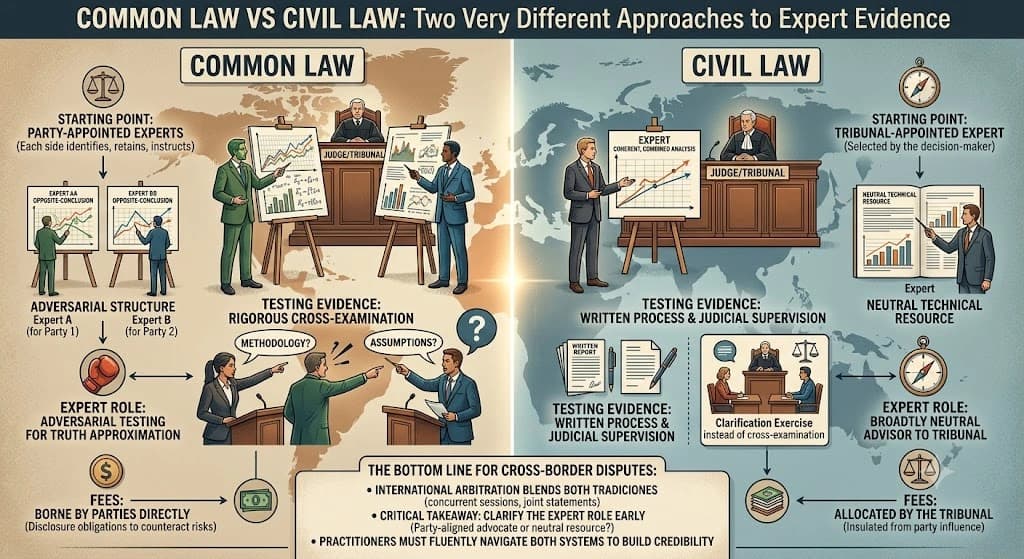
Cross-border technical disputes continue to grow as a share of overall dispute resolution activity, and this trend is pulling expert witness practice toward a genuinely global professional identity rather than one rooted primarily in a single jurisdiction's traditions. Experts increasingly need working fluency in both the adversarial, party-appointed model common in common law systems and the more inquisitorial, tribunal-appointed model common in civil law systems, because international arbitration in particular continues to blend elements of both into its own emerging hybrid practice.
This globalization also puts pressure on experts to develop cultural and procedural fluency alongside technical fluency. An expert who understands not just the substance of their discipline but how expert evidence functions differently across jurisdictions and institutional cultures is positioned to work effectively across a far wider range of engagements than one whose experience is confined to a single system's default assumptions.
The same pressure applies to counsel managing cross-border matters. Legal teams that build genuine familiarity with how expert evidence is appointed and tested across both major traditions, rather than defaulting to whichever approach is most familiar from domestic practice, are better positioned to select and prepare experts appropriately for the specific tribunal or court in front of them. This kind of institutional fluency is increasingly a competitive differentiator for firms handling a meaningful volume of cross-border technical disputes, not merely a nice-to-have specialization.
Risks on the Horizon
None of these trends are risk-free, and a genuinely useful forward-looking view has to name the risks alongside the opportunities. The growing role of technology in analysis raises real questions about verification and accountability: an expert who cannot fully explain how an analytical tool reached a particular output, or who treats a tool's result as inherently more objective simply because it came from software rather than manual analysis, risks exactly the kind of unearned certainty that damages credibility under scrutiny. The discipline of calibrated confidence, being no more certain than the underlying analysis actually supports, applies with equal force to technology-assisted findings as to any other kind.
There is a related risk worth naming plainly: a tool that processes data faster than manual review does not automatically produce more reliable conclusions, and experts have a professional obligation to resist treating speed or volume of processing as a proxy for rigor. An expert who can explain exactly how a tool reached a given output, including its assumptions and limitations, protects their credibility in a way that an expert who simply reports a tool's output as though it were self-evidently correct does not, and this distinction is likely to matter more, not less, as these tools become more deeply embedded in ordinary practice.
Standardization carries a parallel risk of becoming a substitute for genuine engagement rather than a foundation for it, a checklist mistaken for a guarantee of quality rather than a starting point still requiring real judgment. And the increasing complexity of cross-border, technologically sophisticated expert practice raises a genuine access concern: as the baseline expectations for presentation technology, procedural fluency, and cross-jurisdictional competence rise, smaller disputes and less well-resourced parties risk being priced out of the same quality of expert evidence available in larger, better-funded matters, a proportionality problem the profession will need to keep addressing deliberately rather than allowing to develop by default.
This proportionality concern deserves particular attention because it cuts against several of the other trends described above simultaneously. The same technology that makes analysis faster and reports more navigable can, in principle, also make high-quality expert evidence more accessible to smaller matters, if it is deployed thoughtfully rather than becoming an additional cost layer only larger cases can absorb. Whether this trend narrows or widens the gap between well-resourced and modestly-resourced disputes is not yet settled, and is likely to depend heavily on choices individual firms, experts, and institutions make deliberately rather than on the technology's trajectory alone.
What This Means for Practitioners Today
For experts, the practical implication is to treat technological fluency, presentation skill, and cross-jurisdictional literacy as core professional competencies rather than optional extras, while holding the unchanging fundamentals, independence, clarity, calibrated confidence, as firmly as ever. The experts who will be most in demand over the coming years are unlikely to be the ones who simply have the deepest technical expertise in isolation. They will be the ones who combine that expertise with fluency in how expert evidence actually gets produced, tested, and trusted in a rapidly evolving procedural environment.
For legal teams instructing experts, the implication is to raise expectations accordingly, on report format and navigability, on technology-assisted analysis and its documentation, and on an expert's comfort operating across procedural traditions in genuinely cross-border matters, rather than assuming that technical credentials alone are sufficient preparation for the kind of scrutiny expert evidence increasingly receives.
For institutions and tribunals, the implication is to continue investing in the slower, less visible trend described above, building genuine technical fluency and offering the kind of structured, flexible standardization that improves consistency without sacrificing the case-specific judgment good expert evidence still requires.
Frequently Asked Questions
Will technology eventually replace human expert witnesses? This is unlikely in any near-term sense. Technology is increasingly central to how experts conduct analysis, but the core function of expert evidence, independent professional judgment applied to a specific dispute and defended under scrutiny, remains something decision-makers expect from an accountable individual, not an automated output alone.
Is standardization of expert evidence procedures a positive development overall? Largely yes, when implemented as a flexible baseline rather than a rigid template, since it addresses a genuine, well-documented problem of underused and inconsistently applied guidance. The risk lies specifically in over-standardization that ignores case-specific complexity.
How urgently should experts invest in presentation technology and hyperlinked reporting? The baseline expectation is rising steadily rather than suddenly, so this is better approached as an ongoing professional investment than a one-time catch-up project, but experts who delay too long risk their evidence reading as comparatively dated relative to more current practice.
Does the trend toward better-prepared tribunals reduce the importance of report clarity? No, if anything it raises the bar further. A more technically fluent decision-maker is better equipped to notice both genuinely rigorous analysis and analysis that merely appears rigorous, which makes real clarity and calibrated confidence more valuable, not less.
What is the single most practical step an expert can take today to prepare for these trends? Auditing a recent report against current presentation and clarity expectations, hyperlinking, plain-language summary, navigable exhibits, is a concrete, low-cost starting point that addresses several of these trends at once without requiring a wholesale change in practice.
Conclusion
The future of expert witness practice is not a story of fundamental transformation so much as one of intensifying expectations around a role that has not changed at its core. Technology is reshaping how analysis gets conducted and presented. Standardization is slowly addressing a long-standing gap between good guidance and its inconsistent use. Tribunals are, gradually and unevenly, becoming more technically fluent. And the profession is globalizing in ways that demand genuine cross-jurisdictional competence rather than comfort within a single system's assumptions. None of these trends will unfold at the same pace everywhere, and practitioners should be skeptical of anyone claiming precise certainty about how quickly any of them will mature in a given jurisdiction or institution. What is far more certain is the direction each is moving in. Practitioners who treat these shifts as an invitation to sharpen the fundamentals, rather than a distraction from them, are the ones best positioned for what comes next.
Key Takeaways
● The core obligations of expert witness practice, independence, clarity, and calibrated confidence, are not being displaced by change; they are being tested more rigorously by it.
● Technology is expanding across document review, analysis, and presentation, but experts remain accountable for explaining and defending technology-assisted findings with the same rigor as manual analysis.
● Standardization of expert evidence procedures addresses a real, long-standing problem, provided it remains a flexible baseline rather than a rigid, one-size-fits-all template.
● Cross-border fluency, understanding how expert evidence functions differently across common law and civil law traditions, is becoming a baseline professional competency rather than a specialist skill.
Position yourself where the legal industry looks for expertise - sign up on exlitem.com to get discovered by leading lawyers and high-value clients.