
A federal magistrate judge just ordered an expert witness to hand over her AI prompts to opposing counsel. If you use AI in your expert work, this is the case you need to know about.
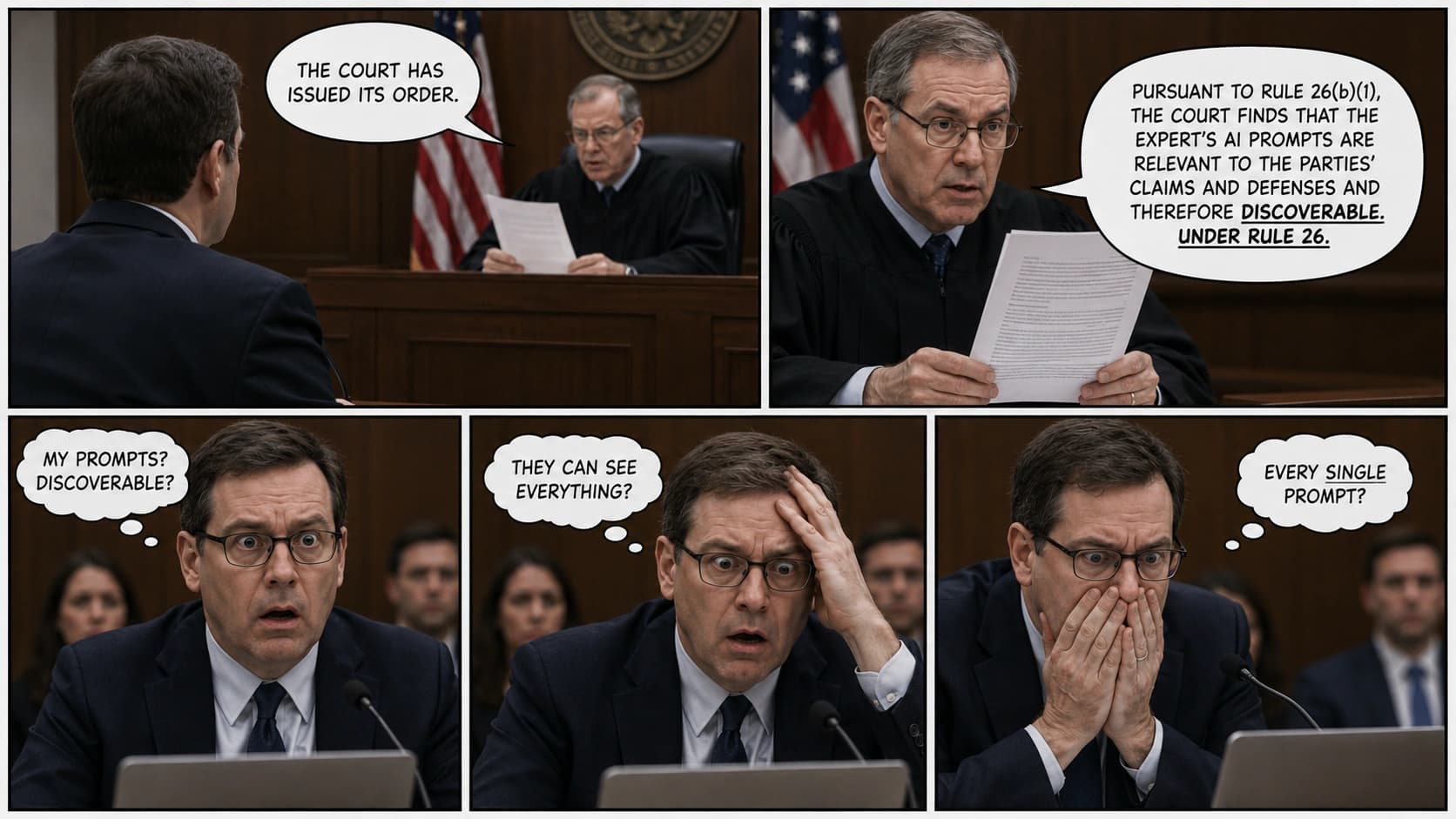
In Conservation Law Foundation v. Shell Oil Co., Civil No. 3:21-cv-00933 (D. Conn. May 18, 2026), Magistrate Judge Thomas O. Farrish ruled that AI prompts used by historian Dr. Naomi Oreskes to cull Shell's document production into a workable subset were part of her methodology — and therefore discoverable under Rule 26(b).
The plaintiff tried two defenses. Both failed.
The Two Arguments That Lost
Argument 1: Prompts aren't part of methodology.
The court disagreed flatly. Citing Macchia v. ADP, Inc., 711 F. Supp. 3d 162 (E.D.N.Y. 2024), Judge Farrish held that the process an expert uses to narrow down documents is part of how she reached her opinion. AI doesn't change that — it just becomes the new tool the expert used to do the narrowing.
Argument 2: The Rule 29 agreement covered the prompts as "notes."
CLF had a side agreement with Shell shielding expert "notes, drafts, or communications" from discovery. They argued AI prompts qualified as notes. The court said no — and laid down a useful rule: to limit otherwise-relevant discovery, a Rule 29 agreement "must be quite clear." Reading "notes" to cover AI prompts wasn't clear enough.
There's also a practical kicker. CLF claimed Dr. Oreskes only used "search terms," not prompts. But her assistant's own declaration referenced "prompt[s]." That contradiction was enough for the court to order CLF to formally certify its responses under Rule 33/34 — opening the door to Rule 37(b) sanctions if anything turns up later.
Where This Fits in the Broader Framework
Conservation Law Foundation is the latest in a growing line of decisions on AI in litigation. The pattern that's emerging: protection depends on who created the prompt, for what purpose, and under what terms of service.
Where This Fits in the Broader Framework
Conservation Law Foundation is the latest in a growing line of decisions on AI in litigation.
The pattern that's emerging: protection depends on who created the prompt, for what purpose, and under what terms of service.
Attorney prompts for litigation strategy are protected opinion work product. See Tremblay v. OpenAI, Inc., 2024 WL 3748003 (N.D. Cal. 2024) and Concord Music Group v. Anthropic, 2025 WL 1482734 (N.D. Cal. 2025).
Party prompts on consumer AI tools generally aren't protected. United States v. Heppner, 2026 WL 436479 (S.D.N.Y. Feb. 2026) — Judge Rakoff held that a defendant's ChatGPT prompts weren't privileged because the platform isn't a lawyer and its terms of service negate confidentiality.
Pro se litigant prompts can be work product if prepared in anticipation of litigation, because AI is a "tool, not a person." Warner v. Gilbarco, 2026 WL 373043 (E.D. Mich. Feb. 2026).
Expert prompts are now squarely discoverable as methodology. That's Conservation Law Foundation.
Separately, courts in Morgan v. V2X and Jeffries v. Harcros Chemicals have begun restricting the use of consumer AI tools on discovery materials altogether through protective orders.
Five Takeaways for Expert Witnesses
1. Treat every prompt as a future exhibit. If you wouldn't want it read aloud at deposition, don't type it. The days of casual experimentation with AI on case materials are over.
2. Document your AI workflow contemporaneously. Keep clean, organized prompt logs. If you're going to be ordered to produce them anyway, you want them to look like methodology — not like fishing.
3. Don't relabel prompts as "search terms" to dodge production. The court flagged this exact maneuver. The assistant's declaration in Conservation Law Foundation referred to "prompts," and that single word contradicted the expert's lawyer's position. Be consistent in how you describe your process.
4. Use enterprise AI tools, not consumer ones. Tools with contractual confidentiality protections — no training on inputs, no third-party disclosure, deletion on request — are now table stakes. The standard from Morgan v. V2X is becoming the floor.
5. Negotiate AI carve-outs into Rule 29 agreements explicitly. If you want expert AI prompts off the table, the agreement has to say so in those words. Generic protection for "notes" or "drafts" won't get you there.
The Bigger Picture
Courts aren't treating AI as a special category requiring new rules. They're applying long-settled doctrine — Rule 26 scope, work product, privilege — to new facts. The decisions are remarkably internally consistent. What's new is that experts now need to assume every prompt they write is potentially Exhibit A.
Methodology has always been discoverable.
AI just made methodology more granular, more visible, and far harder to reconstruct after the fact.