

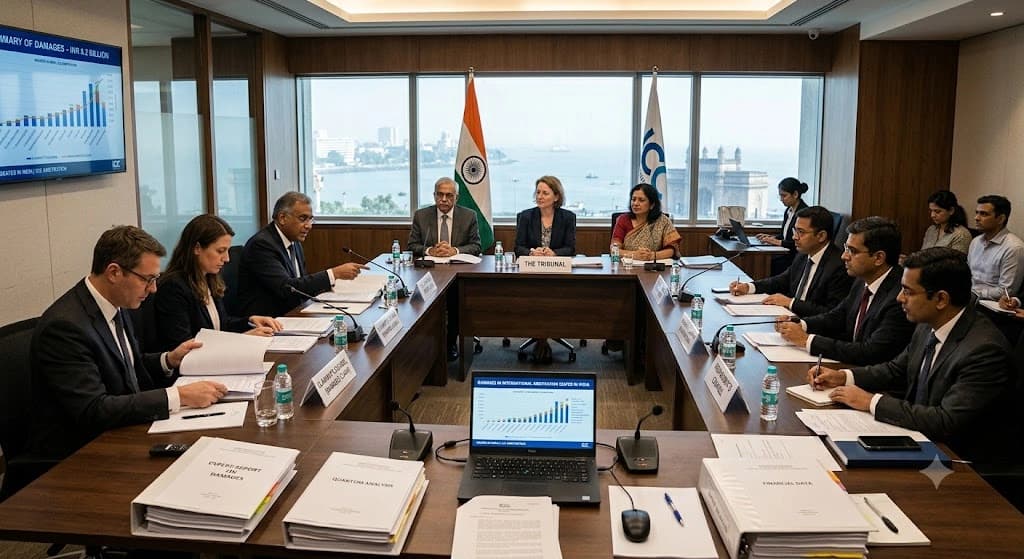
Ask a general counsel what worries them most about an arbitration and, increasingly, the answer isn’t the merits. It’s the number. India’s arbitration ecosystem has spent the last decade narrowing the grounds on which a court can revisit a tribunal’s liability findings, and the 2015 amendments, together with a string of Supreme Court decisions, have made an India-seated tribunal’s factual conclusions on breach and causation close to final. What hasn’t shrunk to the same degree is the fight over quantum - how much the breach cost, what methodology proves it, what interest runs on it, and in what currency it gets paid. In international commercial arbitration seated in India - disputes falling under Section 2(1)(f) of the Arbitration and Conciliation Act, 1996, where at least one party is foreign but the seat is Mumbai, Delhi, or increasingly GIFT City - this fight follows its own, distinct rules.
This analysis sets out how tribunals in these arbitrations actually get to a damages figure: the statutory base that governs the calculation, the methodologies tribunals accept, how interest is layered across the life of a claim, how currency conversion is decided, and - critically - how much room an Indian court still has to change the number once it has been awarded. It closes with what this means in practice for parties and counsel handling India-seated international disputes.
Where the Real Fight Has Moved
Before 2015, Indian courts routinely reopened both liability and quantum under an expansive reading of “public policy.” ONGC v. Saw Pipes Ltd. (2003) held that an award “patently illegal” on its face violated public policy, and ONGC v. Western Geco International Ltd. (2014) went further, importing a Wednesbury-style reasonableness review that let a court set aside an award - including its quantum findings - if it concluded no reasonable tribunal could have reached that figure. In practice, this gave a disappointed party a genuine second hearing on the facts.
The Arbitration and Conciliation (Amendment) Act, 2015 narrowed all of this. “Fundamental policy of Indian law” was redefined to exclude mere errors of law, and Western Geco’s reasonableness test was legislatively overruled. The amendment also introduced a new patent-illegality ground under Section 34(2A) - but confined it expressly to purely domestic awards. Ssangyong Engineering & Construction Co. Ltd. v. National Highways Authority of India (2019) confirmed that international commercial arbitration seated in India does not get this ground at all. The result is that an India-seated international award’s quantum finding is doubly insulated: narrowed public-policy scrutiny applies to it, and the one additional ground still available against domestic-only awards does not apply to it at all.
The practical consequence is that the contest has moved upstream - into the arbitration itself. What methodology a tribunal accepts, how persuasively a party’s expert defends its assumptions under cross-examination, and how transparently the tribunal reasons its way from evidence to a figure now matter more than what happens afterward in a Section 34 challenge. Once a quantum figure is in an award, getting it changed is very hard.
The Statutory Base: Contract Act Meets Arbitration Act
Even in international arbitration, tribunals typically apply Indian substantive law unless the parties have chosen otherwise. Section 28(1)(b) of the Arbitration and Conciliation Act lets parties to an international commercial arbitration designate the governing law; absent that choice, the tribunal applies the rules of law it considers appropriate. Where Indian law governs - still the norm for India-related commercial and infrastructure contracts even when one party is foreign - Sections 73 and 74 of the Indian Contract Act, 1872 supply the basic damages framework.
Section 73 entitles a claimant to compensation for loss that “naturally arose in the usual course of things” from the breach, or that the parties knew, when they made the contract, was likely to result from it. This causation-and-foreseeability gate is the same test, in substance, that structures English contract law, carried into Indian jurisprudence over a century of case law. No actual loss, no compensation - Section 73 does not permit punitive or notional damages.
Section 74 applies where the contract itself names a sum, such as a liquidated-damages clause. The claimant is entitled to “reasonable compensation not exceeding the amount so named,” regardless of whether actual loss is proved - but Indian tribunals and courts consistently treat this as a ceiling, not an entitlement, and will scale a stipulated sum down where it looks punitive rather than a genuine pre-estimate of loss.
Section 28(3) of the Arbitration Act layers a further requirement on top: whatever the substantive law, the tribunal must decide “in accordance with the terms of the contract” and must “take into account the usages of the trade applicable to the transaction.” For international arbitration this matters in practice - tribunals routinely draw on international costing and valuation conventions as trade usage, even while applying Indian contract law to the underlying question of entitlement. And under either provision, punitive damages are never available: compensatory recovery is the ceiling, and an award that strays into punitive territory exposes itself to challenge.
How Tribunals Actually Arrive at a Number
Three valuation approaches recur across India-seated international arbitrations. The income approach - usually a discounted cash flow (DCF) analysis - values loss of profits or a terminated business or concession as the present value of the cash flows the claimant would have received but for the breach. The market approach relies on comparable transactions or assets where a reliable market exists. The cost approach quantifies wasted expenditure or reliance loss - what was actually spent, rather than what would have been earned.
Of the three, DCF draws the closest scrutiny. Tribunals interrogate the discount rate and the underlying business-plan assumptions hardest, because a DCF built on optimistic, unsubstantiated projections is the single most common way an otherwise strong liability case yields a token damages award. The more speculative the counterfactual - a greenfield project with no trading history, for instance - the more sceptically tribunals treat a DCF claim, often preferring a cost-based or lost-opportunity measure instead.
Where the evidence shows loss occurred but its precise extent cannot be established with arithmetic certainty, Indian law does not leave the claimant without a remedy. The Division Bench of the Delhi High Court, in Cobra Instalaciones Y Servicios v. Haryana Vidyut Prasaran Nigam Ltd. (decided by the Single Judge in 2022 and affirmed by the Division Bench in 2024), reinforced this principle in the context of liquidated damages and contractual apportionment. Upholding an award that scaled down a liquidated damages penalty through “honest guesswork” and “rough and ready” methods, the Court reaffirmed, holding that an arbitrator is not disabled from awarding damages merely because the loss cannot be computed with mathematical precision, provided there is evidence that damage in fact occurred. Indian tribunals now apply this as settled doctrine across both penalty assessments and complex valuation frameworks: a party need not prove precise quantum to recover, only that loss occurred and that a reasonable basis exists for estimating it. It is not, however, licence for speculation - the estimate still has to be tethered to evidence.
The practical bar keeps rising. Tribunals increasingly expect quantum evidence presented the way it would be in a well-run international arbitration anywhere: expert reports that disclose methodology and assumptions transparently, are built to withstand cross-examination, and are pinned to the contemporaneous record rather than reverse-engineered from a target figure.
Interest: Three Different Clocks
Section 31(7)(a) lets a tribunal award interest at a rate it considers reasonable, on the whole or part of the sum, for the period between when the cause of action arose and the date of the award - covering both the pre-reference and pendente lite periods - unless the contract provides otherwise. Tribunals routinely fix different rates for different phases within this period. A contractual clause that merely bars interest on “delayed or disputed payments” does not, by itself, oust a tribunal’s power to award pendente lite interest; only an express or necessarily implied prohibition does that, a distinction the Supreme Court has had to reaffirm because parties keep drafting ambiguous interest-exclusion clauses and litigating what they meant.
Section 31(7)(b) then takes over: the awarded sum carries interest at two per cent above the prevailing rate from the date of the award until payment, unless the award directs otherwise. This post-award interest is a statutory entitlement that cannot be contracted out of in advance, and the “sum” it attaches to includes principal plus any interest already built into the award - effectively permitting compounding at the post-award stage. The corollary, reaffirmed by the Supreme Court in 2025, is that once an award fixes a composite rate running through to actual payment, the award-holder cannot layer an additional compound-interest claim on top under Section 31(7)(b); the tribunal’s chosen rate is the ceiling for that period, not a floor.
For India-seated international arbitrations, interest calculations carry an added layer of complexity when the underlying sum is in foreign currency and the applicable benchmark rate has to be identified across currencies. Tribunals resolve this case by case, but it is a question every quantum submission needs to address explicitly - not one to leave for post-award argument.
Currency: Which Rate, Whose Risk
Contracts underlying India-seated international arbitration are frequently priced in a foreign currency, which means the award - and its eventual enforcement - has to answer a question purely domestic disputes never face: on what date, and at what rate, does the foreign-currency sum convert to rupees.
The Supreme Court addressed this directly in DLF Ltd. v. Koncar Generators and Motors Ltd. (2024 SCC OnLine SC 1907), concerning conversion of a Euro-denominated award. The Court held that the governing principle is restitutio in integrum - the award-holder should be put in the position it would have occupied had the award-debtor paid on time, neither rewarded nor penalised by currency movements after the fact. For a foreign award enforced in India, that means the relevant conversion date is when objections to enforcement are finally decided under Section 49 - not the date of breach, and not the date of the award itself.
The Court drew a further distinction for partial payments made during enforcement proceedings: where a sum has been deposited and is genuinely withdrawable by the award-holder, the conversion rate for that portion locks in at the date of deposit; where it isn’t withdrawable, the general rule continues to apply. The practical takeaway for India-seated international arbitration is that currency risk during the enforcement window does not default to either party - it is fixed by reference to when the award actually becomes payable. Parties drafting arbitration clauses for foreign-currency contracts should not assume a tribunal or enforcing court will pick whichever date suits them; the law already has an answer, and it isn’t the date of breach.
How Much Room Courts Still Have to Touch the Number
The trajectory above - Saw Pipes and Western Geco’s expansive review, narrowed by the 2015 Amendment and Ssangyong’s confirmation that patent illegality does not reach international commercial arbitration - leaves one further development worth noting. In April 2025, a five-judge Constitution Bench, in Gayatri Balasamy v. M/s ISG Novasoft Technologies Ltd., held 4:1 that Section 34 carries an implied but limited power to modify an award. Exlitem has covered that judgment’s reasoning and open questions separately; for quantum purposes, what matters is the limits the majority placed on it. The power extends only to severable parts of an award, clerical or computational corrections, adjustment of post-award interest, and the Supreme Court’s own Article 142 power to do complete justice.
None of those categories authorise a court to recalculate a tribunal’s DCF, second-guess its choice of methodology, or substitute its own damages figure because it would have valued the loss differently. The limited modification power is a scalpel for defined, narrow errors - not a route to a second merits hearing on quantum. Combined with the narrowed public-policy ground and the exclusion of patent illegality for international commercial arbitration, the net effect is that once a tribunal has applied its mind to the quantum evidence and explained its reasoning, the figure is close to final. That raises the stakes on getting the quantum case right in front of the tribunal the first time, rather than assuming a reviewing court will fix it later.
Why the Seat Is the Operative Fact
None of the above applies the same way to arbitrations that merely involve an Indian party but are seated abroad - which is why “seated in India” is the operative phrase, not an incidental one. Bharat Aluminium Co. v. Kaiser Aluminium Technical Services, Inc. (BALCO, 2012) settled that Part I of the Arbitration and Conciliation Act - which includes Section 34’s challenge jurisdiction - applies only where the arbitration is seated in India. Choosing a seat is choosing an exclusive jurisdiction: once parties fix a foreign seat, only the courts of that seat supervise the arbitration, and an Indian court’s role over the resulting award is confined to Part II enforcement proceedings under Sections 47–49, where the public-policy ground under Section 48 is narrower still and does not include patent illegality at all.
A quantum finding in a foreign-seated award against an Indian party is, if anything, more insulated from Indian judicial scrutiny than one in an India-seated international arbitration - it can only be resisted at the enforcement stage, on narrow grounds, never challenged head-on the way an India-seated award can be under Section 34. This is precisely why seat selection for India-related contracts - now including institutional options at GIFT City, the Mumbai Centre for International Arbitration, and IAMC Hyderabad - is a substantive decision about how much scrutiny a future damages award will face, not just a procedural convenience.
Where Quantum Claims Come Apart
Even within a legal framework that favours finality once an award is issued, quantum claims fail inside the arbitration itself for recurring, avoidable reasons. The most common is a causation gap: Section 73 requires the loss to flow naturally from the breach or fall within the parties’ contemplation at contract formation, and claims that stretch causation to capture every downstream consequence of a breach routinely get cut back, even where liability is established without dispute.
A close second is failure to mitigate - a claimant that does not take reasonable steps to limit its loss after breach will see its recoverable damages reduced by what better mitigation would have saved, a principle tribunals apply readily even absent an express contractual mitigation clause. Double counting is a third: claiming lost profits and wasted expenditure for the same period, or running both a cost approach and an income approach without netting one against the other, is one of the fastest ways to lose credibility with a tribunal. Once an inconsistency like this surfaces under cross-examination, tribunals tend to discount the rest of the claim too.
A fourth is undisclosed assumptions: a DCF or comparable-transaction analysis that doesn’t transparently set out its inputs, its discount-rate derivation, and its sensitivities invites a tribunal to reject the whole methodology rather than simply adjust it. A fifth, easy to fix but frequently overlooked, is treating currency and interest as afterthoughts - claims that plead a headline figure without addressing which currency, what interest period, and what conversion date apply leave the tribunal to decide those questions with less party input than it should have, usually to the claimant’s disadvantage. The common thread is that arbitration’s procedural flexibility does not lower the evidentiary bar for quantum. Given how narrow post-award review now is, it raises the cost of getting that bar wrong the first time.
What This Looks Like in Practice
The Vedanta Ltd. v. Union of India dispute over the Rajasthan oil block production-sharing contract illustrates how quantum disputes actually play out in long-running India-seated arbitrations involving infrastructure and extractive contracts. In July 2025, the Delhi High Court dismissed a government appeal against an arbitral tribunal’s refusal to stay implementation of a declaratory partial award that had already determined how the parties’ cost-recovery mechanism should be interpreted. The underlying dispute arose from a roughly USD 534 million cost-recovery claim, from which the government had unilaterally deducted approximately USD 377 million pending resolution. Even a declaratory, quantum-adjacent finding, the case shows, can trigger years of further adjudication over precise figures, deductions, and compliance before a final award is reached.
For attorneys advising on India-seated international arbitration, the practical implications follow directly from the analysis above: settle governing law and its interaction with Sections 73 and 74 early; instruct quantum experts who can defend methodology transparently under cross-examination rather than simply producing a number; address interest across all three periods explicitly in submissions; plead currency and conversion-date positions rather than leaving them for enforcement-stage argument; and build workable quantum-determination mechanics into long-term contracts themselves, rather than leaving a tribunal to reconstruct a process after the commercial relationship has broken down. Above all, recognise that given how limited post-award review of quantum has become, the arbitration itself - not a subsequent Section 34 challenge - is where the number actually gets decided.
Takeaway
Damages, not liability, is where India-seated international arbitrations are increasingly won and lost. The law gives tribunals wide latitude to reach a number - through DCF, comparable transactions, or reasoned estimation where precision isn’t possible - while giving courts very little room to change that number afterward, particularly since international commercial arbitration sits outside the one ground (patent illegality) still available against purely domestic awards. For attorneys, quantum experts, and the parties who instruct them, that combination raises the value of getting the damages case right the first time, with transparent methodology and a defensible evidentiary record, because the safety net of judicial review has narrowed to almost nothing.
Position yourself where the legal industry looks for expertise - sign up on exlitem.com to get discovered by leading lawyers and high-value clients.