
Case Background
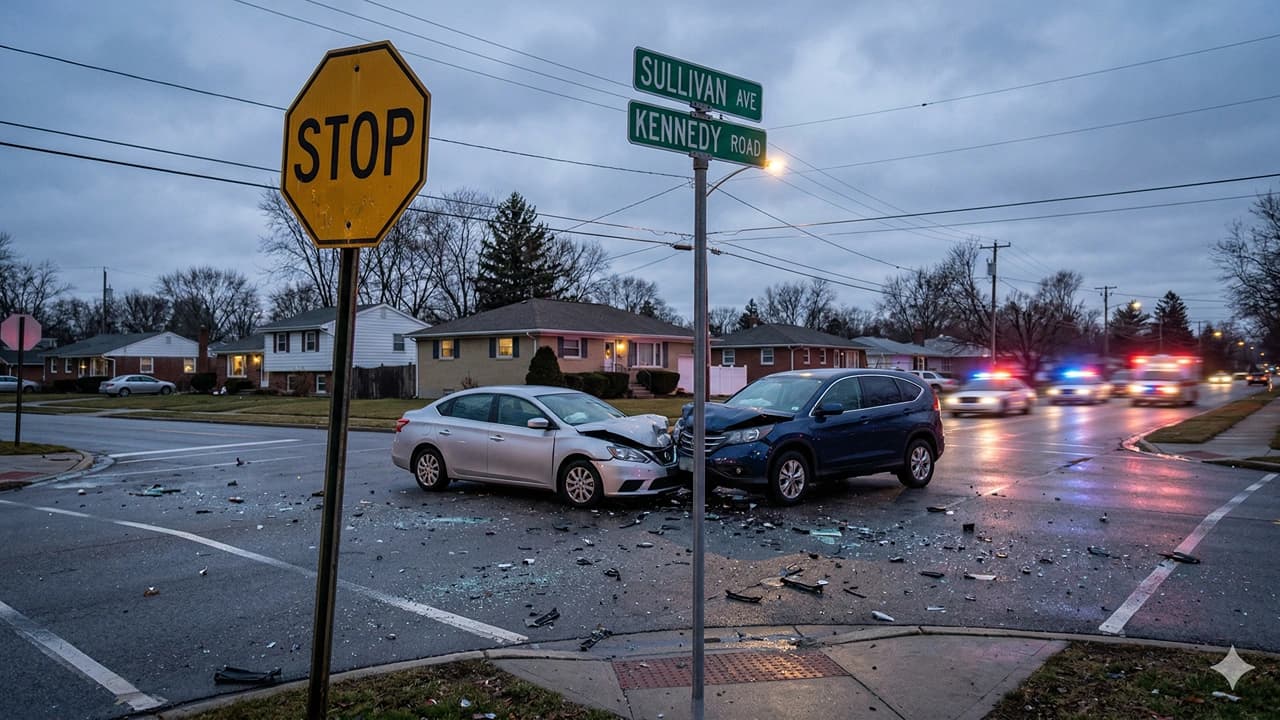
On November 2, 2020, around 5:57 p.m., a violent vehicle collision occurred at the intersection of Sullivan Avenue and Kennedy Road in South Windsor, Connecticut. Richard Strong drove his vehicle westbound on Sullivan Avenue while Carole Worm operated her vehicle on Kennedy Road. The incident began when Worm, who had been stopped at a stop sign, attempted to turn left to proceed east on Sullivan Avenue. Strong alleged that Worm failed to check for oncoming traffic before entering the intersection, which led the front end of her vehicle to strike the front of his vehicle.
Cause
The primary cause of the accident centered on the Defendant’s failure to yield the right of way. Strong asserted that Worm moved from a stop sign without ensuring the path was clear of westbound traffic. He further alleged that she operated her vehicle while distracted by a mobile device and at an unreasonable speed for the road conditions.
Injury
Richard Strong sustained a variety of physical injuries due to the impact. The collision caused trauma to his head, face, nose, and right hip, along with injuries to his neck and back. Additionally, Strong suffered from a concussion and vertigo. These physical conditions resulted in significant pain, discomfort, and a restricted range of motion. Beyond the physical damage, the Plaintiff claimed he experienced mental anguish, including a persistent fear of future disability and medical treatments.
Damages Sought
Strong sought several forms of relief from the Court to address his losses. He requested fair and reasonable monetary damages for his medical expenses and lost wages. Because he alleged reckless behavior, he specifically asked for double or treble damages under Connecticut General Statutes § 14-295. His demands also included punitive damages, attorney’s fees, and Court costs. The initial statement of demand indicated that the amount in controversy exceeded $15,000.
Key Arguments and Proceedings
The legal battle unfolded through three primary counts: negligence, statutory recklessness, and common law recklessness. In the first phase of the proceedings, Strong’s legal team argued that Worm breached her duty of care by failing to keep a proper lookout and failing to control her vehicle. They emphasized that she had admitted to a police officer at the scene that she did not check for traffic before pulling out.
Legal Representation
Plaintiff(s): Richard Strong
· Counsel for Plaintiff(s): John Jay Pavano of Pavano Dombrowski, LLC
· Experts for Plaintiff(s): David Burstein | Jozsef Piri
Defendant(s): Carole Worm
· Counsel for Defendant(s): Derek Mello of Neubert, Pepe & Monteith, P.C.
Key Arguments or Remarks by Counsel
The Plaintiff's counsel focused heavily on the Defendant’s alleged cell phone use. They argued that this choice constituted a "conscious election" to disregard the safety of other motorists. By framing the case through the lens of recklessness rather than simple negligence, the counsel aimed to secure higher damage awards.
Claims
The Plaintiff presented several specific legal claims regarding the Defendant's conduct.
Failure to Obey Traffic Controls Strong claimed that Worm violated General Statutes § 14-301 by failing to stop in obedience to the stop sign and failing to yield the right of way to his vehicle.
Distracted Driving and Mobile Device Use The complaint alleged that Worm used a hand-held mobile telephone while driving, which violated Connecticut General Statutes § 14-296aa. This distraction allegedly prevented her from seeing the traffic ahead of her.
Unreasonable Speed and Lack of Control Strong argued that Worm drove at a speed that was greater than reasonable given the width and use of the highway. He further claimed she failed to apply her brakes in time or turn her vehicle to avoid the collision.
Permanent Disability and Financial Loss The Plaintiff asserted that his injuries were permanent and would cause lifelong pain. He noted that he had been gainfully employed at the time of the accident but lost time from work and incurred substantial medical bills as a result of the crash.
Defense
Carole Worm and her legal team contested the majority of the allegations. While she admitted she was operating her vehicle on Kennedy Road at the time of the crash, she denied the specific claims of negligence and recklessness.
Denial of Liability Worm denied that she had failed to check for traffic or that she had admitted such a failure to the police. She also denied the allegations of speeding and cell phone use.
Insufficient Information Regarding the extent of Strong’s injuries and medical treatments, the defense maintained they lacked sufficient information to form a belief. They essentially forced the Plaintiff to prove every aspect of his medical claims and the necessity of his treatments.
Contributory Negligence The defense sought to shift some of the blame back to Strong, questioning his own role in the collision.
Jury Verdict
On December 4, 2024, the jury reached a final decision after reviewing the evidence and testimonies. The jury found in favor of the Plaintiff, Richard Strong, and against the Defendant, Carole Worm.
The jury determined that Carole Worm bore 98% of the liability for the accident. They also assigned a small portion of the responsibility 2% to Richard Strong.
The jury calculated the total damages as follows:
Total Economic Damages: $10,050.71
Total Noneconomic Damages: $34,000.00
Total Damages: $44,050.71
After reducing the total by Strong's 2% share of liability, the jury issued a final award of $43,169.70.
As part of their deliberations, the jury completed interrogatories to confirm which medical treatments were causally related to the accident and were reasonable and necessary. They validated treatments from Hartford Hospital, Connecticut Imaging Partners, Starling Physicians, and nearly a dozen sessions with South Windsor PT Plus.
Court documents are available upon request at [email protected]