
Case Background
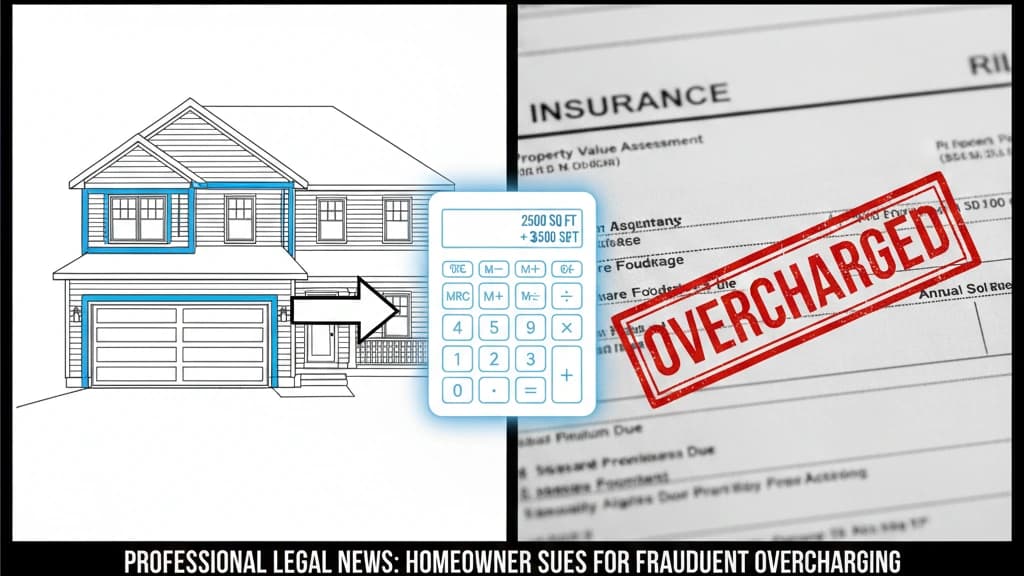
For years, homeowners across California relied on Allstate Insurance Company to protect their most valuable assets. However, a legal battle that began in 2020 revealed that many of these customers paid more than they should have. Tisha Hilario, a resident of San Francisco, discovered that Allstate used a flawed calculation method to determine her insurance premiums. She realized the company inflated the square footage of her home by counting her garage twice in their mathematical formula. This discovery led her to file a class-action lawsuit on behalf of herself and thousands of other policyholders who faced similar overcharges.
Cause
The dispute centered on how Allstate calculated two specific metrics: "Total Finished Living Area" and "Total Living Area." In the insurance world, larger homes typically require higher premiums. Hilario alleged that Allstate intentionally included built-in garages in the "Finished Living Area" category, which is normally reserved for space intended for human occupancy, like bedrooms or kitchens. By doing this, Allstate effectively added the garage's square footage to the base living area and then added it again to reach the "Total Living Area," double-counting the space.
Injury
Policyholders suffered direct financial harm because of these inflated numbers. Since the premium amount directly corresponds to the square footage on file, every extra foot Allstate added meant more money out of the customers' pockets. For Hilario, her actual living space measured about 862 square feet, and her garage was 288 square feet. Instead of basing her bill on the correct total of 1,154 square feet, Allstate billed her for 1,438 square feet. This practice extended to earthquake coverage as well, meaning customers with companion policies paid double the "error."
Damages Sought
Hilario sought to recover the total amount of overcharged premiums for herself and the entire class of California policyholders. The lawsuit estimated that Allstate misappropriated over $10,000,000 through these practices since early 2019. Beyond simple refunds, the legal team requested interest on the overpaid amounts, legal fees, and a Court order to stop Allstate from using the double-counting formula in the future.
Key Arguments and Proceedings
The legal process moved through the United States District Court for the Northern District of California under Judge William H. Orrick. The proceedings involved extensive analysis of insurance contracts and internal Allstate records to prove how the company processed square footage data.
Legal Representation
Plaintiff(s): Tisha Hilario, representing a class of California policyholders with built-in garages.
· Counsel for Plaintiff(s): Brian Eldridge | John Backes Prior | Steven Alan Hart | David Russell Shane
Defendant(s): Allstate Insurance Company.
· Counsel for Defendant(s): Sonia R. Martin | Mark L. Hanover | Isabella C. Hsu | Joshua Kendall Haevernick | Kristine M Schanbacher
Key Arguments or Remarks by Counsel
Hilario's legal team argued that Allstate's actions were not just simple mistakes but a systematic way to boost revenue. They pointed out that Allstate was well-aware of the inflating square footage but chose not to fix the issue. Counsel emphasized that the "Total Finished Living Area" should never include a garage, as no one lives in a garage, and including it there while also counting it as a "Total Living Area" component was deceptive.
Claims
The lawsuit brought forward several legal challenges against the insurance giant. The primary claim focused on breach of contract, asserting that Allstate violated its own policy terms by charging premiums based on incorrect data. Additionally, the Plaintiffs alleged that Allstate engaged in unfair business practices and was unjustly enriched by keeping money that it had no right to collect in the first place.
Defense
Allstate fought the allegations by denying that they had done anything wrong. In their formal response, the company's lawyers argued that Hilario lacked the standing to sue for all class members and that the complaint failed to provide a valid reason for the Court to order the return of any money. They claimed that the terms of the insurance policies "speak for themselves" and denied that they had artificially inflated any square footage to trick policyholders.
Settlement
Instead of a jury trial, the parties eventually reached a settlement agreement to resolve the claims for all affected California policyholders. On December 3, 2025, Judge Orrick granted final approval of the deal, finding it fair and reasonable.
The Court ordered Allstate to pay a settlement amount to resolve the litigation. Under the settlement terms, Allstate distributed funds to the class members and implemented changes to its calculation processes. The judge also approved a service award for Tisha Hilario for her role as the class representative and set aside a portion of the attorneys' fees until the final accounting of the payments was complete. A status conference was scheduled for June 2, 2026, to ensure that the money actually reached the homeowners who had been overcharged. The Court maintained its authority over the case to handle any issues that might pop up during the final stages of the payout.
Court documents are available upon request at [email protected]