
Case Background
The legal battle between Joanne Nelson and the City of Bridgeport began long before a jury ever stepped into the Courtroom. This case centered on a dispute over municipal accountability and the safety of public infrastructure. It all traced back to a specific spring day in 2022 at a prominent local landmark. The incident occurred at 45 Lyon Terrace, the site of a municipal building where the city conducted its daily business. Because this location served the public, the walkways surrounding it saw constant foot traffic from residents and employees alike.
Nelson, a resident of Bridgeport, had expected the city to maintain these paths in a safe manner. When she suffered a fall on the grounds, she decided to seek a legal remedy. She filed her initial legal papers in the Superior Court for the Judicial District of Fairfield. Over the next few years, the case moved through the typical phases of discovery and negotiation. The litigation focused heavily on Connecticut General Statutes §13a-149, a law that dictates how and when a city can be held liable for sidewalk defects. By the time the parties reached the trial phase in early 2026, the case had become a high-stakes test of whether the city had failed in its basic duty to keep the entryway of a government building free of hazards. The proceedings finally came to a head in a Bridgeport Courtroom, where a jury had to decide if the city's maintenance efforts had met the legal standard or if Nelson deserved compensation for her life-altering accident.
Cause
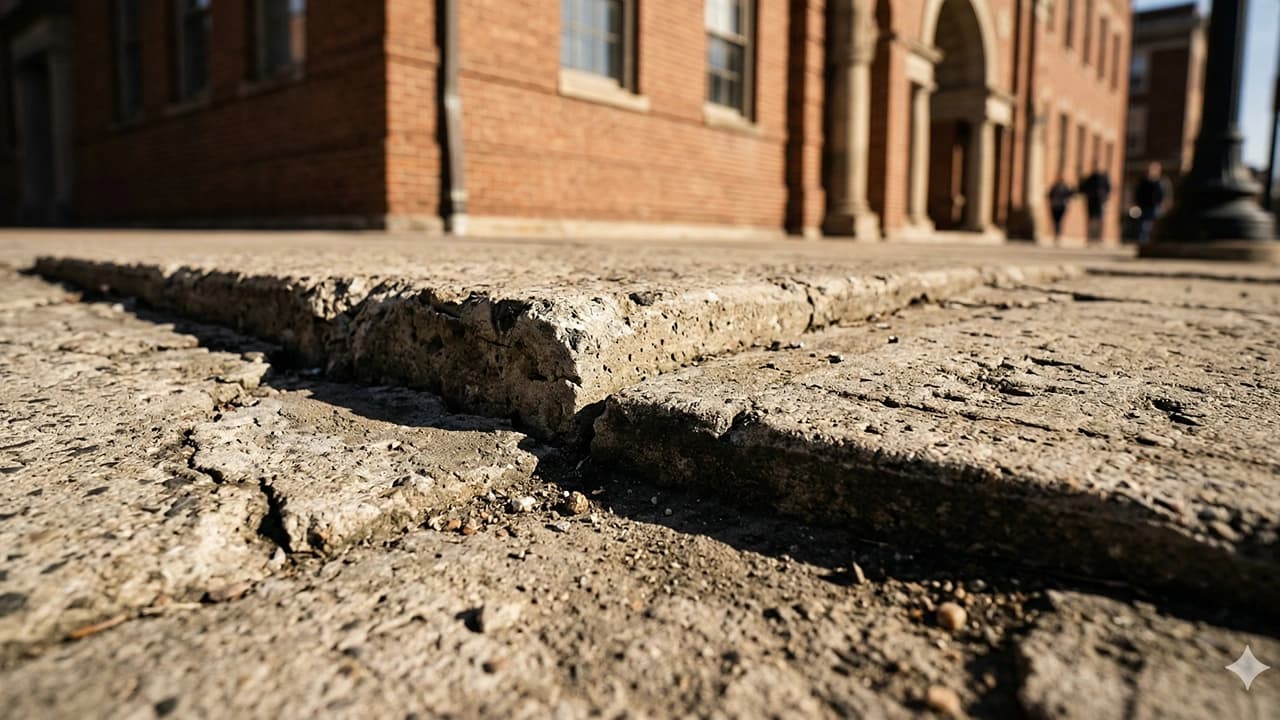
The incident that sparked the lawsuit took place on the morning of April 8, 2022. Around 9:00 a.m., Joanne Nelson arrived at the municipal building at 45 Lyon Terrace. She began to walk along the public sidewalk that ran next to the handicap entryway ramp. As she moved forward, she encountered a significant problem with the concrete surface. The sidewalk had reached a state of disrepair that made it dangerous for pedestrians. Specifically, several sections of the walkway had cracked and shifted, creating a series of uneven edges.
One particular segment of the concrete had upturned significantly. This created a vertical "lip" that rose above the rest of the path. Additionally, a hole or void had formed near the displaced concrete. Because the sidewalk material remained uniform in color, the height difference was difficult to spot from a distance. As Nelson walked toward the entryway, her foot struck the raised edge of the concrete. The obstruction tripped her instantly, sending her stumbling forward. She had no time to steady herself before she hit the ground. The force of the fall was concentrated on her right side as she landed hard on the unforgiving pavement. Before this moment, the city had been responsible for the upkeep of this specific area, but the dangerous condition had remained in place, hidden in plain sight until Nelson tripped over it.
Injury
The physical toll of the fall became apparent immediately after Nelson hit the sidewalk. The impact caused a severe injury to her upper body. When medical professionals examined her, they discovered that she had suffered a fracture of the right humerus. This bone, which connects the shoulder to the elbow, had snapped during the fall. The break caused Nelson immense pain and required immediate medical intervention. Along with the fracture, she suffered from deep contusions and significant bruising across her right shoulder and arm.
The recovery process proved to be long and difficult. Nelson struggled with a persistent soreness that radiated through her shoulder. She found that she could no longer move her arm with the same ease as before the accident. Doctors noted a permanent limitation in her range of motion, which meant she could not perform basic tasks without discomfort. Beyond the physical damage, the experience left Nelson with lasting emotional scars. She dealt with ongoing anxiety that she attributed directly to the trauma of the fall. She argued that the combination of the bone fracture, the physical limitations, and the mental distress had fundamentally changed her quality of life.
Damages Sought
Nelson asked the Court to award her a fair and just amount of money to cover the many losses she had suffered. Her financial burdens began with the mounting medical bills from her initial treatment and the follow-up care for her broken arm. She had to pay for orthopedic specialists, diagnostic imaging, and pain management services. Because the injury was so debilitating, Nelson also required help at home. she sought reimbursement for the costs of home health care providers who had assisted her during her most vulnerable period of recovery.
The lawsuit also focused on non-economic damages. Nelson claimed that she should be compensated for the physical pain and suffering she had endured since April 2022. She highlighted the fact that her injuries were permanent, meaning she would likely face medical challenges for the rest of her life. She also pointed out that her ability to enjoy daily activities had been severely restricted. In her legal filings, Nelson’s team clarified that she was seeking more than $15,000 in damages. This figure was intended to cover her past medical expenses, her future care needs, and the overall impact the injury had on her daily existence.
Key Arguments and Proceedings
Legal Representation
Plaintiff(s): Joanne Nelson.
· Counsel for Plaintiff(s): Christopher M. Cerami of the law firm Willinger, Willinger & Bucci, PC.
Expert for Plaintiff: Nelson U. Alino
Defendant(s): City of Bridgeport.
· Counsel for Defendant(s): Bruce L. Levin
Key Arguments or Remarks by Counsel
Claims
The Plaintiff’s legal team built their case around the idea that the City of Bridgeport had been negligent in its duties. Attorney Christopher Cerami argued that the city had a statutory obligation to keep its sidewalks safe for everyone. He contended that the city breached this duty by allowing the sidewalk near the handicap ramp to fall into such a poor state. The Plaintiff's side argued that the city must have known about the defect, or at least should have known about it, because the cracks and uneven concrete had likely been there for a long time.
Nelson’s counsel also claimed that the city failed to implement a proper inspection system. If the city had been checking the area regularly, they argued, workers would have spotted the tripping hazard and fixed it. The Plaintiff also criticized the city for failing to warn the public. There were no signs, no yellow paint on the raised edges, and no barriers to keep people away from the broken concrete. Because the city had ignored these simple safety measures, the Plaintiff argued that the municipality was solely responsible for the accident and the resulting humerus fracture.
Defense
The City of Bridgeport fought back by denying that it had done anything wrong. Associate City Attorney Bruce Levin admitted that the city owned the sidewalk and had a general duty to maintain it, but he argued that this duty did not make the city an insurer of every pedestrian's safety. The defense claimed that the city had used reasonable efforts to keep its walkways in good condition. They challenged Nelson’s claim that the sidewalk was "defective" in a way that violated the law.
A major part of the city's defense was the issue of notice. The city argued that Nelson had not proven that city employees actually knew about the specific crack she tripped on. Without proof that someone had reported the problem or that it had been visible for an extremely long period, the city argued it could not be held liable. The defense also put the burden of proof squarely on Nelson, asserting that she had to show the city’s negligence was the "sole proximate cause" of her fall. By denying the severity of the defect and the claim of negligence, the city aimed to show that the incident was an unfortunate accident rather than a legal failure by the government.
Jury Verdict
The trial reached its conclusion on March 17, 2026. After hearing all the evidence regarding the broken sidewalk and Nelson’s medical history, the jury had to decide if the City of Bridgeport had truly failed to maintain the walkway at 45 Lyon Terrace and if that failure was the reason for Nelson’s injuries.
The jury delivered a verdict that favored the municipality. The jurors found in favor of the Defendant, the City of Bridgeport, on all issues. They decided that the Plaintiff, Joanne Nelson, was not entitled to any money for her claims. Jury Foreperson Danielle Curtis signed the official verdict form, confirming that the panel had awarded zero damages. The decision brought the four-year legal saga to an end, leaving the city free of any financial liability for the 2022 incident.
Court Documents