
Case Background
This trial was part of the massive James v. PacifiCorp class action lawsuit (No. 20CV33885) filed in Multnomah County Circuit Court, Oregon. The class action, originally brought by sixteen Oregonians, targeted PacifiCorp and its subsidiary Pacific Power over four wildfires that erupted during the 2020 Labor Day weekend. A Phase I jury in June 2023 found PacifiCorp grossly negligent, reckless, and willful in its conduct and determined the utility bore liability for damages to class members within the fire boundaries. Following that verdict, the Court scheduled dozens of Phase II trials to determine individual damages for thousands of class members. Trial No. 22, which began on April 6, 2026, covered eleven Plaintiffs across two of the four fires — the Santiam Canyon Fire and the Echo Mountain Complex Fire. Judge Chanpone Sinlapasai presided over the trial, while Judge Steffan Alexander handled motions.
Cause
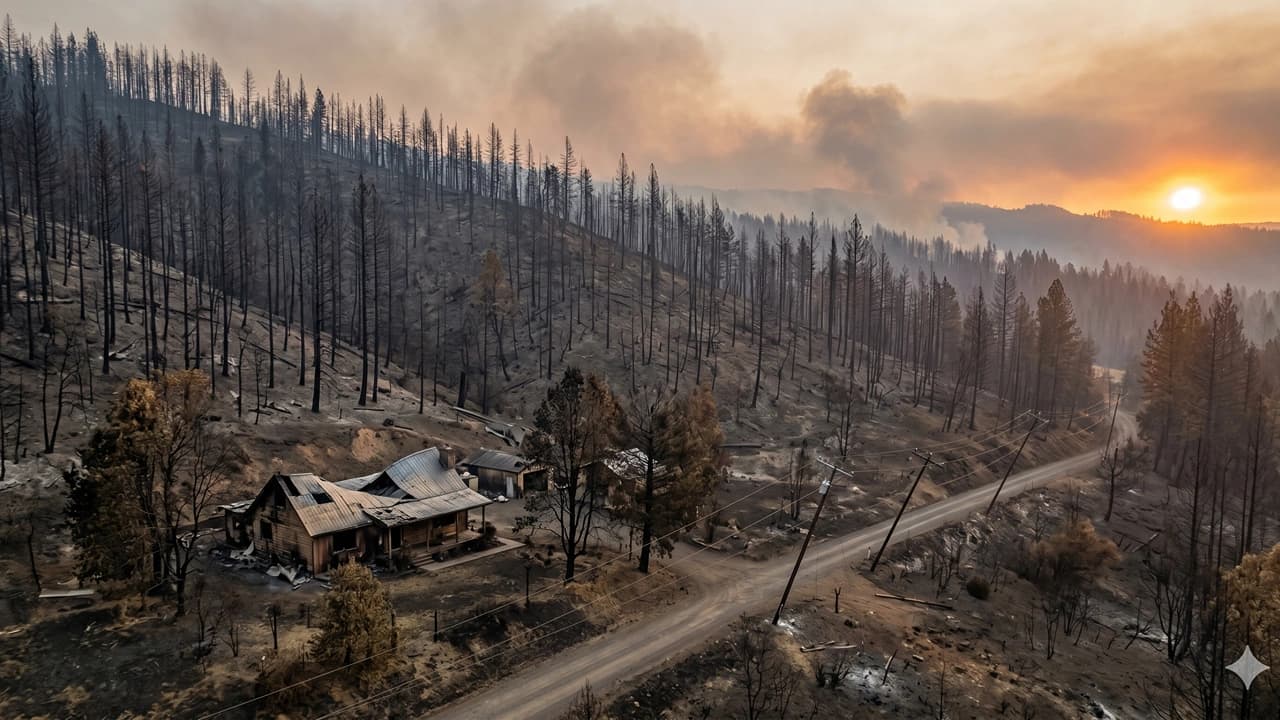
Over the 2020 Labor Day weekend, extreme heat and high winds swept through Oregon. Fire officials warned utilities about the dangerous conditions, but PacifiCorp chose to keep its power lines energized rather than shutting them off. The Santiam Canyon wildfire killed five people and burned over 400,000 acres across four counties. The Echo Mountain Complex fire struck near Lincoln City on the Oregon coast. Multiple Plaintiffs, including families with minor children, brought claims against the utility company for damages suffered during these fires.
Injury
The Plaintiffs reported a range of injuries. Scott Capek, who lived in Gates, Oregon, was in Keizer when the Santiam Canyon fire struck his home. He tried to return to rescue his pets but authorities blocked entry into the area. He later discovered his home was damaged, along with a storage shed, trees, personal property, and vegetation. Capek and his three minor children — Jace, Christopher, and James — all claimed emotional distress and mental suffering. Derrel Andersen suffered loss of personal property and emotional distress from the same fire. Helen Lara also claimed noneconomic damages from the Santiam Canyon fire. Catherine Nicole Clarke and her two minor children, Aria Clarke and Van Maldonado, claimed noneconomic damages from the Echo Mountain Complex fire. Fred Spencer and Arlene Spencer also sought noneconomic damages stemming from the Echo Mountain Complex fire.
Damages Sought
The complaint for Scott Capek sought economic damages up to $750,000 and noneconomic damages up to $25,000,000, along with punitive damages at 0.25 times the combined economic and noneconomic total. Plaintiffs also requested double economic and property damages under ORS 477.089, pre- and post-judgment interest, costs, and injunctive relief. The total prayer for relief in Capek’s complaint alone was $25,750,000. Each Plaintiff filed similar amended short form complaints through the James class action framework.
Key Arguments and Proceedings
Legal Representation
Plaintiff(s): Derrel Andersen; Scott Capek; J.S.C., J.R.C., and C.C. (minors, through guardian ad litem Scott Capek); Helen Lara; Catherine Nicole Clarke; V.M. and A.C. (minors, through guardian ad litem Catherine Nicole Clarke); Fred Spencer; and Arlene Spencer.
· Counsel for Plaintiff(s): Derek C. Johnson | Marilyn A. Heiken | Keith A. Ketterling | Timothy S. DeJong | Cody Berne | Emily Johnson | Daniel Mensher | Yoona Park | Sarah R. Osborn | Matthew J. Preusch | Nicholas A. Kahl | Nicholas Rosinia | Todd Logan | Megan Delurey
Defendant(s): PacifiCorp, an Oregon corporation, and Pacific Power, an Oregon registered electric utility and assumed business name of PacifiCorp.
· Counsel for Defendant(s): Sara C. Cotton | Jeffrey D. Hern | Mario Delegato, Sydney Padgett | Edward Peters | Alison Plessman | Stephanie W. Xiao | Khoa D. Nguyen | Douglas J. Dixon | Thomas B. King | Craig A. Fligor | Michael P. Schneider | Blaine Evanson | Joshua E. Dubin, Esq.
Key Arguments or Remarks by Counsel
Plaintiffs’ counsel argued that PacifiCorp’s decision to keep power lines energized during extreme fire weather directly caused the wildfires that destroyed homes, property, and livelihoods. They relied on the Phase I jury’s findings of gross negligence, recklessness, and willful misconduct as established law of the case.
Defense counsel maintained that PacifiCorp did not start or contribute to the fires. They pointed to the Oregon Department of Forestry’s March 2025 investigation report, which concluded investigators found no evidence of powerline ignitions contributing to the Santiam Canyon fire.
Claims
The Plaintiffs asserted six causes of action: negligence, gross negligence, private nuisance, public nuisance, trespass, and injunction. These causes of action were adopted from the Master Complaint in the James class action and carried forward through the Phase I verdict into these individual Phase II damages proceedings.
Defense
PacifiCorp raised twenty-seven affirmative defenses. The most significant included failure to mitigate damages, lack of causation based on the ODF report, intervening and superseding cause by third parties, comparative negligence of Plaintiffs, preemption by Oregon Public Utility Commission rules, tariff immunity, and multiple due process challenges to the class certification structure. PacifiCorp also argued that punitive damages were unconstitutional in the aggregate given the structure of successive Phase II trials involving up to 5,000 Plaintiffs. Additionally, PacifiCorp raised statute of limitations defenses against personal injury claims and sought setoffs for any insurance payments or collateral source recoveries.
Jury Verdict
On April 14, 2026, a jury in Multnomah County Circuit Court returned a verdict in favor of all eleven Plaintiffs. The trial was presided over by Judge Chanpone Sinlapasai, with Judge Steffan Alexander handling motions. The jury awarded a combined total of $14,535,000 in damages across the Plaintiffs.
Santiam Canyon Fire Plaintiffs
Derrel Andersen received $110,000 in economic damages for loss of personal property and $900,000 in noneconomic damages, totaling $1,010,000. Scott Capek received $550,000 in noneconomic damages. His three minor children each received $150,000 in noneconomic damages: Jace Capek ($150,000), Christopher Capek ($150,000), and James Capek ($150,000). Helen Lara received the largest individual award among Santiam Canyon Plaintiffs at $3,500,000 in noneconomic damages.
Echo Mountain Complex Fire Plaintiffs
Catherine Nicole Clarke received $1,900,000 in noneconomic damages. Her minor children received $250,000 (Aria Clarke) and $375,000 (Van Maldonado) in noneconomic damages, respectively. Fred Spencer received $3,250,000 in noneconomic damages, and Arlene Spencer received $3,250,000 in noneconomic damages.
The verdict was reached by at least nine of the twelve jurors as required under Oregon civil procedure, though different groups of nine jurors could agree on different questions. The presiding juror signed and dated the verdict form on April 13, 2026, and the verdict was filed with the Court on April 14, 2026. Notably, the Oregon Court of Appeals issued a ruling on April 8, 2026 — just two days after this trial began — reversing the Phase I class action verdict and remanding it back to the trial Court, a development that cast significant uncertainty over the broader litigation.
Court documents are available upon request at [email protected]