

Case Background
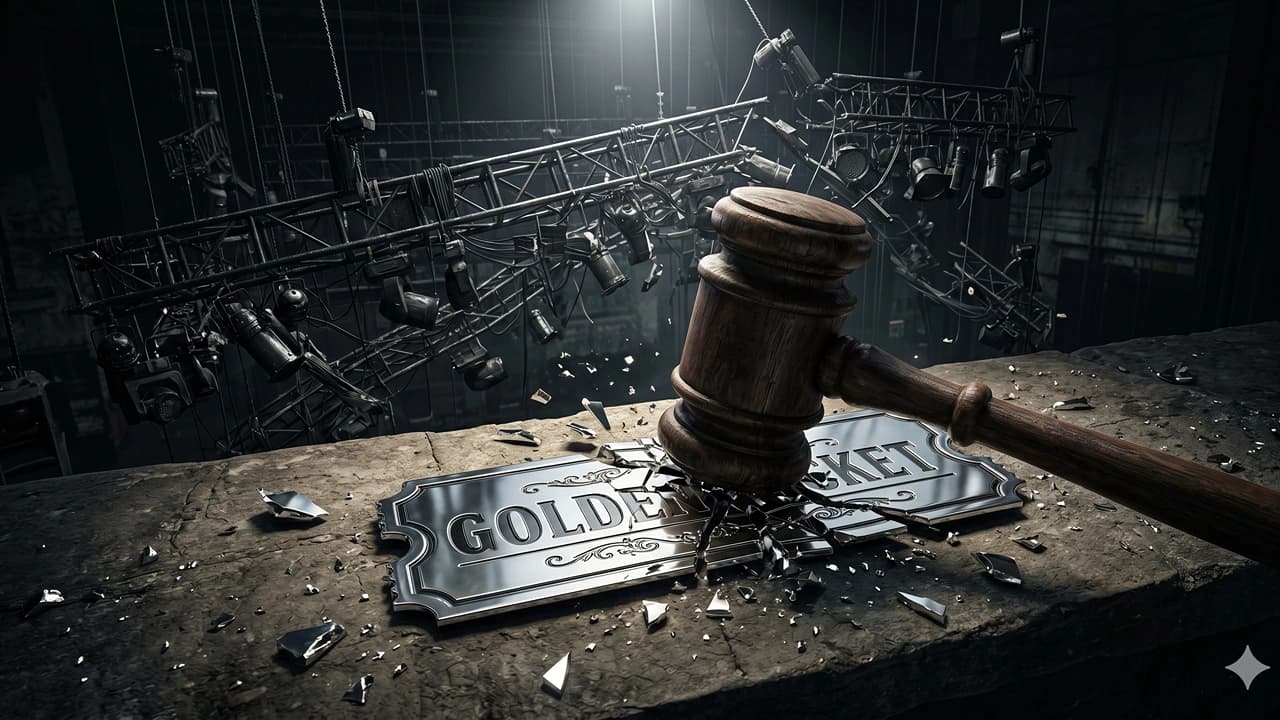
The United States Department of Justice, along with the Attorneys General of 30 states and the District of Columbia, filed a civil antitrust lawsuit to end the illegal monopoly held by Live Nation Entertainment and its subsidiary, Ticketmaster. For years, Live Nation consolidated its power across every level of the live music industry, acting as a gatekeeper that controls how music is performed, sold, and experienced in America. This dominance came at a steep price for fans, who faced skyrocketing fees, and for artists and venues, who found themselves trapped in a system that stifled competition and innovation.
Cause
The government alleged that Live Nation engaged in a systematic "flywheel" strategy to eliminate rivals and maintain its monopoly. By owning the largest concert promoter, the dominant ticketing platform, and a vast network of major venues, Live Nation created a self-reinforcing loop. It used its power in one sector to force compliance in others—often threatening to withhold concerts from venues that didn't use Ticketmaster or requiring artists to use Live Nation’s promotion services to gain access to its amphitheaters. This conduct violated Sections 1 and 2 of the Sherman Act, which prohibit monopolies and unreasonable restraints on trade.
Injury
The monopoly directly harmed the American public and the music industry. Fans suffered from a "Ticketmaster Tax"—a laundry list of service, convenience, and handling fees that often pushed the final price of a ticket far beyond its face value. Innovation slowed because Ticketmaster faced no real pressure to improve its notoriously unstable website or customer service. Meanwhile, independent promoters were driven out of business, and venues lost the ability to choose more cost-effective or fan-friendly ticketing partners.
Damages Sought
The Plaintiffs requested that the Court stop Live Nation’s anticompetitive practices and provide structural relief. Most notably, the government sought the divestiture of Ticketmaster, effectively breaking up the company to restore a competitive balance to the industry. They also asked for a Court order to stop Live Nation from entering into the types of exclusionary contracts that locked up the market for decades.
Key Arguments and Proceedings
Legal Representation
Plaintiffs: United States of America; Attorneys General from Arizona, Arkansas, California, Colorado, Connecticut, District of Columbia, Florida, Illinois, Maryland, Massachusetts, Michigan, Minnesota, Nevada, New Hampshire, New Jersey, New York, North Carolina, Ohio, Oklahoma, Oregon, Pennsylvania, Rhode Island, South Carolina, Tennessee, Texas, Virginia, Washington, West Virginia, Wisconsin, and Wyoming.
Counsel for Plaintiffs: David E. Dahlquist | Alex Cohen | Alexis Lazda | Andrew Kline | Andy Tan | Arianna Markel | Chinita M Sinkler | Collier Kelley | Curtis Strong | Danielle Drory | David Michael Teslicko , Jr | Elena Anastasia Goldstein | Janelle Sharon Robins | Jennifer P. Roualet | Jonathan Scott Goldsmith | Matthew Jones | Michael Glenn McLellan | Rachel Hicks | Sarah Licht | Seana Buzbee | Serajul Ali | Zeynep Elif Aksoy | Robert Bernheim
Defendants: Live Nation Entertainment, Inc. and Ticketmaster L.L.C.
Counsel for Defendants: Alfred Carroll Pfeiffer , Jr. | Andrew Gass | David R Marriott | Jennifer Lynn Giordano | Kelly Smith Fayne | Lindsey Champlin | Niall E. Lynch | Robin L. Gushman | Tim O'Mara | Adam Seth Paris | Daniel J. Hay | Ehson Kashfipour | Franklin Li | James McDonald | Jasdeep Kaur | Jesse Michael Weiss | Kyle Mach | Lauren Ann Moskowitz | Leah Wisser | Marissa Alter-Nelson | Nicole Marie Peles | Robert Reiland | William R Levi
Key Arguments or Remarks by Counsel
Government attorneys argued that Live Nation’s size was not the result of a better product, but of a "velvet hammer" approach to business. They contended that the company used its massive scale to bully the industry into submission. Defense counsel for Live Nation countered that the company’s success was a natural result of efficiency and that the integrated model benefited the industry by providing a "one-stop-shop" for complex global tours.
The Collusion with Oak View Group
The government presented evidence that Live Nation turned a potential competitor, Oak View Group (OVG), into a partner. OVG’s leadership reportedly described the firm as a "hammer" for Live Nation. Instead of bidding against each other for artists, the two companies agreed to stay in their own "lanes." OVG influenced the venues it managed to sign exclusive deals with Ticketmaster, effectively removing a major competitive threat from the market.
Retaliation and Threats
The prosecution detailed instances where Live Nation punished venues that dared to use rival ticketers like SeatGeek. In one case, after a venue switched providers, Live Nation allegedly moved lucrative concerts to other locations and messed with the venue's ability to sell resale tickets. This created a culture of fear; venue owners knew that leaving Ticketmaster meant losing the very shows that kept their doors open.
Exclusionary Contracts
Ticketmaster used long-term exclusive contracts—some lasting up to 14 years—to lock up venues. These deals prevented competitors from even bidding for business. By the time a contract neared its end, Ticketmaster often used "carrots" (large upfront payments) or "sticks" (threats of losing content) to secure a renewal before any rival could make an offer.
Restricting Artist Access
Live Nation owns or controls more than 60 of the top 100 amphitheaters in the U.S. The government argued that Live Nation used this "moat" to force artists to hire them as promoters. If an artist wanted to play a summer tour in these popular outdoor venues, they essentially had to sign with Live Nation or be locked out of the most profitable stops on the circuit.
Defense
Live Nation defended its practices by arguing that the live music industry is more competitive than the government suggests. They claimed that ticketing fees are primarily set by the venues, not Ticketmaster, and that their acquisitions were legal business expansions intended to improve the quality of concerts for fans worldwide. They asserted that their "flywheel" was a sign of a healthy, integrated business rather than an illegal monopoly.
Jury Verdict
A federal jury in New York returned a sweeping verdict against Live Nation Entertainment, Inc. and Ticketmaster L.L.C. on April 15, 2026, finding both companies liable on every claim brought by the Plaintiffs a coalition of U.S. states led by New York. The jury sided with the government on all counts, concluding that Live Nation and Ticketmaster broke federal antitrust law and harmed competition across the live events industry. The verdict marked a decisive win for the states and a stinging defeat for the entertainment giants.
Ticketmaster Monopolized Primary Ticketing for Major Concert Venues
The jury first tackled the question of whether primary ticketing services to major concert venues formed a legitimate antitrust market. It decided that it did. The jury then found that Ticketmaster willfully acquired or maintained monopoly power in that market through exclusionary conduct. It also concluded that Ticketmaster's behavior caused anticompetitive effects — meaning consumers and the market itself suffered real harm because of how Ticketmaster operated.
The jury went a step further and determined that Live Nation controlled, dictated, or encouraged Ticketmaster's conduct in this market. In other words, Live Nation was not a passive parent company — it actively drove the behavior that harmed competition.
Ticketmaster Also Monopolized Primary Concert Ticketing to Major Concert Venues
The Plaintiffs offered a second, narrower market definition: primary concert ticketing services to major concert venues. The jury agreed this was also a proper antitrust market. Once again, the jury found that Ticketmaster willfully acquired or maintained monopoly power through exclusionary conduct, that its behavior caused anticompetitive effects, and that Live Nation controlled or encouraged Ticketmaster's actions in this market as well.
Live Nation Monopolized the Use of Large Amphitheaters by Artists
The case also targeted Live Nation's dominance over large amphitheaters the outdoor concert venues where many of the biggest summer tours take place. The jury found that the use of large amphitheaters, as the Plaintiffs defined it, constituted a proper antitrust market. It then concluded that Live Nation willfully acquired or maintained monopoly power in this market through exclusionary conduct, and that Live Nation's behavior caused anticompetitive effects for artists and the industry.
Live Nation Unlawfully Tied Artist Promotion Services to Amphitheater Access
The jury found that artists — not promoters — are the real customers who rent large amphitheaters. With that established, the jury concluded that Live Nation unlawfully tied its artist promotion services to artists' use of those amphitheaters. Essentially, Live Nation leveraged its control over premier outdoor concert venues to force artists into using Live Nation's own promotion services — a classic antitrust violation known as tying.
Every Plaintiff State Proved Harm to Competition
The verdict form listed all 36 Plaintiff states and the District of Columbia. The jury checked "Yes" for every single one, finding that both Live Nation and Ticketmaster engaged in unlawful conduct that harmed competition in each of those jurisdictions. Not a single state failed to prove its case.
The states that prevailed included Arizona, California, Colorado, Connecticut, the District of Columbia, Florida, Illinois, Indiana, Kansas, Louisiana, Massachusetts, Maryland, Michigan, Minnesota, Nevada, New Hampshire, New Jersey, New Mexico, New York, North Carolina, Ohio, Oregon, Pennsylvania, Rhode Island, South Carolina, Tennessee, Texas, Utah, Vermont, Virginia, Washington, West Virginia, Wisconsin, and Wyoming.
The Jury Awarded Damages Across 22 States
For the states where the jury found Ticketmaster liable on the primary concert ticketing monopolization claim, damages came into play. The jury determined the per-ticket overcharge that residents in each state paid for primary concert tickets at major concert venues because of Ticketmaster's anticompetitive conduct. The jury awarded $1.72 per ticket across all 22 states that qualified for damages — a uniform figure applied to Arizona, California, Colorado, Connecticut, the District of Columbia, Florida, Illinois, Indiana, Michigan, Minnesota, Nevada, New Hampshire, New Jersey, New York, North Carolina, Pennsylvania, Rhode Island, South Carolina, Utah, Washington, West Virginia, and Wisconsin.
While $1.72 per ticket may sound modest, the sheer volume of tickets sold through Ticketmaster across these states over the relevant time period means the total damages figure could reach into the hundreds of millions of dollars.
State Law Claims: A Clean Sweep
Beyond the federal antitrust claims, several states brought their own state-law claims against Live Nation and Ticketmaster. The jury found the Defendants liable on every single one.
California Unfair Competition Law
The jury found that both Ticketmaster and Live Nation engaged in unlawful or unfair business acts or practices that occurred within California, emanated from California, or harmed California residents, all in violation of the California Unfair Competition Law.
Florida Deceptive and Unfair Trade Practices Act
The jury found that both Ticketmaster and Live Nation engaged in unfair methods of competition in violation of the Florida Deceptive and Unfair Trade Practices Act.
Illinois Antitrust Act
The jury found that both Ticketmaster and Live Nation engaged in unlawful conduct in violation of the Illinois Antitrust Act.
Indiana Antitrust Act
The jury found that both Ticketmaster and Live Nation engaged in unlawful conduct after July 1, 2023, in violation of the Indiana Antitrust Act.
Kansas Restraint of Trade Act
The jury found that both Ticketmaster and Live Nation engaged in unlawful conduct in violation of the Kansas Restraint of Trade Act.
New York Donnelly Act
The jury found that both Ticketmaster and Live Nation maintained monopoly power through anticompetitive conduct involving the use of contracts, agreements, arrangements, or combinations, in violation of New York's Donnelly Act.
South Carolina Unfair Trade Practices Act
The jury found that both Ticketmaster and Live Nation engaged in unfair methods of competition in violation of the South Carolina Unfair Trade Practices Act.
Tennessee Trade Practices Act
The jury found that both Ticketmaster and Live Nation engaged in unlawful conduct after April 23, 2024, in violation of the Tennessee Trade Practices Act.
Vermont Consumer Protection Act
The jury found that both Ticketmaster and Live Nation engaged in unfair methods of competition in violation of the Vermont Consumer Protection Act.
The verdict represented a total defeat for the entertainment giants on the liability front, though the case now moves to a remedies phase where the Court will decide what structural or behavioral changes to impose decisions that could fundamentally reshape the American live entertainment industry. Given the breadth of the jury's findings, the remedies phase could reshape the American live entertainment industry for years to come.
Court documents are available upon request at [email protected]