
Early Career Mistakes (Years 1-3)
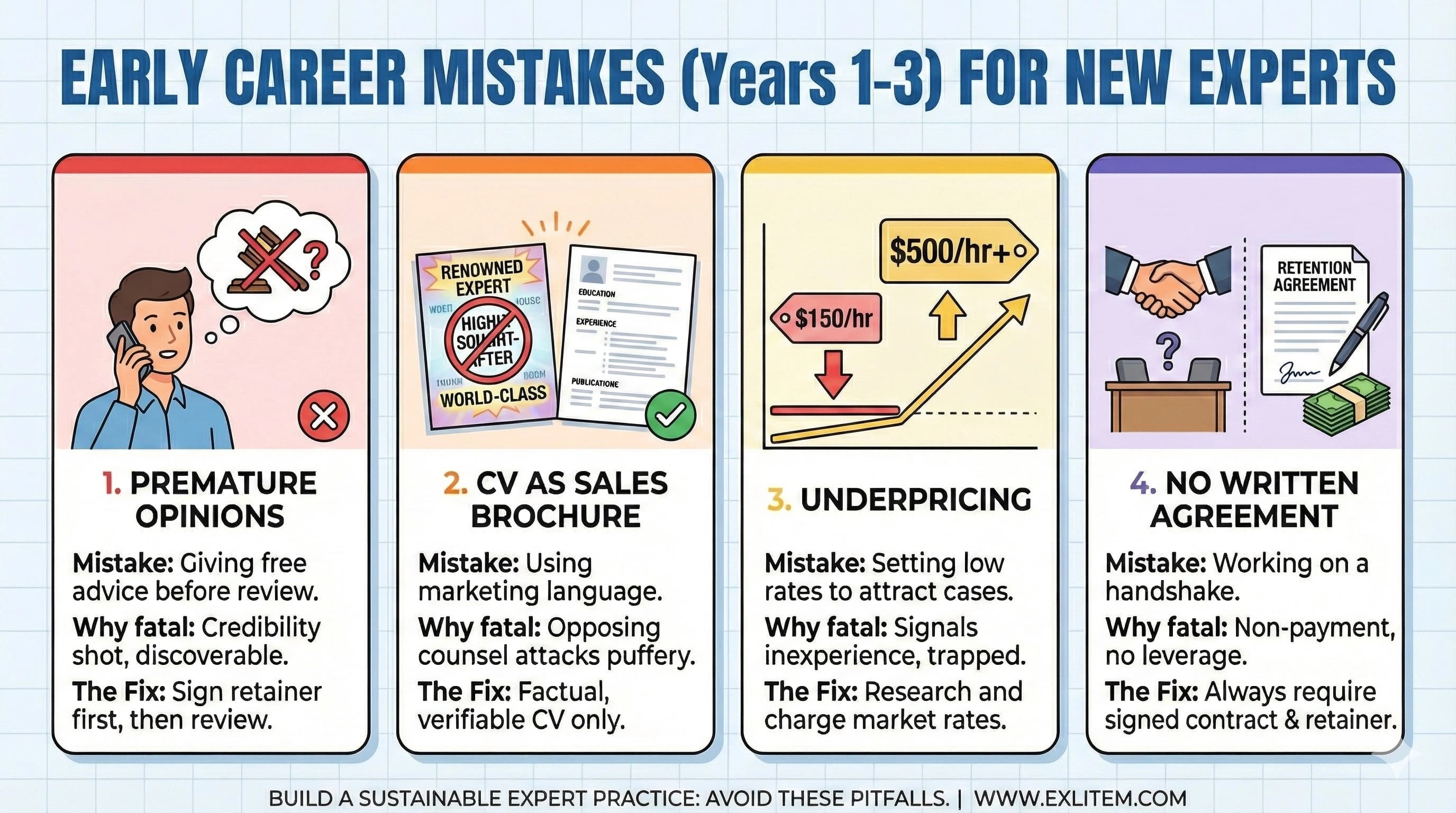
1. New experts are eager to impress.
An attorney calls, describes a case, and the expert starts opining immediately—before reviewing records, before a retention agreement, before getting paid.
Why it's fatal: At deposition, you'll be asked under oath: "When did you first form your opinion in this case?" and "What materials had you reviewed at that point?"
If the honest answer is "I gave the attorney my preliminary view during our first call, before I'd reviewed the medical records," opposing counsel's follow-up writes itself: "So you reached your conclusion first, then reviewed the records to support it?"
This is exactly the pattern that sank the expert in In re Paraquat Products Liability Litigation (S.D. Ill. 2024). The court found the expert's methodology was results-driven—he'd effectively worked backward from a conclusion. The Ninth Circuit has called this approach "the antithesis of the scientific method." The Paraquat expert was excluded, and because he was the sole causation witness, plaintiffs lost on summary judgment.
The phone call itself may be protected work product. But your testimony about when and how you formed your opinion is not.
The fix: Never discuss case specifics until you've reviewed materials and been formally retained. Your first call should cover your qualifications, availability, and fee structure—nothing more.
2. A CV that reads like a sales brochure
New experts often stuff their CVs with puffery: "renowned expert," "highly sought-after consultant," "extensive experience in litigation support."
Why it's fatal: Attorneys aren't fooled. Worse, opposing counsel will read every word aloud at deposition and ask you to defend each claim. "What makes you 'renowned'? Can you name the peers who consider you 'highly sought-after'?"
The fix: CVs should be factual and verifiable. Education, positions held, publications, presentations, certifications. No adjectives. No marketing language. Two sample formats exist—get feedback before your first case.
3. Underpricing yourself (then being stuck there)
New experts often set rates at $150-250/hour, thinking lower fees will help them get cases. Then they're trapped—attorneys expect consistency, and dramatic rate increases raise questions.
Why it's fatal: Low rates signal inexperience. Attorneys assume you charge less because you're worth less. And 68% of experts raised rates in the past five years without losing business—the market supports higher fees.
The fix: Research rates for your specialty before your first case. Medical experts average $555/hour; non-medical average $348/hour. Price at market rate from day one.
4. No written retention agreement
New experts often work on a handshake—the attorney seems trustworthy, the case seems straightforward, and paperwork feels awkward.
Why it's fatal: 46% of experts reported non-payment in the past five years. Without a written agreement, you have no leverage. You also have no clarity on scope, deliverables, or who's responsible for fees.
The fix: 64% of experienced experts now require signed contracts (up from 46%). Your agreement should address retainer requirements, fee schedules, expense policies, cancellation terms, and attorney responsibility for payment. 73% require upfront retainers—median $3,000.
Mid-Career Mistakes (Years 4-10)
5. Letting the attorney write your report
You send a draft. The attorney "cleans it up" and sends back something substantially different—stronger language, conclusions you didn't quite reach, facts framed more favorably.
Why it's fatal: Under the December 2023 FRE 702 amendments, courts now scrutinize methodology with a "more likely than not" standard. If opposing counsel gets draft versions (and in many jurisdictions they can), every edit is an attack point. "This isn't what you originally wrote, is it? Counsel changed your opinion, didn't they?"
The fix: Your report is your report. Accept typographical corrections. Reject substantive changes. If counsel wants different conclusions, you're not the right expert for their case.
6. Becoming an advocate instead of an educator
After several cases, experts develop relationships with attorneys who hire them repeatedly. Gratitude evolves into loyalty. The expert starts "helping" the team—softening unfavorable facts, strengthening favorable ones.
Why it's fatal: Juries detect this shift instantly. Research shows experts perceived as "hired guns" are "neither liked nor believed." And once you've crossed the line, opposing counsel will track your testimony history forever. AI tools now analyze 75,000+ pages of transcripts to find inconsistencies.
The fix: Your duty is to the truth and the court—not to the attorney who hired you. If your honest opinion doesn't help their case, that's their problem to solve.
7. Ignoring your digital footprint
You post a political opinion on LinkedIn. You like a provocative tweet. You write a blog post with a strong stance on an issue tangentially related to your expertise.
Why it's fatal: Attorneys now routinely scrub social media, political donation records, and every online trace of an expert before hiring—and definitely before cross-examination. That 2019 tweet about "frivolous lawsuits" will be blown up as an exhibit when you testify for a plaintiff.
The fix: Audit your digital presence. Google yourself. Review every social platform. Assume opposing counsel will find everything and use it. Either delete problematic content or be prepared to defend it.
8. Not keeping up with legal changes
The December 2023 FRE 702 amendments fundamentally changed expert admissibility standards. Seven states have already adopted similar rules. But many mid-career experts haven't read the amendments or understood their implications.
Why it's fatal: In In re Acetaminophen (December 2023), five "eminently qualified" experts were excluded because they couldn't explain how they weighted Bradford Hill factors. In In re Paraquat (April 2024), methodology deemed "results-driven" got the sole causation expert tossed. These challenges are increasing—and they're succeeding.
The fix: Read the amended Rule 702. Understand the "more likely than not" standard. Document your methodology before forming conclusions. Explicitly address contrary evidence. Never overstate what your methodology supports.
Late-Career Mistakes (Years 10+)
9. Testimony inconsistencies across decades of cases
You've testified 200 times over 15 years. You've said slightly different things in different contexts. You don't remember what you said in 2014.
Why it's fatal: AI does. Tools like LexisNexis Protege and Exlitem's Deposition Analyzer can review hundreds of expert reports and deposition transcripts to find inconsistencies. Expert Witness Profiler provides a complete due diligence report on the background of any expert witness with links and sources to procure previous deposition transcripts and expert reports. What used to take weeks of paralegal time now takes minutes.
The fix: Maintain your own database of prior testimony. Before every deposition, review what you've said on key topics. If your opinions have evolved, be prepared to explain why. Never claim you've "always" held a position unless you're certain.
10. Refusing to adapt to remote testimony
You've testified in courtrooms for 20 years. You know how to command a room, read a jury, project authority. But now half of depositions are virtual—and you're still treating Zoom like a minor inconvenience.
Why it's fatal: Remote testimony is permanent. All 50 states authorize it. Camera placement, lighting, eye contact, speaking pace—these all differ from in-person skills. Looking at the screen instead of the camera eliminates eye contact. Bad audio quality makes you seem unprofessional. A visible bed or political poster in the background has derailed testimony.
The fix: Invest in proper setup: hardwired internet, external microphone, professional webcam, two monitors, neutral background. Practice on camera. Join 10+ minutes early. Pin the questioner's video. Speak slightly faster with stronger volume—video flattens presence. Master this or watch younger experts take your cases.
The Through-Line
At every career stage, the same principle applies: your credibility is your only asset.
Early-career experts destroy it through eagerness and inexperience. Mid-career experts erode it through advocacy and complacency. Late-career experts lose it to inconsistency and inflexibility.
The experts who build lasting practices—charging $600+ per hour for decades—are the ones who protect their credibility above all else. They say "I don't know" when they don't know. They decline cases outside their niche. They refuse to let attorneys influence their opinions. They stay current with legal standards and technology.
The work is interesting, the compensation is excellent, and the intellectual challenge is real. But it's a field with a long memory and increasingly sophisticated tools for exposing weaknesses.
Make your mistakes in training—not in testimony.