
The Adversarial Pressure Cooker
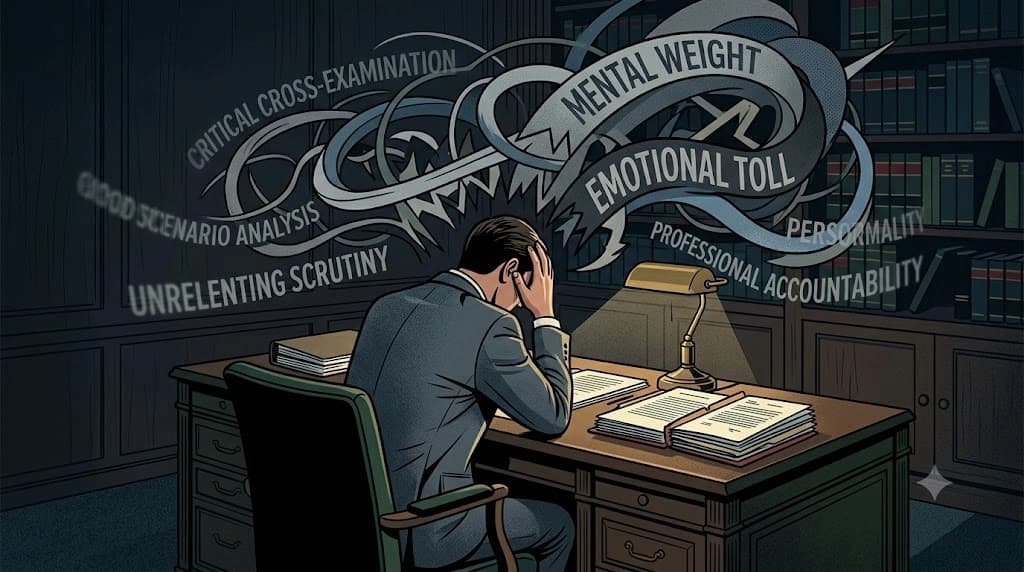
The first source of strain is structural, built into the design of the adversarial system itself. An expert witness is retained specifically because the other side will pay a skilled professional to spend weeks or months looking for every possible weakness in that expert's opinion, credentials, and demeanor, and then attempt to expose all three in a single afternoon.
Kevin Quinley, an insurance claims expert and author of more than ten books on claims and risk management who appeared on Season 1, Episode 1 of On The Stand, names the mechanism directly. Expert witness work, he says, "is very stressful. It is deadline driven. It is in an adversarial context. You have extremely smart people on the other side spending weeks or more preparing to make you look foolish, inconsistent, in a negative light." That pressure is not incidental to the job; according to Quinley, learning to recognize and manage it is "one key aspect of longevity and success in the role of an expert witness."
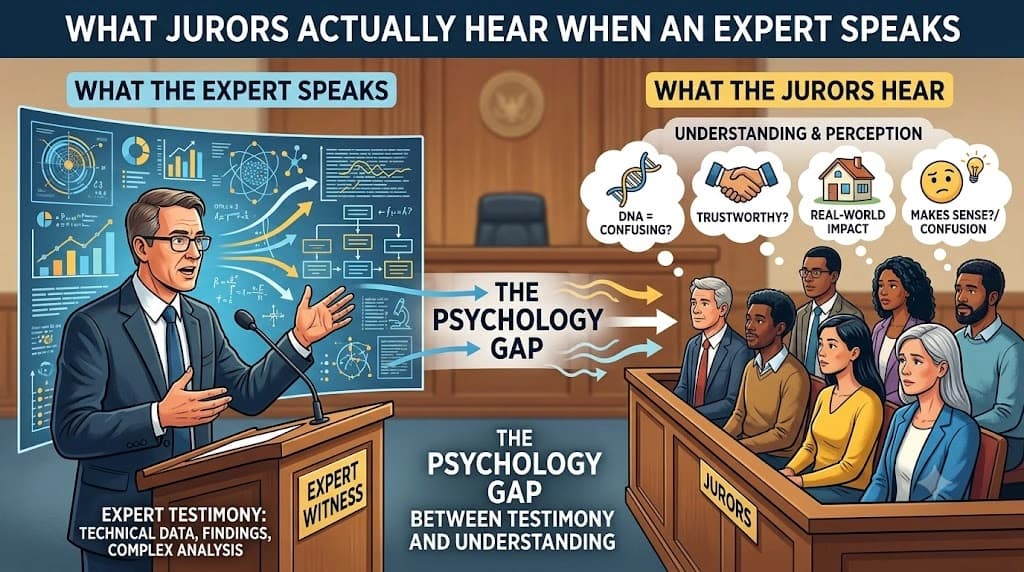
Dr. Eric Cole, a cybersecurity expert who appeared on Season 2, Episode 8 of On The Stand, describes what that pressure feels like from inside a cross-examination. Opposing attorneys will often insist, he notes, that their attacks are strictly professional. "It's not personal, it's business," is the line they tend to use. But Cole is candid that the line does not always hold. "If they're going after you personally and questioning your morals or ethics, it could start to feel a little personal if you're not careful." His answer is not to suppress the feeling but to refuse to let it surface. "The number one rule is no matter what they're asking you, no matter what they're saying, you just got to stay calm and relaxed," he explains, "because ultimately the worst thing an expert can do is lose their cool." The reasoning is practical rather than merely stoic: a visibly rattled expert signals to a jury that something is wrong, regardless of whether anything actually is. "Even if the jury doesn't understand what you're saying, they're going to think, okay, something's going on."
Frederick Fisher, an insurance coverage and professional liability expert with a fifty-year career who appeared on Season 3, Episode 13 of On The Stand, points to a different and less discussed source of the same pressure: the unpredictability of the court calendar itself. "My calendar is looking pretty good. Then nothing coming up. And all of a sudden trial dates get changed. And all of a sudden you got three trials scheduled the same week," he says. "There are times where it can be very, very stressful." Unlike the adversarial pressure Quinley and Cole describe, this stress has nothing to do with the merits of a case or the skill of opposing counsel. It is simply the logistical reality of a system where dozens of independent court schedules can collapse onto an expert's calendar without any warning at all. An expert cannot decline three overlapping trial dates the way they might decline a single overreaching assignment; once retained on multiple active matters, they are at the mercy of judges, opposing counsel, and court administrators they have never met, all making scheduling decisions that have nothing to do with any individual case and everything to do with an overloaded docket.
Taken together, Quinley, Cole, and Fisher describe three distinct flavors of the same underlying condition: stress that is deadline-driven, stress that is personal and adversarial, and stress that is simply logistical chaos outside anyone's control. None of the three is optional to the job. All three, according to the people who have lived with them the longest, have to be actively managed rather than simply endured.
Carrying Someone Else’s Pain
A second, quieter source of strain rarely gets discussed in the same breath as cross-examination: the emotional cost of sitting inside someone else's worst moment, whether that person is a client, a plaintiff, or the physician on the other side of a malpractice claim.
Jordan Redavid, a plaintiff trial attorney and founding partner at Fisher Redavid Trial Lawyers who appeared on Season 1, Episode 2 of On The Stand, describes what it costs to deliver an honest but unwelcome answer to a client who has already suffered. In one case, after a thorough medical review found that a rare, statistically unlikely complication rather than any error explained a client's outcome, Redavid had to tell a woman that the doctor she trusted had done nothing wrong. "Now I have to deliver the bad news to the client, which is part of the job," he says, "but in forty days this woman got an answer, and now she's no longer going to be saddled with the stress of thinking this doctor she trusted did something wrong and ruined her life." The relief in that account does not erase the weight of delivering it. "She's still damaged. I still feel terrible for this woman," Redavid says, even as he describes the outcome as the right one. Carrying that discomfort, alongside the professional obligation to be honest regardless of what the client wants to hear, is part of the job description that never appears in a retention letter.
Dr. Stephen Cohen, a board-certified colorectal surgeon and medico-legal consultant who appeared on Season 3, Episode 1 of On The Stand, arrives at a related insight from the opposite side of the courtroom, having once been a defendant himself. "The first one's the hardest," he says of being sued for the first time. "You really feel like you're the worst doctor in the world. What did I do wrong? I thought I did everything right." That experience now shapes how he approaches every case he reviews as an expert. "It's a lot easier to be the expert witness when you're not emotionally involved than to be the one sued," he says, before describing the discipline he imposes on himself to compensate: "It's very much shaped when I'm talking to a plaintiff attorney, because I pretend like that's me, right? If I'm the doctor that did this, did I fall below the standard of care?" Cohen's method is not to suppress the empathy his own experience as a defendant gave him, but to route it through a fixed, factual standard rather than either sympathy or self-protection, precisely because he knows firsthand how much is at stake emotionally for the person being judged. That is a harder discipline than it sounds. It requires holding two things at once: genuine identification with a defendant who may be innocent of any real wrongdoing, and a willingness to conclude, if the facts require it, that the defendant fell below the standard of care anyway. Cohen's own history as a defendant does not soften that verdict when the evidence points against a colleague. If anything, he suggests, it sharpens his sense of what that verdict will cost the person receiving it, which is precisely why the emotional weight never fully disappears no matter how many cases he reviews.
The Stress Nobody Budgets For
A third category of strain has nothing to do with adversarial skill or emotional weight, and everything to do with how the surrounding legal process is managed. Several experts describe avoidable stress created not by the substance of a case but by poor coordination from the very attorneys who retained them.
Pavithra Kumar, a securities, valuation, and damages expert who appeared on Season 3, Episode 2 of On The Stand, points to a specific and recurring failure: attorneys who do not surface unfavorable documents until the opposing side introduces them first. "I've experienced this where you find out about some bad document when it's cited by the other side, and that's something the attorneys do not provide to your expert," she says. "It's never been catastrophic, but it's really irritating when that happens. It's just unnecessarily stressful." Compounding the problem, Kumar notes, is the frequency with which smaller firms bring experts in far too late in the process, leaving little time for the review, peer checks, and analysis a defensible opinion requires. This is stress that a well-run engagement could simply prevent, and its persistence suggests the pressure on experts is not always inherent to the work itself.
Quinley's own account of the toll bad scheduling can take is even more concrete. Early in his career, before much case material was digitized, he accepted an engagement without asking a basic question: how much material would he need to review. "I got a couple of bankers boxes delivered to my house," he recalls, "and I spent my Christmas vacation, quote unquote, using air quotes, slaving over this Rule 26 report." The experience changed how he operates permanently. "I vowed at that point to try to never put myself in that case again," he says, describing how he now asks about both the deadline and the volume of materials before accepting any new assignment. That discipline was tested again years later when an attorney called the Wednesday before Thanksgiving with a new assignment due the Monday after the holiday. Despite valuing the relationship, Quinley declined. "It was a no-brainer to me," he says. "I thanked him profusely, but I had to politely decline it."
What the Veterans Actually Do About It
If the first three sections describe where the stress comes from, the fourth is about what experienced practitioners have actually built to survive it, since none of them received any formal instruction on the subject.
Quinley has developed what amounts to a personal operating system for the pressure. He compares experts to "professional jugglers": "there are a lot of balls in the air, but if you can only juggle three balls and you accept two more balls and three more balls, now you got five or six, one of those balls is gonna drop." His safeguards include a self-imposed rule to request the complaint and preliminary materials before committing to any case, along with twenty-four hours to weigh it against his existing workload; a fixed daily schedule with a hard shutdown at the end of the day; and simple physical resets, including time outdoors and walking his two dogs. "Those are all techniques I would say in terms of trying to manage the stress," he says, "and realize that you have the autonomy to calibrate how stressful it is." He credits a favorite phrase for reframing the pressure itself: "there's a saying that pressure is a privilege... you're under stress and you have this pressure because you have subject matter knowledge that is needed and desired." Even so, Quinley is honest that the calibration is imperfect; describing an unusually demanding stretch of deposition and trial dates earlier in his career, he recalls asking himself directly, "do I really want to perpetuate this lifestyle," and concluding that "true wealth is discretionary time."
George Reis, a forensic imaging and video analysis expert who appeared on Season 2, Episode 1 of On The Stand, has built his own version of the same boundary system, developed over roughly two decades in the field. "Twenty years ago, if my phone started to ring, I'd run over to it," he says. "Now I'm trying to have a work-life balance, so I'm not in as much a hurry to get to the phone, and if I miss a call, I'm not as concerned." He has also learned to decline the cases that create the most avoidable pressure: "I also try not to take those last-minute rush cases, because I can't do as good a job for the client if I only have a week to do the work." Outside the casework itself, Reis maintains a deliberately separate identity: tending a large vegetable garden with his wife, playing the alto saxophone, and performing magic, interests that share nothing with forensic image analysis and, for that reason, function as genuine recovery rather than an extension of the job.
Maria Babinetz, a vocational rehabilitation expert and incoming president of the American Board of Vocational Experts who appeared on Season 2, Episode 7 of On The Stand, frames the same need in more explicitly clinical terms, describing self-care as her personal operating principle. "It is the ability to take care of yourself, however that looks," she says, "if it is taking time away, or if it is doing something for you, whether it's five minutes a day or if it's just a routine of something." For Babinetz, the specific activity matters less than the consistency of the practice, whether that is a standing date night, an evening with a girlfriend, or simply time with her two dogs. "If you can recharge your batteries however that looks for you," she says, "it's just an opportunity" to return to demanding work with something left to give.
What Quinley, Reis, and Babinetz share is a refusal to treat stress management as something that happens automatically, or something that can be addressed only after it becomes a crisis. Each of them describes a deliberate, repeatable practice, not a one-time realization. Quinley's hard shutdown happens every day, not only on the days he feels overwhelmed. Reis's boundary around last-minute cases is a standing policy, not a case-by-case judgment call made under pressure. Babinetz's self-care routine is scheduled rather than reactive. The common thread is that none of them are waiting until the stress becomes unmanageable to address it; they have built the management into the ordinary rhythm of the work itself, which is precisely what makes it sustainable across a career measured in decades rather than years.
Why This Is Not a Soft-Skills Problem
It would be easy to file all of this under wellness advice, separate from the actual substance of expert witness work. The experts featured here suggest otherwise. Cole's account of composure under cross-examination makes the connection explicit: an expert who cannot manage the emotional pressure of the adversarial process will visibly leak that struggle to a jury, regardless of the underlying merit of their opinion, and that leak becomes evidence in its own right, whether or not it should be. Kumar's and Fisher's accounts point to a related truth from the opposite direction: some of the psychological weight of this profession is not an unavoidable cost of adversarial litigation at all, but the downstream effect of poor case management that a more disciplined intake process, on the attorney's side, could prevent outright. Managing stress, in other words, is not a personal indulgence layered on top of the real work. For at least some of it, it is the real work, or the precondition for doing the real work credibly. Redavid's and Cohen's accounts extend that argument into the emotional register: an expert who cannot process the weight of a client's disappointment or a defendant's fear risks either avoiding the hardest, most honest conclusions to spare themselves the discomfort of delivering them, or burning out of the field within a few years, taking their expertise with them. Neither outcome serves the legal system, which depends on experts who are both rigorous and durable enough to keep doing this work for decades rather than a handful of cases.
Conclusion
No board exam measures whether a physician, an engineer, or a claims professional can survive a decade of being professionally doubted, deposed, and occasionally humiliated, and come back the next month ready to do it again with full composure and unclouded judgment. Quinley learned that lesson over a Christmas vacation spent hunched over bankers boxes. Cohen learned it from the inside of a malpractice suit filed against him personally. Redavid learned it by watching a woman thank him through her own continuing pain. Cole learned it by staying visibly calm while his ethics were questioned in front of a jury. Reis and Babinetz each built, independently, a private system of boundaries and recovery that nobody handed them. Kumar and Fisher learned that some of this weight is preventable, if only the surrounding process were better run.
What ties these accounts together is not a shared technique but a shared absence: none of them were taught how to carry this weight before they were expected to carry it. They built their own methods, largely alone, through the accumulated evidence of what happened when they did not have one. The stress nobody warns you about, it turns out, is not a footnote to expert witness work. For the people who last in this field for decades, learning to manage it is the actual skill.
Experts Featured in This Article
Kevin Quinley - Season 1, Episode 1 | Insurance Claims Expert & Risk Management Author
Jordan Redavid - Season 1, Episode 2 | Plaintiff Trial Attorney & Founding Partner, Fisher Redavid Trial Lawyers
George Reis - Season 2, Episode 1 | Forensic Imaging & Video Analysis Expert
Maria Babinetz - Season 2, Episode 7 | Vocational Rehabilitation Expert & Incoming President, American Board of Vocational Experts
Dr. Eric Cole - Season 2, Episode 8 | Cybersecurity Expert
Dr. Stephen Cohen - Season 3, Episode 1 | Board-Certified Colorectal Surgeon & Medico-Legal Consultant
Pavithra Kumar - Season 3, Episode 2 | Securities, Valuation & Damages Expert
Frederick Fisher - Season 3, Episode 13 | Insurance Coverage & Professional Liability Expert