
Two hurdles, not one
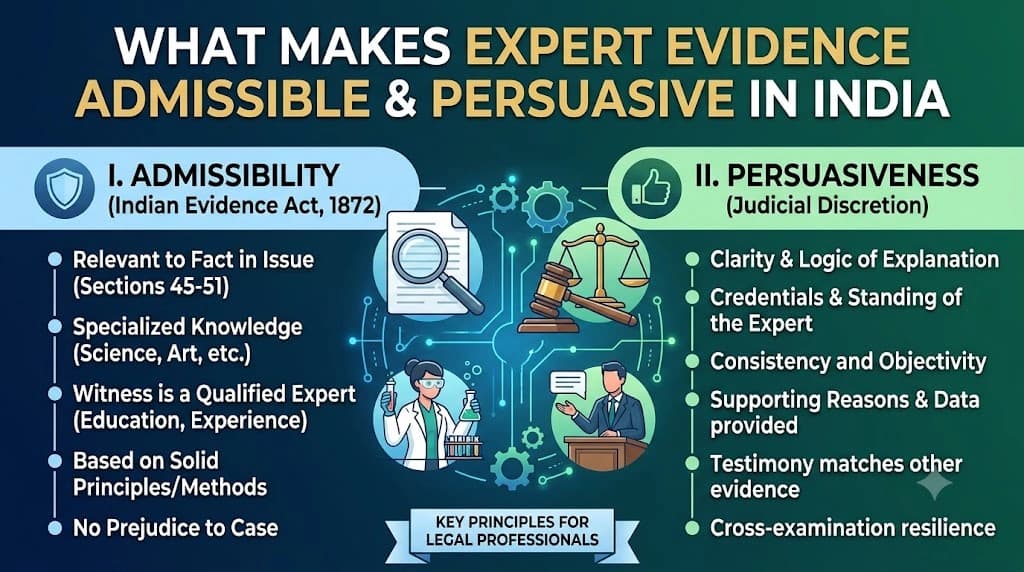
Indian lawyers talk about expert evidence as though getting it "in" is the hard part. It rarely is. The Bharatiya Sakshya Adhiniyam, 2023 (BSA), which replaced the 150-year-old Indian Evidence Act, 1872 with effect from 1 July 2024, sets a relatively low threshold for a technical opinion to be treated as relevant. The harder, and far more consequential, question is what happens after the report is admitted - whether a judge or arbitrator actually relies on it to decide the case. Attorneys who focus their energy on clearing the admissibility bar, and treat persuasiveness as something the expert's reputation will take care of, consistently under-prepare their strongest technical evidence. This piece separates the two tests, walks through the statutory and case law that governs each, and sets out what distinguishes expert evidence that shapes an outcome from expert evidence that a tribunal politely notes and then quietly discounts.
The distinction matters more today than it did even five years ago. India's dispute landscape has grown more technical across every one of Exlitem's core practice lines — forensic accountants tracing fraud through layered digital payment rails, engineers reconstructing delay on infrastructure projects, digital forensics examiners certifying electronic records for the National Company Law Tribunal and enforcement agencies, valuation experts quantifying loss in arbitration seated in Mumbai, Delhi, or GIFT City. Each of these experts sits, or should sit, at the centre of the case. Whether their evidence survives contact with a bench or an opposing counsel's cross-examination depends on choices made long before the hearing.
What "expert" means under Indian law, and why necessity is the real gatekeeper
Section 39 of the BSA - the direct successor to Section 45 of the old Evidence Act — makes the opinion of a person "specially skilled" in a foreign law, science, art, or "any other field," or in questions of handwriting or fingerprint identification, a relevant fact when the court has to form an opinion on that point. The BSA's drafting is deliberately broader than its predecessor: "any other field" replaces a narrower, more enumerated list, which is one reason technical disciplines that did not fit neatly into the old categories - data analytics, industry-specific engineering standards, forensic accounting methodologies - face fewer threshold objections today than they once did.
But the statute only tells a court that expert opinion can be relevant. It does not say when a court must actually treat a witness as qualifying for that status, and that is where the real gatekeeping happens. The Supreme Court's answer, laid down in Ramesh Chandra Agrawal v. Regency Hospital Ltd. (2009), is that the first and foremost requirement for expert evidence to be admitted at all is necessity: the matter in dispute must be genuinely outside the knowledge and experience of a layperson, including a judge. If the question is one the court can resolve using ordinary reasoning and common experience, expert opinion adds nothing and a tribunal is entitled to disregard it, however credentialed the witness. This is a threshold Indian litigators sometimes skip past too quickly - briefing an expert on a point the tribunal can decide unaided wastes both cost and credibility, and can make the rest of a technical case look padded.
Grounds over conclusions: how courts actually read a report
The second principle from Ramesh Chandra Agrawal is the one that should genuinely reshape how technical experts are instructed. The Supreme Court described the expert's real function as putting before the court "all the materials, together with the reasons" that led to a conclusion, so that the court - although not itself expert - can form an independent judgment by applying that reasoning to the facts. A report that states a conclusion without showing the underlying data, the method applied to that data, and the reasoning connecting one to the other is not doing the job the law expects of it.
State of Himachal Pradesh v. Jai Lal (1999) sharpens this further and is arguably the single most important precedent for anyone instructing a technical expert in India. The Supreme Court held that an expert is not a witness of fact - the evidence is "advisory in character" - and a report does not go into evidence automatically. The expert must be examined in court and face cross-examination, and the judge retains full authority to independently evaluate the opinion rather than defer to it. The practical consequence is significant: Indian courts do not ask "is this person qualified," full stop, and then accept whatever the qualified person says. They ask whether the expert has given the court the scientific or technical criteria needed to test the conclusion, and they reserve the right to reject a conclusion even from an unimpeachably qualified expert if the reasoning does not hold up. A technical expert who treats the report as the final word, rather than as the opening submission in a reasoning contest the court will referee, misunderstands the exercise.
Digital and electronic evidence: a stricter, not a looser, regime
Nowhere has the bar risen faster than for electronic and digital evidence, which increasingly sits at the centre of forensic investigations, asset-tracing exercises, and regulatory matters across India. Section 39(2) of the BSA now expressly makes the opinion of an "Examiner of Electronic Evidence" - a role defined by reference to Section 79A of the Information Technology Act, 2000 - a relevant fact whenever a court has to form an opinion on information stored or transmitted through a computer resource or any electronic or digital form. The BSA's explanatory language goes further than the old Act by deeming such an examiner to be an expert for this purpose, giving digital forensics professionals a clearer statutory footing than they had before.
That clearer footing comes with a stricter procedural condition. Section 63 of the BSA, the successor to the old Section 65B, governs how electronic records are proved, and Section 63(4) now requires a certificate that must be signed both by the person occupying a responsible official position in relation to the device that generated the record and by an expert - a dual-certification requirement that did not exist under the old Section 65B(4). The Supreme Court's earlier ruling in Arjun Panditrao Khotkar v. Kailash Kushanrao Gorantyal (2020) had already established, under the old Act, that a Section 65B-type certificate is mandatory for electronic records to be admitted as secondary evidence, overturning a line of cases that had allowed courts to waive the requirement. Read together, the case law and the BSA's own drafting send the same signal: electronic and digital evidence is not becoming easier to get in front of an Indian court, it is becoming more procedurally exacting, and the technical expert certifying that evidence is now a named, load-bearing part of the admissibility chain rather than an optional add-on.
Arbitration runs on a different, more flexible track - but the same reasoning still governs weight
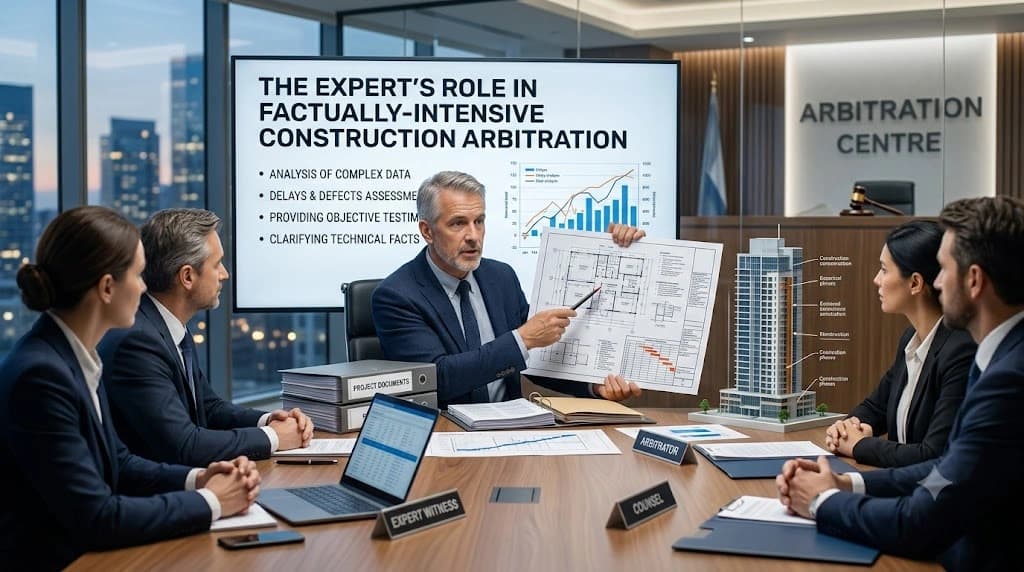
Arbitral tribunals in India are not bound by the BSA at all. Section 19(1) of the Arbitration and Conciliation Act, 1996 expressly frees a tribunal from the technical rules of evidence that bind a court, and Section 26 gives the tribunal its own, freestanding power to appoint an expert to report on specific technical issues, require parties to give that expert access to documents or property, and if a party requests it or the tribunal considers it necessary - put the tribunal's own expert through an oral hearing where parties can question the expert directly and call their own experts to address the same issues.
The absence of a binding evidentiary code does not mean the underlying reasoning disappears. Tribunals seated in India, and Indian counsel appearing before them, still default to the conceptual architecture of expert opinion evidence built up under Section 39 of the BSA and its precedents, because it remains the only settled body of law on what makes an opinion an "expert opinion" in the first place. In practice, most India-seated tribunals apply a functional version of the same test the Supreme Court has articulated for courts: does the witness have genuine, demonstrable expertise in the specific technical question asked, independent of the party instructing them, and has that expertise been applied transparently enough that the tribunal not simply the expert can trace the path from evidence to conclusion. A technical expert appearing in arbitration is not shielded from the "grounds over conclusions" standard simply because the forum is contractual rather than judicial.
Admissible is the floor. Persuasive is the case.
This is where the two-hurdle framing earns its keep. Getting a technical report admitted is, in most Indian proceedings today, a relatively mechanical exercise: establish the witness's special skill, show the subject matter is genuinely outside a layperson's competence, and, where electronic evidence is involved, attach the correct certification. None of that guarantees the tribunal gives the evidence any real weight in the final decision. Persuasiveness is a separate, harder-won quality, and it turns on factors the statute barely mentions.
The first is independence. An expert who has previously worked for, or been regularly instructed by, one of the parties or its corporate group carries a disclosure obligation that Indian tribunals increasingly expect to see satisfied upfront rather than surfaced in cross-examination. Many institutional tribunals now expect a standard of conflict disclosure comparable to the IBA Rules on the Taking of Evidence in International Arbitration, even where those rules have not been formally adopted, simply because parties invoke them by analogy often enough that they have become a practical benchmark. A technical expert who argues for the instructing party's position, rather than presenting an independent opinion the party happens to prefer, is described in Indian practice as elsewhere as a hired gun, and a tribunal that reaches that conclusion tends to discount the credible parts of a report along with the weak ones, because the finding infects the tribunal's confidence in the whole exercise.
Reliability without a Daubert standard: India's method problem
India has no codified equivalent of the reliability screening that some other jurisdictions apply to expert methodology before a court will hear it at all - there is no formal requirement that a technical method be independently tested, peer-reviewed, or subject to a known error rate before an Indian court or tribunal will admit an opinion based on it. That is a genuine gap, and it means the burden of establishing that a method is sound falls almost entirely on how the expert explains it, not on any preliminary judicial filter.
In practice, this makes transparency about method a persuasiveness factor in India in a way it might not be in a jurisdiction with a formal reliability gatekeeping stage. An expert who can show, in plain language a non-specialist tribunal member can follow, why a particular technique is the accepted way to answer the question - and who acknowledges the technique's limitations rather than presenting it as infallible - earns more credibility than one who asserts a conclusion on the strength of credentials alone. This is precisely where India's absence of a formal foundational-validity filter cuts against parties who assume that a qualified expert's chosen method will go unquestioned. It will be questioned, just later in the process - usually in cross-examination, where there is far less room to recover.
Cross-examination is the real admissibility test that matters
Because Indian courts treat an expert report as advisory rather than conclusive, and because the report itself does not go into evidence without the expert being examined, cross-examination functions as the de facto second admissibility test - the one that decides whether the report the court read on paper survives as a credible basis for a finding. An expert who cannot explain, under sustained questioning and in ordinary language, why one method was chosen over another available one, will not survive scrutiny simply because the written report was fluent and well-formatted. Attorneys instructing a technical expert should treat preparation for cross-examination as part of getting the evidence admitted in any meaningful sense, not as a separate, later-stage exercise that begins once the report is filed.
This has a direct implication for how technical experts should be briefed from the outset. The scope of instruction should specify precisely which technical questions the expert is answering, what assumptions (if any) they are entitled to adopt from other witnesses or from counsel, and what documentary record they are working from - because an open-ended brief tends to produce a report that overreaches into territory the expert cannot defend under questioning, or leaves gaps the other side is quick to exploit. Exlitem India's companion explainer on briefing and preparing an expert witness covers this process in more depth; the principle that carries over here is that the report is only as strong as the expert's ability to defend every sentence of it, live, to someone trying to take it apart.
Where technical experts most commonly lose persuasive weight
A handful of patterns recur across forensic accounting, engineering, and digital forensics evidence in Indian proceedings. An expert who reaches a headline conclusion before fully reviewing the underlying data is not being efficient, they are pre-committing to an answer, and a careful cross-examiner will expose the sequence. An expert who cannot articulate, in plain terms, why a particular technical method fits this record better than an available alternative will struggle to defend that choice later, regardless of how sound the underlying science actually is. An expert who treats a foundational assumption causation, the authenticity of an underlying document, the completeness of a data set as someone else's problem to prove, and simply builds a technical opinion on top of it without flagging the dependency, hands the tribunal an easy reason to discount the whole opinion once that assumption is challenged. And an expert who is reluctant to disclose prior instructions from the same party or its affiliates creates exactly the credibility problem described above, typically at the point in a hearing where it is too late to instruct someone else.
There is also a category-specific pattern worth naming for digital and electronic evidence specifically. Given that Section 63(4) of the BSA now requires the expert's own signature alongside the device custodian's, a technical expert whose certificate is procedurally deficient wrong device details, an incomplete chain-of-custody narrative, a mismatch between the certifying expert's stated qualifications and the specific technical question certified creates an admissibility problem that has nothing to do with the underlying merits of the analysis. Attorneys should treat the certification paperwork with the same rigour as the substantive technical opinion, because a defective certificate can keep an otherwise sound piece of digital forensic work out of the record entirely.
A practical checklist before instructing a technical expert
Before instructing any technical expert - engineer, forensic accountant, digital forensics examiner, or industry specialist - attorneys should confirm four things. First, that the question genuinely requires expert input under the Ramesh Chandra Agrawal necessity test, rather than being something the tribunal could reasonably work out on its own; padding a case with unnecessary expert opinion invites the court to ignore it and can dilute the credibility of the expert evidence that actually matters. Second, that the expert's specific technical background matches the exact question in dispute, not just the general discipline - a digital forensics examiner experienced in mobile-device extraction is not automatically the right choice for a server-log authentication question, and a mechanical engineer is not automatically the right choice for a materials-failure question, even though both sit under a broad "engineering" label. Third, that independence and any prior relationship with the instructing party or its group is disclosed at the outset, in writing, rather than left for the other side to discover. Fourth, that the expert has been tested - informally, by counsel, before the report is finalised - on whether they can explain their method and conclusions in plain language to someone with no technical background, because that is a reasonable proxy for how they will perform under cross-examination in front of a court or tribunal that is, by definition, applying exactly that lay standard.
Attorneys should also confirm the correct evidentiary pathway before instructing, since it changes what the expert needs to prepare for. A court proceeding under the BSA requires close attention to the Section 39 relevance test and, for anything electronic, the Section 63(4) dual certification. An arbitration proceeding under the Arbitration and Conciliation Act gives more procedural flexibility under Section 19(1), but a tribunal-appointed expert under Section 26 should be briefed for the oral hearing and cross-questioning that provision expressly contemplates, and a party-appointed expert in arbitration should assume the same functional scrutiny even though no statute mandates it for them specifically.
What this means for how technical evidence should be built
The throughline across the case law is consistent: Indian courts and tribunals are comfortable admitting technical evidence and increasingly comfortable with a wide range of technical disciplines under a broadened statutory definition, but they reserve real scrutiny for how that evidence is reasoned, not just who produced it. A qualified expert with an unclear method loses to a slightly less decorated expert whose reasoning a tribunal can follow and test. Persuasiveness in Indian proceedings is earned in the same place credibility usually is - in the willingness to show the working, disclose the conflicts, and stand behind the conclusion when someone experienced is trying to dismantle it in real time. As India's technical disputes grow more data-heavy and more digitally native, that standard is not going to loosen. It is, if the direction of the last two years of legislative and judicial activity is any guide, going to tighten further.
Takeaway
Admissibility under India's Bharatiya Sakshya Adhiniyam and the Arbitration and Conciliation Act sets a relatively low bar for technical evidence to be heard at all - but courts and tribunals reserve their real scrutiny for the reasoning behind a conclusion, not the conclusion itself. Attorneys who brief a technical expert on necessity, method transparency, independence disclosure, and cross-examination readiness - rather than credentials alone - consistently see their evidence carry more weight in the final decision. Getting a report filed is the easy part; getting it believed is the actual assignment.
Position yourself where the legal industry looks for expertise - sign up on exlitem.com to get discovered by leading lawyers and high-value clients.