
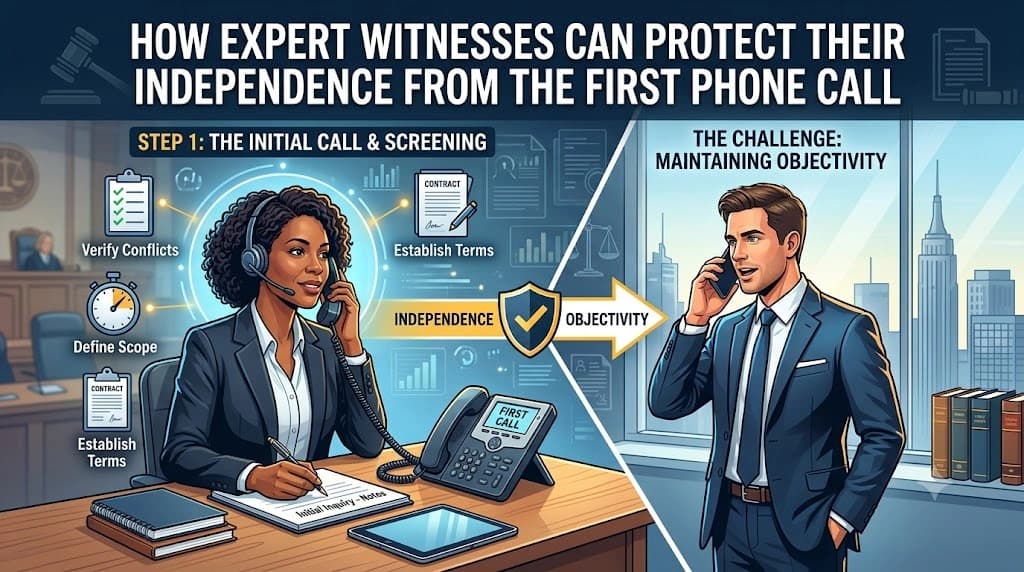
The first phone call with prospective counsel is usually treated as a formality, confirm availability, confirm there is no conflict, get a broad sense of the case, agree on next steps. It is also the single highest-leverage moment in the entire engagement for protecting independence, because every boundary an expert fails to establish in that first conversation has to be established later, under worse conditions, often after a pattern of accommodation has already quietly begun without anyone quite noticing when it started.
This is not a call for suspicion or defensiveness toward prospective counsel. Most legal teams instruct experts appropriately and would welcome, rather than resent, an expert who is clear and professional about independence from the outset. The point is simpler and more practical: the habits, expectations, and boundaries an expert sets in the first conversation shape the entire texture of everything that follows, and getting this right at the outset is considerably easier than trying to correct a drift that has already taken hold months into an engagement.
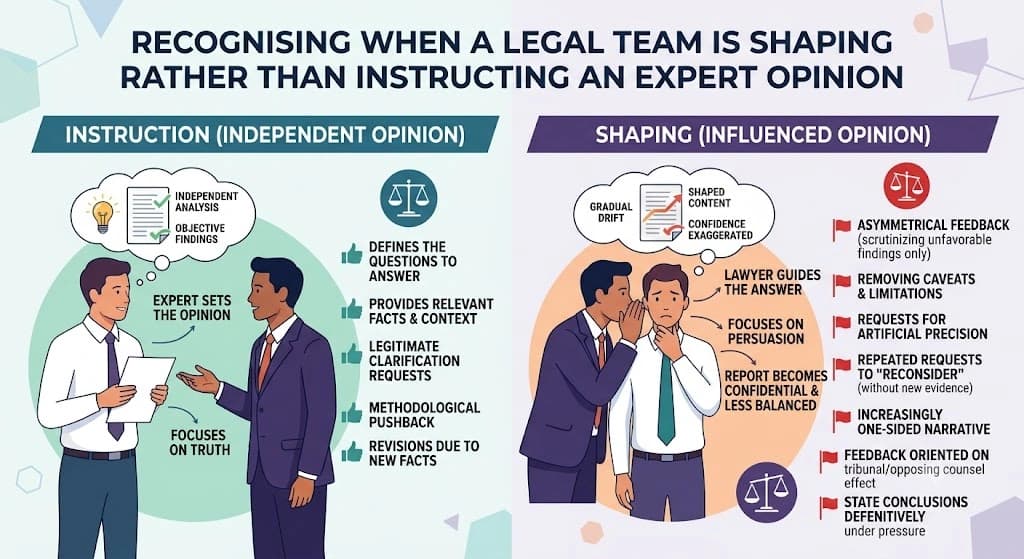
This piece connects directly to the more reactive guidance covered elsewhere in this content series, on recognizing when a legal team has shifted from instructing to shaping an opinion, and on the quiet mechanisms through which that shift typically happens. The best defense against needing that reactive guidance at all is prevention, and prevention is considerably more effective when it starts at the very first conversation rather than being retrofitted onto an engagement already underway.
Why the First Call Matters More Than It Seems
Every subsequent interaction in an engagement builds on the tone and expectations set in the first one. An expert who accepts an engagement without clarifying scope, without discussing how drafts will be reviewed, and without establishing that unfavorable findings are a genuine, accepted possibility has implicitly signaled that these things will be worked out informally as they arise, which tends to mean they get worked out on the legal team's terms rather than through any deliberate agreement.
This is not because legal teams are looking to exploit an absence of stated boundaries. It is simply how any working relationship without explicit terms tends to evolve, gradually, toward whichever party's expectations were clearer and more consistently expressed. An expert who never articulates independence expectations has not chosen neutrality, they have simply ceded the shaping of those expectations to whoever does articulate them, which in practice usually means the instructing legal team.
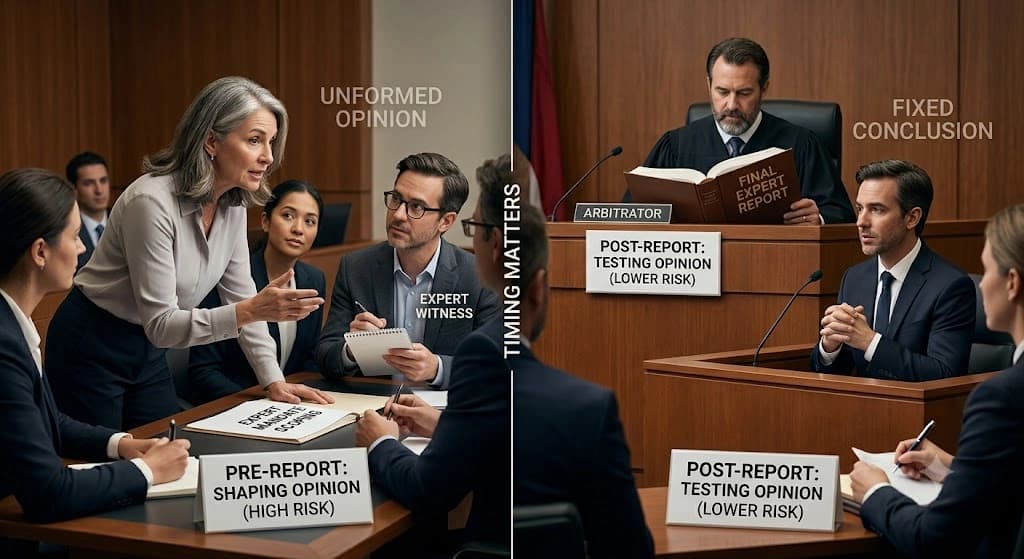
There is also a practical asymmetry worth naming: it is far easier to set a boundary before any work has been done, when there is nothing at stake yet and no relationship dynamics to navigate, than to introduce the same boundary later, after several drafts have already been exchanged and a working rapport has already formed. Raising an independence expectation for the first time mid-engagement can read, unfairly but understandably, as a response to a specific recent friction rather than as a standing professional practice, which makes the same conversation considerably more awkward than it needed to be.
Questions Worth Asking Before Accepting the Engagement
Asking directly what the case's current working theory is, and how firmly that theory is held, gives an expert an early read on whether the engagement is being sought for genuine independent analysis or for validation of a conclusion already reached. A legal team confident enough in their theory to welcome genuine scrutiny answers this question comfortably; a legal team seeking validation rather than analysis often, even unintentionally, signals this through how the question gets answered.
Asking whether any other expert was previously approached or engaged on the same issues, and if so, why that engagement ended, is a legitimate and useful question. An expert who learns that a predecessor's engagement ended over disagreement about a finding has learned something directly relevant to the independence risk of the current opportunity, without needing to ask anything more pointed than a routine background question.
This question is worth asking plainly rather than obliquely, and most legal teams answer it honestly and without discomfort when there is a legitimate, unremarkable reason a prior engagement ended, a scheduling conflict, a change in case strategy unrelated to any specific finding, a conflict of interest discovered late. A vague or reluctant answer to a straightforward, professionally normal question is itself informative, independent of whatever the actual underlying reason turns out to be.
Asking how the mandate will be defined, and by whom, clarifies scope before any analytical work begins. A mandate defined vaguely, "assess the technical issues in the case" without further specification, leaves considerably more room for later disagreement about what the expert should or should not have addressed than a mandate defined with real precision from the outset.
Asking about the anticipated timeline, from instruction through report filing through any hearing, at this early stage also serves an independence function beyond simple scheduling. An unrealistic timeline discussed upfront can be renegotiated or declined before any work has begun. The same unrealistic timeline discovered only after accepting the engagement leaves an expert with far less leverage to push back, and compressed timelines are, as covered elsewhere in this series, one of the conditions most likely to produce exactly the kind of drift independence protections are meant to guard against.
Boundaries Worth Setting Explicitly, Early
Stating plainly, early in the first conversation, that the expert's overriding obligation runs to the tribunal or court rather than to the instructing party, even though this is a standard, expected professional obligation rather than a controversial position, establishes the tone for everything that follows. Most counsel expect and respect this statement; an expert who never says it explicitly has left an assumption unstated that is better made explicit from the outset.
Establishing, before any drafting begins, how review cycles will work, how many rounds are anticipated, what kind of feedback is expected, whether comments will focus on clarity or might extend to substance, gives both sides a shared, agreed framework to refer back to if a later request starts to feel like it is testing that boundary. Without this framework established in advance, there is no shared reference point to point back to later.
It is worth being explicit, at this stage, about how the expert intends to document their own analytical process, keeping successive drafts, noting when and why a finding changed in response to feedback, as a matter of standard practice rather than as a defensive measure introduced only once a concern has already arisen. Framing this documentation habit as routine professional practice, applied to every engagement regardless of how smoothly it is going, normalizes it in a way that introducing it only when trouble appears cannot.
Confirming explicitly that an unfavorable finding is a genuine, accepted possible outcome of the engagement, not a hypothetical courtesy but a real, expected scenario, and that the expert will report such a finding candidly if the analysis produces one, removes any ambiguity about what the engagement is actually for. An expert who states this plainly and receives a positive, unbothered response has learned something reassuring about the engagement; an expert who receives a hesitant or evasive response has learned something worth taking seriously before accepting the engagement at all.
A further boundary worth stating early, though less commonly discussed, is the expert's expectation around access to underlying data and documents. Establishing at the outset that the expert will need direct, complete access to the relevant factual record, rather than a curated selection filtered through counsel's judgment about what is relevant, prevents a later, more awkward negotiation over access once the expert has already identified a specific gap in what has been provided.
What to Listen For in How the Case Is Presented
The way a legal team describes the facts during an initial briefing is itself informative, independent of anything explicitly said about expectations. A briefing that presents the case as a settled narrative with an obviously correct answer, rather than as a genuine set of open technical questions, suggests the engagement may be sought to confirm a predetermined position rather than to conduct independent analysis, even if nobody involved would describe it that way.
Similarly, a legal team that emphasizes, early and repeatedly, how important a particular outcome is to the client rather than focusing on the technical substance of the disputed questions is communicating something about priorities that is worth noting, without necessarily being disqualifying on its own. Client stakes are a normal part of context; the question is whether that context comes packaged with an implicit expectation about which conclusion would be most welcome.
The language used to describe the expert's anticipated role is similarly worth listening to carefully. A legal team that describes wanting an expert to "support" or "back up" a particular position, rather than to "assess" or "analyze" a technical question, is signaling, whether deliberately or as a matter of habit, an expectation about outcome rather than about process. This is often an easy, low-friction moment to gently correct, restating the engagement in terms of independent analysis, and how that correction is received is itself informative.
Putting It in Writing
An engagement letter or scope agreement that documents the mandate, the review process, and an explicit statement of independence expectations converts an informal first-call understanding into something both sides can refer back to throughout the engagement. This document does not need to be adversarial or unusually formal to be effective, it needs only to exist and to be specific enough that a later ambiguity has something concrete to be measured against.
A brief, plainly worded independence statement within this document, confirming that the expert's overriding obligation runs to the tribunal or court, that findings will be reported candidly regardless of favorability, and that the expert retains full discretion over methodology and conclusions, costs little to include and provides a clear, mutually agreed reference point that both protects the expert and reassures counsel that the engagement is being approached with appropriate professional rigor from day one.
Documenting agreed terms in writing also protects the expert's own position if independence is later challenged, whether through cross-examination or through a formal complaint. An expert who can point to a written scope agreement establishing clear terms from the outset is in a considerably stronger position than one relying entirely on memory of an informal early conversation.
What This Early Groundwork Buys You Later
The practical value of everything described above becomes most visible precisely at the moments described elsewhere in this content series, when a legal team's feedback begins to drift from legitimate instruction toward substance-shaping pressure. An expert who established clear review-process expectations at the outset has a specific, agreed standard to point back to when a later request appears to cross it, rather than having to construct that standard from scratch in the middle of an uncomfortable conversation.
This groundwork also changes the tenor of any later pushback considerably. Raising a concern by referring back to terms both sides explicitly agreed to at the outset reads as holding to a shared understanding rather than as a new, potentially confrontational demand, which tends to produce a far more constructive response from counsel than the same substantive concern raised without that shared reference point available.
There is also a reputational dimension that compounds over the life of a practice. An expert who consistently sets these terms at the outset, and holds to them without drama when it matters, becomes known within a jurisdiction or practice area as someone whose opinions carry weight precisely because they are not for sale to a particular outcome. That reputation is built case by case, largely through unglamorous groundwork laid in first phone calls that nobody but the expert and counsel on the line will ever hear about, and it is very difficult to shortcut once a track record in the opposite direction has already formed.
What This Means for Experts and the Counsel Who Instruct Them
For experts, the practical implication is to treat the first conversation with prospective counsel as a genuine opportunity to establish independence, not merely a scheduling call, asking the specific questions and stating the specific boundaries described above as a routine part of accepting any engagement rather than reserving them for cases that already feel unusual.
For counsel, the implication is to recognize that an expert who raises these questions and boundaries clearly and professionally at the outset is signaling exactly the kind of rigor that produces durable, credible expert evidence, not raising an obstacle to a smooth working relationship. Legal teams that welcome this kind of clarity from the outset tend to get better, more defensible analysis from the experts they instruct.
There is a selection effect worth naming directly here. Experts willing to ask pointed questions before accepting a mandate and to set explicit boundaries around independence are, on the whole, the same experts capable of forming and defending a rigorous, well-reasoned opinion under cross-examination later. The two traits tend to travel together, which makes the first phone call a surprisingly useful, low-cost screening tool for counsel assembling a team, well before any formal vetting process begins.
For firms building long-term relationships with a roster of experts, the implication is to build these questions and this documentation into standard onboarding practice for any new expert engagement, rather than leaving each individual lawyer to raise or skip them inconsistently depending on personal habit. A firm known for this kind of consistent, upfront clarity becomes, over time, a firm experts are more willing to work with repeatedly.
Frequently Asked Questions
Will asking these questions during an initial call make an expert seem difficult to work with? Generally not. Most experienced legal teams expect and respect a clear, professional statement of independence expectations early in an engagement, and are more likely to be reassured than put off by it.
Is a formal written scope agreement necessary for every engagement? It is not strictly necessary for every matter, but it is strongly advisable for any engagement of meaningful complexity or duration, since it protects both the quality of the working relationship and the expert's own position if independence is later questioned.
What should an expert do if a prospective client responds poorly to a question about how an unfavorable finding would be handled? A hesitant or evasive response to this question is a meaningful signal worth weighing carefully before accepting the engagement, since it may indicate the engagement is being sought for validation rather than genuine independent analysis.
How specific should a mandate be defined at the outset of an engagement? As specific as the case reasonably allows. A vaguely defined mandate leaves considerably more room for later disagreement about scope than one that identifies the specific technical questions the expert is being asked to address.
Is it appropriate to ask about the case's anticipated timeline before accepting an engagement? Yes, and doing so serves an independence function beyond simple scheduling, since an unrealistic timeline discovered only after acceptance leaves far less room to push back than the same concern raised and resolved before any work has begun.
Conclusion
Independence is easiest to protect at the moment it is least likely to feel urgent, before any analytical work has begun, before a working relationship has formed, and before there is anything specific yet at stake. The questions asked and boundaries set in that first conversation with prospective counsel shape the entire texture of what follows, giving an expert a clear, shared standard to rely on if drift begins later and, in some cases, giving them the information needed to decline an engagement that was never likely to support genuinely independent analysis in the first place. The experts who treat this first conversation with real deliberateness rarely find themselves needing the more difficult, mid-engagement conversations described elsewhere in this content series, because the groundwork laid at the outset does most of the protective work before it is ever needed.
Key Takeaways
● The first conversation with prospective counsel is the highest-leverage, lowest-cost moment for establishing independence boundaries, considerably easier than raising the same expectations mid-engagement after a working relationship has already formed.
● Asking about the case's working theory, prior experts, and how the mandate will be defined gives an expert an early, useful read on whether genuine independent analysis is actually being sought.
● Stating plainly that an unfavorable finding is a genuine, accepted possible outcome, and observing how that statement is received, is one of the most informative and lowest-risk questions an expert can ask before accepting an engagement.
● Documenting agreed terms, mandate, review process, and independence expectations, in writing protects both the working relationship and the expert's own position if independence is later challenged.
Position yourself where the legal industry looks for expertise - sign up on exlitem.com to get discovered by leading lawyers and high-value clients.