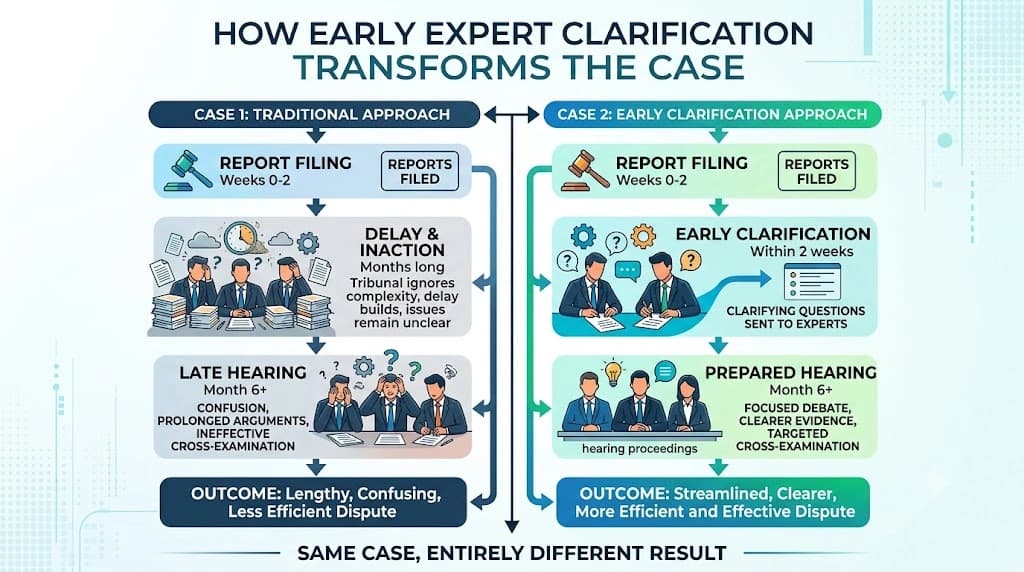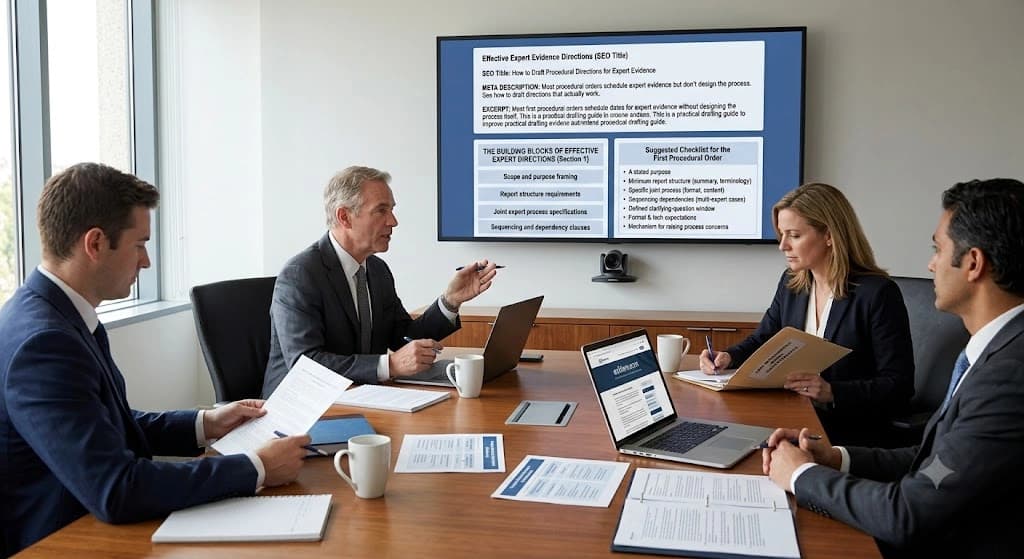

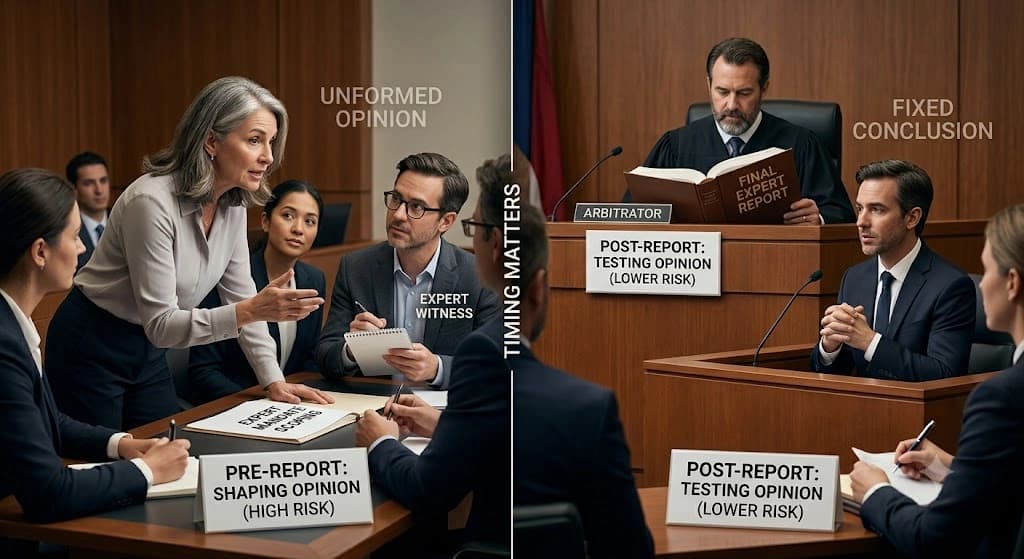
There are two distinct moments when a tribunal can engage substantively with an expert on the record: before that expert has committed a final opinion to writing, and after. The two moments look similar on the surface, both involve the tribunal asking questions, both aim at the same underlying goal of testing and clarifying technical evidence, but they carry meaningfully different risks and produce meaningfully different value, and conflating them is where most of the confusion around this topic comes from.
Understanding the distinction matters because the two kinds of engagement are not interchangeable tools a tribunal can reach for based on convenience alone. Post-report questions, addressed in depth elsewhere in this content series, test an opinion that already exists. Pre-report engagement operates on an opinion that has not yet formed, which changes the entire risk calculus involved.
This is not a purely academic distinction. Tribunals genuinely committed to efficient, well-managed expert evidence sometimes reach instinctively for pre-report engagement because it seems to offer earlier, more preventive value than waiting for a report to be filed before intervening. That instinct is not wrong, but it is incomplete without a clear-eyed accounting of the additional risk pre-report engagement carries relative to its post-report counterpart, an accounting this piece is intended to provide.
What Distinguishes the Two Moments
Post-report engagement happens after an expert has completed their analysis and filed a report expressing a final, considered opinion. Questions at this stage test, clarify, or probe reasoning that already exists in a fixed, documented form. The expert's conclusion is not up for revision in response to the tribunal's framing of the question, only its explanation is being tested.
Pre-report engagement happens before that opinion exists, sometimes as early as the initial scoping of an expert's mandate, sometimes later but still before a draft report has crystallized into a final position. At this stage, anything the tribunal says has the potential to shape not just how an existing opinion gets explained, but what that opinion ultimately becomes, because the analysis is still genuinely in progress and therefore genuinely influenceable.
It is worth noting that pre-report engagement itself spans a range, from very early mandate-setting, before an expert has begun substantive analysis at all, to later-stage engagement closer to when a draft report is nearly complete. The risk generally increases the closer engagement occurs to the point where the opinion is substantially formed, since an expert deep into analysis has more fully developed views that a tribunal's framing could subtly influence than one who has not yet begun.
This distinction, testing a fixed conclusion versus potentially shaping a conclusion still being formed, is the single most important variable in evaluating the risk and value of tribunal engagement at either stage, and it explains why the two moments deserve very different treatment despite looking superficially similar.
A useful analogy, though imperfect, is the difference between editing a finished document and co-authoring one still being drafted. Editorial feedback on a completed document can only refine how existing ideas are expressed. Input offered mid-draft can genuinely change what the document ends up saying. Tribunals engaging with experts before a report is filed are, in this sense, closer to the second category than the first, whether or not that is the tribunal's intention.
The Case for Post-Report Questions
The value of post-report questions is substantial and has been explored in depth elsewhere: questions asked shortly after a report is filed land while a case is still malleable enough to benefit from clarification, resolve misunderstandings before they harden into contested points, and improve the quality of subsequent joint expert conferences by establishing a clearer shared understanding of each expert's actual position. Because the opinion being tested already exists in fixed form, these benefits come with minimal risk to the tribunal's neutrality, provided the questions stay disciplined to clarification rather than drifting into an implicit substantive position.
This combination, real benefit with limited risk, is precisely why post-report engagement has become an increasingly normalized part of good case management practice, and why it deserves to be a standard feature of how technically complex disputes are handled. Where this piece adds to that earlier treatment is in drawing out precisely why the same intuitive appeal, early engagement improves how expert evidence functions, does not transfer cleanly to the pre-report stage without a meaningfully different risk calculation.
The Case for Pre-Report Engagement
Pre-report engagement offers a different, genuinely valuable benefit that post-report questions cannot replicate: the opportunity to shape the scope of an expert's mandate before significant analytical work has already been invested in a particular direction. A tribunal that identifies, early, that an expert's terms of reference are ambiguous or likely to produce analysis on a question that turns out not to be genuinely disputed can prevent wasted effort that post-report engagement, by definition, arrives too late to avoid.
There is also a genuine efficiency argument specific to complex, multi-issue disputes: without some pre-report clarity about which technical questions the tribunal considers central, an expert may reasonably choose to address every plausible issue exhaustively, producing an unnecessarily broad, expensive report where a narrower, better-scoped mandate would have served the case just as well. Pre-report engagement, limited to scope rather than substance, can prevent this kind of costly over-breadth before it happens rather than trying to correct for it afterward.
This efficiency benefit connects directly to the hidden costs of poorly managed expert evidence described elsewhere in this content series. An overly broad report driven by an ambiguous mandate imposes real cost, on the expert producing it, on counsel reviewing it, on an opposing expert responding to it, well beyond what a well-scoped mandate would have required. Pre-report scoping, done well, is one of the few interventions capable of preventing that cost before it accrues rather than only mitigating it afterward.
In some inquisitorial and hybrid arbitral traditions, structured pre-report engagement, a tribunal formally defining an expert's terms of reference and mandate before analysis begins, is an established and unremarkable part of standard practice, precisely because that engagement is understood from the outset to be about scope rather than substance.
This cross-tradition observation matters for practitioners working across common law and civil law systems specifically. What might read as an unusually active tribunal posture in a purely adversarial context is, in a more inquisitorial or hybrid setting, simply the ordinary, expected mechanism by which an expert's role gets defined before work begins, a difference in procedural culture worth understanding rather than assuming one tradition's norm applies universally.
Why Pre-Report Engagement Carries More Risk
The risk profile of pre-report engagement is meaningfully higher than post-report questioning, and the reason traces directly back to the distinction drawn earlier. Because the expert's opinion has not yet formed, any indication from the tribunal about which conclusions seem more plausible, even an unintentional one embedded in how a question is framed, has the potential to actually shape the analysis rather than merely test it. This is a fundamentally different risk than anything post-report questioning carries, because a post-report question cannot retroactively change an opinion that has already been filed in fixed form.
This risk is compounded by a subtler dynamic: an expert engaging with a tribunal before their own analysis is complete is, consciously or not, more attentive to cues about what the tribunal seems to want or expect than an expert defending an already-formed, independently reached conclusion. Even a tribunal genuinely intending only to clarify scope can inadvertently signal something about its substantive expectations through word choice, emphasis, or the specific framing of a scoping question, and an expert still forming their opinion is precisely the audience most likely to absorb that signal, deliberately or not.
The appearance-of-prejudgment concern is also sharper at this stage. A tribunal that engages substantively with an expert before that expert's opinion exists is vulnerable to the perception, fair or not, that it is shaping the outcome rather than merely managing the process, a perception considerably harder to dispel than the equivalent concern around post-report questions, which by definition arrive after the tribunal has had no opportunity to influence what the opinion actually became.
This perception risk exists independently of whether any actual influence occurred. A party disadvantaged by an expert's eventual conclusion has an obvious incentive to scrutinize any pre-report communication for evidence that the tribunal's engagement shaped the outcome, and even entirely innocent, scope-only communication can become the subject of that scrutiny simply because it occurred before the opinion was finalized. Post-report questions do not carry this same vulnerability, because no amount of scrutiny can establish that a question asked after a fixed opinion was filed somehow caused that opinion to be what it already was.
The Independence Test That Distinguishes Safe From Unsafe Engagement
The practical distinction that separates legitimate pre-report engagement from genuinely risky engagement is whether the tribunal's involvement addresses scope or substance. Defining what an expert's mandate should cover, which technical questions are genuinely disputed and therefore worth analyzing in depth, which are not disputed and can be addressed more briefly, is scope. It shapes the boundaries of the analysis without expressing any view on what the analysis should conclude within those boundaries.
Anything that expresses or implies a view on the likely or preferred substance of the analysis, even indirectly, crosses into unsafe territory. A tribunal specifying that an expert's mandate should address whether a particular delay was caused by a specific factor is scoping. A tribunal specifying that an expert's mandate should address why a particular delay was caused by that factor has, subtly but importantly, presupposed an answer the expert has not yet independently reached.
Word choice carries unusual weight at this stage precisely because the audience, an expert still forming their opinion, is unusually attentive to it. A tribunal drafting pre-report scoping language benefits from a deliberate, careful review specifically for words or phrasing that could be read as presupposing an answer, a discipline worth building into the drafting process itself rather than trusting that good intentions alone will keep the language appropriately neutral.
This same test, would the same direction make sense regardless of which way the underlying technical question is likely to resolve, that helps distinguish legitimate post-report clarification from improper substantive engagement applies with even greater importance at the pre-report stage, precisely because the cost of getting it wrong is higher when an opinion is still being formed rather than merely being tested.
A Practical Framework for Choosing
Tribunals deciding whether pre-report engagement is warranted in a given case benefit from asking a specific, narrow question: is there a genuine, identifiable risk that the expert's mandate, as currently defined, is ambiguous enough to produce wasted analytical effort or an unnecessarily broad report. If the answer is yes, brief, scope-focused pre-report engagement, defining terms of reference clearly rather than commenting on likely conclusions, is worth the modest additional risk it carries. If the mandate is already reasonably clear, the case for pre-report engagement weakens considerably, and the safer, lower-risk post-report questioning window becomes the more appropriate tool.
This framework also suggests a useful default for genuinely uncertain cases: where a tribunal cannot confidently determine whether a mandate is ambiguous enough to justify the added risk, erring toward the post-report window is usually the safer choice, since the cost of waiting a few additional weeks to engage is almost always smaller than the cost of a pre-report intervention later scrutinized as having shaped an outcome it was only meant to scope.
Multi-expert, sequenced disputes are the clearest candidates for genuinely valuable pre-report engagement, because ambiguity about scope in one expert's mandate can cascade into wasted effort or misalignment across several dependent experts simultaneously, a cost that post-report questioning, arriving only after each expert has already completed their analysis, cannot prevent.
A useful safeguard, regardless of how the underlying decision is made, is documenting the reasoning behind any pre-report engagement at the time it occurs, briefly noting why the tribunal considered the mandate ambiguous enough to warrant clarification. This creates a contemporaneous record that distinguishes legitimate, well-reasoned scoping from an ad hoc intervention, and gives the tribunal a ready, transparent answer if the engagement is later scrutinized by a party disadvantaged by the resulting opinion.
What This Means for Tribunals, Counsel, and Experts
For tribunals, the practical implication is to reserve pre-report engagement specifically for genuine scope ambiguity, keeping any pre-report communication disciplined to terms of reference rather than substance, and to default toward the lower-risk post-report questioning window for anything beyond that narrow purpose. Where the two tools might both plausibly apply, the safer default is nearly always to wait.
For counsel, the implication is to flag genuine scope ambiguity early, proactively, rather than waiting to discover it only once an expert has already produced an overly broad or misdirected report, since pre-report engagement is only available as a remedy before the analysis has actually happened.
For experts, the implication is to seek clarity on mandate and scope explicitly at the outset of an engagement, and to treat any tribunal communication received before their own analysis is complete with particular care, distinguishing genuine scoping guidance from anything that might, even unintentionally, be read as a substantive signal.
For institutions developing model procedural guidance, the implication is to distinguish clearly, in any standard clauses addressing tribunal-expert communication, between the scoping stage and the post-report stage, since treating the two as a single undifferentiated category of "tribunal engagement with experts" obscures exactly the distinction this piece argues is most important to preserve.
Frequently Asked Questions
Is pre-report engagement ever advisable, or should tribunals wait for post-report questions in every case? It is advisable specifically when genuine ambiguity in an expert's mandate risks producing wasted analytical effort, particularly in complex, multi-expert disputes. Outside that narrow circumstance, post-report questioning generally offers a better risk-to-benefit balance.
What is the clearest example of pre-report engagement that stays safely on the process side of the line? A tribunal clarifying that an expert's mandate should address a specific, named technical question, without any indication of which answer the tribunal expects or considers more likely, is a clear example of safe, scope-focused pre-report engagement.
Why does the same kind of question carry more risk before a report is filed than after? Because an opinion not yet formed can genuinely be shaped by a signal from the tribunal, while an opinion already filed in fixed form cannot be retroactively changed by a question, only tested or clarified.
Can counsel help reduce the risk associated with pre-report engagement? Yes, primarily by ensuring an expert's mandate is drafted clearly and specifically enough from the outset that genuine scope ambiguity, the main legitimate justification for pre-report engagement, rarely arises in the first place.
Should a tribunal document its reasoning when engaging with an expert before a report is filed? Yes. A brief, contemporaneous note explaining why the mandate was considered ambiguous enough to warrant clarification creates a transparent record that distinguishes legitimate scoping from an intervention that might later be scrutinized as improper.
Conclusion
Pre-report and post-report engagement are not two versions of the same tool, they are different tools suited to different problems, with meaningfully different risk profiles that stem directly from whether the opinion being engaged with already exists in fixed form or is still being formed. Post-report questions test; pre-report engagement can shape, even when it does not intend to, which is precisely why it deserves a narrower purpose and considerably more caution. Tribunals that understand this distinction clearly can use both tools appropriately, capturing the real efficiency value pre-report scoping offers in genuinely ambiguous, complex disputes, while relying on the lower-risk post-report window for everything else. Getting the choice between them right is less about avoiding engagement altogether and more about matching the right tool, carefully bounded, to the right moment in a case's development.
Key Takeaways
● Post-report questions test an opinion that already exists in fixed form; pre-report engagement risks shaping an opinion still being formed, which is why the two carry meaningfully different risk profiles.
● Pre-report engagement offers genuine value specifically in preventing wasted analytical effort from an ambiguous mandate, particularly in complex, multi-expert disputes with sequencing dependencies.
● The test separating safe from unsafe engagement at either stage is the same: would the same direction make sense regardless of which way the underlying technical question is likely to resolve.
● Tribunals should reserve pre-report engagement for genuine scope ambiguity and default to the lower-risk post-report questioning window for everything beyond that narrow purpose.
Position yourself where the legal industry looks for expertise - sign up on exlitem.com to get discovered by leading lawyers and high-value clients.