
An expert three drafts deep into a report has a nagging, hard-to-articulate feeling that something about the engagement has changed. The relationship with the client still feels collegial. Nothing anyone has said sounds improper. And yet the report in front of them, compared with the first draft written from a blank page, reads differently, more confident where the evidence supports moderate confidence, quieter about a limitation the expert knows is genuinely real. That feeling is worth taking seriously. It usually means the line between being instructed and being shaped has already been crossed, quietly, somewhere in the drafts nobody flagged as the moment it happened.
This piece is a practical companion to the broader question of why this drift happens in the first place. Its focus is narrower and more immediately useful: what specific signals are worth watching for, which ones can be dismissed as ordinary collaboration, and what an expert should actually do once the feeling described above turns out to be justified.
None of what follows requires treating a legal team with suspicion as a default posture. Most legal teams instruct experts appropriately throughout an engagement, and most instances of drift, where they occur, are unintentional rather than a deliberate strategy. The purpose of a concrete checklist is not to encourage defensiveness but to replace a vague, hard-to-act-on feeling with something specific enough to actually evaluate.
The Difference Between Instruction and Shaping, Briefly
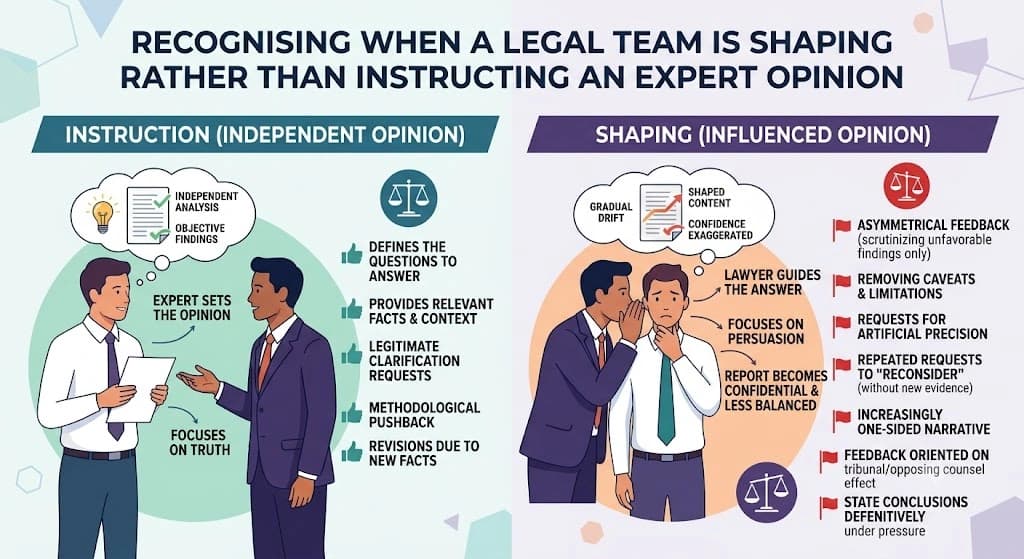
Instruction defines the question an expert is asked to answer, provides relevant factual and legal context, and otherwise leaves the analysis and its conclusions to the expert's independent judgment. Shaping influences the answer itself, gradually, through repeated framing, selective pressure, and feedback that changes substance while presenting itself as concern for clarity or presentation.
The practical difficulty is that shaping rarely announces itself with language distinguishable from instruction. Both can sound, in any single conversation, like a legal team simply trying to be helpful. The difference only becomes visible in a pattern over time, which is exactly why a checklist of concrete, recognizable signals is more useful than a single definitional test applied once.
This is also why an expert relying solely on instinct, however experienced, is at a genuine disadvantage compared to one using a concrete, repeatable checklist. Instinct is valuable as a first alert, the nagging feeling described at the outset of this piece is often the earliest sign something has shifted, but instinct alone cannot reliably distinguish a genuine pattern from an unusually demanding but entirely legitimate working relationship. The signals below exist to turn that instinct into something checkable.
Concrete Signals Worth Taking Seriously
A consistent pattern of feedback that only ever asks for reconsideration of findings unfavorable to the instructing party, while favorable findings pass through review without similar scrutiny, is one of the clearest and most common signals. The asymmetry itself, not any single instance of pushback, is what matters.
A request to remove or soften a caveat, limitation, or qualifying statement, framed as improving readability or confidence, but which actually changes what the report communicates about the underlying certainty of a finding, is a signal worth pausing on directly. Genuine readability edits do not typically require deleting substantive qualifications.
A request to state a finding as a single figure or definitive conclusion where the underlying analysis genuinely supports a range or a qualified answer follows the same logic. Precision is valuable when the underlying analysis supports it. A request for artificial precision, dressed up as a request for a clearer or more useful answer, is a substantive change wearing a presentation-focused justification.
Repeated requests to "reconsider" the same finding across multiple rounds, without new evidence or a genuine methodological reason prompting each request, suggests the requests are motivated by the finding's implications rather than by any flaw in the underlying analysis.
A noticeable shift in which facts get emphasized in the narrative sections of a report, growing more one-sided with each successive draft in a way that does not track any change in the underlying data, indicates that framing pressure has accumulated even if no single edit looks improper in isolation.
A pattern of feedback arriving with an explicit or implicit reference to what the tribunal or opposing counsel is likely to focus on, rather than to whether the underlying analysis is accurate, is a signal worth naming directly. Feedback oriented around persuasive effect rather than analytical soundness, even when well-intentioned, is a marker that the conversation has shifted from instruction toward strategy in a way that risks pulling the underlying analysis along with it.
Being asked to state a conclusion more definitively than the underlying data actually supports, particularly under time pressure close to a filing deadline, is a signal that deserves attention regardless of how reasonable the request sounds in the moment it is made.
Feeling measurably more comfortable expressing findings that favor the instructing party than findings that do not, a subjective but genuinely diagnostic signal, often indicates that the working relationship itself has begun to exert quiet pressure on how confidently different kinds of findings get expressed.
None of these signals, taken alone, is proof that shaping has occurred. Each is a prompt for closer, honest examination rather than an automatic conclusion. But an expert who notices two or three of these signals appearing together, across the same engagement, has good reason to move from vague unease to the concrete self-check described later in this piece.
Signals That Are Usually Fine
Not every request for revision or clarification is a warning sign, and treating every editorial suggestion with suspicion is neither accurate nor sustainable for a working professional relationship. Requests to explain technical terminology more clearly, restructure a report for better readability, or add a plain-language summary address presentation rather than substance and are almost always legitimate regardless of how the underlying finding turned out.
Genuine pushback on methodology, asking why a particular approach was chosen over an alternative, is a normal and valuable part of a rigorous engagement, provided it is asked with comparable intensity regardless of which finding the methodology in question happens to support. The presence of pushback is not itself concerning; the pattern of where that pushback consistently lands is what deserves scrutiny.
A legal team asking an expert to explain their reasoning more fully for the team's own internal understanding, rather than for inclusion in the report itself, is also ordinarily legitimate. Counsel has a genuine need to understand an expert's analysis well enough to present the case coherently, and requests aimed purely at counsel's own comprehension, rather than at changing what the report ultimately says, do not raise the same concern as requests that alter the document itself.
Requests driven by a genuine change in the underlying facts, new documents produced, a witness statement finalized, a factual assumption corrected, are legitimate reasons to revisit an earlier finding and should not be mistaken for shaping simply because the timing happens to coincide with a request that also benefits the instructing party's position.
The practical way to distinguish this legitimate category from genuine shaping is to check whether the underlying justification, a new document, a corrected assumption, actually exists and actually supports the requested change on its own analytical merits, independent of whose position it happens to favor. A legitimate factual update survives this check easily. A request dressed up as responding to new facts, where the facts do not actually justify the specific change requested, does not.
What to Do in the Moment You Notice It
The first, most practical step is documentation rather than confrontation. Keeping successive drafts on file and periodically comparing an early version against the current one makes gradual drift visible in a way that comparing only adjacent drafts cannot. This documentation serves a dual purpose: it protects the expert's own position if the pattern is later scrutinized, and it gives the expert concrete, specific examples to raise if a conversation with counsel becomes necessary.
The second step is a private, honest self-check, applying the simple test of asking, for each recent significant change, whether it altered what was being said or only how it was being said. An expert who runs this test consistently across a small number of recent changes usually gets a clear enough answer to know whether a genuine pattern exists or whether the feeling was, this time, a false alarm.
The third step, once a genuine pattern is identified, is raising it directly rather than either silently complying or silently resisting. Silent compliance allows the drift to continue and eventually compounds into a report the expert cannot fully stand behind. Silent resistance, quietly reverting changes without explanation, creates confusion and erodes trust without addressing the underlying pattern.
A fourth, often overlooked step is timing the conversation deliberately rather than raising it in the middle of a tense exchange about a specific draft. Choosing a calmer moment, a dedicated check-in rather than a reactive response to the latest round of feedback, allows the conversation to focus on the pattern as a whole rather than escalating what might otherwise be read as a defensive reaction to a single recent request.
How to Raise It With Counsel Without Damaging the Relationship
Framing the conversation around the underlying analysis rather than around counsel's conduct or intentions tends to be far more productive than framing it as an accusation. Explaining, specifically, why a particular finding needs to remain qualified given the underlying data, rather than commenting on why the request to remove the qualification felt inappropriate, keeps the conversation on professional, substantive ground.
Most legal teams, confronted with a clear, well-reasoned explanation of why a specific change would misrepresent the underlying analysis, accept the pushback without difficulty, because most instances of shaping are genuinely unintentional rather than a deliberate strategy, and a well-reasoned professional explanation is usually all that is needed to correct course.
It often helps to reference the shared interest both expert and counsel have in a durable, credible opinion, rather than framing the conversation as a disagreement. An opinion that cannot withstand cross-examination because it was shaped beyond what the analysis supports serves the instructing party's interests no better than it serves the expert's own, and grounding the conversation in that shared stake tends to produce a more collaborative response than treating the exchange as adversarial from the outset.
Where a pattern persists despite this kind of direct, professional pushback, it is reasonable and appropriate to name the pattern explicitly rather than continuing to address each instance individually. A short, calm statement noting that recent feedback has consistently pushed in one direction, and that the expert needs to maintain a genuinely independent analysis regardless of how that analysis ultimately reads, reframes the conversation honestly without requiring an accusation of bad faith.
When to Escalate Further
If direct, professional pushback does not change the pattern, an expert has a genuine decision to make about whether to continue the engagement. This is not a step to take lightly, but it is a legitimate and sometimes necessary one. An expert whose independence has been genuinely compromised, and who proceeds anyway, risks far more than an uncomfortable conversation, they risk their credibility under cross-examination and their professional reputation across future engagements.
Consulting a trusted colleague or a professional body's guidance, where available, before making this decision provides a valuable outside perspective on whether the pattern genuinely rises to the level of compromised independence or whether it reflects an unusually demanding but ultimately legitimate working relationship. An outside perspective is often clearer than the expert's own view from inside a relationship that has, by definition, been gradually shifting.
Where an engagement does need to end over this kind of concern, handling the transition professionally, giving reasonable notice, and avoiding any suggestion of the specific reasons in a way that could be read as an accusation against counsel, protects the expert's own reputation for professionalism even while protecting their independence. The goal of escalation is to preserve the integrity of the analysis, not to punish or publicly criticize the legal team involved, and keeping that distinction clear serves the expert well regardless of how the specific situation resolves.
What This Means for Experts Building Long-Term Practices
Experts who build these checks into their standard working process, periodic draft comparison, the substance-versus-presentation test applied consistently, direct and professional pushback raised early rather than accumulated silently, rarely find themselves facing the more serious escalation scenario described above, because the pattern gets named and corrected while it is still small and easily addressed.
This discipline also protects an expert's reputation over the full arc of a career, not just within a single engagement. An expert known across the profession for maintaining genuine independence, even under pressure from a difficult legal team, builds exactly the kind of credibility that makes their opinion more persuasive and more sought-after over time, while an expert whose reports show a recognizable pattern of accommodation eventually pays for that pattern in ways far more costly than any single uncomfortable conversation with counsel would have been.
There is also a broader benefit worth naming: legal teams that work repeatedly with an expert known for raising these concerns directly and professionally, rather than either accommodating silently or reacting defensively, generally come to respect and even prefer that discipline over time, because it produces exactly the durable, defensible opinions that serve a case well regardless of which side ultimately prevails on the merits.
Frequently Asked Questions
What is the single clearest sign that a legal team is shaping rather than instructing? A consistent asymmetry in scrutiny, unfavorable findings challenged repeatedly, favorable findings accepted without similar pushback, is usually the clearest and most reliable signal, because it is a pattern rather than any single defensible request.
Should an expert refuse every request to soften or reconsider a finding? No. Genuine methodological pushback and legitimate readability edits are normal and valuable. The concern is specifically with requests that change substance while presenting themselves as concern for presentation, and with patterns that consistently favor one outcome over another.
How should an expert raise a concern about shaping without sounding accusatory? Framing the conversation around the underlying analysis and data, rather than around counsel's conduct or intentions, keeps the discussion professional and substantive, and is usually sufficient to correct genuinely unintentional drift.
What should an expert do if a pattern of shaping persists despite direct pushback? Consulting a trusted colleague or available professional guidance before deciding whether to continue the engagement is a reasonable next step, and in serious, persistent cases, declining to continue is a legitimate professional choice worth taking seriously.
Is it normal to feel a vague sense that something has shifted before being able to identify a specific example? Yes, and this feeling is worth treating as a genuine signal rather than dismissing. It typically means a pattern has already started to accumulate across several small changes, and running the concrete checks described in this piece against recent drafts usually turns that vague sense into specific, checkable examples.
Conclusion
The gap between being instructed and being shaped is rarely obvious in any single moment, which is precisely why a concrete, repeatable set of signals matters more than a single definitional test. Experts who build periodic self-checks into their standard practice, comparing drafts over time, testing whether a requested change affects substance or only presentation, and raising genuine patterns directly and professionally when they appear, protect both the quality of their analysis and the durability of their professional reputation. The nagging feeling that something has shifted is rarely wrong. It deserves a concrete process for checking, not dismissal, and the experts who build that process into ordinary practice rarely find themselves facing a serious, late-stage crisis of confidence in their own report.
Key Takeaways
● The clearest signal of shaping is a consistent asymmetry in scrutiny, unfavorable findings challenged repeatedly while favorable ones pass through with little pushback, rather than any single defensible request.
● A simple, repeatable test, asking whether a requested change affects what is being said or only how it is being said, distinguishes legitimate editorial feedback from substance-shaping pressure.
● Raising a genuine pattern directly, framed around the underlying analysis rather than counsel's conduct, corrects most instances of unintentional drift without damaging the working relationship.
● Where direct, professional pushback does not change a persistent pattern, consulting a trusted colleague and, if necessary, declining to continue the engagement are legitimate and sometimes necessary professional choices.
Position yourself where the legal industry looks for expertise - sign up on exlitem.com to get discovered by leading lawyers and high-value clients.