
The standard model treats the meet-and-confer between opposing experts as a single event, scheduled once, usually late in the process, after both sides have exchanged full reports and shortly before a hearing. Two experts talk, once, produce a joint statement, once, and that single document becomes the entire record of any direct professional exchange between them for the whole life of the case. Given how much technical disagreement typically exists between opposing experts, and how much of it could plausibly be resolved through direct conversation, treating this exchange as a one-time event rather than an ongoing feature of the process is worth questioning more directly than it usually gets.
This is not an argument for constant contact between opposing experts, which would create its own serious problems. It is an argument that the conventional cadence, one conversation, one document, one shot at narrowing years of accumulated technical disagreement, is often mismatched to how complex disputes actually develop, and that a more deliberate, structured approach to frequency produces better outcomes for the tribunal without compromising the independence the single-meeting model is partly designed to protect.
The Traditional Model and Its Limits
The logic behind a single, late-stage meet-and-confer is straightforward enough: wait until both experts have fully developed their positions, based on complete evidence and complete instructions, then let them compare those fully formed positions directly. This avoids the risk of premature conversation shaping an analysis before it has been properly developed, and it fits naturally into a procedural timetable that treats expert evidence as something produced once and finalized.
The limitation is that complex disputes rarely stay static between the moment an expert's mandate is defined and the moment their final report is filed. New documents surface during disclosure. Factual assumptions shift as witness evidence develops. The scope of what actually needs analysis narrows or expands as the legal theory of the case evolves. An expert who forms their initial technical position early and only compares notes with the opposing expert once, near the very end, has no structured opportunity to discover, mid-process, that a significant portion of their eventual disagreement traces back to something that could have been clarified months earlier through a much shorter, more targeted conversation.
There is also a practical cost to concentrating the entire narrowing exercise into a single late-stage conference. A joint conference held near a hearing, under real time pressure, with two fully developed and often quite entrenched positions on the table, has less room to actually shift either expert's thinking than an earlier conversation held before either position had fully hardened. Positions developed and defended in isolation for the length of an entire case are, in practice, harder to move than positions still being actively refined.
There is a psychological dimension to this that is worth naming plainly. An expert who has spent months, sometimes years, defending a position in written reports, internal drafts, and conversations with instructing counsel has a natural, entirely human tendency to become more attached to that position over time, independent of its underlying technical merit. A single late-stage conference asks that expert to revisit a deeply entrenched view under real time pressure, with a filing deadline bearing down, which is precisely the condition least conducive to genuine reconsideration. Earlier conversations, held before that entrenchment has fully set in, work with rather than against ordinary human psychology.
What Changes When Experts Talk Earlier and More Than Once
A structured approach involving more than one point of contact between opposing experts tends to surface disagreement while it is still cheap to resolve, rather than after both sides have already built substantial analysis around assumptions that later turn out to be avoidably mismatched. An early, brief conversation focused narrowly on methodology, for instance, before either expert has completed detailed calculations, can reveal that the two experts are planning to use fundamentally different approaches to a shared technical question, giving the tribunal or the parties an opportunity to address that divergence while it still costs relatively little to do so.
Multiple points of contact also allow narrowing to happen incrementally, which tends to produce more durable agreement than narrowing attempted all at once at the end. An expert who has already had one or two earlier conversations with the opposing expert, and has had time to consider those exchanges away from the pressure of a final joint statement deadline, often arrives at the final conference having already internalized and adjusted to points raised earlier, rather than encountering them for the first time under deadline pressure.
There is a documentation benefit as well. A series of shorter conferences, each producing a brief note on what was discussed and what, if anything, changed as a result, gives the tribunal a much richer picture of how the experts' positions evolved and why, compared with a single joint statement that shows only where two fully formed positions ended up without much visibility into how they got there. This evolving record can itself be useful evidence of genuine, good-faith engagement between the experts, distinct from a single document that could, in principle, have been produced with little real underlying dialogue behind it.
This evolving record also has practical value beyond the immediate case. Experts who participate in a well-run, multi-stage conferencing process build a track record, over time and across matters, of engaging genuinely and constructively with opposing experts rather than simply defending an initial position until a single deadline forces some movement. That track record becomes part of an expert's professional reputation in a way that a single joint statement, however well produced, generally cannot capture on its own.
The Risk of Too Much Contact
None of this is an argument for unlimited or unstructured contact between opposing experts, and the risks of overcorrecting in that direction are real. Frequent, informal contact between experts, without a clear record of what was discussed, creates exactly the kind of opacity that undermines confidence in the eventual joint statement, since neither the tribunal nor the parties can easily verify what actually happened across a series of loosely documented conversations. The value of structured, periodic conferences depends entirely on each one being properly scoped, properly recorded, and clearly distinguished from casual or unstructured contact.
There is also a genuine risk that more frequent contact creates more opportunities for the kind of drift discussed elsewhere in this content series, where one expert's technical position gradually shifts toward the other's, not through legitimate persuasion but through repeated social contact that erodes the willingness to maintain a disagreement over time. This risk is real but manageable, and it argues for careful structure around each conference rather than for avoiding multiple conferences altogether. A well-documented, narrowly scoped conference held three times over the life of a case poses less risk of this kind of erosion than a single, unstructured, lengthy conference held once, precisely because structure and documentation are what actually protect against improper influence, not infrequency on its own.
Procedural fairness concerns also deserve direct acknowledgment. Multiple conferences mean multiple opportunities for the process to be managed unevenly, whether through scheduling that favors one side's availability or through an accumulation of small procedural choices that, over several conferences, tilt the process in one direction. Tribunals adopting a multiple-conference model need to apply the same procedural rigor to each conference that a single late-stage conference would receive, which requires more administrative attention over the life of the case, not less.
Finding the Right Cadence: A Practical Framework
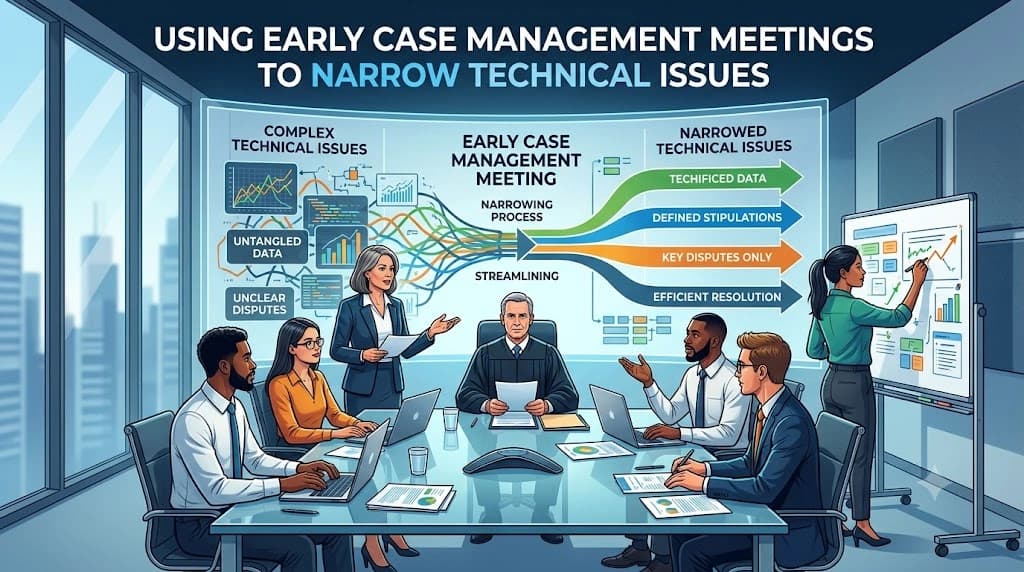
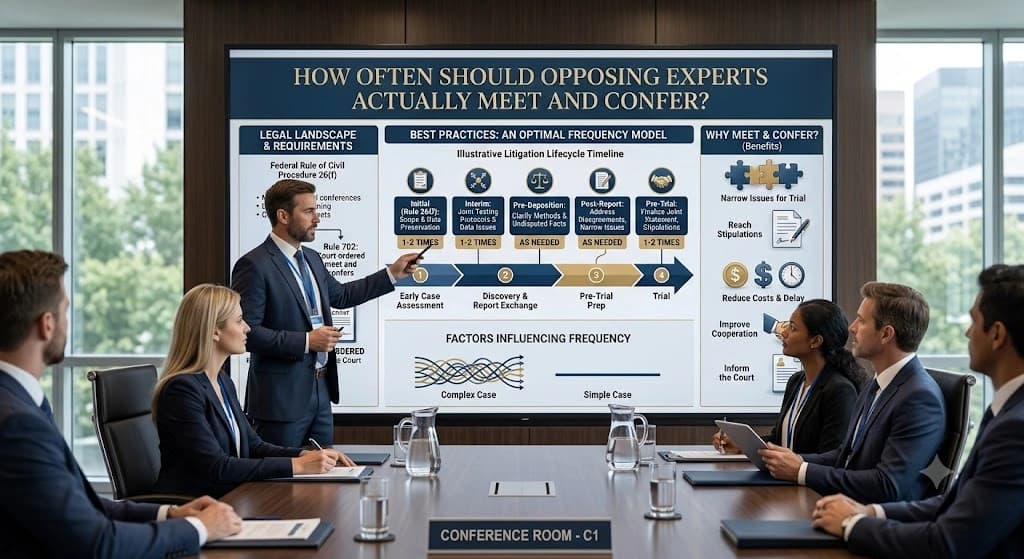
Rather than defaulting to either a single late-stage conference or unlimited ongoing contact, the more useful question is what specific milestones in a case's development would genuinely benefit from a structured expert conversation. A conference held shortly after both experts have received their initial instructions and begun preliminary analysis, focused narrowly on methodology and scope rather than substantive conclusions, can surface fundamental mismatches early, when they are cheapest to address. A second conference, held after a significant evidentiary development, a major document production, an important witness statement, a ruling on a disputed legal premise, gives the experts a structured opportunity to discuss how that development affects their respective analyses, rather than each expert absorbing it independently and potentially in divergent ways.
The final, traditional late-stage conference retains real value in this model, but its function shifts. Rather than being the only opportunity to narrow years of accumulated disagreement, it becomes the opportunity to confirm and finalize narrowing that has already been happening incrementally throughout the case, which tends to produce a more focused, more useful final joint statement than one attempting the entire exercise from a standing start.
The right number of conferences for any given case depends heavily on its complexity, duration, and the extent to which the underlying facts and evidence are likely to develop significantly over time. A relatively contained, well-defined technical dispute may need only the traditional single conference. A lengthy, evolving, document-heavy dispute with a long gap between initial instruction and hearing is a much stronger candidate for a structured, multi-conference approach. As a rough guide, disputes expected to run under a year from initial expert instruction to hearing rarely justify more than the traditional single conference, since there is limited time for circumstances to shift meaningfully in the interim. Disputes running considerably longer, particularly those involving evolving factual records or ongoing regulatory developments, tend to benefit noticeably from at least one interim conference in addition to the final one, and the benefit generally scales with the length and complexity of the gap being bridged.
What Should Trigger an Interim Conference
Certain developments in a case are strong, practical triggers for scheduling an interim expert conference rather than waiting for the traditional end-stage meeting. A significant new document or dataset becoming available partway through the case is one clear trigger, since it may materially affect both experts' analysis and is far more efficiently discussed once, jointly, than absorbed separately and only compared much later. A tribunal ruling that resolves or narrows a previously disputed legal premise underlying the experts' work is another, since it may allow both experts to discard entire branches of analysis that were previously necessary only because the premise remained open.
A significant delay between the original instruction and the eventual hearing date is itself worth treating as a trigger, independent of any specific new development, simply because market conditions, regulatory environments, and factual circumstances relevant to many technical disputes can shift meaningfully over an extended gap, and an interim check-in helps ensure both experts' analyses remain current and comparable rather than anchored to assumptions that were reasonable when initially formed but have since become stale.
A change in the composition of either legal team, while less obviously connected to the experts' technical work, can also be a useful trigger worth considering. New counsel joining a case sometimes bring a genuinely different read on a disputed legal premise underlying the expert's mandate, and an interim conference held shortly after such a transition can surface, early, whether that shift has introduced any new divergence between the two experts' working assumptions, rather than letting it surface for the first time in the final joint statement.
Practical Safeguards to Preserve Independence Across Multiple Meetings
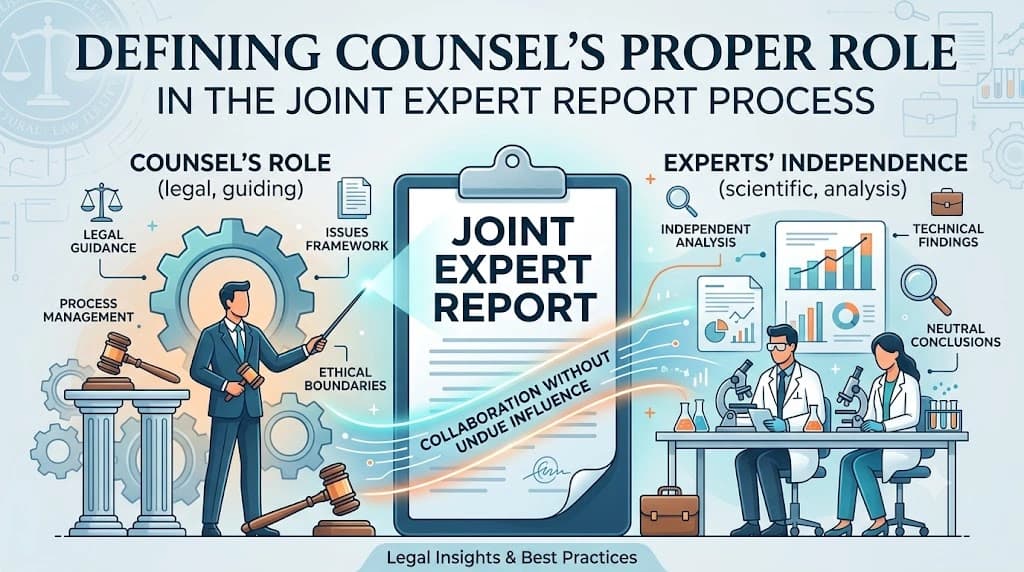
The safeguards that make a multiple-conference model workable are largely the same safeguards that protect any single joint conference, applied consistently across each one. Every conference should have a clearly defined, narrow scope agreed in advance, ideally by the tribunal or case manager rather than left to informal agreement between the parties. Every conference should occur without counsel present, for the reasons discussed in more detail elsewhere in this series, and every conference should produce a brief written record, circulated promptly, documenting what was discussed and what, if anything, changed as a result.
A further safeguard specific to the multiple-conference model is worth adding: each conference's scope should be limited to genuinely open technical questions at that stage of the case, rather than allowed to drift into re-litigating points already settled in an earlier conference. This keeps each conference efficient and prevents the cumulative process from becoming an extended, informal negotiation rather than a series of discrete, well-defined professional exchanges.
It is also worth designating, in advance, who bears responsibility for confirming that each conference actually stays within its agreed scope. Leaving this to the experts alone works well in most cases, since experienced experts are generally attentive to the boundaries of their own role, but a case manager or tribunal member with visibility into each conference's brief written record provides a useful check, particularly across a longer series of conferences where scope drift might otherwise go unnoticed until well after it has occurred.
What This Means for Tribunals, Counsel, and Experts
For tribunals, the implication is to consider, at the outset of a lengthy or evolving case, whether a structured schedule of interim expert conferences would genuinely add value, rather than defaulting automatically to the traditional single late-stage model simply because it is the more familiar convention.
For counsel, the implication is to recognize that supporting a multiple-conference model, properly scoped and documented, generally serves the client's interest in a credible, well-narrowed expert record, even though it requires more administrative coordination over the life of the case than a single end-stage meeting would.
For experts, the implication is that engaging with the opposing expert earlier and more than once, within a properly structured process, tends to produce a more considered, more defensible final position than one formed in isolation and tested against the opposing view only once, under the time pressure of an approaching hearing.
Frequently Asked Questions
Does meeting more than once increase the risk that one expert's opinion will be improperly influenced by the other? The risk exists but is manageable through the same safeguards that protect any single conference, clear scope, no counsel present, and a written record of each session, applied consistently across every meeting rather than only the final one.
How many interim conferences are appropriate for a typical complex dispute? There is no fixed number; the right approach is to schedule a conference around genuine milestones, a significant document production, a ruling on a disputed premise, or a substantial gap in time, rather than adopting a fixed schedule unrelated to how the case is actually developing.
Should the tribunal or the parties decide when interim conferences occur? Ideally the tribunal, since this keeps the schedule tied to the case's genuine developments rather than to either party's strategic timing preferences. That said, either party should retain the ability to request an interim conference when a genuine milestone arises, subject to the tribunal's oversight, rather than being limited strictly to conferences the tribunal initiates on its own schedule.
Does this approach add significant cost compared to a single late-stage conference? It adds some incremental administrative cost, but this is frequently offset by a more focused, more efficient final conference and a reduced risk of expensive supplemental reports needed to address late-discovered mismatches between the experts' positions.
Conclusion
Treating the meet-and-confer between opposing experts as a single, late-stage event is a convention rather than a requirement, and it is often a poor fit for disputes that evolve substantially between initial instruction and final hearing. A more deliberate approach, built around genuine milestones in a case's development rather than a fixed, single point near the end, surfaces disagreement while it is still inexpensive to address and produces a final joint statement that confirms incremental narrowing rather than attempting the entire exercise under deadline pressure. The safeguards that make this work are not exotic; they are the same safeguards that protect any properly run expert conference, applied consistently across however many conferences a case actually warrants.
Key Takeaways
● A single, late-stage meet-and-confer is a widely followed convention, not a requirement, and it is often poorly matched to disputes that evolve significantly over the life of a case.
● Earlier, more frequent structured conferences surface disagreement while it is still cheap to resolve, rather than after both sides have built extensive analysis around avoidably mismatched assumptions.
● The risks of more frequent contact, improper influence and inconsistent process, are manageable through the same safeguards, clear scope, no counsel present, written records, applied consistently across every conference rather than only the final one.
● Genuine case milestones, significant new evidence, a ruling on a disputed premise, or a substantial time gap, are more useful triggers for scheduling interim conferences than a fixed, arbitrary number.
Position yourself where the legal industry looks for expertise - sign up on exlitem.com to get discovered by leading lawyers and high-value clients.