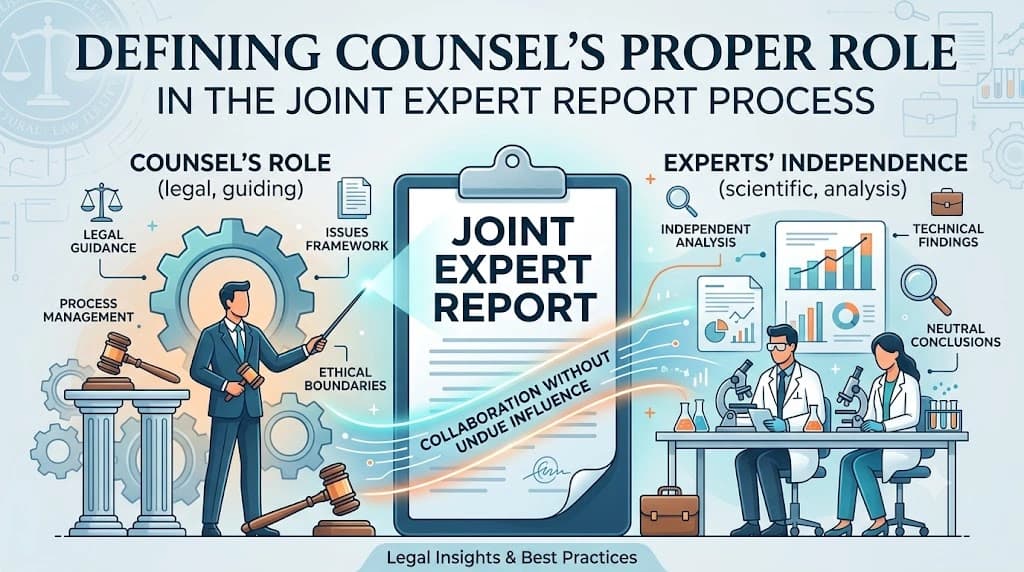


Two experts are asked to value the same asset. Both are competent, both are independent in the ordinary sense of the word, and neither has been told what number to reach. Yet their reports arrive months apart valuing the same asset on entirely different bases, one using a discount rate built around one set of assumptions about legal risk, the other using a discount rate built around a different set entirely. Neither expert did anything improper. Both were simply told, by their respective legal teams, to treat a specific disputed legal question a particular way before beginning their technical analysis. The result is not two competing views of the same question. It is two answers to two different questions, dressed up as though they were comparable.
This is one of the least discussed sources of distortion in expert evidence, precisely because it does not look like a problem when it happens. Each expert can point to entirely sound technical work. The distortion sits upstream, in the legal guidance each expert was given before that technical work ever began, and it is often invisible to anyone reading only the two expert reports side by side.
Where Guidance Differences Enter Without Anyone Intending Them To
Expert reports frequently rest on legal assumptions the expert is not qualified, and is not asked, to determine independently. Whether a particular clause should be read narrowly or broadly, whether a specific date marks the relevant breach for valuation purposes, whether a regulatory change should be treated as foreseeable or not, these are legal questions, and it is entirely appropriate for counsel to instruct an expert on how to treat them for purposes of the expert's own analysis. The instruction itself is not the problem.
The problem arises because each side's legal team forms its own view of these contested legal questions, quite reasonably, and instructs its own expert accordingly, without any obligation to align that instruction with what the other side's expert has been told. Two competent legal teams looking at the same disputed clause can reach genuinely different, both defensible, interpretations, and when each team passes its own interpretation down to its own expert as a working assumption, the two resulting reports are answering related but distinct questions from the outset, often without either expert flagging clearly enough, or the tribunal registering clearly enough, that this has happened.
This gets more pronounced the more technical and multi-layered the underlying analysis is. A quantum report built on a chain of assumptions, breach date, discount rate, causation scope, mitigation obligations, accumulates divergence at every link if the two experts were given different legal guidance at each one. By the time the two reports reach their bottom-line figures, the gap between them may look like a matter of professional disagreement about valuation methodology, when much of it actually traces back to differing legal premises neither expert chose and neither expert is positioned to resolve.
There is also a timing dimension to how this problem develops. Legal teams often refine their view of a contested interpretive question as a case develops, sometimes months after the expert has already been instructed and has built an analysis around the earlier framing. If that refined view is not communicated back to the expert clearly, or is communicated only informally, the expert's eventual report can end up reflecting an interpretation the legal team itself has since moved away from, adding yet another layer of potential mismatch that has nothing to do with the opposing expert's instructions at all.
The Specific Ways Conflicting Guidance Distorts Comparability
The most direct distortion is a straightforward mismatch in scope: one expert instructed to value a claim on one legal theory, the other instructed to value it on a different theory, producing figures that cannot be meaningfully compared because they are not measuring the same thing. A tribunal comparing the two bottom-line numbers without understanding this gets an entirely misleading picture of how far apart the experts actually are on matters within their own technical competence.
A subtler distortion involves timing assumptions. Experts instructed to use different dates as the relevant valuation point, even by a matter of months, can produce dramatically different results in volatile markets or fast-moving industries, and that divergence has nothing to do with either expert's technical judgment. It reflects a legal disagreement about which date matters, filtered through two independent, technically sound calculations that happen to start from different points.
A third distortion, easy to miss because it looks like ordinary professional disagreement, involves the treatment of uncertainty and risk. An expert instructed to assume a particular contingency is unlikely will apply a correspondingly lower risk discount than an expert instructed to treat the same contingency as a live possibility. Both experts are doing entirely legitimate technical work with the assumptions they were given. The resulting gap in their figures looks like a dispute over valuation methodology when it is substantially a dispute over an underlying legal or factual premise that was never actually put to either expert as an open question.
A fourth, less obvious distortion involves the framing of the question itself rather than any specific input assumption. One legal team might instruct its expert to assess damages on a lost-profits basis, while the other instructs its expert to assess the same claim on a cost-basis or restitutionary theory, because each side genuinely believes a different legal framework applies. The resulting reports are not simply using different numbers within a shared analytical structure; they are built on entirely different analytical structures, which makes any direct numerical comparison between them close to meaningless without first resolving which framework the tribunal considers appropriate.
Why This Is Harder to Detect Than Outright Bias
Conflicting legal guidance is considerably harder to spot than an expert who has simply adopted an advocate's position, because nothing about either individual report looks wrong. Each expert has followed sound methodology from a defensible starting assumption, has disclosed that assumption clearly in most cases, and has not strayed from their area of technical competence. The distortion only becomes visible when someone compares the two sets of instructions each expert actually received, and that comparison rarely happens automatically, since instructions are typically privileged or at least not routinely exchanged between opposing legal teams.
This also means the distortion tends to survive scrutiny that would catch more obvious problems. Cross-examination focused on an expert's methodology will usually confirm the methodology is sound, because it is. Cross-examination focused on whether the expert followed their instructions faithfully will usually confirm that they did, because they did. The genuinely productive question, whether the instructions themselves were aligned with the other side's expert closely enough to produce comparable output, sits in a gap that neither line of questioning naturally reaches unless someone deliberately directs attention there.
Joint expert conferences, discussed elsewhere in this content series as a valuable tool for narrowing disputed issues, run into a particular limitation here. Two experts meeting to discuss their areas of agreement and disagreement can identify that their figures differ, and can often identify that the difference traces back to differing assumptions, but they are typically not well positioned to resolve which legal assumption is correct, since that determination sits with the tribunal rather than with either expert. The joint conference can surface the source of the divergence; it cannot settle it.
There is a practical middle ground some experienced experts have adopted on their own initiative: presenting their conclusion not as a single figure but as a figure conditional on the stated assumption, paired with a brief, clearly labeled note on how the conclusion would shift under the alternative assumption the opposing expert appears to be using. This does not require the expert to opine on which legal premise is correct, which would exceed their proper role, but it does give the tribunal a considerably clearer picture of how much of the gap between the two reports is attributable to the underlying legal disagreement rather than to any genuine difference in technical judgment.
What Tribunals Can Do to Reduce the Risk
Tribunals and case managers have a genuine tool available here that is underused in practice: identifying, early in the proceedings, the specific legal and factual questions that will materially affect the experts' analysis, and resolving or at least narrowing those questions, where possible, before the experts complete their reports rather than after. A preliminary ruling or clear procedural direction on a genuinely disputed premise, issued early enough to inform both experts' work, does more to align the eventual reports than any amount of after-the-fact reconciliation during cross-examination.
Where an early ruling is not practical, because the underlying legal question is itself contested and cannot be resolved without a full hearing, tribunals can still require both experts to state explicitly, and prominently, the specific legal and factual assumptions their analysis depends on, distinct from their own technical conclusions. A tribunal reading two reports that each flag their key assumptions clearly is in a far better position to understand where genuine technical disagreement lies versus where the reports are simply answering different questions, than a tribunal reading two reports where the underlying assumptions are buried in a footnote or left implicit.
Directing the experts, as part of a joint conference, to specifically identify and list any points at which their legal instructions appear to diverge, without asking either expert to adjudicate which instruction is correct, is a further practical step some tribunals have adopted with good results. This keeps the experts within their technical competence while still surfacing the comparability problem clearly enough for the tribunal, and the parties, to address it directly.
What Counsel Can Do Independently, Without Coordinating With the Other Side
Individual legal teams, without any obligation to coordinate with an opponent, can still reduce this problem meaningfully on their own side. Instructing an expert clearly and explicitly about which assumptions are being provided as legal premises, as opposed to technical judgments the expert is being asked to form independently, makes the eventual report considerably more transparent about where its conclusions actually come from. An expert report that states plainly, "this analysis assumes the relevant breach date is X, an assumption provided by instructing counsel and not independently determined," gives the tribunal exactly the information needed to evaluate whether that assumption, rather than the expert's technical work, explains a divergence from the opposing expert's figures.
Counsel can also usefully instruct an expert to produce, alongside the primary analysis built on the assumptions provided, a clearly labeled sensitivity analysis showing how the conclusion would change under the alternative assumption the other side is likely to advance. This does not require any coordination with opposing counsel and does not compromise the expert's advocacy-free posture; it simply gives the tribunal a more complete picture without waiting for a joint conference or cross-examination to surface the same information less efficiently.
A Note on Points Especially Vulnerable to This Problem
Some categories of dispute are more exposed to this issue than others. Valuation questions involving discount rates, growth assumptions, and risk premiums are particularly vulnerable, because small differences in legal guidance about relevant time periods or risk contingencies compound through discounted cash flow or comparable-transaction methodologies into large differences in the bottom-line figure. Causation analysis in complex, multi-factor disputes is similarly exposed, since legal guidance about which factors to hold constant and which to treat as variables shapes the entire structure of the technical analysis before any calculation begins.
Disputes involving regulatory or statutory interpretation carry a related but distinct version of the problem, because the underlying legal question, how a specific provision should be read, often has no single objectively correct answer available to either expert, and each expert's technical conclusion inherits whichever interpretation their own legal team happened to adopt. Recognizing which category a given dispute falls into early is itself a useful diagnostic step, since it flags where extra care in stating and comparing assumptions is likely to matter most.
Construction and delay disputes present a further variant worth naming, since they often turn on which events are treated as the responsible party's risk versus the other party's risk under the relevant contract. An expert instructed to allocate a particular delay event to one party will produce a materially different critical-path analysis than an expert instructed to allocate the same event to the other party, and the resulting programs can look, superficially, like a dispute about scheduling methodology when the actual disagreement sits entirely in the underlying contractual allocation of risk.
What This Means for Experts, Counsel, and Tribunals
For experts, the implication is to state assumptions provided by instructing counsel explicitly and separately from independent technical judgments, as a matter of routine practice rather than only when asked. This protects the expert's own credibility by making clear which parts of the analysis reflect the expert's own expertise and which parts reflect a legal premise supplied from outside.
For counsel, the implication is to treat the instructions given to an expert as a document that will eventually be compared, directly or indirectly, against whatever instructions the opposing expert received, and to instruct with that eventual comparison in mind rather than purely with an eye toward the most favorable framing in isolation.
For tribunals, the implication is that comparability between opposing expert reports cannot be assumed simply because both experts are competent and independent. It has to be actively checked, ideally by resolving material legal premises early or by requiring both experts to state their assumptions with enough clarity that any remaining divergence in their conclusions can be traced to its actual source.
Frequently Asked Questions
Is it improper for counsel to instruct an expert on how to treat a disputed legal question? No. This is a routine and necessary part of expert instruction, since experts are not typically qualified to resolve legal questions independently. The issue arises only when the resulting assumption is not clearly disclosed as a legal premise rather than a technical conclusion.
Can a joint expert conference resolve conflicting legal guidance between opposing experts? It can surface the divergence and help both sides understand where it comes from, but resolving which legal premise is correct is a matter for the tribunal, not for the experts themselves.
Should an expert be concerned if their conclusions differ significantly from the opposing expert's? Not necessarily. A significant difference may reflect differing legal instructions rather than any weakness in either expert's technical work, and the first step is usually to identify whether the two experts were working from comparable assumptions in the first place.
Is it the tribunal's responsibility to identify when this problem has occurred, or the parties'? In practice it tends to be a shared responsibility. Well-prepared counsel will flag the issue directly when it is favorable to do so, but tribunals that build assumption-disclosure requirements into their procedural directions from the outset are less dependent on the parties raising the issue voluntarily.
What single step reduces this risk most effectively? Requiring both experts, as a matter of standard practice, to state their key legal and factual assumptions explicitly and separately from their technical conclusions, does more to reduce this risk than almost any other single procedural step available to a tribunal.
Conclusion
Conflicting legal guidance to opposing experts produces a distortion that is easy to miss precisely because nothing about either individual expert's work looks wrong. Two sound, independent technical analyses built on different legal premises will diverge, sometimes considerably, in ways that have nothing to do with either expert's competence and everything to do with instructions neither expert chose. Addressing this requires attention from all three sides of the process: experts stating their assumptions clearly, counsel instructing with eventual comparability in mind, and tribunals actively checking that two reports are actually answering the same question before treating any gap between them as genuine technical disagreement.
Key Takeaways
● Two competent, independent experts can produce sharply divergent conclusions not because of any flaw in their technical work, but because they were given different legal assumptions to build that work on.
● This distortion is harder to detect than outright bias because each individual report looks sound; the problem only becomes visible when the underlying instructions are compared directly.
● Valuation disputes involving discount rates and multi-factor causation analysis are especially vulnerable, since small differences in legal guidance compound into large differences in the final figures.
● Requiring experts to state legal and factual assumptions explicitly, separate from their own technical conclusions, is the single most effective step available for surfacing this problem before it distorts a tribunal's understanding of the evidence.
Position yourself where the legal industry looks for expertise - sign up on exlitem.com to get discovered by leading lawyers and high-value clients.