
Ask ten experienced litigators to describe their role during a joint expert report process and the answers will cluster into two very different camps. One group describes something close to full disengagement: set the logistics, step back, wait for the result. The other describes active stewardship: reviewing drafts, checking language, staying close to a document that will shape how the case is understood by the tribunal. Both groups believe they are doing their job properly. Only one of them actually is.
The confusion is understandable, because nothing else in a case works the way the joint reporting process is supposed to work. Every other document a legal team touches, witness statements, submissions, correspondence, benefits from careful legal input and drafting. The joint expert statement is deliberately built to be the one exception, and treating it like every other document is where the role of counsel most often goes wrong. The instinct to help is not the problem. The instinct applied to the wrong document, at the wrong stage, in the wrong way, is.
Why Counsel's Role Here Differs From Every Other Stage of the Case
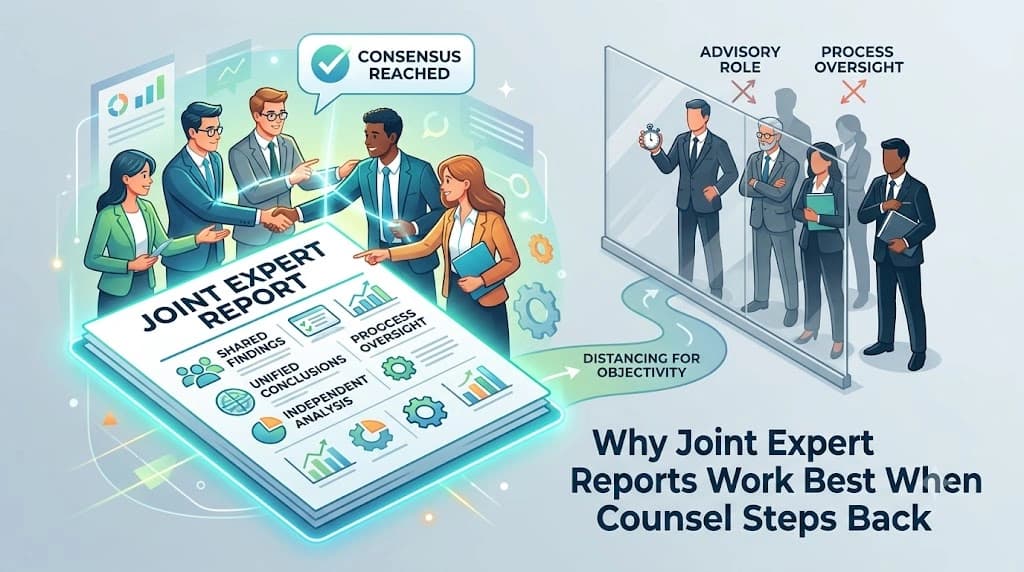
The joint report process exists to produce something no other part of litigation or arbitration produces: an unfiltered, professional-to-professional account of where two independent experts actually agree and disagree, arrived at without either side's legal team present or involved in real time. That single design feature, the deliberate absence of counsel from the substantive exchange, is what gives the resulting document its evidentiary weight. A tribunal reads a joint statement differently than it reads a submission precisely because it assumes the statement was not drafted with legal strategy in mind.
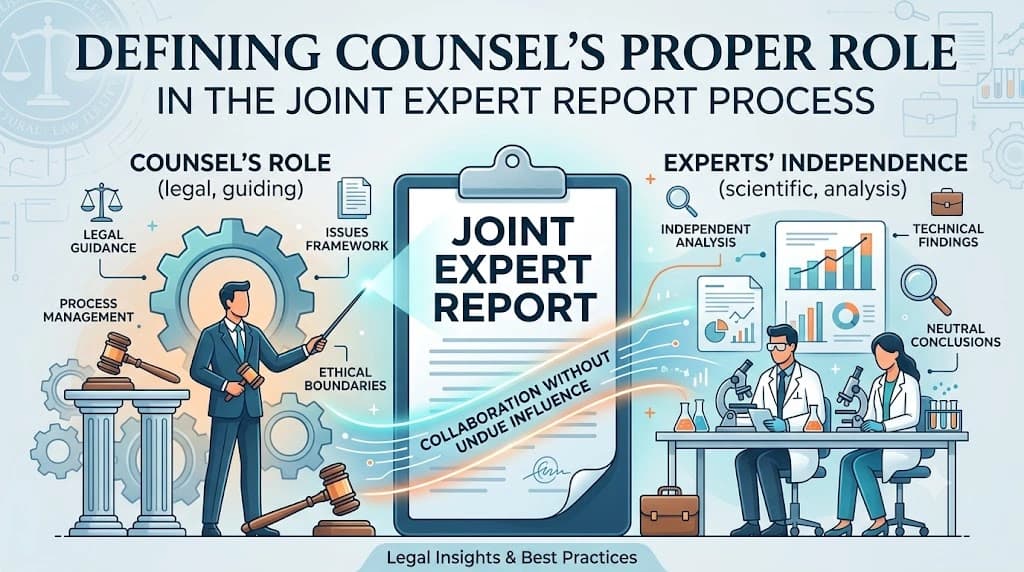
This creates an unusual role for counsel, one closer to an event organizer than a legal drafter. The legal team's job is to build the conditions under which two experts can have a genuine professional conversation, then to get out of the way entirely while that conversation happens, then to receive the result largely as written. Framed this way, the role is not smaller than counsel's normal involvement in the case; it is simply different in kind, requiring a different set of instincts than the ones that serve well in drafting a witness statement or a legal brief.
Before the Conference: Where Counsel Adds Genuine Value
The period before the joint conference is where counsel's involvement is not just appropriate but genuinely necessary, because several things have to happen correctly for the conference itself to be productive. The list of issues the experts are being asked to address needs to be defined clearly enough that both experts are working from the same understanding of scope, since a joint conference conducted against an ambiguous issues list tends to produce a document that talks past the real points of disagreement rather than addressing them directly.
Scheduling matters more than it might appear to. A joint conference squeezed into an inconvenient window, immediately before a filing deadline or a travel commitment, tends to be rushed, and a rushed joint conference produces a thinner, less useful statement than one given proper time. Counsel who protects adequate time for this stage, rather than treating it as a box to check on the way to a deadline, is adding real value to the eventual quality of the evidence.
There is also a legitimate role in confirming procedural ground rules before the conference begins: whether the experts will meet by video or in person, whether a shorthand note-taker or transcript will be used, how the draft statement will be circulated and finalized once produced. None of this touches substance. All of it makes the substantive conversation that follows go more smoothly, and experts consistently report that a well-organized conference, logistically speaking, lets them focus entirely on the technical discussion rather than on procedural friction.
Counsel also has a legitimate role in confirming, well ahead of time, what happens if the experts cannot reach consensus on a particular point during the allotted conference time. Some matters benefit from a scheduled follow-up session; others are better served by the experts simply recording the disagreement as unresolved and moving on. Deciding this in advance, as a matter of process rather than in the moment, prevents a conference from either dragging on unproductively or ending prematurely on a point that genuinely warranted more discussion.
During the Conference: Why Absence Is the Correct Choice
The single clearest marker of a properly run joint expert process is that counsel is not in the room, literally or by proxy, when the experts actually talk. This is not a matter of etiquette. An expert who knows their legal team is listening, even silently, tends to choose words more carefully, hedge more often, and steer away from concessions that might look unhelpful to the case, even when no one has said anything to prompt that caution. The mere possibility of being overheard changes what gets said, which is exactly why the rule exists in the first place.
Some jurisdictions and arbitral institutions make this expectation explicit in their procedural rules or standard directions; many leave it to convention and professional norm instead. Where it is left to convention, the practical guidance for counsel is straightforward: if a joint conference has not been affirmatively organized to exclude legal teams, that omission itself is worth correcting before the conference happens rather than after, since raising the issue retroactively tends to cast unwarranted suspicion on a statement that may in fact have been produced properly.
Remote conferencing has introduced a specific modern wrinkle worth naming directly. A joint conference conducted over video, with each expert appearing from an office where counsel could plausibly be present just off-screen, carries a credibility risk that an in-person meeting at a neutral location does not. Firms serious about protecting the integrity of the process now routinely ask experts to confirm, as a matter of course, that they are participating from a location where no one else is listening, and some go further and ask for that confirmation to be recorded in the joint statement itself.
There is a related question worth addressing directly rather than leaving ambiguous: whether written communication counts as presence. An expert who steps out of a video conference briefly to check a message from their instructing solicitor, even one framed as purely administrative, has introduced exactly the kind of interruption the absence rule is meant to prevent. The cleanest practice is to treat the entire duration of the conference as a closed session, with no communication of any kind between an expert and their legal team until it concludes, regardless of the medium.
After the Conference: The Narrow, Legitimate Review Role
Once the experts have produced a draft joint statement, counsel does have a legitimate, limited role in reviewing it before it is filed. That role is to check for factual accuracy: does the document correctly describe the scope of issues addressed, does it accurately reflect procedural details like dates and case references, is there any plain error that would confuse a reader unfamiliar with the underlying dispute. This is proofreading in substance, even when it involves reading closely.
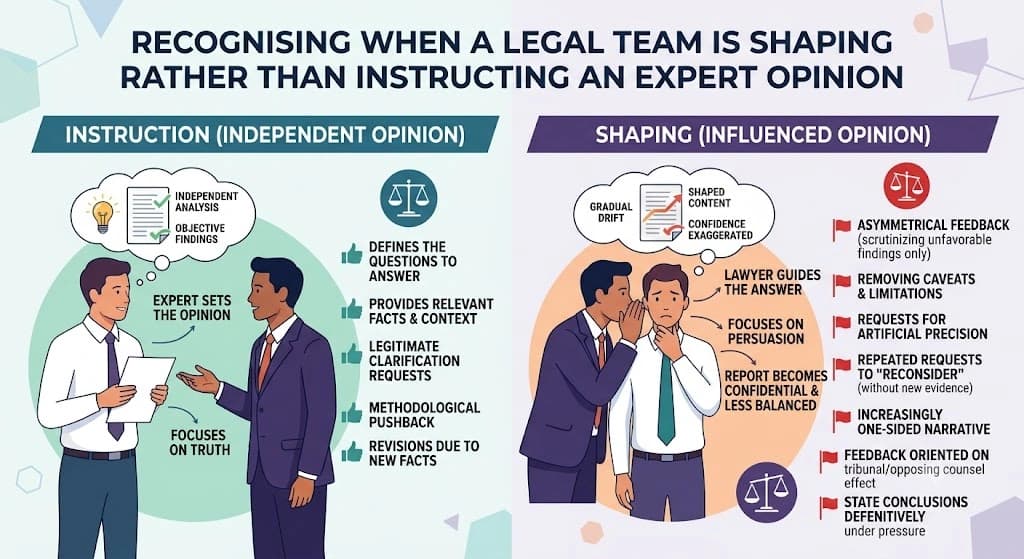
What falls outside that legitimate role is any suggestion about how a point of agreement or disagreement should be framed, worded, or emphasized. A legal team that responds to a draft joint statement with "can we soften this line" or "this point could be stated more favorably" has stopped reviewing and started drafting, and the resulting document, however small the individual edit, is no longer purely the experts' own work product. Tribunals that later learn a joint statement went through several rounds of wording changes after the experts signed off on it tend to discount the document more heavily than one that shows no such history, regardless of how the changes are characterized.
A useful discipline for firms is to require that any comment on a returned draft be phrased strictly as a factual question rather than a suggested edit, "is this an accurate description of the calculation methodology" rather than "should this say the methodology was reasonable." The first invites the expert to correct an actual error if one exists. The second invites the expert to make the document sound better for the client, which is precisely the outcome the process is designed to prevent.
Timing matters here as well. A review turned around quickly, within a day or two of receiving the draft, signals that counsel is checking rather than deliberating over strategy. A review that takes considerably longer, particularly one accompanied by internal discussion among several members of the legal team about how a passage reads, suggests something closer to a drafting exercise than a factual check, even if the eventual comments back to the expert are phrased carefully.
Common Missteps That Undermine the Process
The most common misstep is not a single dramatic overreach but a series of individually small, seemingly reasonable requests that compound over the life of an engagement. A legal team that reviews one draft joint statement and suggests one wording change has probably done no lasting damage. A legal team that does this as a matter of habit, across every joint statement an expert produces for them, has trained that expert to expect legal review as a normal part of the process, which quietly changes how candidly the expert drafts in the first place, even before any specific request arrives on a given case.
A second common misstep is delegating this discipline unevenly within a firm. A senior partner who understands the boundary perfectly may hand day-to-day management of an expert relationship to a more junior associate who has never been told where the line sits, and the associate, trying to be helpful and thorough, ends up doing exactly the kind of substantive review the partner would never have sanctioned directly. Firms that have thought carefully about this tend to write the boundary into internal guidance explicitly, rather than assuming it will be understood and passed down informally.
A third misstep, less discussed than the first two, is over-preparing an expert for the conference itself under the banner of "helping them succeed." Briefing an expert extensively on the other side's likely positions, the client's preferred framing of disputed points, or which concessions would be strategically costly is not logistical support, however well-intentioned. It is an attempt to shape the outcome of a conversation that is supposed to happen without that shaping, and experts on the receiving end of this kind of briefing, even when they resist acting on it consciously, often find it harder to approach the conference with a genuinely open mind.
Building This Into Standard Practice Across a Firm
Firms that manage this well tend to treat the joint reporting process as a distinct workflow with its own checklist, separate from the general document-review processes that govern the rest of the case. That checklist typically covers confirming the issues list, confirming logistics, confirming that no legal team member will be present during the conference, and defining in advance exactly what post-conference review will and will not cover.
Written internal guidance matters more here than in most areas of practice management, precisely because the boundary between acceptable and unacceptable involvement is subtle enough that individual judgment, applied inconsistently across a firm's lawyers, produces inconsistent results. A firm-wide standard, applied the same way regardless of which partner or associate happens to be running a particular matter, produces joint statements a tribunal can trust regardless of who filed them, which is itself a quiet but durable competitive advantage over firms whose practice varies case by case.
Some firms go a step further and designate a specific point of contact, often someone outside the core case team, to handle all logistics related to joint expert conferences. This has a practical benefit beyond consistency: it physically separates the people managing the joint reporting process from the people developing case strategy, which makes it considerably harder for strategic considerations to bleed into the logistical support an expert receives, even inadvertently.
What This Means for Clients and Case Strategy
Clients sometimes assume that closer legal oversight of every document in a case, including the joint expert statement, serves their interests by minimizing risk. In this specific context, the opposite is usually true. A joint statement that shows signs of legal-team shaping, whether through timing, wording, or simple pattern recognition by an experienced tribunal, tends to be discounted, and that discounting can outweigh whatever narrow tactical benefit the shaping was meant to secure. Clients are generally better served by counsel who explain this distinction plainly, rather than by counsel who quietly manage the process more tightly out of an instinct toward caution that does not actually reduce risk in this particular part of the case.
The stronger long-term strategy, and the one favored by counsel with the most experience across a range of tribunals, is to build a reputation, case after case, for producing genuinely independent joint statements. That reputation compounds. A tribunal or arbitral institution that has seen a firm's joint statements hold up as credible across several matters extends a form of trust that a firm with a mixed or shaped track record has to work much harder to earn.
There is also a cost-efficiency argument that tends to resonate with clients focused on the bottom line. A joint statement that genuinely narrows the issues in dispute reduces the amount of hearing time, and therefore expense, needed to resolve the remaining points. A joint statement shaped to avoid conceding anything preserves more issues for the hearing, which sounds protective in the short term but typically increases the overall cost of the dispute without a corresponding improvement in the client's prospects, since the preserved issues still have to be argued and decided eventually, just at a later and more expensive stage of the case.
Frequently Asked Questions
What is the single clearest sign that counsel has overstepped in the joint reporting process? A pattern of post-conference wording changes that go beyond correcting factual errors is the clearest sign, particularly when those changes consistently favor the client's position rather than simply improving clarity.
Should junior lawyers be given the same guidance as senior partners on this issue? Yes, and arguably more explicitly, since junior lawyers are often the ones managing day-to-day communication with experts and are the most likely to unintentionally cross the line while trying to be helpful.
Is it acceptable for counsel to attend a joint conference silently, without speaking? No. The concern is not limited to what counsel says during the conference; an expert's awareness that counsel is present, even silently, is enough to change how candidly they participate.
How should a firm handle a situation where an expert requests legal input during the conference itself? Politely decline and redirect the expert back to the technical discussion with the opposing expert, and address any procedural or logistical concern separately, after the conference has concluded.
Does the same standard apply to court-annexed proceedings and private arbitration alike? Broadly, yes. The specific procedural rules governing joint expert conferences vary between courts and arbitral institutions, but the underlying principle, that the substantive exchange should occur without legal-team involvement, holds across both settings.
Conclusion
Counsel's role in the joint expert reporting process is not smaller than its role elsewhere in a case; it is simply structured differently, front-loaded into preparation and confirmation of process rather than extended into the substantive exchange itself. Firms that understand this distinction clearly, and build it into how they train lawyers at every level, tend to produce joint statements that carry real evidentiary weight. Firms that treat the joint statement like every other document in the case, benefiting from the same kind of careful legal attention, tend to produce documents that look procedurally correct while quietly forfeiting the credibility the process was designed to protect.
Key Takeaways
● Counsel's legitimate role in the joint reporting process is concentrated before and after the experts' conference, in logistics and factual review, not during the substantive exchange itself.
● An expert's mere awareness that counsel might be listening during a joint conference changes what gets said, which is why physical and remote absence both matter equally.
● Post-conference review should be limited strictly to correcting factual inaccuracies; any comment aimed at reframing language more favorably crosses into substantive interference.
● Firms that codify this boundary in written internal guidance, rather than leaving it to individual judgment, produce more consistent and more credible joint statements across their practice.
Position yourself where the legal industry looks for expertise - sign up on exlitem.com to get discovered by leading lawyers and high-value clients.