

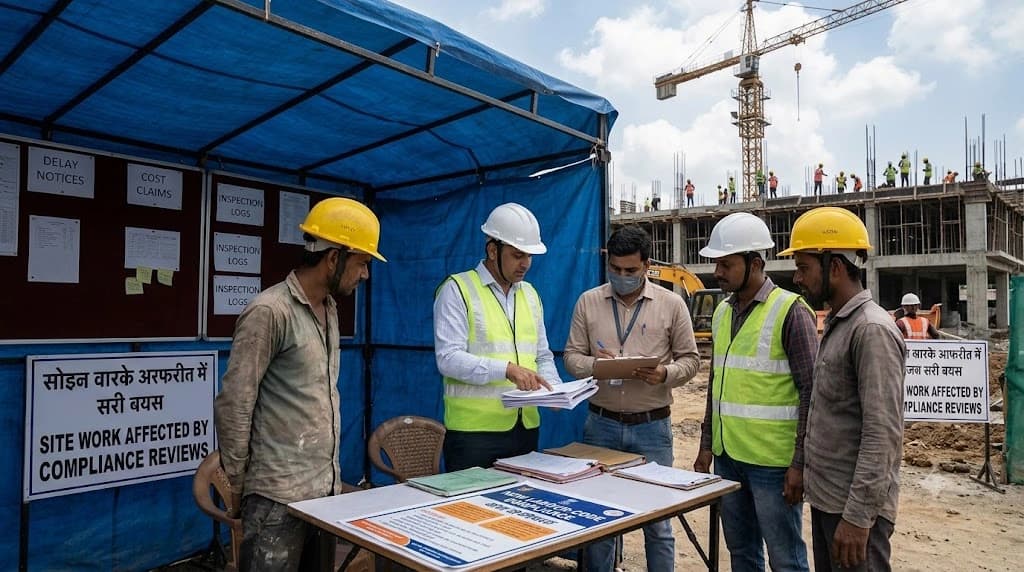
What actually changed, in terms that matter to a construction contract
Three changes sit at the centre of nearly every dispute now forming.
First, the wage definition and the 50% rule. The Code on Wages introduces a single, common definition of “wages” that applies across gratuity, provident fund, bonus and retrenchment compensation calculations. Under this definition, allowances and exclusions from wages cannot exceed 50% of an employee’s total remuneration. If they do, the excess is added back into “wages” for statutory purposes. For construction labour - where a meaningful share of site-worker compensation has historically been structured as site allowance, travel allowance, and other components sitting outside the wage base - this forces a restructuring of the pay packet. The practical effect is a higher wage base for the same take-home pay, which mechanically increases the employer’s provident fund contribution, gratuity accrual and bonus liability. On a labour-intensive contract - finishing works, MEP, formwork-heavy structural packages - this is not a rounding error. It changes the unit cost of labour that the contractor priced into the bill of quantities.
Second, contract-labour licensing tied to the work order rather than the establishment. Under the erstwhile Contract Labour (Regulation and Abolition) Act, 1970, a contractor typically held a licence tied to an establishment or a defined engagement, renewed periodically regardless of which specific work order it was executing. Under the Occupational Safety, Health and Working Conditions Code framework, contractor licences are increasingly linked to the specific period and scope of the work order under which labour is engaged, with a unified registration portal replacing the earlier scatter of state-specific processes. This sounds like simplification, and in the medium term it should be. In the transition period, however, it means a contractor mobilising for a new phase of a project, or moving a workforce between two work orders on the same site, may need to obtain a fresh licence tied to that specific order before lawfully deploying labour - a step that did not exist in the same form under the old regime. On a schedule where mobilisation is meant to happen within days of a notice to proceed, a licensing step that takes weeks is a direct source of programme delay, not a paperwork inconvenience.
Third, the absorption of the Building and Other Construction Workers’ Welfare Cess Act, 1996 into the Code on Social Security. The 1% cess on the cost of construction - excluding land cost and the cost of any contractor’s own establishment - continues, but its administration shifts from assessment by a state authority to self-assessment by the employer. This is being sold as an ease-of-compliance measure, and for compliant, well-advised contractors it probably is. But self-assessment carries its own risk: if a contractor under-assesses the cess base - a live question on contracts where the split between “cost of construction” and other cost heads is not free of ambiguity - the exposure resurfaces later as a reassessment demand with interest and penalty, landing well after the original project accounts were closed and margins booked. That is exactly the kind of deferred, quantifiable cost overrun that ends up in a final account dispute or a claim for indemnity between contractor and sub-contractor.
Layered on top of these three changes is a fourth, more procedural one: on cessation of employment, full and final settlement of wages, including overtime and leave encashment, must now be completed within two working days. For an industry that runs on a highly mobile, high-turnover migrant workforce moving between sites and contractors, a two-day settlement window is an operational stretch. It pushes contractors toward holding larger working-capital buffers for labour payouts and toward faster back-office turnaround - costs that were not built into contracts priced under the old, more forgiving settlement timelines.
A new site-level cost floor: safety, health and welfare
The wage-definition and licensing changes get most of the attention because they are the largest line items. But the Occupational Safety, Health and Working Conditions Code also raises the baseline cost of simply running a compliant site, in ways that add up across a large workforce and a long programme.
The Code’s rules bring in mandatory annual health check-ups for workers above a threshold age, crèche facilities where a site employs a specified number of women workers, upgraded drinking-water and sanitation standards, and more prescriptive requirements around protective equipment and welfare amenities than applied under the erstwhile Factories Act and BOCW Act framework taken separately. None of this is individually expensive. Collectively, on a site running several hundred workers over a two- or three-year construction programme, it is a recurring overhead that was not a line item in most bills of quantities priced before the codes commenced. Contractors on fixed-price contracts are absorbing it in the near term and, in a growing number of cases, flagging it as a change-in-law cost item alongside the wage and licensing claims discussed below.
There is also a data and portability dimension that adds administrative cost rather than direct cash cost. The Code on Social Security enables inter-state portability of a construction worker’s welfare registration and benefits, so a migrant worker registered in one state can carry entitlements to a site in another. That is a genuine improvement for the worker. For the contractor, it means tracking and updating worker registration data across state BOCW welfare boards as workers move between sites - a recordkeeping obligation that did not exist in the same form under the state-siloed registration system it replaces, and one that a pan-India contractor now has to resource as a standing compliance function rather than a one-off registration exercise.
A change to the contracting model itself
The Industrial Relations Code adds a fourth shift that is easy to miss because it is not framed as a cost item at all, yet it changes how construction employers structure their workforce. The Code gives statutory, nationwide recognition to fixed-term employment - direct engagement of a worker for a defined project or period, with proportionate statutory benefits, without the worker converting into a permanent employee purely by reason of tenure. Construction has always run on project-based labour; what changes is that employers now have a cleaner, statutorily sanctioned route to engage that labour directly, rather than routing it through a labour contractor purely to avoid the practical and legal complications of direct employment.
That has a real second-order effect on existing subcontracting arrangements. A principal contractor that has, for years, engaged site labour through a chain of labour contractors may now find it commercially cleaner to bring some of that workforce onto fixed-term direct contracts instead. Where that shift happens mid-project, it can trigger disputes with the existing labour contractor over early termination of the labour-supply arrangement, and disputes with the workers themselves over which entity is the true employer of record for provident fund, gratuity and BOCW welfare purposes - a recharacterisation question that did not need to be asked as often under the old regime. Separately, the Code also raises the threshold at which an establishment needs prior government permission before retrenchment, lay-off or closure, moving it from 100 workers to 300, which changes the calculus for how a struggling contractor manages workforce reduction on a delayed or distressed project, and by extension how quickly it can reduce its cost base if a project stalls.
None of this shows up as a single dramatic claim. It shows up as a slow renegotiation of subcontracts already in place, and - where the renegotiation fails - as a dispute over which party bears the cost of restructuring an existing labour-supply chain that a change in law has made partly redundant.
Where this lands: the change-in-law clause
Almost every standard-form Indian construction and EPC contract whether based on FIDIC, the National Highways Authority of India’s model concession and EPC agreements, or negotiated private forms contains a change-in-law clause. The mechanics vary, but the structure is consistent: if a change in applicable law occurs after a specified reference date (typically bid date or contract signing date) and that change increases the contractor’s cost of performance or delays the works, the contractor is entitled to an adjustment to the contract price, the time for completion, or both.
The labour codes create an unusually sharp version of a familiar interpretive problem: what counts as the “change” for the purposes of that clause, and when did it occur?
There are at least three candidate dates, and contracting parties are not converging on the same one. A contractor executing a contract signed in 2022 might argue that the relevant change in law is the notification bringing the codes into force on 21 November 2025 because that is the date on which compliance obligations under the new regime actually became binding, superseding the erstwhile Acts. A principal or employer, by contrast, might argue that the codes were enacted by Parliament in 2019 and 2020 respectively, so any contract signed after those enactment dates was on notice of the coming change and cannot treat the eventual commencement as an unforeseen event. A third position increasingly the more defensible one on the facts — is that the change-in-law event crystallised only on 8 May 2026, when the final central rules were notified, because it was only at that point that the actual compliance obligations (wage calculation methodology, licensing procedure, cess self-assessment mechanics) became knowable and capable of being priced. Contracts signed before that date, on this reading, could not have priced in obligations that did not yet exist in operative form.
This is not an academic distinction. On a mid-sized EPC contract, the difference between “the change occurred in 2019” and “the change occurred on 8 May 2026” is the difference between a contractor having no claim at all and a contractor having a fully arguable claim for both additional cost and extension of time across every month of execution since the rules took effect. Expect this precise question when, for change-in-law purposes, did the labour codes actually “change” the law to become one of the more litigated construction-contract interpretation issues of 2026 and 2027, whether in domestic arbitration, institutional arbitration before India’s newer arbitral institutions, or before the commercial divisions of the High Courts.
The mobilisation delay nobody priced
Extension-of-time claims arising from labour-law transition are unusual in one respect: they are not about the employer withholding site access, or design information arriving late, or utilities not being relocated the classical causes of delay claims on Indian infrastructure projects. They are about the contractor’s own compliance apparatus not being ready in time to deploy labour it already had available.
A contractor with an existing, compliant contract-labour licence under the old CLRA regime, mobilising a new work order or a new phase of an existing project, may now need a fresh work-order-linked licence or registration under the new framework before it can lawfully deploy that labour on the new scope. Where the relevant state government has not yet operationalised its own rules and portal and state rules, not just central rules, ultimately govern the state-jurisdiction elements of this framework, given labour’s place on the Concurrent List - the contractor is caught between a central obligation that has commenced and a state administrative mechanism that has not caught up. That gap has already produced site-level delays in labour deployment that would not have existed eighteen months ago, and those delays are now working their way into extension-of-time notices.
The patchwork is real. States retain the ability to vary thresholds and procedural detail even as the central codes apply nationally for instance, differing state approaches to the numerical threshold at which contract-labour licensing requirements bite. A contractor running simultaneous sites in two or three states is not dealing with one new compliance regime; it is dealing with one new central framework and several different state implementations of it, at different stages of readiness, at the same time. For a pan-India infrastructure contractor, that fragmentation is itself a cost additional legal and compliance overhead that has to be resourced site by site rather than centrally, and that was not contemplated in contracts priced against a single, stable, pre-2025 compliance map.
Tender disqualification risk is now a delay risk too
There is a second-order effect worth flagging for anyone advising on public infrastructure procurement. Government tender evaluations increasingly build in compliance due diligence as a bid qualification criterion proof of EPFO compliance, ESIC registration, BOCW registration, and a clean labour-inspection history are being sought as part of the tender documentation itself, not just as post-award obligations. A contractor with unresolved EPFO demands, a lapsed or transitional BOCW registration, or an open labour dispute now carries a bid-disqualification risk that did not attach in the same way before the codes commenced and before due-diligence practices tightened around them.
This matters for delay-and-cost analysis because it changes where the risk sits in the project timeline. A compliance gap that would once have surfaced as an operational headache mid-project can now surface at the award stage, either disqualifying a contractor outright or forcing a re-tender that itself becomes the cause of the very delay the employer was trying to avoid. Anyone assessing critical-path delay on a public infrastructure project awarded in the last six months should be asking, at the outset, whether any part of the pre-award timeline was affected by labour-compliance due diligence because if it was, that is now a documented, causally distinct source of delay separate from the traditional culprits of design change, site handover and utility relocation.
What this means for how these disputes will be fought
For quantum and delay experts, forensic accountants and construction-claims specialists working on Indian projects with an execution period spanning November 2025 onward, the labour codes introduce a new category of cost head that needs to be isolated and quantified distinctly from general inflation or standard cost escalation claims.
Three things follow from that.
First, the causal chain needs to be documented cleanly. A claim that simply asserts “labour costs went up” will not survive scrutiny in arbitration or before a court. What is defensible is a claim that traces a specific cost increase - higher PF and gratuity accrual arising from the 50% wage-definition rule, for instance - to a specific, dated regulatory change, and quantifies the delta against the wage structure that was priced into the original contract sum. That requires a payroll-level reconstruction of the wage base before and after the relevant compliance date, not a general assertion of cost inflation.
Second, the “which date” question needs to be argued on the specific wording of the contract’s change-in-law clause, not on a generic assumption. Some clauses are drafted around “enactment,” some around “coming into force,” and some around the more precise “publication of rules, regulations or notifications having the force of law.” Given that the codes were enacted years before they commenced, and the operative rules followed the commencement by a further five and a half months, the drafting of the specific clause in front of a tribunal will do most of the work in determining whether a claim succeeds.
Third, delay claims arising from work-order-linked licensing gaps need contemporaneous evidence - licence applications, portal correspondence, state-authority acknowledgements - showing that the contractor pursued compliance diligently and that the delay arose from the administrative transition itself rather than from the contractor’s own default. Tribunals assessing extension-of-time claims will want to see that the contractor did everything it could, promptly, and that the gap was systemic rather than self-inflicted.
Takeaway
The labour codes were sold, correctly, as a simplification of a fragmented and outdated statutory landscape. For construction contracts already in execution when the transition happened, simplification has arrived alongside a genuine cost and time shock that most contracts did not anticipate in their change-in-law drafting. Over the next twelve to eighteen months, expect a steady stream of change-in-law notices, extension-of-time claims tied to licensing transition gaps, and final-account disputes over BOCW cess self-assessment - all flowing from the same root event, interpreted differently depending on which side of the contract a party sits.
For attorneys and in-house counsel managing live infrastructure and construction contracts, the immediate action items are concrete: audit every active contract’s change-in-law clause against the actual dates of enactment, commencement and rule notification; get ahead of work-order-relicensing requirements before mobilisation deadlines rather than after a delay has already accrued; and build a clean, payroll-level record of the wage-cost delta attributable to the new wage definition, so that any eventual claim is quantifiable rather than asserted.
Position yourself where the legal industry looks for expertise - sign up on exlitem.com to get discovered by leading lawyers and high-value clients.