

India’s infrastructure pipeline - highways, metro corridors, renewable energy plants, ports and data centres - has produced a parallel pipeline of disputes. Most of these disputes are, at their core, arguments about money: how much delay cost, how much a variation should have added to the contract price, how much a contractor lost when an employer’s default disrupted its planned sequence of work. Liability findings matter, but they rarely settle a construction arbitration on their own. The award turns on quantum — and quantum turns on the expert who calculated it.
Yet the process of choosing a quantum expert is treated, in far too many Indian arbitrations, as an afterthought. Parties instruct a chartered accountant or a quantity surveyor they have used before, hand over a bundle of invoices, and expect a number to come back that will hold up under cross-examination. It often doesn’t. Tribunals seated in Mumbai, Delhi, Bengaluru and increasingly at GIFT City have grown visibly more exacting about the methodology behind a quantum claim, not just its conclusion. This explainer sets out what attorneys and in-house counsel need to know before they instruct one.
Why quantum expertise has become a strategic decision, not an administrative one
The Arbitration and Conciliation (Amendment) Bill 2024 has tightened timelines and reinforced the emergency-arbitrator framework, which means quantum submissions now have to be prepared and defended on a compressed schedule. There is less room for an expert report to be reworked mid-proceeding.
At the same time, the four consolidated Labour Codes that came into force on 21 November 2025 have created new categories of cost and delay claims specific to the construction sector: compliance-driven work stoppages, mandatory health-check stand-downs, and wage-arrears exposure that contractors did not price into original tenders. A quantum expert instructed today needs to understand not just prolongation cost and loss-of-profit methodology, but how a statutory compliance shock flows through to a contractor’s cost base - and whether that cost is properly claimable at all, or is simply the ordinary business risk a contractor is expected to absorb.
Institutional arbitration has also matured. The Mumbai Centre for International Arbitration’s 2025 Rules introduced early dismissal, joinder and summary procedures, and MCIA’s own reporting shows caseloads and claim values rising steadily. IAMC Hyderabad and the arbitration centre coming up at GIFT City add further venues where quantum evidence will be tested by tribunals drawing on international as well as domestic practice. An expert who has only ever worked within the informal culture of ad hoc Indian arbitration may struggle in front of a tribunal applying institutional rules and international quantum conventions.
Put together, these shifts mean the choice of quantum expert is no longer a back-office decision left to the finance team. It shapes case strategy from the day a dispute is contemplated.
What a quantum expert actually does
It helps to be precise about the role, because “quantum expert” gets used loosely in Indian practice to describe several distinct functions.
A quantum expert quantifies loss, cost, or value. In a construction context this typically covers four kinds of work. First, valuing variations and additional work where the contract’s own valuation machinery has broken down or is disputed. Second, calculating prolongation and thickening costs arising from delay - the increased cost of keeping site establishment, plant, supervision and overheads running longer than planned. Third, quantifying disruption losses, where the contractor’s productivity fell below what it would have achieved but for the employer’s interference, even though the overall completion date may not have moved. Fourth, assessing loss of profit or loss of overhead recovery where the contract was terminated, suspended, or reduced in scope.
This is different from the role of a delay expert or planning expert, who is concerned with the programme - what caused which delay, and whether it affected the critical path. In well-run arbitrations the two experts work from a shared factual record but produce separate reports, because the skill sets are different: one is forensic scheduling, the other is forensic accounting and costing. Instructing a single individual to do both, unless that person is genuinely qualified in both disciplines, is one of the most common ways Indian parties weaken their own quantum case. A quantum expert who has simply adopted a delay expert’s causation findings without independently testing them invites a tribunal to discount the entire report.
It is also worth separating the quantum expert from the contract administrator or engineer who issued interim certificates during the works. Certificates issued during performance of the contract are contemporaneous administrative documents, not independent expert opinion, and tribunals treat them accordingly - useful evidence of what was recorded and paid at the time, but not a substitute for an independent forensic valuation once the dispute has crystallised.
The legal framework: what Indian arbitration law actually permits
Two provisions of the Arbitration and Conciliation Act, 1996 frame how quantum expert evidence is treated, and attorneys should be precise about which one applies to a given engagement.
Section 26 governs the tribunal’s own power to appoint an expert. It allows an arbitral tribunal, unless the parties have agreed otherwise, to appoint one or more experts to report on specific issues and to require a party to provide the expert with relevant information, documents or access to property for inspection. If a party requests it, or the tribunal considers it necessary, the tribunal-appointed expert must participate in an oral hearing where parties can put questions and call their own expert witnesses to testify on the same issues. This is a materially different animal from a party-appointed expert: the tribunal’s own expert is meant to assist the tribunal directly, and parties retain the right to test that expert’s findings through their own witnesses and cross-examination.
Section 19(1) of the Act makes clear that the Indian Evidence Act, 1872 does not bind arbitral proceedings. That said, the concept of expert opinion evidence under Section 45 of the Evidence Act which defines an expert as a person with special knowledge, skill or experience acquired through practice, observation or study - remains the conceptual reference point that tribunals and counsel default to when arguing about whether a witness qualifies as an expert and whether their opinion should carry weight. In practice, most Indian-seated tribunals apply a functional test drawn from this concept: does the witness have genuine, demonstrable expertise in the specific question asked, independent of the party that instructed them, and has that expertise been applied transparently to the facts of the case.
Neither provision tells a tribunal how much weight to give an expert’s number. That is left, as the Supreme Court has repeatedly affirmed in the context of arbitral awards, to the arbitrator’s assessment of the factual matrix - meaning a tribunal is free to accept an expert’s methodology in part, discount unsupported assumptions, and arrive at its own quantum finding even where it does not adopt either side’s expert wholesale. This is exactly why the credibility of the expert, and not just the arithmetic in the report, decides how much of the claim survives.
Methodology: what tribunals in India will and will not accept
The single biggest reason quantum claims fail in Indian construction arbitration is methodology, not facts. Four approaches recur, and attorneys should know which one fits their record before they instruct an expert to use it.
The total cost method calculates loss by subtracting the contract price from the total cost actually incurred. It is the simplest method and the easiest to attack, because it assumes every rupee of cost overrun was caused by the other party’s breach, ignoring the possibility that the contractor’s own tender was unrealistic, that its own inefficiency inflated costs, or that some overruns were independent of the events complained of. Tribunals in India, as elsewhere, treat a bare total cost claim with real scepticism.
The modified total cost method starts from the same total-cost base but strips out costs attributable to the contractor’s own errors, unrelated events, or an unrealistic original tender, isolating only the overrun that is genuinely connected to the respondent’s conduct. It is more defensible, but a tribunal will still expect the expert to show that the original tender was reasonable, that the actual costs were reasonably incurred, and that the remaining overrun cannot practically be broken down claim-by-claim because the causes are genuinely intertwined. Where a claim can be particularised discretely, tribunals expect it to be - a modified total cost approach used as a shortcut around available records tends to be rejected rather than merely discounted.
A particularised or “actual cost” method ties each head of loss to a specific causative event, using contemporaneous records - daily site diaries, resource allocation sheets, correspondence, variation instructions, and as-built programmes compared against the as-planned baseline. This is the most labour-intensive method and the one Indian tribunals are most receptive to, precisely because it does not ask the tribunal to take the expert’s causation assumptions on faith.
For delay-related cost specifically, the international convention that Indian quantum and delay experts increasingly draw on - the Society of Construction Law’s Delay and Disruption Protocol - distinguishes between prospective analysis (time impact analysis, applied as close as possible to when a delay event occurs) and retrospective analysis conducted after completion, which starts by identifying the critical delay path and only then attributes cost to it. India does not yet have a uniform institutionalised standard of its own for this analysis, which is precisely why the credentials and judgement of the individual expert instructed matter more here than in mature offshore markets: the expert is often filling a methodological gap that domestic practice hasn’t standardised.
What to look for when instructing a quantum expert
Credentials are a starting point, not a guarantee. A genuine quantum expert for a construction dispute will typically be a chartered quantity surveyor - commonly RICS-qualified - with specific forensic and dispute experience, or a forensic/chartered accountant with a demonstrable track record in construction cost analysis rather than general commercial damages work. Membership of a body such as the Chartered Institute of Arbitrators is a useful signal of familiarity with tribunal procedure and cross-examination discipline, but it is not a substitute for sector-specific quantum experience. An expert who has quantified losses in shipping or manufacturing disputes does not automatically transfer that skill to a road-widening EPC contract with its own valuation clauses, price variation formulae and statutory cost inputs.
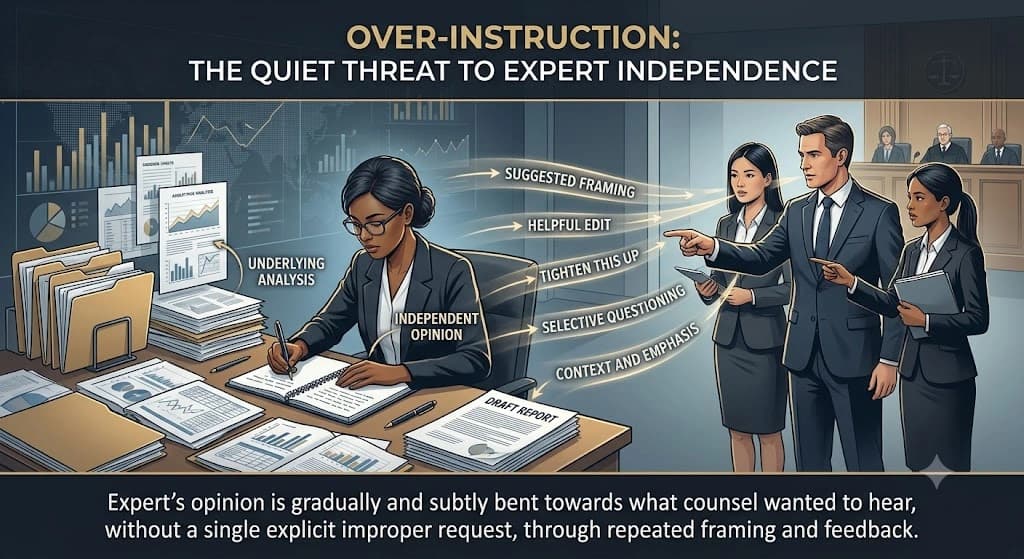
Independence is not a formality. It is the single quality a tribunal will test hardest, and it is where party-appointed experts most often come unstuck. An expert who has previously worked for, or been regularly instructed by, one of the parties or its group should disclose this clearly at the outset rather than leave it to be discovered in cross-examination. Many institutional tribunals in India now expect the kind of conflict disclosure associated with the IBA Rules on the Taking of Evidence in International Arbitration, even where those rules are not formally adopted, simply because parties routinely invoke them by analogy. An expert who argues for their client’s position rather than presenting an independent opinion sometimes described as a “hired gun” is a liability the moment cross-examination begins, because a tribunal that concludes an expert has abandoned independence will discount not just the disputed parts of the report but the credible parts too.
Fit to the record matters as much as fit to the discipline. Before instructing an expert, counsel should be honest about what documentary record actually exists. If site records are thin, an expert who insists on a particularised actual-cost method may simply produce a report full of gaps that the other side exploits. Equally, if good contemporaneous records do exist, instructing an expert to take a shortcut through a modified total cost method wastes the strength of the case. The right method is dictated by the evidence available, not by what is fastest to produce.
Familiarity with the applicable contract form is essential and frequently overlooked. A quantum expert who has spent a career on domestic item-rate government contracts will assess loss differently from one experienced in FIDIC-based international EPC contracts, where valuation of variations, delay damages caps, and loss-of-profit exclusions are drafted very differently. Counsel should confirm the expert has actually priced and defended claims under the specific contractual valuation regime in play, not merely construction disputes in general.
Finally, ask how the expert has performed under cross-examination before, not just how many reports they have written. Section 26(2) of the Arbitration and Conciliation Act gives parties the right to question a tribunal-appointed expert at an oral hearing, and party-appointed experts are routinely cross-examined as a matter of tribunal practice even though the Act does not separately mandate it for them. A quantum report that cannot survive being taken apart line by line under questioning is worth less than its page count suggests.
Party-appointed, tribunal-appointed, or joint expert: choosing the right structure
Most Indian construction arbitrations still proceed with each side instructing its own quantum expert, and this remains the default for good reason: a party-appointed expert can be briefed early, can shape the record-gathering exercise, and gives counsel a collaborator who understands the case theory from the inside. But it is not the only structure available, and attorneys should actively consider the alternatives rather than defaulting to habit.
A tribunal-appointed expert under Section 26 becomes relevant where the parties, or the tribunal, want a single neutral view on a narrow, technical valuation question for instance, the fair value of a specific variation where both sides’ experts have talked past each other. Because the tribunal’s own expert can be cross-examined by both parties and does not carry either side’s instructions, a well-reasoned Section 26 report often carries disproportionate weight in the final award. Counsel who are confident their position will hold up under neutral scrutiny should not be afraid to propose this route; counsel who are not should treat a tribunal’s suggestion of one as a signal worth taking seriously.
A joint expert, instructed by both parties by consent, is rarer in India than in some offshore jurisdictions but is increasingly used for narrow, largely mechanical valuation exercises reconciling measurement of quantities, for example where the dispute is really about a formula rather than a judgment call. It is not appropriate where the underlying quantum question is genuinely contested on causation or entitlement, because a joint expert cannot credibly advocate for either side’s version of events.
Whichever structure is chosen, institutional rules increasingly shape how expert evidence is exchanged and tested. MCIA’s 2025 Rules, for instance, build in early procedural mechanisms - summary disposal and structured joinder among them that can affect when and how quantum evidence needs to be ready. An expert unfamiliar with the institution’s procedural rhythm, whether at MCIA, IAMC Hyderabad, or the arbitration centre developing at GIFT City, can end up producing a report on the wrong timeline for the forum, which is an entirely avoidable problem.
Cross-border quantum questions are becoming more common, too. Contracts routed through GIFT City, or arbitrations seated in India but governed by foreign-law-influenced FIDIC contracts, sometimes require a quantum expert who is comfortable applying internationally recognised costing conventions alongside Indian contract and cost data. An expert who has only ever worked within a purely domestic frame of reference may undervalue or fail to properly translate how an international costing convention should apply to an Indian project’s actual cost base.
Red flags that should end a conversation with a prospective expert
An expert who offers a headline number before reviewing the underlying records is not being efficient - they are pre-committing to a conclusion. An expert who cannot clearly explain why they chose one quantification method over another, in plain language, will not be able to defend that choice under cross-examination either. An expert who treats delay causation as someone else’s problem and simply assumes the causation case will be proven is building a report on a foundation the tribunal may never accept. And an expert who is reluctant to disclose prior work for the instructing party’s group, or for its lawyers, is creating a credibility problem that will surface at the worst possible time - usually mid-hearing, when it is too late to instruct someone else.
Getting the process right
The most effective use of a quantum expert starts long before the arbitration does. Where a project is already showing signs of delay or cost overrun, early involvement of a quantum expert - even informally, to advise on what records to preserve - materially improves the eventual claim. Contemporaneous records win construction arbitrations; the expert’s job is to organise and interpret that record, not to manufacture a case from what is left after the fact.
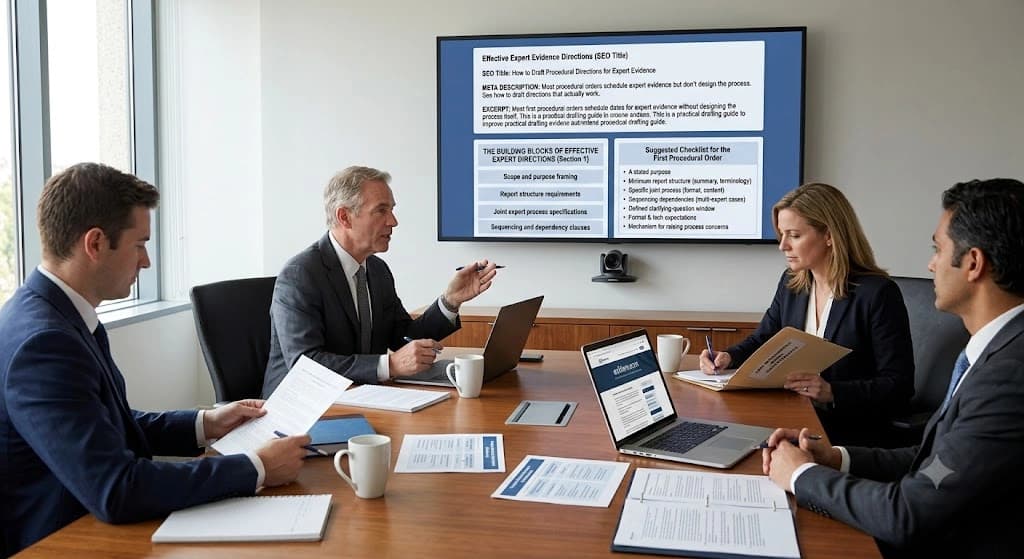
Once a dispute is formally underway, the quantum expert’s scope of instruction should be defined precisely and in writing: which heads of claim they are quantifying, what documents they will be given access to, whether they are expected to coordinate with a separately instructed delay expert, and what assumptions (if any) they are entitled to rely on from other witnesses. Loose or open-ended instructions are a common source of reports that either overreach into territory the expert is not qualified to address, or leave gaps that the other side highlights.
Where possible, counsel should also test the expert’s draft findings internally before they are finalised - not to soften an unwelcome conclusion, but to identify weaknesses while there is still time to shore up the underlying record or narrow the claim to what can genuinely be supported.
What it costs to get this wrong
The consequences of a weak quantum expert rarely show up as an outright rejection of the claim. More often, they show up as erosion: a tribunal that accepts liability but awards a fraction of what was claimed, because it could not follow the expert’s reasoning from cause to cost. A modified total cost claim that collapses under cross-examination can drag down heads of claim that were, on their own facts, perfectly sound - because once a tribunal loses confidence in an expert’s independence or method on one point, it tends to scrutinise everything else that expert has signed off on far more sceptically. Parties frequently discover, too late, that the fee saved by instructing a generalist accountant instead of a sector-specialist quantity surveyor was a false economy once set against what was left on the table in the award.
There is a proportionality question here that Indian counsel should raise early rather than late. Expert fees should scale with what is realistically recoverable, not with the size of the claim as pleaded. A claim quantified at an inflated, unparticularised figure invites both a costs risk if the tribunal later finds the claim to have been overstated, and a credibility cost that can taint the rest of the case. Being realistic about quantum from the outset - even if it means pleading a smaller, better-evidenced number - is consistently the more effective strategy in front of Indian tribunals that have grown used to seeing inflated global claims dressed up as precise calculations.
Counsel should also budget for the expert’s time to be spent early, on record review and scoping, rather than concentrated entirely at the report-drafting stage. An expert who is instructed only weeks before submissions are due, and asked to build a methodology around whatever records happen to be available, is being set up to produce exactly the kind of vulnerable report described above.
Takeaway
A quantum expert is not a calculator for hire. In Indian construction arbitration, the choice of expert increasingly decides how much of a claim survives cross-examination, particularly as tribunals grow more exacting about methodology and as new sources of cost claims emerge from the 2025 Labour Codes and tightened arbitration timelines. Attorneys should prioritise sector-specific credentials, demonstrable independence, a quantification method that matches the actual documentary record, and a track record of holding up under questioning - over reputation or convenience alone.
Position yourself where the legal industry looks for expertise - sign up on exlitem.com to get discovered by leading lawyers and high-value clients.