
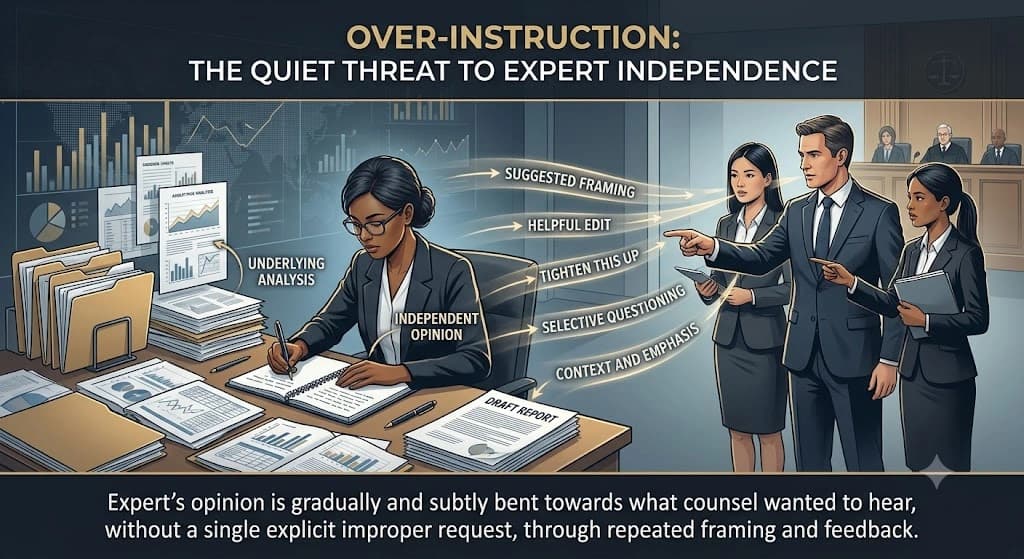
Over-instruction rarely looks like an instruction at all. It looks like a legal team offering a helpful suggestion about framing, a well-meaning request to tighten up a paragraph, a passing comment about what the tribunal is likely to find persuasive. No single one of these moments would strike anyone involved as improper. Add enough of them together across a case, and an expert's opinion can end up shaped more by what counsel wanted to hear than by what the underlying analysis actually supports, without a single person involved having intended anything of the sort.
This is precisely what makes over-instruction more dangerous, in a practical sense, than deliberate attempts to corrupt an expert's opinion. Deliberate corruption is rare, easy to recognize when it occurs, and universally condemned across the profession. Over-instruction is common, difficult to recognize from inside the relationship where it is happening, and often defended by everyone involved as ordinary, reasonable collaboration right up until the moment an opposing expert or skilled cross-examiner exposes how much the analysis actually bent toward what the instructing party wanted.
This piece treats over-instruction as a distinct phenomenon worth naming and defining carefully, precisely because vague awareness that it exists somewhere in the profession does little to help any specific expert or legal team recognize it happening in their own working relationship. A phenomenon this quiet requires more than general caution. It requires a specific vocabulary and a specific set of checks, which is what the remainder of this piece sets out to provide.
What Over-Instruction Actually Is
Over-instruction is the process by which a legal team's framing, emphasis, or repeated feedback shapes an expert's analysis or conclusions beyond what legitimate instruction requires, without ever crossing into an explicit request to reach a particular result. It sits in a specific, uncomfortable middle ground: clearly distinguishable from outright fabrication or dishonesty on one side, but genuinely different from the kind of instruction an independent expert is entitled to receive on the other.
Legitimate instruction includes defining the scope of an expert's mandate, providing relevant factual background, and explaining the legal framework within which the expert's opinion needs to be useful. None of this compromises independence, because it shapes what question the expert answers without shaping what the honest answer to that question turns out to be. Over-instruction crosses a line legitimate instruction respects: it begins to shape the answer itself, gradually and often invisibly, through repeated framing choices rather than a single explicit directive.
This distinction, between shaping the question and shaping the answer, is worth returning to repeatedly throughout an engagement rather than settling once at the outset. A legal team's involvement that stays entirely on the question side of this line, however extensive, poses no threat to independence at all. The risk begins precisely at the point, often gradual and hard to pinpoint exactly, where involvement starts to influence the answer as well.
The word "quiet" in the phenomenon's usual description is doing real work. Over-instruction rarely announces itself. It accumulates through a series of individually defensible interactions, each one plausible as ordinary collaboration between an expert and the legal team retaining them, until the cumulative effect has measurably shaped the analysis in a direction the legal team wanted, whether or not the legal team consciously intended that outcome.
How It Happens Without Anyone Intending It
The most common mechanism is repeated, incremental feedback on drafts. A legal team reviewing an early draft flags a paragraph as "confusing" or "not quite landing," and the expert, reasonably trying to be helpful and responsive, revises it. Repeated across many drafts and many paragraphs, this ordinary editorial process can, without any single instance being improper, gradually push the report's overall framing and emphasis toward whatever version reads most persuasively to the instructing party, a different thing entirely from what reads most accurately given the underlying analysis.
A second mechanism is selective questioning. A legal team that asks probing, skeptical questions specifically about findings unfavorable to their case, while accepting favorable findings without similar scrutiny, is not instructing the expert to reach a particular conclusion, but is applying asymmetric pressure that can shape which findings get revisited and refined most carefully and which simply survive because nobody pushed back on them.
This asymmetry is especially easy to miss because each individual instance of skepticism looks like exactly the kind of rigorous engagement a legal team should be bringing to an expert's draft findings. The problem is not that scrutiny occurs, careful scrutiny of an expert's reasoning is genuinely valuable. The problem is that the scrutiny is not applied evenly, so favorable findings receive less analytical pressure and survive into the final report with less testing than unfavorable ones, purely as a function of which findings happened to attract attention.
A third, subtler mechanism is context and emphasis provided at the outset of an engagement. A legal team that frames the factual background in a way that highlights certain events and downplays others, entirely legitimately, from their own perspective on the case, can shape which facts an expert weighs most heavily in forming an initial impression, an impression that then anchors the rest of the analysis even as the expert works independently from that point forward.
This anchoring effect is well understood in other analytical fields and applies with equal force to expert witness work: an initial impression formed early tends to color how subsequent, genuinely independent analysis gets interpreted, even when that analysis is conducted with real rigor. An expert aware of this tendency can partially guard against it by deliberately revisiting the case's full factual record independently, rather than relying solely on the framing initially provided by instructing counsel, before finalizing an analytical approach.
The Specific Moments Where Over-Instruction Creeps In
The initial briefing conversation is a common entry point, not because anything improper is typically said explicitly, but because the framing and emphasis chosen at this stage shapes an expert's starting orientation to the case before any independent analysis has begun. An expert who absorbs a compelling, one-sided narrative about the facts at the outset carries that narrative into their analysis even while genuinely trying to remain objective.
Draft review cycles are the most consistently cited moment across the profession, precisely because of the incremental drift mechanism described above. Each individual round of feedback can feel entirely reasonable, and the expert reviewing that feedback rarely has a clear vantage point from which to notice the cumulative direction of many small changes made over weeks or months.
Deadline pressure late in an engagement creates a distinct version of the same risk. An expert facing a compressed timeline is, understandably, less likely to push back on a suggested framing change or revisit a finding counsel seems uncomfortable with, simply because there is less time available to do the additional work a genuine reconsideration would require, which means time pressure itself can function as a subtle form of over-instruction even when nobody intends it that way.
This connects directly to why the timing of expert instruction matters so much for independence, not just for cost and quality. An expert instructed late, working under compressed deadlines from the outset, faces this pressure throughout the engagement rather than only near its end, which means late instruction does not just produce rushed analysis, it produces analysis more vulnerable to over-instruction at every stage, simply because there is rarely enough slack in the schedule for the expert to push back and still meet the filing deadline.
Pre-hearing preparation introduces a final, distinct risk: coaching intended to help an expert communicate more clearly and confidently under cross-examination can drift into coaching that shapes how findings get characterized or emphasized when the pressure of an upcoming hearing makes a more favorable framing feel like reasonable preparation rather than a substantive change.
The distinction worth holding onto during hearing preparation specifically is between rehearsing how to explain an existing finding clearly under pressure, which is legitimate and valuable preparation, and rehearsing a version of the finding that has been subtly reframed to sound more favorable than the written report actually supports. The second version creates exactly the kind of written-versus-oral inconsistency that skilled cross-examination is specifically designed to expose, at the worst possible moment for the expert's credibility.
Why It's Hard to Detect From Inside
Over-instruction is difficult for an expert to recognize while it is happening, for reasons that have little to do with a lack of integrity and much to do with ordinary human psychology. An expert working closely with a legal team over months of a case naturally builds rapport with that team, and wanting to be helpful, responsive, and easy to work with is a normal, largely positive professional instinct that, left unchecked, can quietly translate into being more accommodating about framing and emphasis than strict independence would require.
There is also a genuine cognitive difficulty in distinguishing gradual drift from legitimate refinement. An expert who revises a finding in response to counsel's feedback cannot always tell, in the moment, whether that revision reflects a genuine improvement in the analysis or a subtle accommodation to what the feedback implicitly wanted, because both can look identical from the inside of the process producing them.
The absence of a clear, single moment where a line gets crossed compounds this difficulty further. Deliberate corruption has an identifiable moment an expert can recognize and refuse. Over-instruction, by its incremental nature, rarely presents that kind of clear decision point, which is precisely why active, deliberate vigilance is required rather than simply trusting that good intentions alone will prevent the drift.
There is also a relationship dynamic that makes raising a concern about over-instruction, even to oneself, socially uncomfortable in a way that refusing an explicit improper request is not. Declining an outright dishonest request is professionally unambiguous. Pausing to ask whether months of collegial, seemingly reasonable collaboration have gradually shaped an opinion requires questioning a relationship that, by every visible signal, has been going well, which is a much harder thing to do deliberately and consistently.
The Signs Counsel and Experts Can Both Watch For
A useful signal for experts is noticing whether feedback consistently pushes in one direction, toward emphasizing findings favorable to the instructing party and softening or reconsidering unfavorable ones, rather than being genuinely balanced in its scrutiny of both. Feedback that only ever asks an expert to reconsider inconvenient findings, never convenient ones, is a pattern worth naming explicitly rather than absorbing silently over successive rounds.
A related signal is noticing when a request framed as an editorial suggestion, tightening language, improving clarity, actually changes the substance of a finding rather than merely its presentation. An expert who develops the habit of asking, of any requested change, whether it affects what is being said or only how it is being said, has a reliable, practical test for catching over-instruction before it accumulates.
Keeping an early draft on file, and periodically comparing it against the current version, is a simple, concrete practice that makes gradual drift visible in a way that reviewing only the most recent draft against the one immediately before it cannot. Drift that is invisible change to change becomes considerably more obvious viewed across the full arc of an engagement.
For counsel, a useful signal is noticing whether an expert's draft has changed meaningfully across successive revisions in ways that consistently favor the client's position, and asking honestly whether that pattern reflects genuine analytical refinement or the kind of asymmetric pressure described above, even when no single request along the way was explicitly improper.
What Legitimate Instruction Looks Like By Contrast
Legitimate instruction is scope-defining rather than conclusion-shaping. It tells an expert what questions need answering, provides the factual and legal context necessary to answer them usefully, and otherwise leaves the analysis and its conclusions entirely to the expert's independent judgment. Legitimate feedback on a draft addresses genuine clarity, whether a non-specialist reader can follow the reasoning, rather than the substance of what that reasoning concludes.
The clearest marker separating legitimate instruction from over-instruction is whether the same feedback would be given regardless of which conclusion the expert's analysis actually produced. A request to explain a technical term more clearly would be given regardless of the underlying finding. A request to "reconsider" a specific finding, especially one already reached through careful analysis, is considerably more likely to be conclusion-directed, whether or not it is phrased that way.
What This Means for Experts and Legal Teams
For experts, the practical implication is to build active, deliberate checks against gradual drift into standard practice, documenting the reasoning behind any change made in response to feedback, and periodically asking whether the overall direction of a report's evolution has consistently favored the instructing party's position more than genuine analytical refinement alone would predict. None of this requires treating a cooperative legal team with suspicion. It requires treating one's own drafting process with the same rigor applied to the underlying technical analysis.
For legal teams, the implication is to distinguish clearly, in their own internal practice, between feedback aimed at clarity and feedback aimed at substance, and to apply the same level of scrutiny to favorable findings as to unfavorable ones, since asymmetric scrutiny is one of the most common and least intentional mechanisms through which over-instruction actually occurs.
For tribunals and opposing counsel, understanding over-instruction as a distinct, common phenomenon, rather than a euphemism for outright dishonesty, sharpens what to look for when testing an expert's independence: not just whether an opinion is honest, which it usually is, but whether its emphasis and framing show signs of the asymmetric, incremental shaping described throughout this piece.
Frequently Asked Questions
Is over-instruction the same as asking an expert to lie or fabricate findings? No. Over-instruction operates through legitimate-seeming feedback and framing rather than explicit dishonesty, which is precisely what makes it harder to recognize and more common than deliberate corruption of an expert's opinion.
Can over-instruction happen even when the legal team has good intentions? Yes, and this is the typical case rather than the exception. Most instances of over-instruction involve a legal team genuinely trying to help an expert communicate more effectively, without recognizing that the cumulative effect of their feedback has shaped substance rather than only presentation.
What is a simple test an expert can use to catch over-instruction in real time? Asking, of any requested change, whether it affects what is being said or only how it is being said, provides a reliable, practical check that can be applied consistently across an engagement.
How can a legal team avoid inadvertently over-instructing an expert? Applying the same level of scrutiny to findings that favor their case as to findings that do not, and distinguishing explicitly between feedback aimed at clarity and feedback that would change the underlying substance, meaningfully reduces the risk.
Does over-instruction happen more often with less experienced experts? It can, since less experienced experts may be less practiced at distinguishing legitimate editorial feedback from substance-shaping pressure, and may feel less secure pushing back against an established legal team's suggestions, but experienced experts are far from immune given how gradual and socially comfortable the drift typically feels.
Conclusion
Over-instruction is dangerous precisely because it rarely feels like anything other than ordinary, reasonable collaboration while it is happening. No single request, no single round of feedback, typically looks improper in isolation. It is only the cumulative pattern, viewed honestly and from a step back, that reveals whether an expert's analysis was genuinely independent or was gradually shaped toward what the instructing party wanted to hear. Protecting against this requires more than good intentions on either side. It requires building deliberate, specific checks into the working relationship between expert and counsel, checks that catch the drift early, before it becomes the kind of pattern an opposing expert or skilled cross-examiner will eventually expose.
Key Takeaways
● Over-instruction shapes an expert's conclusions through repeated, individually defensible feedback and framing, rather than through any explicit, improper request, which is exactly what makes it harder to recognize than deliberate corruption.
● Common mechanisms include incremental draft feedback, asymmetric scrutiny of favorable versus unfavorable findings, and framing set at the outset of an engagement that anchors an expert's initial impression of the facts.
● A simple, practical test, asking whether a requested change affects what is being said or only how it is being said, helps experts distinguish legitimate editorial feedback from substance-shaping pressure.
● Legal teams protect against inadvertently over-instructing an expert by applying the same scrutiny to favorable findings as to unfavorable ones, since asymmetric attention is one of the most common and least intentional drivers of the problem.
Position yourself where the legal industry looks for expertise - sign up on exlitem.com to get discovered by leading lawyers and high-value clients.