
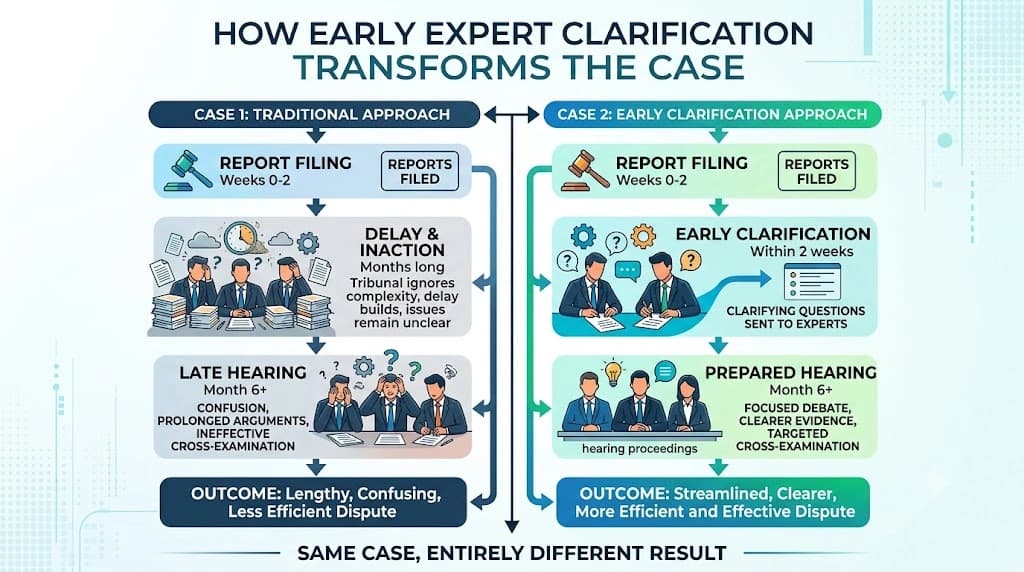
Picture the same case run two different ways. In the first, the tribunal reads both expert reports when they are filed, sets them aside, and revisits the technical detail only once the hearing begins months later. In the second, the tribunal poses a short list of clarifying questions within weeks of the reports landing, then proceeds to the hearing much as before. The second case almost always turns out to be a materially different, and materially better-run, dispute than the first, even though nothing about the underlying technical questions themselves has changed at all.
The mechanism behind this difference is simple but easy to underestimate: questions asked early land while the case is still malleable. A misunderstanding, an ambiguous assumption, or a genuine gap in an expert's reasoning identified within weeks of a report being filed can still be corrected, clarified, or narrowed before positions harden and before the cost of addressing it multiplies. The same issue, left undiscovered until a hearing, has to be litigated in the most expensive, most adversarial, least flexible setting available.
This is worth taking seriously as a genuine case management lever rather than a minor procedural nicety, because the timing of engagement with expert evidence is one of the few variables a tribunal can control directly and cheaply. Unlike the underlying technical complexity of a dispute, which the tribunal has no power to simplify, when substantive engagement with an expert's reasoning first occurs is entirely within the tribunal's control, and shifting it earlier costs little beyond the discipline of asking.
What Changes When Questions Come Early
An expert report, once filed, sits untested until someone engages with it. If that engagement first happens at a hearing, everything about how the issue gets resolved is shaped by the adversarial pressure of that setting, cross-examination, time constraints, the presence of a live audience whose reaction the expert cannot fully anticipate. If the same issue is instead surfaced through a written clarifying question weeks after filing, the expert has time to consider the question carefully, consult their own analysis without pressure, and respond in a considered, precise way that often resolves the ambiguity entirely before it ever needs to become a contested point.
There is also a straightforward psychological difference between how an expert engages with a written question received calmly at their desk and the same question posed live under cross-examination. The written setting invites genuine reflection, checking the underlying data again, reconsidering an assumption on its merits, rather than the instinctive, sometimes defensive posture that live adversarial questioning tends to provoke even in experts who have done entirely rigorous work. An answer produced under the first set of conditions is often simply a better, more considered answer than the same question would produce under the second.
This timing difference compounds because early questions frequently reveal that what looked like a genuine technical disagreement between opposing experts was actually a misunderstanding, a difference in how a term was used, an assumption one expert made explicit and the other left implicit, that dissolves once each side clarifies its own position. Issues that dissolve this way never make it to the hearing at all, which means hearing time that would otherwise have been spent litigating a misunderstanding gets spent instead on the genuine disagreements that remain, a much more productive use of everyone's time.
Early questions also change what a joint expert statement is capable of achieving. A joint conference held after the tribunal has already asked and received answers to its clarifying questions starts from a clearer, better-defined shared understanding of each expert's actual position, producing a joint statement that documents real, substantive disagreement rather than a document tangled up in cross-purposes because each expert was still working from a slightly different reading of the other's report.
This sequencing benefit is easy to underestimate until it is missing. A joint conference conducted before either expert's ambiguities have been clarified frequently spends much of its available time simply establishing what each expert actually meant in their initial report, time that could otherwise have gone toward substantively engaging with genuine points of disagreement. Early tribunal questions effectively do this clarifying work in advance, so the joint conference can start from genuine substance rather than basic mutual comprehension.
Why Waiting Until the Hearing Is So Costly
The default alternative, deferring all substantive engagement with expert evidence until the hearing, is not a neutral choice, even though it often feels like the natural or cautious one. It concentrates every misunderstanding, every ambiguity, and every genuine disagreement into a single, high-pressure setting where the cost of resolving each one is at its highest.
A misunderstanding surfaced at a hearing cannot simply be clarified in writing and set aside. It has to be explored live, through questioning, often extending hearing time that was budgeted for genuinely disputed issues rather than resolvable confusion. A tribunal that discovers, mid-hearing, that two experts were actually talking past each other on a supposedly disputed point has lost the opportunity to have that clarified efficiently in writing months earlier, and now has to work through it in real time, in front of both parties, under exactly the conditions least suited to calm, careful clarification.
There is a compounding cost specific to multi-day hearings: time lost early in a hearing resolving what turns out to be a clarifiable misunderstanding is time unavailable later in the same hearing for the genuinely disputed issues that actually need adversarial testing. Hearings run on fixed schedules far more often than case teams would prefer, and time spent on an issue that early written questions would have resolved is time a tribunal cannot recover for the issues that genuinely required the hearing format.
There is also a cost to the parties that compounds this problem beyond the hearing itself: preparing for cross-examination on an issue that might have been resolved in writing months earlier requires real time and expense regardless of whether the issue ultimately turns out to be a genuine disagreement or a resolvable misunderstanding. Counsel cannot know in advance which category a given ambiguity will fall into, so both sides prepare as though every unresolved ambiguity is a live, contested issue, a cost that early clarification would have eliminated for at least some portion of them before hearing preparation ever began.
What Makes a Good Early Question
Not every early question achieves the benefits described above, and the design of the question matters as much as its timing. Effective early questions are narrow and specific, targeting a particular assumption, data point, or step in the reasoning rather than asking an expert to justify their entire opinion in general terms, which invites a defensive, unfocused response rather than a precise, useful one.
Effective early questions also stay disciplined to process and clarification rather than drifting into an implicit substantive position. A question asking why a particular data set was used, or what would change under a specified alternative assumption, invites the expert to explain their own reasoning without requiring the tribunal to signal any view on which reasoning is more persuasive. A question that presupposes one interpretation of contested facts over another crosses from clarification into something closer to an indication of the tribunal's thinking, which risks exactly the appearance-of-prejudgment concern that makes some tribunals hesitant to engage early at all.
The best early questions are also genuinely open to a range of answers rather than functioning as a disguised challenge. An expert who senses that a question is really an attempt to trap them into an inconsistency responds defensively, in writing just as they would under hostile cross-examination, which undermines the entire value of asking early in a lower-pressure format in the first place.
A useful discipline for drafting these questions is to ask whether the same question would make sense regardless of which expert it was directed to, and regardless of which party's position the answer ultimately supports. A question that only makes sense as a challenge to one specific expert's conclusion has likely drifted from clarification into something closer to cross-examination conducted prematurely and in writing, which loses most of the benefit early questioning is meant to provide.
How Early Questions Change Expert and Counsel Behavior
The value of early questioning extends beyond the specific issues it resolves in any single case, because the expectation that questions will come early changes how experts and counsel approach the initial report itself. An expert who knows a tribunal will likely pose specific clarifying questions shortly after filing has a real incentive to write a report that anticipates and addresses the most obvious ambiguities upfront, rather than leaving them to surface only if someone happens to ask.
Counsel preparing an expert for this dynamic likewise has an incentive to review a draft report specifically for the kind of ambiguity a tribunal question might target, closing gaps proactively rather than hoping they go unnoticed until a hearing. This produces a quiet but genuine improvement in report quality across a tribunal's practice over time, once the expectation of early questioning becomes a normalized, anticipated part of how cases in front of that tribunal are handled.
This effect compounds across a tribunal's caseload in a way that is easy to overlook if attention stays fixed on any single case. Practitioners who appear repeatedly before the same tribunal or within the same institution learn, over successive matters, what kind of scrutiny to expect early, and adjust their default drafting habits accordingly, well beyond the specific case that first prompted the adjustment. A tribunal that consistently asks good early questions is, in effect, training the practitioners who appear before it to produce clearer reports as a matter of course.
The Risk of Getting the Timing or Framing Wrong
Early questioning is not risk-free, and two specific failure modes are worth naming directly. Questions asked too early, before an expert has had adequate time to develop their full analysis, risk being based on an incomplete or provisional version of the reasoning, producing answers that then have to be revisited once the fuller analysis is complete, adding a round of clarification rather than saving one. Waiting until a report is genuinely finalized and filed, rather than reacting to a preliminary draft or an early indication of an expert's likely conclusion, avoids this specific failure mode without sacrificing much of the timing benefit early questioning is meant to capture.
Questions framed too broadly or too aggressively, effectively asking an expert to defend their entire opinion rather than clarify a specific point, replicate the adversarial pressure of a hearing in written form without gaining any of the benefit early, low-pressure engagement is meant to provide. A tribunal that poses this kind of question early has often simply moved the hearing's most stressful dynamic earlier in the case rather than avoiding it.
Building This Into Practice
Capturing the benefit of early questioning reliably, rather than relying on a tribunal's case-by-case instinct to ask or not ask, works best when the practice is built into the case's procedural directions from the outset. Specifying a defined window, a set number of weeks after report filing, during which the tribunal may pose written clarifying questions, normalizes the practice as an expected part of the process rather than an unusual or exceptional intervention.
Encouraging counsel to flag genuinely ambiguous points in the opposing expert's report, for the tribunal's awareness rather than as an argument, can also usefully inform which questions get asked, since counsel reviewing a report adversarially often spot exactly the kind of ambiguity a clarifying question is best suited to resolve, even though counsel cannot pose the question directly themselves.
A short, standing agenda item at the first post-filing case management conference, specifically inviting the tribunal to raise any clarifying questions it has identified from an initial read of both reports, gives this practice a natural, recurring home in the case timetable rather than depending on someone remembering to propose it as a one-off. Once this becomes a routine feature of a tribunal's practice, it requires little additional deliberate effort to sustain across successive matters.
What This Means for Tribunals, Counsel, and Experts
For tribunals, the practical implication is to treat early clarifying questions as a standard, expected feature of case management for any technically complex dispute, rather than an occasional practice reserved for cases where a problem happens to become obvious early. The narrower and more disciplined the questions, targeting specific points rather than general reasoning, the more benefit is captured without any risk to perceived neutrality, and the habit is worth building even in matters that do not, at first read, appear to contain an obvious ambiguity.
For counsel, the implication is to prepare experts for the likelihood of early questions as a matter of course, reviewing draft reports specifically for the kind of ambiguity most likely to attract one, and to consider proactively flagging genuine ambiguities in opposing reports for the tribunal's awareness where appropriate.
For experts, the implication is to treat an early clarifying question as a genuine opportunity rather than a threat, a chance to resolve an ambiguity calmly, in writing, well before it would otherwise have to be defended under the pressure of a hearing.
For institutions developing model case management guidance, the implication is to include an optional, standard clause establishing an early clarifying-question window as part of default procedural templates, lowering the effort required for any individual tribunal to adopt the practice without having to design it from scratch for every new matter.
Frequently Asked Questions
How soon after a report is filed should clarifying questions typically be asked? There is no universal rule, but a window of a few weeks, enough time for the tribunal to have genuinely engaged with the report but before positions have hardened further, tends to capture most of the benefit.
Does asking early questions risk the tribunal appearing to prejudge the case? Not when questions are framed narrowly around clarification of an expert's own reasoning rather than presupposing a particular interpretation of contested facts. The framing of the question matters more than the fact of asking it early.
Can counsel request that a tribunal ask a specific clarifying question of the opposing expert? Directly requesting a specific question is unusual in most systems, but flagging a genuine ambiguity for the tribunal's awareness, without arguing a position on it, is a reasonable and often effective way to inform which questions the tribunal ultimately chooses to ask.
What is the biggest risk of asking clarifying questions too early? Questions posed before an expert's analysis is genuinely complete risk being based on a provisional or incomplete version of the reasoning, which can add an additional round of clarification rather than resolving the ambiguity in one pass.
Does early questioning replace the need for cross-examination at a hearing? No. It complements cross-examination by resolving misunderstandings and clarifiable ambiguities in advance, leaving hearing time available for the genuine, substantive disagreements that adversarial testing is actually well suited to explore.
Conclusion
The gap between a case where expert evidence is engaged with early and one where it is not becomes visible well before any hearing begins, in how clearly issues get defined, how productive joint expert conferences turn out to be, and how much hearing time ends up devoted to genuine disagreement rather than resolvable confusion. Early, narrow, disciplined clarifying questions are one of the lowest-cost, lowest-risk interventions available to any tribunal, and the cases where they are used consistently tend to run more smoothly at every subsequent stage, not because the underlying technical questions were any less difficult, but because the confusion that would otherwise have compounded across the case was resolved while it was still cheap to resolve. The tribunals that build this practice into their standard approach are, in effect, choosing to spend a small amount of attention early in exchange for a considerably smoother, less contentious process everywhere downstream.
Key Takeaways
● Questions asked shortly after a report is filed land while a case is still malleable, allowing misunderstandings to be resolved calmly in writing rather than litigated expensively at a hearing.
● Effective early questions are narrow, specific, and disciplined to clarification of an expert's own reasoning rather than presupposing a particular interpretation of contested facts.
● The expectation of early questioning changes behavior beyond any single case, incentivizing experts and counsel to proactively address ambiguity in reports before anyone has to ask.
● Building a defined early-questioning window into a case's procedural directions from the outset captures this benefit reliably, rather than depending on a tribunal's case-by-case instinct to engage.
Position yourself where the legal industry looks for expertise - sign up on exlitem.com to get discovered by leading lawyers and high-value clients.