
What the CJI Actually Said
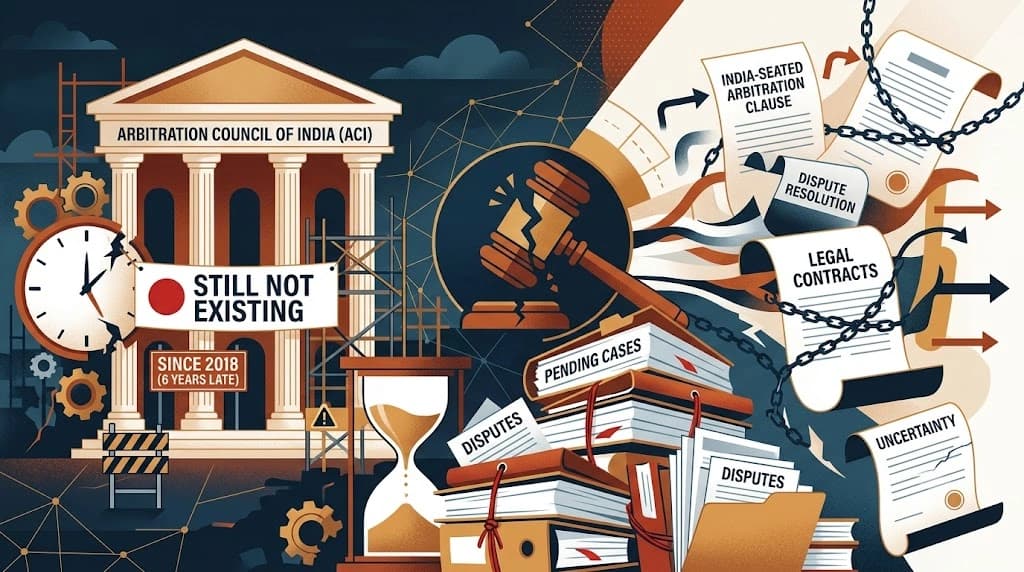
The setting was not incidental. The Indian Institute of Arbitration and Mediation (IIAM) marked 25 years of operation with a summit in New Delhi on 11 July 2026, and the Chief Justice's intervention was less a ceremonial nod than a pointed status update. CJI Kant told the gathering that India is moving toward treating alternative dispute resolution "not as a lesser substitute for justice but as one of its ordinary pathways" - and then immediately qualified that ambition by flagging the institutional machinery still missing to support it. Six years after the Arbitration and Conciliation (Amendment) Act, 2019 created the Arbitration Council of India (ACI) on paper, the Council has never been constituted. No chairperson has been appointed. No members sit on it. None of its statutory functions - grading arbitral institutions, accrediting arbitrators, maintaining a depository of domestic awards - have been performed by the body Parliament designed to perform them.
What made the remarks notable wasn't the diagnosis - practitioners have made the same point in law-review footnotes since at least 2021 - but the fact that they came from the CJI, on record, at a public forum, paired with an expression of hope that a bill addressing the gap will "now come up before Parliament." That is as close to a judicial nudge as India's arbitration bar has had in some time, and it is the reason this story belongs in the Must Cover column rather than the background file.
What the Council Was Actually Built to Do
To understand why the gap matters, it helps to be precise about what Parliament asked the ACI to do. The 2019 Amendment inserted an entirely new Part IA into the Arbitration and Conciliation Act, 1996 - Sections 43A to 43M - establishing the Council as a statutory body. Its composition was deliberately weighted toward independence and expertise: a retired Supreme Court or High Court judge as Chairperson (appointed by the Central Government in consultation with the Chief Justice of India), an eminent arbitration practitioner as a Central Government nominee, an academic member with research and teaching experience in arbitration, and two ex officio government secretaries from the Department of Legal Affairs and the Department of Expenditure.
Under Section 43D, the Council's functions were meant to include framing policy for the grading of arbitral institutions, setting standards for accrediting arbitrators, running training and capacity-building programmes, and maintaining a depository of domestic arbitral awards - the kind of infrastructure that mature arbitration jurisdictions take for granted. Section 43-I specifically empowered the Council to grade institutions against criteria including infrastructure quality, the calibre of empanelled arbitrators, and track record on time-bound disposal of cases. Section 43J tied arbitrator accreditation to qualifications and experience norms set out in the Act's Eighth Schedule.
In other words, the ACI was never a symbolic add-on. It was designed as the accreditation and quality-assurance layer beneath India's entire institutional-arbitration push - the body that would tell a party choosing between, say, the Mumbai Centre for International Arbitration (MCIA), the India International Arbitration Centre (IIAC) in Delhi, or the Indian Arbitration and Mediation Centre (IAMC) in Hyderabad which institution actually met a baseline standard, rather than leaving that judgment entirely to word of mouth and law-firm relationships. Its absence means that baseline simply doesn't exist. Every India-seated institution is, in effect, self-graded.
Six Years, No Council: Why the Gap Persisted
The delay has not gone unremarked in the years since 2019. Arbitration practitioners flagged the risk of an unimplemented Council almost as soon as the amendment passed, and the criticism has only sharpened with time: so much of the 2019 reform's promise was deferred to a body that then failed to materialise that commentators have described the amendment as having taken one step forward and two steps back.
No government notification has constituted the Council's membership, and none of the appointments contemplated under Sections 43B and 43C - the Chairperson, the practitioner-member, the academic member - have been made. The practical result, as CJI Kant's remarks confirm, is that six years of grading policy, accreditation standards, and case-law-informing infrastructure that Parliament asked for simply never arrived. For attorneys advising clients on arbitration clauses, that has meant operating in a vacuum where institutional credibility is established by an institution's own marketing, by counsel's personal experience, and by informal reputation among the bar - not by any independent, statutorily sanctioned benchmark.
The 2024 Draft Bill's Answer - and Why It Changes the Question
The Government's response, such as it is, has been in motion since February 2024, when a 16-member expert committee chaired by Dr. T. K. Viswanathan - a former Secretary in the Ministry of Law and Justice - submitted a report recommending a further round of arbitration-law reform. The Department of Legal Affairs converted that report into the Draft Arbitration and Conciliation (Amendment) Bill, 2024, released for public consultation on 18 October 2024. As of CJI Kant's remarks this month, the Draft Bill remains exactly that: a consultation draft. It has not been introduced in Parliament, let alone enacted.
What is notable is how the Draft Bill proposes to handle the ACI problem - not by fixing the appointment delay, but by rethinking the Council's mandate altogether. Rather than persisting with a formal grading system that has never actually been operated, the Draft Bill proposes to strip the Council of its Section 43-I grading power and replace it with a lighter-touch function: recognising arbitral institutions and publishing model procedural rules and guidelines, rather than ranking them.
Several other changes in the Draft Bill are directly relevant to disputes practice and worth flagging to clients now, even while the Bill sits in limbo:
First, the definition of "arbitral institution" is being broadened and simplified. Under the 2019 regime, an institution needed to be formally designated by the Supreme Court or a High Court to carry certain statutory functions - a bottleneck that effectively locked out newer or regional centres. The Draft Bill instead defines an arbitral institution simply as a body that administers arbitration proceedings under its own rules or as otherwise agreed by the parties, removing the court-designation requirement entirely.
Second, arbitral institutions themselves would gain powers that currently sit exclusively with courts - extending the time limit to render an award, reducing an arbitrator's fees where delay is attributable to the tribunal, and substituting arbitrators mid-proceeding. This is a meaningful shift of authority away from the judiciary and toward institutional case management, consistent with the reform's stated goal of reducing court intervention.
Third, the Bill introduces a strict 60-day limit for courts to dispose of an application referring parties to arbitration where a valid arbitration agreement exists, and a matching 60-day limit for filing appeals from arbitration-related orders - both aimed at the chronic problem of interlocutory applications stalling arbitrations for months or years before they even begin.
Fourth, the Bill finally gives legislative footing to emergency arbitration, which Indian courts - including the Supreme Court - have already recognised through case law but which the Act itself has never explicitly addressed. It also proposes replacing the ambiguous term "place" with the more precise "seat" and "venue", a terminological fix aimed at reducing the recurring seat-versus-venue litigation that has consumed years of court time in India-seated matters.
Fifth, the Fourth Schedule - the fee scale tied purely to the value of a claim - is proposed for deletion, in favour of a more nuanced, complexity-based approach to arbitrator remuneration, addressing a long-standing practitioner complaint that value-linked fee scales incentivise inflated claims and discourage arbitrators from taking on lower-value but complex disputes. And the Bill proposes an appellate arbitral tribunal mechanism and formal recognition of audio-visual proceedings, both aimed at institutionalising practices that arbitral institutions have already adopted informally.
Taken together, these are not cosmetic changes. They would shift India's arbitration framework further toward the institutional model that jurisdictions like Singapore and Hong Kong have used to build credibility as seats, while sidestepping the ACI's original, apparently unworkable, grading mandate rather than trying to force it into operation six years late.
Why CJI Kant's Remarks Matter Now, Specifically
Draft bills languish in India's legislative process routinely, and the 2024 Draft Bill's consultation phase has already run well past its original comment window without a parliamentary introduction. What changes with CJI Kant's remarks is not the text of the Bill - that hasn't moved - but the signalling. A sitting Chief Justice choosing to raise a specific legislative gap by name, at a public institutional event, is a different order of pressure than a law-firm client alert or an academic paper making the same point. It suggests the judiciary itself sees the ACI's absence as a live problem for India's credibility as an arbitration seat, not merely an academic curiosity, and that there is appetite on the bench for the Bill to move. For firms advising foreign clients on whether to seat India-related disputes in Mumbai, Delhi, Hyderabad, or offshore, that judicial framing is itself a data point worth including in seat-selection advice - even before the law changes.
The Parallel Track: Courts Are Quietly Fixing What the Legislature Hasn't
While the ACI stalls, a second and less visible pattern deserves attention: Indian High Courts have spent the past several years chipping away, case by case, at the procedural friction that legislative reform was supposed to address wholesale. The clearest recent example arrived the same week as the CJI's remarks. In an order dated 8 July 2026 in Bharat Sursingh Asher and others, Justice S. Manu of the Kerala High Court held that a "duly certified copy" of an arbitration agreement, for purposes of the Kerala High Court Scheme for Appointment of Arbitrators, 1996, does not need to be attested by a public authority such as a notary. An affidavit certifying the copy as a true copy of the original - together with an explanation for why the original itself was not produced, and attestation by the party or its counsel - is enough.
On its face this is a narrow procedural ruling about one High Court's arbitrator-appointment scheme. Its practical significance is broader: it removes a documentation hurdle that has, in practice, delayed the filing of straightforward arbitrator-appointment petitions when an original agreement is lost, held by a counterparty, or otherwise unavailable - precisely the kind of friction the Draft Bill's institutional-empowerment provisions are meant to eliminate by giving arbitral institutions more procedural latitude. The two developments read well together: courts easing documentary formalism at the retail level, while the pending legislation aims to remove the same category of friction at the systemic level. Attorneys should expect more of this - incremental judicial gap-filling - for as long as the legislative fix remains stalled.
What This Means for Attorneys Advising Today
The honest advice for practitioners is not to wait. India's institutional-arbitration infrastructure - MCIA, IAMC Hyderabad, IIAC in Delhi, and the nascent international arbitration centre planned for GIFT City - continues to develop its own rules, panels, and case-management practices independent of whether the ACI ever gets constituted. Institutional credibility in India today is, and will likely remain for some time, a function of an institution's own track record, its published statistics, its panel of arbitrators, and counsel's direct experience with it - not a Council-issued grade. When advising a client on institutional choice for an India-seated clause, that means doing the diligence the ACI was meant to do centrally: asking for an institution's actual case-disposal timelines, checking its published rules against the 2024 Draft Bill's direction of travel (does the institution already allow tribunal-ordered fee reductions or arbitrator substitution, for instance, ahead of the law catching up), and treating emergency-arbitrator availability as a practical selection criterion given that the courts, not the ACI, are the ones currently giving that concept legal teeth.
For drafting, the seat/venue distinction that the Draft Bill would formalise is worth adopting in clauses now, even without the amendment - using "seat" and "venue" explicitly, rather than the ambiguous "place", is already good drafting practice under existing Supreme Court jurisprudence and costs nothing to implement ahead of the statute catching up. Similarly, parties negotiating arbitrator fees should not wait for the Fourth Schedule's possible deletion; complexity-based fee arrangements can be, and increasingly are, negotiated directly into institutional rules or ad hoc clauses today.
Finally, firms should treat the current moment - CJI Kant's remarks, the Kerala HC ruling, and the continuing consultation on the Draft Bill - as a live news hook rather than settled background. Clients considering India as a seat, or already committed to India-seated arbitration, will have real questions about whether to wait for the amendment or proceed under the current framework. The honest answer, on the evidence to date, is to proceed: six years of non-constitution of the ACI suggests institutional patience is not a strategy, and the Draft Bill's own logic - sidelining the Council's original grading function rather than rescuing it - implicitly concedes that India's arbitration ecosystem has already moved on without it.
Ripple Effects Across the Disputes Practice
The ACI gap and the Draft Bill are usually discussed as a pure arbitration-procedure story, but the consequences run across every practice area Exlitem India covers. Construction arbitration is disproportionately technical-evidence-heavy - delay and disruption claims routinely turn on programme analysis, quantum experts, and voluminous contemporaneous records - and the Draft Bill's proposal to let institutions themselves extend award timelines and manage arbitrator substitution matters more, not less, in matters where a tribunal needs additional time to work through expert reports rather than being forced toward an artificial deadline or a court-supervised extension under Section 29A. Counsel running infrastructure and EPC disputes should read the institutional-empowerment provisions specifically through that lens: a faster, institution-managed extension process is a direct answer to the timeline pressure that complex quantum and delay analysis puts on tribunals today.
For forensic and investigations-adjacent disputes - asset tracing, fraud-linked arbitration references, and matters that intersect with SEBI, RBI, or Enforcement Directorate action - the Draft Bill's legislative recognition of emergency arbitration is the more consequential provision. Emergency relief is often the only tool available to freeze assets or preserve evidence before a tribunal is even constituted, and Indian courts have had to build that recognition through case law rather than statute. A codified emergency-arbitrator mechanism would remove a layer of argument that opposing counsel can currently raise about the enforceability of emergency orders, which matters disproportionately in fraud and asset-tracing references where speed is the entire point.
Damages and quantum practice is affected more indirectly, chiefly through the proposed deletion of the Fourth Schedule's value-linked fee scale. Complex quantum-heavy arbitrations - the kind that require forensic accountants, valuation experts, and extensive document review - are precisely the matters where a flat, claim-value-based fee schedule discourages arbitrators from taking the time the dispute actually requires. A complexity-based fee framework, if enacted, would remove a disincentive that currently works against exactly the technically intensive cases Exlitem's readership is most often instructed on.
None of this is contingent on the ACI itself finally being constituted. It is contingent on the Draft Bill moving - which is precisely why CJI Kant's remarks, thin as they are on hard legislative detail, are worth attorneys' attention now rather than when a bill text is actually tabled.
What to Watch
Three things will tell us whether this month's signalling turns into action: whether the Draft Bill is formally introduced in Parliament rather than remaining a consultation document; whether any appointments are made to the ACI even in its current, unamended form, which would suggest the government intends to operate the existing statute rather than wait for the amendment; and whether other High Courts follow Kerala's lead in relaxing procedural formalities around arbitrator appointment, which would reinforce the judiciary-led gap-filling pattern this piece has traced. Exlitem India will track all three.
Takeaways
The Arbitration Council of India has existed on paper since 2019 and nowhere else since 2019 - no members, no grading, no accreditation. CJI Surya Kant's on-record remarks this month are the strongest public signal in some time that the pending Draft Arbitration and Conciliation (Amendment) Bill, 2024 - which would replace the Council's grading function with a lighter-touch recognition role, introduce 60-day court and appeal timelines, empower arbitral institutions directly, and give legislative footing to emergency arbitration - may finally move toward Parliament. Attorneys advising on India-seated arbitration should not wait for the amendment: institutional diligence, seat/venue drafting discipline, and awareness of the judiciary's own incremental procedural reforms (like the Kerala High Court's ruling easing certified-copy requirements) are actionable today, regardless of when or whether the Bill is enacted.
Position yourself where the legal industry looks for expertise - sign up on exlitem.com to get discovered by leading lawyers and high-value clients.