
The Legal Architecture: How Rule 26 Draws the Line
The foundation for the testifying/consulting distinction is Federal Rule of Civil Procedure 26, which creates a framework for expert discovery that treats the two categories very differently.
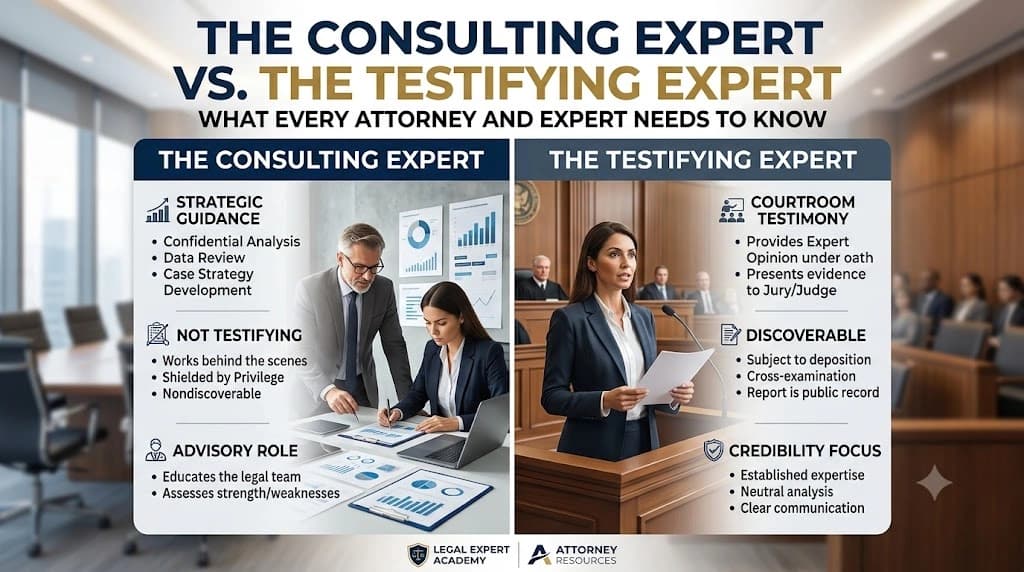
Under Rule 26(a)(2), a party must disclose the identity of any expert witness it may use at trial to present evidence, and - in the case of a retained or specially employed expert - must provide a comprehensive written report. That report must contain the expert's complete opinions, the basis and reasons for them, all facts or data considered, any exhibits to be used, the expert's qualifications, a list of prior testimony, and the expert's compensation. This is an extensive and consequential obligation. Once an expert is disclosed as a testifying expert, that expert's communications with counsel become partially discoverable: attorneys must disclose any facts or data provided to the expert, and any assumptions the attorney supplied that the expert relied upon.
Non-testifying consulting experts, by contrast, are protected by Rule 26(b)(4)(D). Under this provision, a party ordinarily cannot discover facts known or opinions held by a consulting expert who is not expected to be called as a witness. This protection is robust. It functions in concert with the attorney work-product doctrine to create a zone of frank, confidential engagement between attorney and expert that simply does not exist once an expert has been designated for testimony.
The line between the two categories is not always drawn at the outset. Experts are sometimes retained in a consulting capacity with the option to transition to a testifying role if their analysis supports a favorable opinion. Others begin as testifying experts and, for strategic reasons, are withdrawn from that designation - though courts scrutinize this maneuver carefully, and the work-product protection for communications after disclosure is generally not retroactively restored.
Toni Elhoms, a medical billing and coding expert with more than 200 depositions and five professional certifications who appeared on On the Stand Season 3, Episode 6, brings the federal report requirements into sharp relief from the expert's perspective: "in federal court, it is required and it's required in a very specific format." She also cautions experts about an often-overlooked vulnerability: draft opinions can be discoverable. The implication is significant - the transition from consulting work (where communications are protected) to testifying expert status (where they may not be) must be managed with care.
The Consulting Expert: Working in the Shadows of Strategy
If the testifying expert is the public face of a party's technical case, the consulting expert is the architect who designs it - working behind the attorney-client relationship, largely invisible to opposing counsel, and free to give assessments that might otherwise never survive the exposure of formal discovery.
What does a consulting expert actually do? Pavithra Kumar, a financial and securities expert and Principal at Advanced Analytical Consulting Group (AACG) who appeared on On the Stand Season 3, Episode 2, describes it with striking precision. In complex financial litigation, consulting work means "managing the day-to-day analysis, managing the correspondence with attorneys, running various scenarios, drafting the reports and exhibits." The consulting expert, in this model, is deeply involved in the technical substance of the case - sometimes more so than the testifying expert who will ultimately sign the opinions.
This collaborative, behind-the-scenes model is not limited to financial cases. It reflects a broader truth about modern litigation: the work of analyzing and framing complex technical evidence is substantial, and it frequently requires more than one expert working in different capacities.
Michael Graham, a medical librarian and founder of Graham Med Legal Research who appeared on On the Stand Season 3, Episode 4, occupies what may be the purest consulting role described on the podcast. He explicitly states: "I'm considered a consultant and not an expert." He never testifies. His role is to conduct systematic medical literature searches - using more than 100 databases - to identify the published evidence that will underpin a medical expert's opinions. "I'm a neutral information provider," he explains. He works on both plaintiff and defense cases in medical malpractice and product liability, supporting both attorneys and testifying experts. His work product - the research he conducts, the literature he identifies - is protected from discovery as long as he remains in a non-testifying consulting role.
John Puls, a licensed clinical social worker and addiction specialist who appeared on On the Stand Season 2, Episode 4, describes a particularly important gatekeeping function that consulting experts can serve. Sometimes, after reviewing a case, he tells attorneys directly: "you don't really want me to write a report." This is the consulting expert doing exactly what the role is designed to allow: providing a frank, protected assessment that the attorney can use to decide whether to proceed - without creating a document that could surface in litigation and damage the case.
Pre-Litigation Screening: The Consulting Expert's Most Strategic Deployment
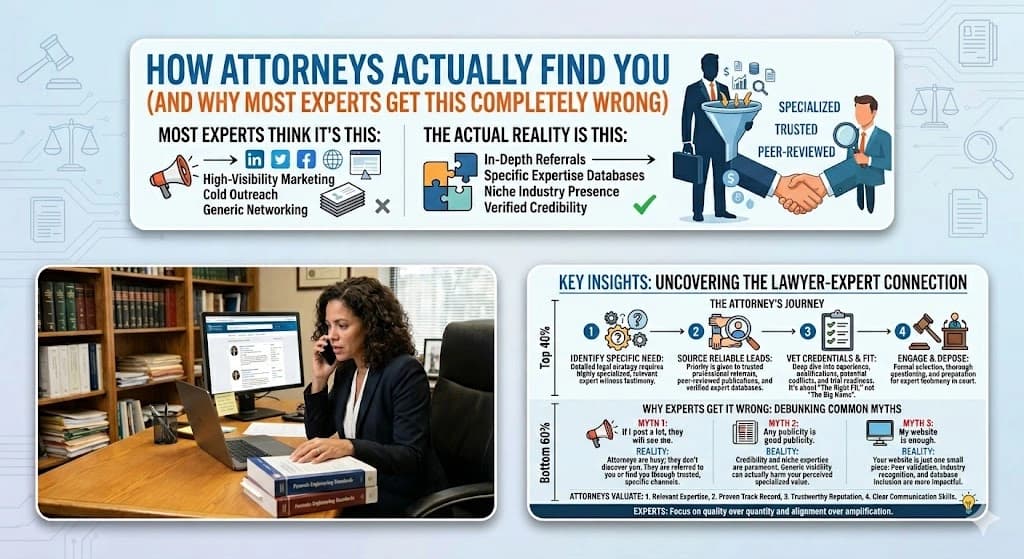
Perhaps the most underutilized - and most valuable - function of the consulting expert is pre-litigation case screening. Before a complaint is filed, before the case development clock starts running, before the parties have committed resources to litigation, a consulting expert can help an attorney make the most consequential early decision: whether this case is worth bringing at all.
Jordan Redavid, a plaintiff personal injury attorney and founding partner of Fischer Redavid Trial Lawyers who appeared on On the Stand Season 1, Episode 2, is unequivocal on this point: "The earlier that I can involve experts the better - in fact if I can involve them in the screening process, meaning do I even want to go forward or should this client even go forward." He describes using an orthopedic surgeon in a pure consulting and screening capacity before deciding whether to file suit on a rotator cuff case. When that surgeon reviewed the matter and concluded the case lacked merit, Redavid had a frank, privileged assessment he could act on - not a formal, discoverable opinion that would haunt him if he proceeded regardless.
Dr. Stephen Cohen, a board-certified colorectal surgeon with more than 30 years of experience in both practice and medico-legal consultation who appeared on On the Stand Season 3, Episode 1, makes the value proposition of pre-litigation consulting quantifiable. He states plainly: "About 40% of the time I review a case and tell the plaintiff attorney they don't have a case." That is a striking number. It means that for roughly four out of ten matters he reviews in a consulting capacity, his independent assessment prevents a potentially unsuccessful lawsuit from moving forward - saving the attorney, the client, and the judicial system from the costs of litigation that was never likely to succeed.
His guidance for attorneys is equally direct: "Get the expert involved early in the case before you decide anything." This principle - early expert involvement as a strategic imperative - runs throughout the best practices described by attorneys and experts across all three seasons of the podcast.
Dr. Robert Belfer, a pediatric emergency medicine expert at Children's Hospital of Philadelphia with experience in more than 75 cases who appeared on On the Stand Season 3, Episode 5, brings a similar philosophy to his pre-litigation practice. He advocates strongly for blind pre-litigation review, where the expert assesses the case without knowing which side is seeking the opinion - a methodology that protects both the credibility of the opinion and the strategic options of the attorney. He recommends that attorneys "curbside" a specialist before investing heavily in a case: a preliminary, informal consultation - which he makes available free of charge for the first 15 to 20 minutes - that can provide early directional guidance before any formal engagement begins.
The Florida legal context makes this even more concrete: Redavid explains that Florida requires an expert affidavit before a medical malpractice complaint can even be filed. This means that in Florida medical malpractice cases, pre-litigation consulting expert engagement is not merely strategic - it is legally required before the case begins.
The Testifying Expert's Obligations: Reports, Methodology, and the Daubert Gauntlet
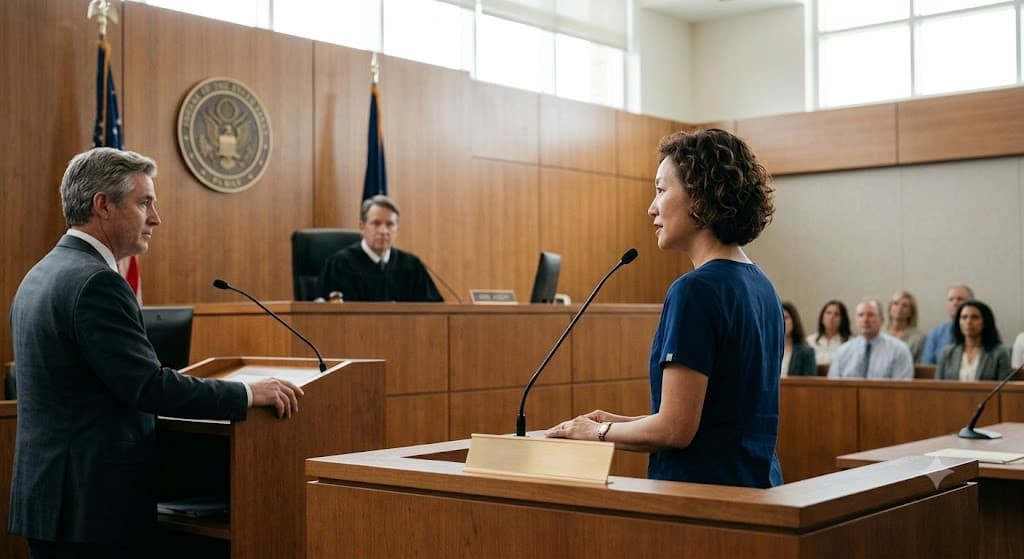
While the consulting expert works in protected silence, the testifying expert operates under an intense and scrutinized set of legal obligations. Once disclosed, the testifying expert's opinions are subject to challenge, their methodology must be defensible under Rule 702 and the Daubert standard, and their written report becomes a binding statement of their views.
Kevin Quinley, an insurance claims expert witness with experience in more than 140 cases who appeared on On the Stand Season 1, Episode 1, frames the testifying expert's fundamental obligation with clarity: "your role as an expert witness is simply to give your opinion - you're an advocate for your opinion versus being an advocate for the plaintiff or the defendant." This is not a minor distinction. The testifying expert who allows themselves to be pulled toward advocacy for a party - rather than advocacy for their genuine, independently formed views - is the expert who will crumble under cross-examination and potentially be excluded under Daubert before the jury ever hears a word.
Michael G. Kaplan, a forensic accountant and CPA with 46 years of experience and roughly 300 cases who appeared on On the Stand Season 1, Episode 3, addresses the practical art of Rule 26 report writing. His memorable formulation: "a good expert report starts with the following four words: once upon a time." What he means is that the report must tell a coherent story - it must take the reader, whether judge or jury, through the facts and reasoning in a way that builds logically toward the expert's conclusions. A report that reads like a technical document without narrative architecture fails to do its job, regardless of how sound the underlying analysis is.
Kaplan is also attuned to the evolving legal standards. The 2023 amendment to Federal Rule of Evidence 702 clarified that judges must act as active gatekeepers, confirming that an expert has actually applied their stated methodology to the facts of the specific case - not merely asserted that they have. For testifying experts, this means the written report and the testimony must demonstrate that methodology was followed, not just described.
Toni Elhoms adds an important practical dimension: the federal Rule 26 report is mandatory and format-specific. She describes working with attorneys who are less familiar with federal practice and stresses that the requirements are non-negotiable - the report must exist, must meet the required content standards, and must be served within the court's disclosure deadlines. Experts who have worked primarily in state court, where requirements vary widely, are sometimes surprised by how demanding federal practice is.
Discovery, Discoverability, and the Email Problem
One of the most consequential - and most frequently misunderstood - aspects of the testifying/consulting distinction is what happens to communications after expert disclosure. This is an area where the rules create real traps for the unwary.
Alvin Wolff, a personal injury attorney with 40 years of experience and more than 7,000 resolved cases who appeared on On the Stand Season 2, Episode 5, offers the most direct warning in the entire podcast series on this point: "you never want to put any of this in writing - because your emails are discoverable once you've disclosed your expert." Once an expert is disclosed as a testifying witness, the attorney's communications with that expert to the extent they reveal facts or data provided to the expert or assumptions supplied by counsel are subject to disclosure. The candid back-and-forth that characterized the consulting phase, if it continues after disclosure, can become opposing counsel's discovery target.
Toni Elhoms similarly warns experts that draft opinions - the intermediate versions of an expert's analysis before the final report is issued can be discoverable in federal court. While the 2010 amendments to Rule 26 eliminated the automatic discoverability of draft reports and expert-attorney communications in most circumstances, the rule has exceptions, and state court practice varies significantly. The practical message: assume that what you write may be read.
This is precisely why the consulting expert role is structured around confidentiality. Communications with a non-testifying consulting expert retain work-product protection because that expert is never disclosed the communications never become subject to the expert disclosure rules. For attorneys, the practical implication is clear: if there are questions you need frank answers to, or analyses you need to conduct that might not support favorable opinions, they belong in the consulting phase, under the protection of Rule 26(b)(4)(D).
Wolff also describes the stakes of not managing this correctly from the expert selection side. He recounts having to part ways with an expert he believed would not survive a Daubert challenge - a decision that required reconsidering the entire case strategy. The lesson: expert selection, and the decision about which expert plays which role, has consequences that extend from the earliest stages of case development all the way through trial.
When One Team Plays Both Roles: The Financial Litigation Model
In complex financial, securities, and commercial litigation, the consulting/testifying distinction often operates not between two individuals but between two roles within the same professional team or firm.
Pavithra Kumar's description of how her practice works illustrates this model with particular clarity. When a financial expert witness firm is retained, there is typically a testifying expert - a senior professional whose name will appear on the report, who will sit for deposition, and who will take the stand if the case goes to trial. Supporting that testifying expert is a consulting team: analysts, associates, and sometimes other principals who manage the day-to-day work of the case. They run the financial models, analyze the data, draft the exhibits, manage the voluminous document review, and maintain the correspondence with attorneys.
This consulting team is not expected to testify. Their work product is protected as part of the testifying expert's analytical support. But as the case moves toward deposition or trial, the dynamic shifts: the testifying expert must fully master everything the team has done, must be able to explain and defend every aspect of the analysis, and must be prepared to own every conclusion as their own independent opinion.
Kumar also addresses a practical challenge that arises within this model: what happens when the consulting team and the testifying expert reach different conclusions about the analysis? Managing that disagreement - navigating the difference between the team's working conclusions and the testifying expert's independently formed opinion - requires both intellectual rigor and professional sensitivity. The testifying expert cannot simply rubber-stamp the consulting team's work. Their obligation is to form and advocate for opinions that are genuinely their own, regardless of how those opinions were developed.
K. David Meit, a Certified Property Manager and real estate expert witness with more than 35 years of experience who appeared on On the Stand Season 2, Episode 3, captures the relationship between expert and attorney with an image that applies equally to both the consulting and testifying roles: "I'm an arrow in the attorney's quiver." The expert - whether consulting or testifying - is a tool deployed in service of a legal strategy. What distinguishes the consulting expert from the testifying expert is where and how that arrow is deployed: one in the dark, protected space of case development; the other in full view of the court.
What Attorneys Actually Want From Each Type of Expert
The attorney perspective on the consulting/testifying distinction reveals what practitioners most value from each role - and what makes each effective or ineffective.
For consulting experts, the most valuable quality is candor. Attorneys need honest assessments, including assessments that may be unfavorable to their client's case. Jordan Redavid's use of an orthopedic surgeon as a pre-litigation screener reflects this: the attorney wanted to know whether the case had merit before committing to it, and that required an expert willing to say "no" - something an expert in a testifying role would rarely be retained to do. Dr. Cohen's observation that he tells plaintiff attorneys they have no case approximately 40% of the time captures exactly this value: the consulting expert who functions as a gate, not just a rubber stamp.
Alvin Wolff describes wanting experts - both consulting and testifying - to serve as gatekeepers who will tell him early if the case lacks merit. For a plaintiff attorney working on contingency, as most personal injury attorneys do, a frank "you don't have a case" from a consulting expert early in case development is worth far more than a testifying expert who provides a favorable opinion that ultimately falls apart under cross-examination.
For testifying experts, what attorneys value most is credibility, independence, and the ability to communicate clearly. Kevin Quinley's formulation - that the expert is an advocate for their opinion, not for a party - is not merely an ethical principle. It is a practical one: juries and judges can detect advocacy masquerading as expertise, and the testifying expert who is perceived as a hired gun loses credibility with the fact-finder no matter how sound their analysis.
Wolff makes another point that applies specifically to testifying experts: he values inexperience strategically. He has found that experts who have never testified before bring a freshness and authenticity to the stand that can be more compelling than a seasoned expert who comes across as polished but rehearsed. "I love it when they've never done it before," he notes. This is the opposite of the conventional wisdom that testifying experience is always an asset - a reminder that attorneys evaluate testifying experts on a dimension that consulting experts never have to worry about.
Managing the Transition: When a Consulting Expert Becomes a Testifying Expert
One of the most consequential decisions in litigation is when, and whether, to transition an expert from a consulting to a testifying role. This transition is not reversible without strategic cost, and it must be managed carefully.
The moment a consulting expert is disclosed as a testifying expert, the protection of Rule 26(b)(4)(D) dissolves with respect to that expert. The communications, the working documents, the frank assessments that were protected under consulting status now become subject to the disclosure rules that govern testifying experts. If those communications contain candid views that are unfavorable - or that could be used by opposing counsel to suggest the expert was coached or directed - they become a liability.
This is why the best practice, consistently described by experienced practitioners across the On the Stand podcast series, is to conduct a rigorous consulting phase before making any testifying expert designation. Use the consulting engagement to identify weaknesses in the case, test potential opinions under scrutiny, and arrive at a confident, defensible view of what the expert can and cannot support. Only then should the expert be disclosed - at which point the testifying relationship begins on solid, strategically sound footing.
Michael Graham's approach to pure consulting - where he explicitly never transitions to a testifying role - represents one end of this spectrum. His value to attorneys and experts lies precisely in his non-testifying status: his research supports expert opinions without becoming subject to the discovery exposure that would come with testifying status.
John Puls's willingness to tell attorneys "you don't really want me to write a report" represents a similar principle: the consulting expert who helps an attorney understand the limits of their case - before the attorney has committed to a theory or a designated expert - is performing the most strategically valuable function the expert engagement model permits.
Best Practices: Building an Expert Strategy That Uses Both Roles Effectively
The expert witnesses and attorneys across three seasons of On the Stand converge on a set of practical principles for making the most of the consulting/testifying distinction.
Involve experts early, before litigation begins. Jordan Redavid's principle - "the earlier that I can involve experts the better" - is echoed by virtually every practitioner who has discussed pre-litigation strategy. Early expert involvement, in a protected consulting capacity, allows attorneys to make informed decisions about case viability before committing resources to litigation.
Use consulting experts for frank pre-litigation review. Dr. Cohen, Dr. Belfer, and others describe pre-litigation screening as one of the highest-value uses of expert consultation. An independent, blinded assessment of a case's merits - conducted before suit is filed and under the protection of the consulting relationship - provides information no other source can provide.
Protect communications after disclosure. Alvin Wolff's warning about discoverable emails is fundamental. Once an expert is designated as a testifying witness, treat all communications with that expert as potentially discoverable. Do the frank strategic analysis before disclosure, in writing only what must be written.
Understand the difference between state and federal requirements. Toni Elhoms and Michael G. Kaplan both emphasize that the rules - and particularly the Rule 26 report requirements - vary significantly between state and federal court. Experts who move between jurisdictions must understand which set of requirements applies to their engagement.
Build the testifying expert's report as a narrative. Kaplan's insight - that a good report tells a story - reflects what courts and juries actually need. Technical accuracy alone is insufficient. The report must guide the reader through the facts and analysis to the expert's conclusions in a way that is coherent, accessible, and persuasive.
Never blur the independence line. Kevin Quinley's principle that the expert is an advocate for their opinion - not for a party - is the ethical and practical foundation of effective expert testimony. Consulting experts who are candid, and testifying experts who are independent, serve both their professional obligations and their attorneys' long-term interests.
Conclusion: Two Roles, One Strategy
The distinction between the consulting expert and the testifying expert is not a technical legal nicety - it is a fundamental strategic architecture that shapes how cases are investigated, how evidence is developed, and how litigation is conducted at every level, from pre-litigation screening through trial.
Consulting experts work in the protected space created by Rule 26(b)(4)(D), providing attorneys with the candid, confidential analysis they need to evaluate cases, identify weaknesses, and make sound litigation decisions. Testifying experts work under the full disclosure obligations of Rule 26(a)(2), forming independent opinions that must withstand cross-examination and the gatekeeping scrutiny of Daubert and Rule 702.
The experts and attorneys who have shared their experiences on On the Stand with Ashish Arun - from Kevin Quinley's 140 cases as an insurance expert to Dr. Pavithra Kumar's complex financial litigation work to Michael Graham's never-testifying role as a medical literature consultant - collectively paint a picture of how these two roles function together in practice. They reinforce a consistent message: the most effective litigation strategy deploys both roles deliberately, early, and in full awareness of the legal protections and obligations each carries.
For attorneys, the takeaway is to bring consulting experts into case evaluation before the facts have hardened into a litigation strategy. For experts, it is to understand which role they are filling and what obligations - and protections - that role entails. For anyone seeking to understand how the machinery of complex litigation actually functions, the consulting/testifying distinction is as good a place to start as any.
Experts featured in this Article -
Kevin Quinley — S01E01, insurance claims
Jordan Redavid — S01E02, plaintiff PI attorney
Michael G. Kaplan — S01E03, forensic accountant
K. David Meit — S02E03, real estate expert
John Puls — S02E04, addiction/mental health
Alvin Wolff — S02E05, PI attorney (specific episode video found)
Dr. Stephen Cohen — S03EP1, colorectal surgeon
Pavithra Kumar — S03EP2, financial/securities expert
Michael Graham — S03EP4, medical librarian
Dr. Robert Belfer — S03EP5, pediatric emergency medicine
Toni Elhoms — S03EP6, medical billing/coding