
How Attorneys Actually Search - And It’s Not Where Experts Think
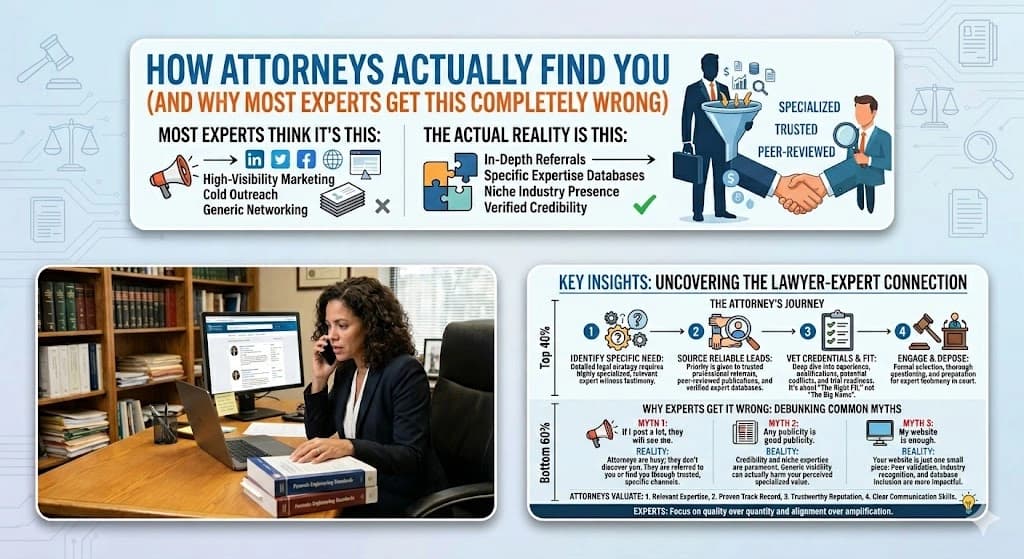
The first mistake most would-be expert witnesses make is imagining that attorneys find them the way consumers find products - through passive browsing of directories, professional websites, or keyword searches. In practice, experienced trial attorneys rely on a far more specific and personal set of channels.
Jordan Redavid - plaintiff attorney and founding partner of Fischer Redavid Trial Lawyers, featured in Season 1, Episode 2 - describes a layered approach that begins with his professional community. “My first phone calls are to people I know and trust,” he explains. When a novel or complex case demands someone outside his immediate network, Redavid turns to trial lawyer association forums - specifically organizations like the Trial Lawyers Exchange (TLE) in Florida and the Georgia Trial Lawyers Association (GTLA) - where attorneys share vetted expert recommendations with each other.
“I’ll go into our forums, I’ll look at our archives,” Redavid says. These attorney communities serve as curated, trust-filtered expert witness marketplaces - invisible to most experts, but highly active among practitioners.
Meanwhile, in Missouri, Alvin Wolff - personal injury and medical malpractice attorney with over 40 years of practice and more than 7,000 resolved cases, featured in Season 2, Episode 5 - follows a parallel path but adds one step that surprises many experts: a literature search. “I’ll go see who’s writing about this area,” Wolff explains. When he needs a medical expert in a particular specialty, he reads the journals and publications to find out who the active, publishing authorities actually are. “The better the doctor’s credentials, the more reasonable his fees and the more accessible he is,” Wolff observes.
This is a signal of enormous practical importance: published, credible experts are discovered not through self-promotion alone, but through the actual professional record they build over careers.
Content Marketing and the Invisible Pipeline
No expert witness illustrates the power of professional visibility through content more clearly than Kevin Quinley - an insurance claims consultant and expert witness with more than 40 years of experience, the author of 10 books and more than 700 published articles, featured in Season 1, Episode 1.
Quinley did not start publishing to get expert witness cases. He published because he was passionate about his field - insurance claims and risk management. But the compound effect of that publishing over time became the most powerful business development tool he had. “You’ve got to give before you get,” Quinley explains. Years of writing articles, speaking at conferences, leading professional associations, and contributing to industry publications created a gravitational pull: law firms began calling him without any direct outreach. His name was simply attached to the subject matter, and attorneys who needed an insurance expert naturally encountered it.
“Big trees grow from little seeds,” Quinley reflects, describing how each article, speech, and professional relationship eventually translated into work. His advice to new experts echoes a principle common in professional services: “Dig your well before you’re thirsty.” The expert who waits until they need cases to start building visibility will always be too late.
Dr. Robert Handfield - Bank of America University Distinguished Professor at North Carolina State and one of the world’s leading authorities on supply chain management, featured in Season 2, Episode 10 - demonstrates a similar phenomenon from the academic side. “I believe that’s because I have a strong academic background as well,” Handfield says, explaining why he is regularly contacted by legal teams. “I publish a lot. I publish books, peer-reviewed journal articles.” He also runs an industry-academic cooperative program, working alongside companies across multiple sectors - creating ongoing visibility within the professional communities most likely to generate expert witness referrals.
Handfield’s first case came not through any marketing effort, but through a referral from supply chain managers at a pharmaceutical company he was consulting with. They recommended him to their legal counsel as someone who “knows a lot about our company” and “would be a really good expert witness.” His professional reputation preceded him into the courtroom.
LinkedIn and Digital Presence - The New Front Door
The digital channel that has most changed the expert witness discovery landscape in recent years is LinkedIn. Multiple experts and attorneys confirm it is now the primary place where attorneys verify an expert’s credentials and reach out for initial contact.
Dr. Stephen Cohen, speaking directly to colleagues wondering whether they should market themselves, addresses the discomfort many professionals feel about self-promotion: “Don’t be scared to market… there’s a lot of different avenues you can legitimately market yourself that are not third parties that don’t put your hand in your pocket to take money from you that are reputable. There is no reason not to do that.”
His own prescription is clear: LinkedIn is the most important tool. On his profile, he maintains his full CV, his email address, and his cell phone number. “Attorneys will call me all the time,” he says. “If I’m in the operating room, I may not answer right away, but I will call you back.”
Dwyane King - a certified AML (anti-money laundering) expert, former Toronto Police Service officer, and one of Canada’s foremost authorities on financial crime, featured in Season 3, Episode 9 - offers the same advice from an entirely different professional world: “LinkedIn is probably the best way because email addresses change and phone numbers change.” King is regularly active on the platform, sharing observations and commentary on money laundering cases in the news - building both visibility and a record of expertise that attorneys can review before reaching out.
John Puls - a Licensed Clinical Social Worker and addiction specialist who has testified in high-profile cases involving addiction treatment and mental health, featured in Season 2, Episode 4 - demonstrates what happens when experts make themselves genuinely findable. Attorneys frequently contact Puls because, in his niche area of addiction treatment litigation, he is sometimes the only credentialed expert they can locate. “The comments I frequently get from attorneys is ‘you were the only person I found who could do this type of work,’” Puls says. Having a website, directory listing, and active professional presence is not vanity - it is visibility that generates work.
What is most striking about Puls’ entry into expert witness work: his very first case came through a Facebook post, when someone in a professional group asked if anyone knew an expert in addiction treatment litigation. He saw the post, responded, and a career was born. The channel matters less than the presence. If you are not reachable, you are not hireable.
Conferences, Associations, and Professional Networks
Beyond digital presence, in-person professional activity remains one of the most reliable pathways to expert witness engagements - both for experts seeking visibility and for attorneys building their expert networks.
For John Puls, conference presentations have proven to be the single most effective marketing activity he engages in. By presenting at professional conferences in addiction treatment and mental health, he connects directly with clinicians, researchers, and other professionals across the country - people who later refer him to attorneys, or who are themselves approached by attorneys looking for experts in his specialty.
Kevin Quinley built much of his business through a similar combination of conference speaking, professional association leadership, and co-authoring with practitioners in adjacent fields. Being president of a professional association, chairing committees, and speaking at industry events all created the kind of sustained visibility that passive directory listings never could.
For Alvin Wolff, the professional medical network serves as a deeply trusted expert referral source. Over four decades of practice, he has built relationships with physicians through medical-legal conferences and professional organizations - relationships he draws on when he needs an expert in a particular medical specialty. These are not cold searches; they are trusted networks built through years of professional engagement.
The lesson across all three is consistent: expert witness work rarely flows from random discovery. It flows from sustained professional credibility and community belonging. Experts who invest in their professional communities are also, often without realizing it, investing in their expert witness pipeline.
The Agency Question - Expert Search Services
One of the most debated channels in expert witness discovery is the paid search agency or expert witness placement firm - companies that help attorneys find and vet experts for specific cases. The verdict from the attorneys and experts interviewed across On The Stand is decidedly mixed.
Jordan Redavid has used paid search agencies for especially niche or technical cases. He acknowledges that his single most effective expert in a complex case came through one of these services. However, he describes the experience as “very expensive” and notes that even a carefully vetted expert found this way was subsequently challenged under Daubert. “They’re not guaranteed,” Redavid says. For most cases, he would rather rely on trusted personal referrals or professional community channels first.
Alvin Wolff is even more direct. He will only turn to referral services “unless I can’t find somebody independently.” His preference is for direct contact with the expert, without any intermediary. He finds that many services add friction without adding proportionate value.
Dr. Robert Handfield, on the other hand, works with a third-party company that actively represents him to legal teams. “I will work through a third-party company that represents me, that will talk to legal teams based on new cases that are coming forward, and they’ll present me as a potential witness,” he explains. For experts at the top of their field who are not actively marketing themselves, having a representative can open doors that passive presence alone would not.
Dr. Stephen Cohen urges experts not to assume they must rely on paid third parties, while acknowledging that some services are reputable. His concern is with the subset of services that charge fees to experts or take a cut of their billings - arrangements that reduce earnings without necessarily improving case quality. “There’s a lot of different avenues to do it legitimately,” he says, “that are not third parties that don’t put your hand in your pocket.”
A newer model is also emerging. Dr. Cohen described a platform called Kalivar, through which attorneys upload brief case details and multiple experts provide blinded preliminary opinions on whether a case has merit. The attorney can then select the expert whose reasoning and communication style they find most compelling - turning the discovery process into a two-way audition. It is early days for platforms like this, but they point toward a future where expert discovery is more structured, more transparent, and more efficient for both sides.
What Attorneys Actually Want - And What Drives Them Away
Expert witnesses who focus only on credentials and visibility are solving for only half the problem. Once an attorney finds a potential expert, they are quickly evaluating a set of factors that have nothing to do with expertise - and these factors determine whether that expert gets hired, kept, and referred to others.
Responsiveness is the single quality mentioned most often by attorneys. Alvin Wolff puts it plainly: the expert who “won’t play games,” is “responsive,” and “learns the file” is the expert worth hiring again. He describes the frustration of reaching out to a promising expert only to encounter delays, screening processes, or unanswered calls.
Dr. Stephen Cohen offers a counterpart from the expert’s side: “When an attorney calls me, unless I’m in the operating room, I stop and answer the phone. What do you need? What can I do? How can I help? It is not their side job.” This is not mere politeness - it reflects a deep understanding of how attorneys operate. They are managing time-sensitive deadlines, scheduling orders, and disclosure requirements. An expert who treats attorney calls as low priority will quickly fall to the bottom of the referral list.
Jordan Redavid identifies several specific behaviors that destroy attorney trust. Surprise invoices - charges the expert did not communicate upfront - create immediate friction and signal a lack of professional transparency. Overly familiar behavior that blurs the line between expert and advocate can undermine credibility with juries. And ghosting or delayed responses at critical case junctures can jeopardize the case itself.
Interestingly, both Redavid and Alvin Wolff expressed genuine openness to first-time expert witnesses. “I’ve given a lot of experts their maiden voyage,” Wolff notes, explaining that first-time witnesses can sometimes be more credible with juries precisely because they cannot be impeached as career testifiers. What attorneys lose in courtroom experience, they may gain in the authenticity that jurors respond to. For emerging experts, this is an important insight: lack of experience is not necessarily a barrier if credentials are strong and the expert is professional, responsive, and willing to prepare deeply.
The Long Game - Word of Mouth as the Ultimate Pipeline
For experts who have been practicing long enough, something remarkable happens: the marketing stops being active and becomes passive. The referral engine takes over.
Dr. Stephen Cohen describes reaching a point where 75 to 80 percent of his new cases come from attorneys he has already worked with - or from new attorneys at those same firms who heard about him from a colleague. “An email yesterday, an attorney in my firm said they work with you and we should reach out about this case,” he recalls. The original relationship, built through excellent work and professional rapport, continues to generate new business years later.
Kevin Quinley has described a similar evolution. He regularly engages in what he calls business development outreach - reaching out to attorneys he has not heard from in a while, checking in, staying present. Combined with his ongoing publishing and speaking, this keeps him visible in the minds of attorneys who may not have a current case but will remember his name when one arises.
Dwyane King is still at an earlier stage of this journey - currently working full-time in the financial sector while taking cases selectively. But he has a clear long-term plan: build reputation and expertise now, become fully available later, and let the professional network that has been accumulating for decades generate the case flow he needs. “In two or three years when I’m done full-time work, that’s when I’ll probably put the shingle out in front of the door and make myself a lot more available and really start to drive my face in the market,” King explains.
The arc from unknown to in-demand expert witness is not a sprint - it is a long professional campaign of showing up, contributing, and delivering excellent work. Kevin Quinley’s phrase serves as an apt guiding philosophy for anyone entering this space: “Dig your well before you’re thirsty.”
Conclusion
The gap between being qualified and being found is one of the central challenges of the expert witness profession - and it is entirely bridgeable with the right strategy. Attorneys search in specific, often underappreciated channels: professional association forums, published literature, trusted colleague networks, and increasingly, LinkedIn. The experts who get hired consistently are the ones who have made themselves visible in these spaces long before any specific case arose.
Content creation and conference participation build the foundation. Digital presence and responsiveness convert opportunities into engagements. Excellent work and professional integrity turn single engagements into ongoing relationships. And over time, those relationships become a self-sustaining referral engine.
The experts who understand this - like Kevin Quinley, who gave before he got; like John Puls, who made himself findable in a highly specialized niche; like Dr. Stephen Cohen, who picks up the phone - are the ones who never have to wonder why attorneys are not calling.
The ones who do not understand it are still waiting for their credentials to speak for themselves.
Experts Featured in this Article
Kevin Quinley (S01E01) — insurance expert, content marketing philosophy
Jordan Redavid (S01E02) — plaintiff attorney, how attorneys actually search
Alvin Wolff (S02E05) — plaintiff attorney, literature search + network
John Puls (S02E04) — addiction expert, Facebook post origin + findability
Robert Handfield (S02E10) — supply chain professor, academic publishing
Dr. Stephen Cohen (S03EP1) — surgeon, LinkedIn + responsiveness + Kalivar
Dwyane King (S03EP9) — AML expert, LinkedIn + long-game strategy