
Collaboration between opposing experts is usually described as an unambiguous good. Narrowed issues, candid dialogue, professional respect between technical peers, all of it sounds like exactly what a well-functioning dispute resolution process should produce. And most of the time, it is. But collaboration between experts is not automatically virtuous simply because it looks cooperative, and treating every instance of expert agreement as evidence of a well-run process misses a genuine tension worth examining directly: some agreement reached through collaborative dialogue genuinely reflects sound technical consensus, and some of it reflects an expert conceding more ground than the underlying analysis actually supports, simply because conceding feels more collegial than holding a position firmly.
Neither extreme, reflexive collaboration nor reflexive resistance, serves a case well. The useful skill is distinguishing between the two, in real time, during exactly the kind of professional exchange that is supposed to be free of outside coaching. That distinction is harder to draw than it sounds, and getting it wrong in either direction carries real costs.
Why Collaboration Is Generally Treated as a Virtue in Expert Practice
The professional culture around expert evidence has, for good reason, developed a strong preference for experts who engage constructively with opposing views rather than defending a position reflexively regardless of what the other side raises. An expert who dismisses every point raised by an opposing expert without genuine engagement looks less credible to a tribunal than one who visibly considers the other side's reasoning and either adopts it, where warranted, or explains clearly why it does not change their own conclusion.
This preference exists because it usually produces better evidence. Experts who never revise anything in response to a competent opposing view are more likely to be defending a position out of habit or loyalty than out of genuine technical conviction, and tribunals experienced enough to have seen both kinds of experts tend to discount the ones who never move an inch, regardless of what is actually raised against them. Genuine intellectual engagement, including a willingness to concede specific points when the underlying analysis genuinely supports doing so, is one of the clearest signals of an expert operating independently rather than as an advocate.
The trouble is that this entirely reasonable preference for collaborative, engaged experts can tip into a different and less reasonable expectation: that any concession is inherently good, that narrowing disagreement is always progress, and that an expert who reaches more agreement with the opposing expert has done a better job than one who reaches less. This framing quietly erases the possibility that the correct, most defensible position genuinely involves substantial disagreement, and that reaching for agreement past that point is not collaboration in any meaningful sense. It is simply conceding ground the analysis does not actually require conceding.
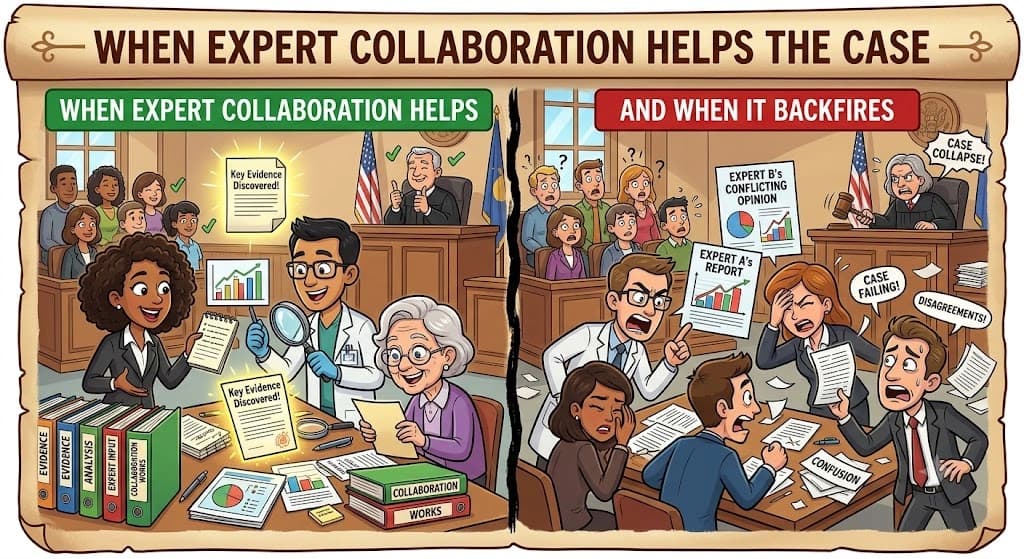
Where Collaboration Genuinely Helps the Case
The clearest cases of beneficial collaboration involve genuinely technical questions where two competent experts, working independently and honestly, converge on a shared answer because the underlying analysis actually supports that answer. A calculation error identified and corrected during a joint discussion, a methodological refinement adopted because the opposing expert's approach is demonstrably more accurate for the specific fact pattern at hand, an assumption revised because new information genuinely changes its validity, these are all instances where collaboration produces a better, more accurate final position than either expert would have reached alone.
Collaboration also helps considerably in narrowing the sheer volume of what a tribunal has to resolve, when the narrowing reflects genuine agreement rather than strategic concession. Two experts who identify, through honest technical dialogue, that a particular sub-issue was never actually in serious dispute once properly understood, save the tribunal meaningful time and the parties meaningful expense, without either side giving up anything of real substance. This kind of narrowing is unambiguously good, and it is the primary reason the entire joint conferencing process exists in the first place.
A further, less discussed benefit involves the quality of the eventual disagreement that remains. Experts who have engaged seriously and collaboratively with each other's positions, conceding what genuinely warrants conceding, tend to leave behind a much sharper, better-articulated residual disagreement than experts who resisted engagement altogether. A tribunal facing a precise, well-defined point of genuine technical disagreement between two experts who have clearly done the work of testing each other's reasoning is in a considerably better position to resolve that disagreement than one facing a sprawling, poorly tested dispute between two experts who never seriously engaged with each other's views.
Collaboration of this kind also tends to produce more efficient cross-examination later, when the case reaches a hearing. An expert who has already worked through and either accepted or clearly rejected the strongest points the opposing expert can raise has, in effect, pre-tested their own position under something close to adversarial conditions, well before facing formal cross-examination. This generally produces a more confident, more precise witness at the hearing itself, since the expert has already confronted the hardest questions once, in a lower-stakes setting, and had time to refine their answers accordingly.
When Collaboration Starts to Backfire
The risk begins when the social dynamics of a collaborative conversation start to exert pressure independent of the underlying technical merits. Two professionals meeting to discuss a disagreement, particularly over an extended session, naturally develop a kind of interpersonal rapport, and that rapport can create a mild but real pull toward agreement simply because disagreement, sustained over a long conversation with someone one is actively engaging with respectfully, starts to feel socially uncomfortable in a way it would not feel on paper. An expert susceptible to this pull may find themselves conceding a point less because the analysis has genuinely changed and more because continuing to disagree, in the moment, feels disproportionately confrontational relative to the actual stakes of the specific point.
A related risk involves asymmetric persuasive skill, distinct from asymmetric technical merit. Some experts are simply more articulate, more confident, and more persuasive in live conversation than others, independent of whose underlying position is actually stronger. A joint conference between a highly persuasive expert and an equally competent but less rhetorically confident one can produce a joint statement that reflects the balance of interpersonal persuasive skill in the room rather than the balance of the actual technical merits, particularly if the less confident expert interprets their own hesitation as a signal that their position must be weaker than it actually is.
This asymmetry can be compounded by differences in experience with the joint conferencing format itself, separate from either general confidence or underlying technical skill. An expert who has participated in dozens of joint conferences over a long career develops a familiarity with the rhythm and negotiation dynamics of the exchange that a highly competent expert appearing in only their second or third joint conference may not yet have. That experience gap, on its own, can shift the balance of a conference in ways that have nothing to do with the comparative strength of either expert's actual analysis.
There is also a specific failure mode worth naming directly: conceding a point to preserve credibility on other points. An expert who senses that holding firm on every single disputed item risks looking rigid or uncooperative may deliberately concede a smaller, less important point specifically to bank goodwill and credibility for the points that matter more. This is not necessarily irrational as a tactic, but it is worth the expert being honest with themselves about when they are doing it, since a concession made for interpersonal strategic reasons rather than genuine technical conviction is a different thing entirely from a concession made because the analysis warrants it, even though the two look identical on paper.
The Difference Between Conceding a Point and Conceding Ground
It helps to draw a clear distinction between two things that get bundled together under the single word "concession." Conceding a point means changing a specific conclusion because the underlying technical reasoning genuinely supports the change, a calculation was wrong, an assumption does not hold, a methodology is demonstrably weaker for this specific fact pattern. This kind of concession strengthens an expert's credibility rather than weakening it, since it demonstrates the expert is following the analysis rather than defending a position for its own sake.
Conceding ground means agreeing to language, framing, or emphasis that goes beyond what the underlying technical position actually requires, typically because doing so feels more collegial, more efficient, or less confrontational in the moment. This kind of concession, repeated across a joint conference, can quietly shift the substance of a joint statement away from what either expert would have concluded working entirely independently, without either expert making a single technically indefensible statement along the way. The distortion happens gradually, through many small moments of accommodation, rather than through any single obviously wrong concession.
The practical challenge is that these two kinds of concession feel identical from the inside, in the moment, during a live conversation. An expert genuinely revising a conclusion and an expert quietly accommodating social pressure both experience the moment as "agreeing with a good point," and distinguishing between them requires a level of self-awareness that is considerably harder to maintain in real time than it is to describe afterward.
A Practical Test for Deciding Whether to Concede
One useful discipline is a simple pause-and-restate test: before agreeing to any specific point during a joint conference, silently restating, to oneself, the precise technical reason the concession is warranted, independent of how the conversation has gone or how the other expert has framed the point. If that internal restatement produces a clear, specific technical justification, the concession is almost certainly sound. If it produces something closer to a vague sense that continuing to disagree feels unproductive or uncomfortable, that is a signal worth taking seriously before proceeding.
A second useful discipline involves separating real-time conversation from final commitment wherever the process allows it. An expert who notes, during the conference itself, that a particular point warrants further consideration rather than committing to a position on the spot, and who reviews that specific point independently afterward before the joint statement is finalized, gives themselves a genuine check against the social pressure of the live exchange. This does not need to apply to every point raised, but reserving it for points that feel meaningfully consequential is a low-cost safeguard against the kind of drift discussed above.
Some experienced experts build this discipline into their standard practice explicitly, treating the joint conference itself as producing only a provisional draft rather than a final document, with a short, defined window afterward reserved specifically for reviewing any point conceded under live conversational pressure before it becomes final. This does not reopen genuinely settled points to indefinite renegotiation; it simply builds a brief, structured pause into the process specifically to separate the heat of live dialogue from the more considered judgment that tends to follow it.
A third discipline, useful for particularly significant points, is asking explicitly what the concession would look like if written down and read cold, days later, without the context of the conversation that produced it. A concession that reads as clearly justified under that kind of scrutiny is almost certainly sound. One that reads as puzzling or difficult to reconstruct the reasoning for, once removed from the social context of the conversation, deserves a second look before it becomes part of a final, filed joint statement.
What This Means for Experts and the Counsel Who Instruct Them
For experts, the implication is to treat genuine collegiality and rigorous independence as fully compatible rather than in tension, engaging warmly and constructively with an opposing expert's reasoning while holding a separate, disciplined internal check on whether each specific concession is technically warranted or merely socially comfortable in the moment.
For counsel, the implication is to resist the instinct, discussed at length elsewhere in this content series, to treat a joint statement showing substantial residual disagreement as a failure of the process. A joint statement reflecting genuine, well-tested disagreement on points that actually warrant disagreement is a better outcome for the case, and arguably a better outcome for the tribunal, than one showing extensive agreement achieved partly through social accommodation rather than technical conviction.
For tribunals, the implication is to read joint statements with some awareness of this dynamic, recognizing that the absence of disagreement is not automatically evidence of a well-run collaborative process, and that a joint statement showing careful, well-articulated residual disagreement on a smaller number of genuinely disputed points can reflect more rigorous engagement than one showing broad but less rigorously tested agreement.
This does not mean tribunals should treat broad agreement with automatic suspicion, since genuine consensus is common on questions where the technical answer really is relatively clear-cut. The more useful practice is simply not to equate the volume of agreement with the quality of the process on its own, and to give the same careful attention to how a joint statement's areas of agreement were reached as is typically given to how its areas of disagreement are explained and justified.
Frequently Asked Questions
How can an expert tell, in the moment, whether they are conceding a point for the right reasons? A useful check is to silently restate the specific technical justification for the concession before agreeing to it. A clear, specific justification suggests the concession is sound; a vague sense that continued disagreement feels unproductive is worth pausing on.
Is it a bad sign if a joint statement shows very little disagreement between the experts? Not necessarily, but it is worth some scrutiny. Extensive agreement can reflect genuine technical consensus, or it can reflect social accommodation during the conference itself, and the two are not always easy to distinguish from the finished document alone.
Should an expert avoid conceding points during a joint conference to protect their position? No. Genuine, well-reasoned concessions strengthen an expert's credibility rather than weakening it. The goal is not to avoid concession altogether but to ensure every concession made is grounded in genuine technical reasoning rather than interpersonal dynamics.
Does this concern apply equally to both sides of a dispute? Yes. The social pressures that produce unwarranted concessions during a joint conference do not track which side an expert is instructed by; they arise from the basic dynamics of live, collaborative conversation and can affect any expert, regardless of how strong their underlying position actually is.
Is video conferencing better or worse than in-person meetings for managing this risk? The evidence is mixed. Video conferencing reduces some of the interpersonal rapport-building that drives unwarranted concessions, but it can also make it harder to read genuine engagement accurately, which carries its own separate risks. Neither format eliminates the need for the internal disciplines described above.
Conclusion
Collaboration between opposing experts is genuinely valuable, and an expert who engages constructively with an opposing view is, in most cases, doing exactly what the process is designed to encourage. The risk is not collaboration itself but the quiet substitution of social comfort for technical conviction that can occur within it, a substitution that produces concessions indistinguishable, in the moment, from genuine ones. The experts who navigate this well are not the ones who resist collaboration to avoid the risk, nor the ones who collaborate freely without noticing the risk exists. They are the ones who collaborate genuinely while maintaining a disciplined, honest check on why each specific concession is actually being made.
Key Takeaways
● Collaboration between opposing experts is genuinely valuable when concessions reflect real technical reasoning, and genuinely risky when concessions reflect social accommodation that feels identical to reasoning in the moment.
● Conceding a specific point because the analysis warrants it strengthens an expert's credibility; conceding ground because disagreement feels socially uncomfortable quietly distorts the eventual joint statement without any single obviously wrong step.
● A simple internal test, restating the specific technical justification for any concession before agreeing to it, helps experts distinguish genuine revision from social pressure in real time.
● Tribunals should not treat extensive agreement in a joint statement as automatic evidence of a well-run process; a smaller number of genuinely well-tested points of disagreement can reflect more rigorous engagement than broad but less scrutinized consensus.
Position yourself where the legal industry looks for expertise - sign up on exlitem.com to get discovered by leading lawyers and high-value clients.