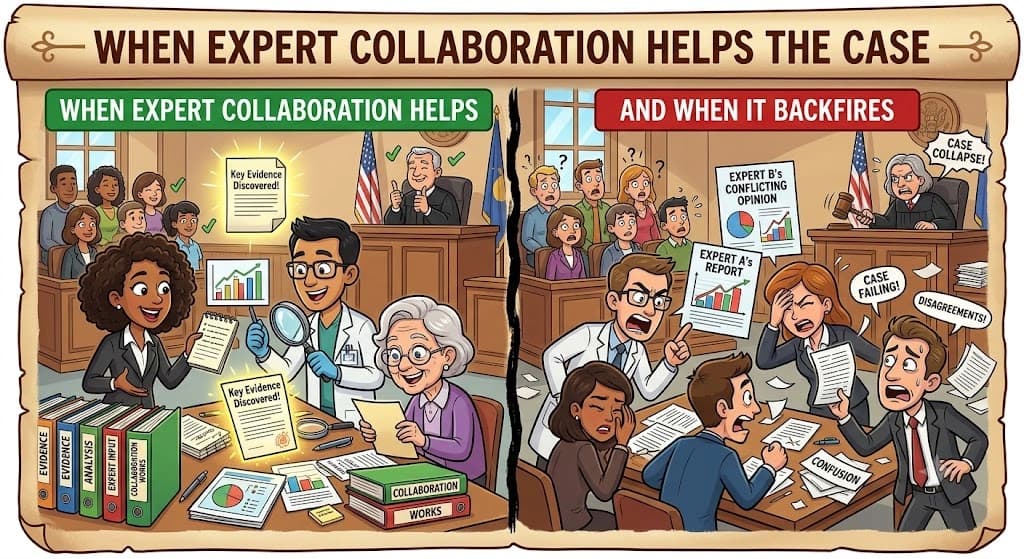


Almost every institution, professional body, and jurisdiction involved in expert evidence has, by now, published some version of formal guidance on how experts should be instructed, how joint conferences should be run, how independence should be protected, and how counsel should and should not interact with the experts they engage. Much of this guidance is thoughtful, specific, and directly responsive to the exact problems that recur, case after case, throughout expert evidence practice. And yet the same problems keep recurring. Over-instruction, drift in joint statements, ambiguous scoping, improper contact, all of the issues examined throughout this content series continue to show up regularly in practice, in jurisdictions and institutions that have had clear, published guidance addressing exactly these issues for years.
This gap between the quality of available guidance and the consistency of actual practice is worth examining directly, because it is not primarily a knowledge problem. Most experienced practitioners in this field have, at minimum, a general awareness that guidance exists on most of these points. The gap sits somewhere between knowing the guidance exists and actually applying it consistently under the specific pressures of a live, active case, and understanding exactly where that gap opens up is the first step toward closing it.
Why Good Guidance Exists but Struggles to Change Behavior
Formal guidance documents are, almost by design, written in calm, general terms, addressing the range of situations that might arise across many different kinds of cases. This generality is necessary for the guidance to be broadly applicable, but it also means the guidance rarely arrives, in the moment it would actually be useful, framed as directly relevant to the specific pressure a practitioner is facing in a specific case. A junior associate under deadline pressure, drafting a comment on a returned joint statement draft, is unlikely to be actively recalling a specific clause of a professional guidance document at that exact moment, even if they read and understood that document thoroughly at some earlier point.
There is also a structural mismatch between how guidance is typically produced and how behavior actually changes in professional practice. Guidance documents are usually written once, by a committee, reviewed periodically, and published as a static reference. Behavior change, by contrast, tends to happen through repetition, feedback, and consequence, mechanisms that a published document, however well drafted, cannot provide on its own. Reading a guidance document once, even carefully, is a poor substitute for the kind of repeated, reinforced practice that actually shapes how someone behaves under real pressure.
A further factor is that much of the guidance in this specific area addresses behavior that feels, in the moment, entirely reasonable and well-intentioned rather than obviously improper. Suggesting a wording change to a joint statement draft does not feel, to the person making the suggestion, like a violation of independence principles; it feels like normal, careful legal review. This is precisely why the guidance exists in the first place, but it also means the guidance is competing against an instinct that does not register itself as needing to be checked against anything.
There is also a volume problem worth acknowledging directly. Practitioners active in this field are routinely expected to be familiar with guidance from multiple overlapping sources, institutional rules, professional body codes of conduct, individual tribunal practice notes, firm-specific policies, and the sheer volume of material makes it genuinely difficult for any single document to stand out as the one worth recalling in a specific moment. When everything is technically important, nothing carries the specific, memorable weight needed to actually surface at the right time.
The Awareness Gap
Even setting aside the question of whether guidance changes behavior once known, there is a genuine gap in how consistently practitioners are even exposed to the relevant guidance in the first place. Formal training on expert evidence protocols varies enormously by firm, by jurisdiction, and by career stage. Some practitioners receive thorough, structured training on these specific issues early in their careers; many others absorb the relevant norms informally, through observing more senior colleagues, a method that transmits whatever habits those senior colleagues actually practice, good or bad, rather than what any formal guidance document actually says.
This informal transmission mechanism is a significant part of why problematic practices persist even in institutions with excellent published guidance. A junior lawyer who observes a senior colleague reviewing and reshaping a joint statement draft, without any apparent concern, absorbs that behavior as the actual professional norm, regardless of what a training document elsewhere states the norm should be. Guidance documents compete against lived, observed practice, and observed practice tends to win when the two diverge, simply because it is more vivid, more immediate, and modeled by someone the junior lawyer respects and is trying to learn from.
This dynamic is particularly resistant to correction because it is largely invisible to the people perpetuating it. A senior lawyer modeling a subtly problematic practice around expert engagement is very rarely doing so deliberately or with any awareness that a junior colleague is absorbing it as the norm; the senior lawyer is simply doing what has always worked for them, without any specific moment of reflection prompting a reconsideration of whether that practice actually aligns with published guidance they may have read years earlier and since forgotten the specifics of.
The awareness gap is compounded further by turnover and institutional memory loss. A firm or institution that trains a cohort of lawyers thoroughly on expert evidence protocols at one point in time does not automatically maintain that same level of awareness as personnel change over subsequent years, unless the training itself is built into an ongoing, recurring process rather than a single event tied to a particular period.
The Incentive Gap
Even where awareness is not the limiting factor, incentives frequently point in a direction that runs against the guidance's own recommendations, at least in the short term. A legal team facing pressure to produce the most favorable possible outcome for a client has an immediate, tangible incentive to review and shape a joint expert statement more actively than the guidance recommends, because doing so, in the specific case at hand, plausibly serves the client's short-term interest, even though the aggregate effect across many cases, discussed elsewhere in this content series, is to produce less credible evidence overall.
This incentive mismatch is genuinely difficult to resolve through guidance alone, because guidance operates at the level of general principle while the incentive pressure operates at the level of a specific, immediate case with a specific, immediate client watching the outcome. A lawyer who correctly perceives that closer involvement with a specific joint statement carries some tactical benefit in this particular case is unlikely to be dissuaded purely by a general document explaining why the practice is unwise as a category, especially under the kind of time and outcome pressure that characterizes real litigation and arbitration practice.
The incentive gap is narrower, though not eliminated, at the institutional level than at the level of the individual case, which is part of why some of the more effective interventions discussed later in this piece operate through institutional and tribunal-level mechanisms rather than relying purely on individual practitioners internalizing general guidance.
It is also worth distinguishing between incentive problems that are genuinely difficult to solve and those that persist mainly through inattention. Some departures from good practice happen because a specific, immediate tactical advantage genuinely exists and someone is choosing to pursue it, a harder problem to solve through guidance alone. Others happen simply because no one paused to consider whether the specific action being taken aligned with known good practice, a much easier problem to solve, since it requires only a moment of friction, a checklist item, a required sign-off, a specific procedural direction, inserted at the right point in the workflow to prompt that pause.
The Enforcement Gap
Guidance that exists purely as a recommendation, without any meaningful mechanism for enforcement or consequence, competes poorly against incentives that point the other way. Much of the published guidance in this area is framed in exactly this voluntary, recommendatory form, describing best practice without attaching any specific, reliably applied consequence to departures from it. A practitioner weighing whether to follow a piece of guidance that carries real, if modest, short-term tactical cost against a document with no enforcement mechanism behind it is, in practice, weighing a certain cost against an uncertain, rarely realized one.
This is not to suggest that formal enforcement is the only lever available, since reputational consequences, discussed elsewhere in this content series, do operate as a genuine, if slower and less certain, form of accountability. But reputational consequences accumulate gradually, over many cases and much longer timeframes than the pressure of any single active matter, which means they compete poorly, in the moment a specific decision is being made, against the immediate, visible incentive present in that particular case.
Tribunals and case managers who actively enforce guidance through specific procedural directions, rather than leaving adherence to the parties' own good judgment, close this enforcement gap considerably more effectively than guidance documents alone can. A procedural order explicitly stating that joint conferences will occur without counsel present, with specific consequences attached to violations, functions very differently from a general guidance document recommending the same practice as good conduct, even though the underlying substantive recommendation is identical in both cases.
Why Voluntary Codes Underperform Relative to Procedural Requirements
The distinction between voluntary best-practice guidance and binding procedural requirement turns out to matter enormously in practice, even when the underlying substantive content is nearly identical. A voluntary code, however well drafted, has to compete against the individual case pressures discussed above with essentially no institutional weight of its own; a procedural requirement, embedded in the specific order governing a specific case, has the tribunal's own authority behind it and applies regardless of what any individual practitioner's private view of the underlying wisdom might be.
This suggests a practical, actionable insight: the most effective way to translate good general guidance into consistent practice is to build it into the specific procedural architecture of individual cases, rather than relying on it existing as a separate, general reference document practitioners are expected to internalize and apply consistently on their own initiative. Tribunals and case managers who take specific guidance principles and convert them into specific, binding directions in their own procedural orders are, in effect, closing the enforcement gap and the incentive gap simultaneously, for the specific case at hand.
What Actually Changes Behavior
The interventions that appear to shift practice most reliably share a common feature: they operate closer to the point of decision than general guidance does. Case-specific procedural directions, discussed above, are one clear example. Structured checklists built into a firm's own internal workflow for expert engagements, discussed elsewhere in this content series, are another, since a checklist consulted at the moment a specific decision is being made competes far better against in-the-moment incentive pressure than a general principle recalled, if at all, from memory.
Training that is repeated and reinforced over time, rather than delivered once, also appears to produce more durable change than a single training event, however thorough. This matches the broader pattern observed across many fields where behavior change is the goal: single exposures to information rarely produce lasting change in professional practice, while repeated, spaced reinforcement, particularly reinforcement tied to specific, concrete scenarios rather than abstract principle, tends to perform considerably better.
Visible modeling by senior practitioners may be the single most underused lever available. Given how strongly the awareness gap discussed above is shaped by observed behavior rather than formal training, senior lawyers and experienced experts who visibly and consistently follow good practice, in ways junior colleagues can actually observe, do more to close that gap than any additional guidance document is likely to achieve on its own.
There is a related, low-cost intervention worth naming specifically: senior practitioners narrating their own reasoning out loud, in the moment, when following good practice in a way that might otherwise go unnoticed. A partner who explains briefly, to a junior colleague reviewing a joint statement draft, exactly why a proposed comment is being limited strictly to a factual accuracy question rather than a wording preference, turns an otherwise invisible good habit into a visible, teachable moment. This costs almost nothing and does more to transmit genuine practice than the same partner simply following the rule silently, however consistently.
A Practical Path Forward for Institutions, Firms, and Individual Practitioners
For institutions and tribunals, the clearest lever available is converting general guidance into specific, case-level procedural directions as a matter of routine practice, rather than leaving good conduct to the parties' voluntary adherence to separately published guidance.
For firms, the most effective step is building relevant guidance directly into operational workflow, checklists, standard engagement letter language, designated points of contact for expert logistics, discussed elsewhere in this content series, rather than treating a training session or a policy document as sufficient on its own.
For individual practitioners, the most reliable safeguard is treating adherence to good practice as a habit built through repetition and visible modeling rather than as a rule to be recalled from memory under pressure, and recognizing that being visibly observed by more junior colleagues carries a responsibility that a private reading of a guidance document does not.
Frequently Asked Questions
If formal guidance already exists, why does new guidance keep getting published on the same issues? Largely because publishing new guidance is easier and more visible than the harder, slower work of actually changing embedded practice, and institutions sometimes reach for a new document when the real gap is in enforcement or reinforcement rather than in the content of the guidance itself.
Does more detailed guidance produce better adherence than more general guidance? Not reliably. Detail helps once someone is actively trying to apply the guidance, but it does little to close the awareness or incentive gaps that prevent the guidance from being consulted or followed in the first place.
Is enforcement always the missing piece? Not always, but it is frequently underweighted relative to how much attention goes into drafting the substantive guidance itself. A shorter, less detailed guidance document backed by consistent procedural enforcement often outperforms a more thorough one that exists purely as a voluntary recommendation.
What can an individual practitioner do if their firm has not built good practice into its workflow? Raising the issue directly and proposing a specific, concrete workflow change, a checklist item, a standard engagement letter clause, tends to be more effective than simply advocating for greater awareness of existing guidance in the abstract.
Do experts themselves have a role in closing this gap, or is it primarily a counsel and institutional responsibility? Experts have a meaningful role, particularly in modeling good practice visibly during joint conferences and in stating their own boundaries clearly and early, discussed elsewhere in this content series, which reinforces the same norms from the other side of the relationship.
Conclusion
The gap between good expert witness guidance and consistent expert witness practice is not primarily a knowledge problem, and closing it requires more than simply publishing additional guidance addressing the same well-understood issues. Awareness gaps, incentive gaps, and enforcement gaps each play a distinct role in why good guidance so often goes unused in the specific moments it would matter most, and the interventions that actually close these gaps, case-specific procedural directions, workflow-embedded checklists, repeated training, and visible modeling by senior practitioners, all share the common feature of operating closer to the actual point of decision than a general reference document ever can.
Key Takeaways
● The gap between good guidance and consistent practice is not primarily a knowledge problem; it reflects distinct awareness, incentive, and enforcement gaps that a published document alone cannot close.
● Guidance competes poorly against observed, informal professional practice, which means visible modeling by senior practitioners is one of the most underused levers for closing the awareness gap.
● Voluntary codes underperform relative to specific, case-level procedural requirements, since binding directions carry institutional weight that general guidance documents lack.
● The most effective interventions, procedural directions, workflow-embedded checklists, repeated training, all operate closer to the actual point of decision than a static reference document can.
Position yourself where the legal industry looks for expertise - sign up on exlitem.com to get discovered by leading lawyers and high-value clients.