
Joint expert reports exist for one specific purpose: to let two independent professionals, appointed by opposing sides, talk to each other directly and identify exactly where their opinions agree and where they genuinely diverge. That is the entire premise. It is also the reason so many joint reports disappoint the tribunals and judges who read them, because a document that is supposed to capture a candid professional exchange too often reads instead like a carefully negotiated settlement between two legal teams, with the experts' own voices flattened somewhere in the drafting process.
This does not usually happen because anyone sets out to interfere. It happens because legal teams are trained to manage risk, joint reports carry real risk, and the natural response to risk is to get involved. The trouble is that involvement in a process explicitly designed to be expert-to-expert tends to defeat the purpose of having that process at all.
What the Joint Discussion Process Is Actually For
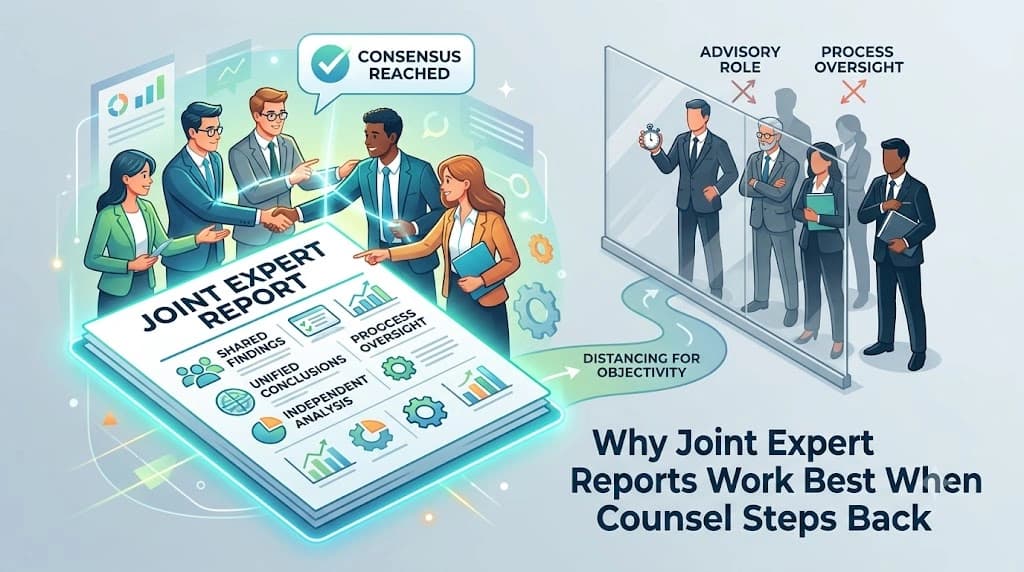
The theory behind joint expert reports is straightforward. Two experts, each independently qualified and each having formed their own opinion, meet or confer without the legal teams present, work through the areas of technical disagreement between their reports, and produce a document that records where they agree, where they still disagree, and why. A tribunal reading that document gets something genuinely useful: a narrowed set of issues, described in the experts' own words, with the reasons for disagreement laid out plainly enough to be tested at a hearing.
The value of this exercise depends entirely on the experts actually doing the talking. A joint report that emerges from two experts each relaying positions worked out in advance with their own legal teams is not a professional exchange captured on paper. It is closer to two separate written submissions stapled together under a shared heading, and tribunals experienced enough to have seen both kinds tend to notice the difference immediately.
It is worth being precise about what "narrowing issues" actually means in practice, because the phrase gets used loosely. A genuinely narrowed joint statement identifies specific technical points, a particular assumption, a particular calculation input, a particular methodological choice, where the two experts now agree, having not agreed on paper beforehand. It is not the same as a statement that simply restates each expert's original position side by side under a shared list of headings, which technically satisfies the procedural requirement to produce a joint report while doing none of the substantive work the process was designed to accomplish.
How Counsel Involvement Creeps Into the Process
Very little of this interference looks like outright interference. It usually starts with something that sounds entirely reasonable: reviewing a draft joint statement before it is filed, to check for accuracy or to make sure nothing has been miscommunicated. From there it is a short step to suggesting a rewording here, flagging a point that "might need more support" there, and before long the legal team has effectively pre-negotiated the areas of agreement and disagreement before the experts have even had their own conversation.
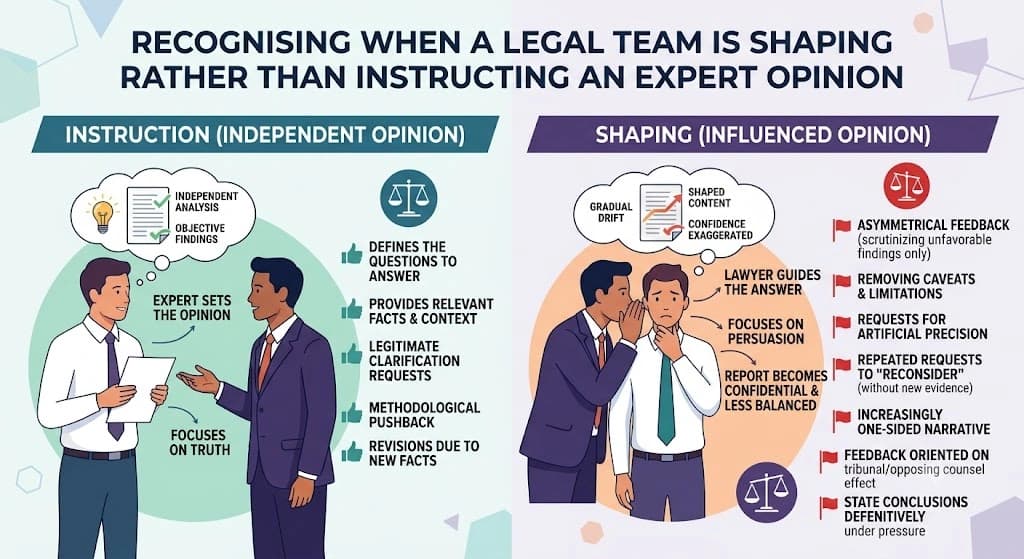
A related and even more common pattern involves briefing the expert beforehand on what outcome from the joint discussion would be helpful to the case, without ever describing it in those terms. An expert told, ahead of a joint conference, which points are considered central to the client's position and which are considered negotiable has effectively been given a script, whether or not anyone intended it that way. The joint discussion that follows may look procedurally correct, two experts, no lawyers in the room, but its substance was decided before it started.
A third pattern shows up after the discussion rather than before it: a legal team reviewing the draft joint statement and pushing back on specific formulations, not because they misstate anything but because they are less favorable than an alternative phrasing would be. Persistent, repeated pushback on wording eventually produces a document shaped more by editorial negotiation than by the expert's actual professional judgment, even when every individual edit seems minor in isolation.
A fourth pattern is subtler still and often goes entirely unnoticed by the expert involved: the informal exchange of impressions between the two legal teams before the joint conference, each side quietly signaling to the other, through counsel-to-counsel conversation, what kind of joint statement would be acceptable. Neither expert is directly instructed in this version. Instead, each expert's own legal team arrives at a shared, unstated sense of where the boundaries of acceptable agreement lie, and communicates that sense to their expert in ways subtle enough that it rarely feels like instruction at all, right up until the joint statement lands exactly where both legal teams quietly expected it to.
What Gets Lost When Counsel Shapes the Discussion
The most immediate cost is candor. Two experts who know their draft statement will be reviewed and potentially reworded by counsel before filing have every incentive to hedge, soften, or avoid stating points of genuine agreement that might be inconvenient for their side. A joint report produced under those conditions tends to be longer on carefully qualified language and shorter on the plain, direct statements that make a joint report useful in the first place.
The second cost is narrowing. One of the main practical benefits of a well-run joint discussion is that it genuinely reduces the number of issues a tribunal has to resolve at a hearing, because the experts have already agreed on the parts that were never really in serious dispute. When legal teams shape the discussion in advance, agreement tends to be limited strategically rather than substantively, and issues that could have been resolved between the experts get preserved instead because resolving them was not seen as tactically useful.
The third cost is credibility, and it is the most durable one. A tribunal that senses, correctly or not, that a joint statement was shaped by counsel rather than produced through genuine expert dialogue will discount the document accordingly, and that discounting tends to spill over onto the experts' individual reports as well. Once a decision-maker starts reading an expert's contributions with an eye toward what the lawyers might have written for them, restoring full confidence in that expert's independence becomes considerably harder, sometimes for the remainder of the case.
The Difference Between Logistics and Substance
None of this means counsel should have no role whatsoever in the joint reporting process. There is a clear and useful category of involvement that causes no harm at all: arranging the logistics of the conference, confirming the list of issues the experts have been directed to address, checking that the final document is signed and filed correctly, and answering procedural questions about format or deadline. This is administrative support, and experts generally welcome it because it lets them focus entirely on the substantive discussion.
The line gets crossed the moment logistical support turns into substantive input, meaning any involvement in what the experts should say, how strongly they should say it, or which points are worth conceding. A useful practical test is to ask whether a piece of involvement would look appropriate if described plainly to the tribunal. Confirming a meeting date passes that test easily. Suggesting a specific form of words for an area of continuing disagreement does not.
Some legal teams draw this line naturally, treating the joint discussion the same way they would treat a closed-door jury deliberation: a process they set up and then leave entirely alone until the result comes back. Others draw it far less consistently, treating the joint report as simply one more document in the case that benefits from careful legal drafting, without registering that it is a fundamentally different kind of document precisely because it is supposed to be the experts' own work product.
A concrete illustration makes the distinction easier to apply. A legal team that emails an expert to confirm the joint conference has been rescheduled to accommodate a time zone difference is providing logistics. A legal team that emails the same expert suggesting that a particular calculation methodology "would be worth raising" during the conference, because it happens to favor the client's position, has crossed into substance, regardless of how the email is phrased or how reasonable it sounds in isolation. The difference is not always obvious from a single message; it becomes obvious when the pattern of messages, taken together, amounts to steering rather than support.
What a Well-Run Joint Discussion Actually Looks Like
The clearest sign of a well-run joint discussion is that the resulting document surprises someone. If a joint statement confirms exactly what both legal teams expected going in, with no genuine points of agreement conceded by either side and no areas of disagreement narrowed from where they stood beforehand, that outcome itself is worth treating with some suspicion. Real professional dialogue between two competent experts, working independently through genuinely disputed technical questions, tends to produce at least some movement, some acknowledgment that a particular point is not as contested as it first appeared, or that a specific assumption in one report does not hold up under the other expert's scrutiny.
Well-run joint discussions are also typically brief relative to how long the underlying dispute has been running, because the experts are working from their own reports and their own analysis rather than trying to reconcile positions that were shaped by outside input beforehand. Two experts who arrive at a joint conference having done their own thinking can usually identify areas of agreement and disagreement efficiently. Two experts whose positions were pre-negotiated through their respective legal teams often take considerably longer, because much of the actual negotiation is happening in a process the joint conference was never meant to replace.
The best practice among experienced experts is to treat any pre-conference conversation with counsel as strictly limited to confirming the scope of issues to be addressed and the logistics of the meeting, and to say so plainly if a conversation drifts toward anything resembling strategy or preferred outcome. This is rarely an awkward conversation in practice. Most competent counsel, reminded of the purpose of the exercise, recalibrate without friction, because their genuine interest is a credible joint report rather than a compromised one.
It also helps to set this expectation early, ideally as part of the original engagement discussion rather than in the days immediately before a joint conference is scheduled. An expert who raises the topic proactively, stating plainly that any pre-conference discussion will be limited to scope and logistics, rarely encounters resistance, because the request arrives as a normal professional boundary rather than as a response to something that has already started to go wrong. Waiting until a specific request for input actually arrives before addressing the issue tends to make the conversation feel more pointed than it needs to be, for both sides.
Why This Distinction Carries Extra Weight in International Arbitration
The joint conferencing process carries particular weight in international arbitration, where hearings are often compressed into a matter of days after years of written proceedings, and a tribunal's ability to narrow live issues before the hearing begins matters more than in a system with the option of extended trial time to work through unresolved technical disagreement. Arbitral tribunals also frequently include members from different legal traditions, some more familiar with common law expert conferencing conventions than others, which means the joint statement itself often carries more interpretive weight than it might before a domestic court used to the same experts and the same procedural conventions case after case.
The cross-border character of many arbitrations adds a further wrinkle. Opposing experts frequently come from different professional cultures, with different norms around how directly to state disagreement, and a joint conference conducted without outside interference gives them room to work through that cultural gap directly, expert to expert, rather than having it filtered and potentially distorted through two legal teams operating under different assumptions about what a joint statement is supposed to accomplish. Preserving the integrity of that direct exchange matters more, not less, when the two participants do not already share a common professional shorthand.
What This Means for Counsel and Experts
For counsel, the practical implication is to treat the joint expert conference the way a well-run mediation treats a private caucus: a space deliberately kept separate from the adversarial machinery of the case, where the value of the process depends entirely on the participants believing it is genuinely private and genuinely theirs. Involvement that would be entirely normal in reviewing a witness statement or a written submission is, in this specific context, exactly the kind of interference that undermines the document's value.
For experts, the implication is to hold the line on this distinction even when a request for input feels minor or well-intentioned. Declining to discuss preferred outcomes ahead of a joint conference, and declining to accept post-conference edits that go beyond correcting factual inaccuracies, protects the credibility of the joint statement and, by extension, the expert's own credibility as an independent professional rather than an advocate operating under a different label.
For tribunals and case managers, the implication is that clear procedural directions at the outset, specifying that joint conferences occur without counsel present and that draft statements are not subject to legal-team revision beyond correcting plain errors, remove much of the ambiguity that otherwise allows this kind of interference to develop gradually and, in most cases, unintentionally.
Frequently Asked Questions
Should counsel be present during the joint expert conference itself? Generally not. The value of the conference depends on the experts speaking candidly to one another, and the presence of either legal team tends to change what gets said, even when neither side intends to influence the discussion.
Is it appropriate for counsel to review a draft joint statement before it is filed? A limited review for plain factual accuracy is reasonable. Requests to reword areas of agreement or disagreement to make them more favorable go beyond that limited purpose and should generally be declined.
What should an expert do if counsel asks, ahead of a joint conference, which points are most important to concede or hold firm on? This request, however it is phrased, is asking the expert to treat the joint discussion as a negotiation rather than a professional exchange, and is worth declining plainly and without extended explanation.
Does declining this kind of input risk damaging the relationship with instructing counsel? Rarely, in practice. Most experienced counsel understand, once reminded, that a credible joint statement serves their case better than a compromised one, and the request is more often a product of habit than of any deliberate intent to interfere.
Should experts keep their own private notes of what was discussed during a joint conference? Yes. A brief personal record made shortly after the conference protects the expert if the drafting process later becomes contentious, and it also helps ensure the filed statement accurately reflects what was actually agreed rather than a secondhand reconstruction of it.
Conclusion
Joint expert reports only do their job when they are actually produced the way they are designed to be: by two independent professionals working through genuine technical disagreement without outside input shaping what they say before, during, or after the fact. Every point at which a legal team's involvement moves from logistics into substance chips away at the value of the exercise, and tribunals experienced enough to have seen both a genuine joint statement and a negotiated one tend to notice the difference without needing it pointed out. The practical fix does not require elaborate procedural machinery. It requires counsel recognizing where the useful role ends, and experts holding that line clearly and without apology when it is tested. Tribunals that build this expectation into their procedural directions from the outset, rather than leaving it to the parties' own good judgment, tend to receive joint statements worth reading closely rather than joint statements that simply confirm what everyone already assumed going in.
Key Takeaways
● Joint expert reports are only as valuable as the genuine, independent dialogue between experts that produces them; legal-team involvement in substance, rather than logistics, undermines the entire purpose of the exercise.
● Counsel involvement typically creeps in gradually, through draft review, pre-conference briefing on preferred outcomes, or post-conference pushback on wording, rather than through any single deliberate act of interference.
● A useful test for any proposed involvement is whether it would look appropriate if described plainly to the tribunal; logistics pass this test easily, substantive input does not.
● A well-run joint discussion typically produces some genuine movement or concession from at least one side; a joint statement that confirms exactly what both legal teams expected beforehand is itself worth treating with some suspicion.
Position yourself where the legal industry looks for expertise - sign up on exlitem.com to get discovered by leading lawyers and high-value clients.