
Case Background
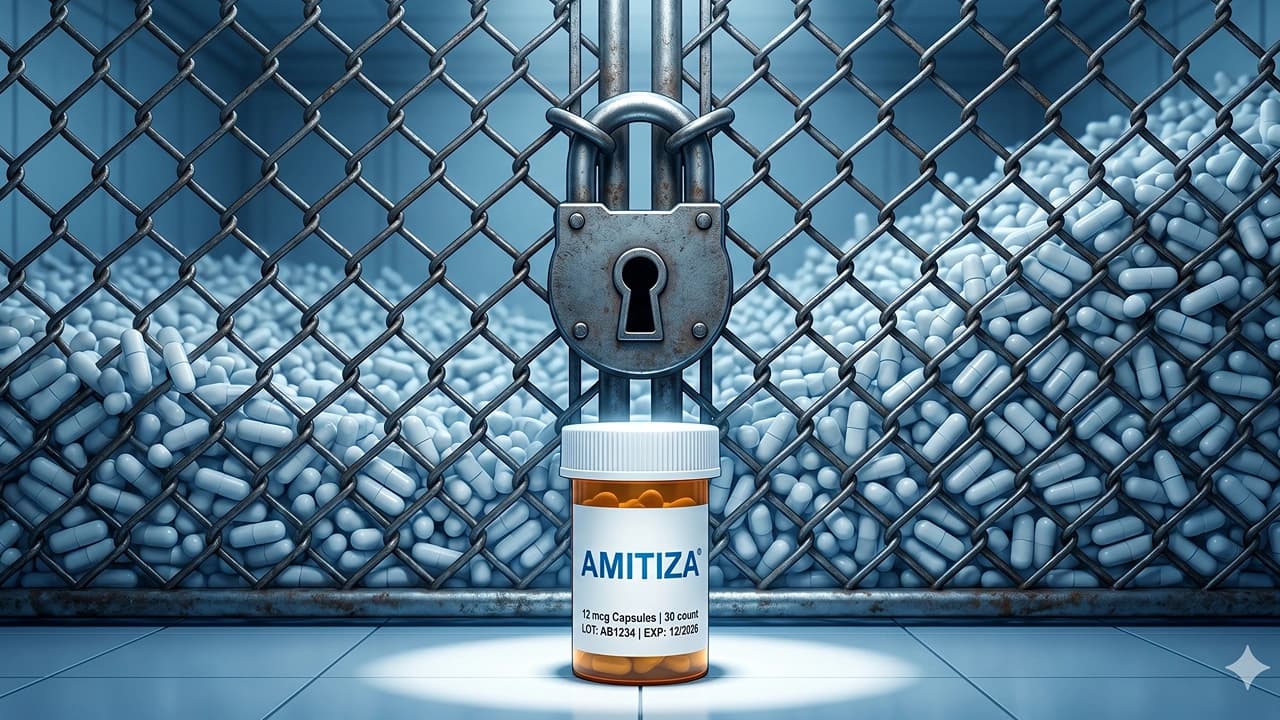
The business relationship underpinning this dispute began in 2004 when Takeda and Sucampo entered into a 16-year exclusive licensing and commercialization agreement. Under that setup, Sucampo handled clinical development while Takeda assumed sole responsibility for marketing, sales, and retail distribution of the drug Amitiza in the United States. The Food and Drug Administration approved the brand-name medicine in January 2006 to treat chronic idiopathic constipation in adults. Takeda launched commercial sales three months later. By 2008, federal regulators expanded the approved indications to include irritable bowel syndrome with constipation in women.
Financially, the product generated significant market returns. For the twelve months ending September 30, 2020, total domestic capsule sales reached approximately $427 million. Takeda kept the vast majority of these revenues, while paying a tiered royalty rate between 18% and 26% back to Sucampo. In October 2014, the two companies amended their arrangement to extend the operational term and split future net sales evenly. Sucampo entirely ceased independent domestic marketing operations by the end of 2014, leaving Takeda as the exclusive entity supplying the brand-name drug to American purchasers.
Cause
The antitrust conflict emerged directly from patent litigation handling. While the primary chemical compound patent for Amitiza expired in late 2014, secondary formulation patents remained in place. Par Pharmaceutical filed the first Abbreviated New Drug Application with a Paragraph IV certification to market a generic version. Sucampo and Takeda sued Par for infringement, which triggered a statutory 30-month administrative delay on generic approval. On September 30, 2014, the companies settled the patent lawsuit by executing a Settlement and License Agreement.
Under this private settlement, Par agreed to keep its generic equivalent off the market until January 1, 2021. In exchange, Takeda agreed not to launch a competing authorized generic product during Par’s initial 180-day regulatory exclusivity window. Takeda also extended this non-competition promise for an additional 18 months, effectively giving Par a two-year generic monopoly. Between 2017 and 2020, Takeda settled subsequent patent challenges from five other generic manufacturers—Dr. Reddy's, Amneal, Teva, Sun, and Zydus—by binding all of them to a deferred entry date of January 1, 2023.
Injury
The purchasers stated that the non-competition agreement suppressed standard pharmaceutical price drops. Normally, the entry of multiple generic options drives consumer costs down sharply. By paying Par to delay its product launch and blocking other generic competitors through regulatory bottlenecks, Takeda effectively extended its brand monopoly for six additional years. When Par finally entered the market in January 2021, the agreement insulated it from brand-backed competition. This artificial market isolation forced direct purchasers and end-payors to buy the medication at inflated, non-competitive price points for years.
Damages Sought
The direct purchaser class demanded full financial restitution for the excessive pricing regularities. Acting under the Clayton Act, the Plaintiffs sought final judgment for cumulative financial overcharges, treble damages, pre-judgment and post-judgment interest, litigation expenditures, and reasonable attorney fees.
Key Arguments and Proceedings
Legal Representation
Plaintiff(s): FWK Holdings, LLC, Meijer, Inc., and Meijer Distribution, Inc., representing a class of direct pharmaceutical purchasers.
Counsel for Plaintiff(s): Thomas M. Sobol | Lauren Guth Barnes | Jessica R. MacAuley | Bradley J. Vettraino | Joseph M. Vanek | David P. Germaine | Eamon Kelly | John Bjork | Peter D. St. Phillip , Jr. | URIEL RABINOVITZ | Charles Z Kopel | Courtney Elizabeth Finerty-Stelzner | RENEE A. NOLAN | Scott J. Tucker | Thomas K. Griffith | William J Fidurko | Alberto Rodriguez | April D. Lambert | Barry S. Taus | Bradley J. Vettraino | Charles Z Kopel | Clark Craddock | Eamon P. Kelly | Erin C. Burns | John D. Radice | Kenneth Pickle | Martin Amaro | A. Luke Smith | Daniel Polonsky | David P. Germaine | Joshua Owen Hall | Kristen Anne Johnson | Mark T. Vazquez | Rebekah Glickman-Simon
Defendant(s): Takeda Pharmaceutical Company Limited | Takeda Pharmaceuticals U.S.A., Inc | Endo International | Par Pharmaceutical, Inc.
Counsel for Defendant(s): Fred A. Kelly, Jr | Joshua S. Barlow | Aakruti G. Vakharia | Michael F. Brockmeyer | Ralph E. Labaton | Andre M. Geverola | Elizabeth Trentacost | Katie J.L. Scott | Thomas J. Carr | Wallace Wu | Ada V. Anon | Ali Nayfeh | Anish Vaidya | Assad Rajani | Bee Nagle | Drew Needham | Eliza Buergenthal | H. Tiffany Jang | Laura Scott Shores | Matthew Wilk | Sam Sullivan | Seth Engel | David S. Shotlander
Key Arguments or Remarks by Counsel
Plaintiffs' Claims
The legal team representing the direct purchasers argued that Takeda and Par formed an unlawful alliance to split monopoly profits rather than risk a Court ruling on patent validity. The Plaintiffs underlined that standard industry licenses outside of litigation settlements require a generic company to return roughly 90% of its profits to the brand owner. In this instance, Takeda granted Par a highly favorable 50% royalty structure, which dropped down to 15% if any other generic product entered the retail space.
The Plaintiffs asserted that this preferential royalty deal operated as a reverse payment valued between $29 million and $280 million. They argued that this immense financial value induced Par to abandon its viable patent challenges and accept a delayed market entry. The Plaintiffs stated that without this multi-million dollar inducement, Par would have won its lawsuit and introduced low-cost alternatives by January 2016, paving the way for wide-open market competition by July 2016.
Defendants' Defense
Takeda and Par countered all assertions of market manipulation, trade restraint, or conspiracy. In their formal answers, the corporate Defendants maintained that they operated entirely within the scope of valid intellectual property rights. Takeda stated that the September 2014 settlement represented a lawful, pro-competitive compromise that resolved complex, unpredictable, and expensive patent litigation. The defense argued that the structured royalty terms did not constitute an improper reverse payment designed to block generic access, but rather reflected a reasonable settlement of disputed property claims.
Jury Verdict
A federal jury in Massachusetts returned a unanimous verdict on May 18, 2026, in the antitrust case titled In Re Amitiza Antitrust Litigation, finding Takeda Pharmaceutical Company liable for anticompetitive conduct related to the drug Amitiza.
Takeda's Liability
The jury found that the Purchasers proved, by a preponderance of the evidence, that Takeda possessed substantial market power within the relevant market. The jury further determined that the Settlement Agreement between Sucampo, Takeda, and Par contained a large and unjustified reverse payment from Sucampo and Takeda to Par, and that this payment produced anticompetitive effects. The jury also concluded that Sucampo and Takeda entered into an implicit agreement with Par under which Par agreed not to launch its own authorized generic version of Amitiza.
Procompetitive Benefits Defense
Takeda argued that its conduct carried procompetitive benefits, and the jury agreed that Takeda proved its conduct did produce such benefits. However, the jury went on to find that the reverse payment provisions were not necessary to achieve those procompetitive benefits and that alternative ways existed to reach the same result with less harm to competition. Because the jury reached this conclusion, the verdict form directed it to skip the question of whether the anticompetitive effects substantially outweighed the procompetitive benefits, and the jury moved directly to the damages portion of the form.
Overcharge Findings
The jury found that the anticompetitive Settlement Agreement between Sucampo, Takeda, and Par resulted in overcharges to every Purchaser group identified on the verdict form. The Direct Purchaser Class, Albertsons Companies, CVS Pharmacy Inc., H-E-B L.P., The Kroger Co., Walgreen Co., and the members of the End Payor Class were all found to have been overcharged as a result of the agreement.
Generic Entry Date
The jury determined that a generic version of Amitiza would have come to market in April 2018 if the anticompetitive settlement agreement had not existed.
Damages Awarded
The jury awarded overcharge damages to each Purchaser group as follows. The Direct Purchaser Class received $474,897,965. Albertsons Companies received $8,997,050. CVS Pharmacy, Inc. received $191,125,219. H-E-B, L.P. received $4,996,283. The Kroger Co. received $20,343,515. Walgreen Co. received $121,375,579.
The End Payor Class received damages broken down by state and jurisdiction. California received $25,984,698. Connecticut received $3,368,225. The District of Columbia received $663,326. Hawaii received $961,699. Iowa received $2,577,360. Maryland received what appears on the handwritten verdict form to read $5,949,566, though the first digits in the original document are partially difficult to read. Minnesota received $3,116,835. North Dakota received $513,528. Nebraska received $2,114,039. New Mexico received $1,227,290. Nevada received $1,454,046. Rhode Island received $808,124. South Dakota received $1,213,685. Tennessee received $12,962,499. Vermont received $293,459.
Willfulness, Flagrancy, and Damages Multiplier
The End Payor Plaintiffs asked the jury to find that Takeda's actions were willful and flagrant. The jury found that Takeda's actions were willful by a preponderance of the evidence but determined that those actions were not flagrant. The verdict form then asked the jury to select an additional damages multiplier. The jury chose 1X, meaning no additional damages beyond the base amounts already awarded. The options of 2X (two times damages) and 3X (three times damages) were left unchecked.
Court documents are available upon request at [email protected]