
The Hallucinated Citation: How AI Is Quietly Ending Expert Witness Careers
The first frontier of AI risk for experts is also the most embarrassing. Richard Leisner, a corporate and securities expert witness and the publisher of a daily Daubert-tracking blog who appeared on Season 2, Episode 11 of On The Stand, has become an informal historian of the AI-related expert exclusions piling up in real time. He cites one recent New York case as a representative cautionary tale.
“Recently an expert was excluded for using AI for calculations,” Leisner says, “and AI, as you all know, is not great at math.” The expert in question was a battery technologist whose report contained quantitative analyses generated by a general-purpose large language model. The numbers, when checked, were wrong. The exclusion was not narrowly framed; it was a broad rebuke of an expert who had outsourced part of the analytical work without auditing the output. Across the field, opposing counsel is now actively hunting for these gaps. Citations are pulled up live in deposition. Calculations are independently re-run. Every footnote is treated as a possible trapdoor.
Dr. Chris Daft, a medical devices and patent expert witness with a doctorate in physics from Oxford and nearly two decades at General Electric’s research laboratory, who appeared on Season 3, Episode 10 of On The Stand, has built his AI defense around the assumption that opposing counsel will check everything. In a recent biometric security case requiring more than thirty academic citations, he describes a discipline that should be standard for every expert using any AI tool in 2026:
“For every citation in my report, I followed the link. I noted the date I accessed the source. I identified the precise passage that supported my opinion. And I provided a PDF of every document along with the report.” In other words, he treated each citation as if a hostile attorney would try, on the record, to prove it did not exist. The reason for the discipline is structural. Hallucinated citations from AI tools tend to be plausible-sounding because LLMs are optimized to produce text that reads correctly. The journal title is real. The author exists. The article does not. Without the verification habit, an expert can sign a report containing fictitious sources without ever realizing it.
Dr. Daft is also unsparing about the discipline’s asymmetry. “I really only have one resource which I can offer, and that is my credibility,” he says. “If my credibility is destroyed because I didn’t prepare well enough, then I need to stop being an expert witness and find something else to do.” Hallucinated citations are not a small mistake. They are a career-ending one.
AI as an Amplifier of Expertise - Not a Substitute For It
If the cautionary stories dominate the headlines, the constructive stories are quieter and, in their way, more important. A growing number of experts are using AI not to write their reports but to handle the analytical heavy lifting that used to consume entire weeks of professional time. Done correctly, the work product is faster, more thorough, and more defensible than its pre-AI predecessor.
Seth Miller, a battery technologist and forensic data analyst who appeared on Season 3, Episode 7 of On The Stand, tells a story that has become emblematic of what AI can do when an expert keeps the work inside their own discipline. He was retained on a case where the dataset arrived as a single comma-separated-values file roughly thirty gigabytes in size - too large for Microsoft Excel, too large for the standard tools the expert had used a decade earlier. “Over the weekend,” he recalls, “I used ChatGPT to help me write Python code that parsed the file, broke it into manageable chunks, and ran the analyses I needed. The code stayed local. The data never left my machine. I understood every line of what the model produced because I had to debug it.”
Miller is careful about the framing. The AI did not produce the analysis. It produced the scaffolding for the analysis - the boilerplate code that any data analyst could in principle have written, but that would have taken him three or four times longer to write by hand. The interpretation of the parsed data - what it meant for the battery failure mode in the underlying case - was entirely his own. He calls AI “an amplifier of expertise.” Used inside a discipline the expert already understands, it lets a senior expert do work that previously required a junior team. Used outside that discipline, it creates the illusion of work that has not been done.
Dr. Daft draws the same distinction in patent litigation. He has experimented extensively with AI tools - he is currently preparing a conference presentation on AI best practices for expert witnesses - but he insists on running anything sensitive through on-premise models rather than commercial cloud services. “If I am working on confidential patent material,” he says, “I cannot upload it to a cloud service whose terms I do not control.” Confidentiality is itself a Daubert-adjacent concern: if the expert’s tools leak protected information, the chain of custody is broken before the report is even written.
When AI Becomes the Evidence: Healthcare’s New Liability Trap
In some fields, the most consequential AI question is not how the expert uses the technology but how the people involved in the underlying dispute used it. Medicine is the clearest example. Electronic medical record systems now routinely include AI-assisted documentation features that auto-populate notes, suggest diagnoses, and summarize prior encounters. Each of those features creates a new evidentiary surface that experts on both sides must learn to interrogate.
Toni Elhoms, a medical coding and revenue-cycle compliance expert who appeared on Season 3, Episode 6 of On The Stand, treats AI in healthcare documentation as a liability category in its own right. Her concern is not that physicians use AI tools - they will, and increasingly must. Her concern is that the AI-generated content rarely matches the encounter as the patient experienced it. “The note will say the provider performed a comprehensive review of systems,” she says. “The patient will say no one ever asked them about their cardiovascular history. When you pull the audit trail, you see the AI inserted that language by default and the provider signed it without editing.” Those audit-trail discrepancies, once visible, are decisive in litigation - and they are visible the moment a competent expert knows where to look.
Dr. Steven Brown, a chiropractic physician and forensic records reviewer who appeared on Season 3, Episode 8 of On The Stand, brings the audit-trail discipline to a point most clinicians find uncomfortable. He describes a Chicago case in which a chiropractor altered a single clinical note one hundred and seventy-two times after the file had been subpoenaed. The provider had no idea the EMR system was logging every keystroke. The audit trail - not the note itself - became the centerpiece of the case. “You would be surprised how many providers do not understand that the audit trail is part of the record,” Dr. Brown says. “It is the most honest part of the record.”
Both experts are cautious about a different AI artifact: third-party medical-records review software that promises to summarize thousands of pages of records into a tidy litigation chronology. Dr. Brown refuses to use such tools in his own work. “I read every page myself,” he says. “If the software misses an entry that turns out to be the entry that mattered, I cannot defend that on the stand. The convenience is not worth the exposure.” Elhoms is similarly skeptical: AI summarization tools, in her experience, smooth over the discrepancies between what the chart says and what the audit trail proves - which is precisely the territory where the case is usually won or lost.
The Cross-Examination Has Changed: How Opposing Counsel Is Now Using AI
If experts are using AI to do their work, attorneys are using it to attack that work. The shift has been quiet, asymmetric, and consequential. The hostile cross-examination of 2026 is not what it was in 2022, and experts who prepare as if the technology has not changed are walking into traps that have been laid for them by tools they may not even know exist.
Elhoms has watched the shift in real time on the medical-coding side of healthcare litigation. “Opposing counsel is now using ChatGPT and similar tools to generate cross-examination outlines,” she observes. “They feed the report into the model and ask it to produce a list of potential weaknesses. Some of the questions are nonsense. Some are devastating. The expert has to be ready for both.” The implication for preparation is direct: the expert who has not stress-tested their own report against the obvious AI-generated lines of attack has skipped a step that opposing counsel has now made standard.
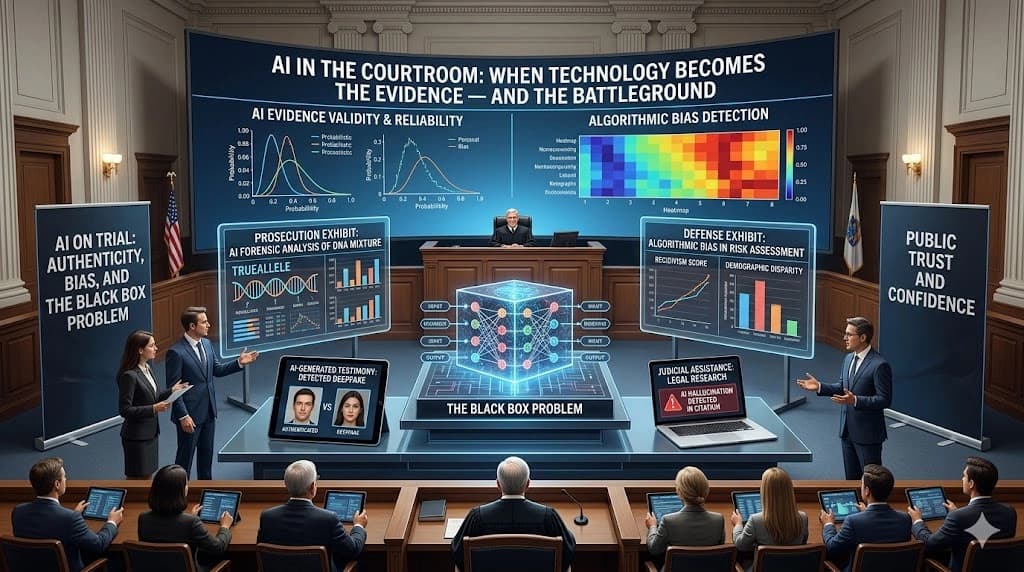
Leisner makes the same point at the doctrinal level. He maintains a daily blog tracking Daubert and Rule 702 challenges nationwide, and the AI-related decisions are now numerous enough to constitute their own subgenre. Some involve the expert’s own use of AI. Others involve AI-generated evidence in the underlying case - deepfaked video, synthetic audio, machine-generated forensic analysis. “We are still figuring out the doctrinal framework,” he says. “Some judges are reluctant to apply Rule 702 strictly because they are uncomfortable with the technology. Others are throwing experts out at the first sign of unverified machine output. Until appellate guidance catches up, the result depends heavily on the bench you draw.”
Ed Cheng, a professor of evidence law at Vanderbilt University and an expert on scientific testimony who appeared on Season 2, Episode 15 of On The Stand, frames the deeper problem in characteristically blunt terms. “People go to law school to avoid science and math,” he says. The judges and juries who must now adjudicate AI-related disputes are, on average, less technically literate than the witnesses appearing before them. Cheng has long argued that the right way to think about scientific testimony is not as a duel of individual experts but as the courtroom’s attempt to read a community consensus - a “mark of exclusion” approach in which the relevant question is whether the expert’s opinion sits comfortably inside the range of views accepted by their professional community.
Applied to AI, the framework is unforgiving. An expert who relies on AI in a way that the broader professional community has not yet validated is no longer relying on consensus; they are relying on novelty. The cross-examination question writes itself: Doctor, can you point to any peer-reviewed publication establishing that the tool you used produces reliable output for this purpose?
The Wave That Has Not Crested: Why AI Disputes Are About to Explode
Experts who have not yet faced an AI-related case are about to. The growth curve is no longer hypothetical.
Amit Bansal, a forensic finance and dispute-resolution expert based in India with twenty-nine years of experience and appearances at the LCIA and SIAC arbitration forums, who appeared on Season 2, Episode 16 of On The Stand, watches the wave from a vantage point that few American experts share. India’s expert witness ecosystem grew from a handful of practitioners to more than a dozen in fifteen years - and Bansal is convinced the next decade will be defined by technology disputes. “With more and more technology and AI coming into place,” he says, “we will see a lot of disputes in the tech space. Somebody will need to decipher that for tribunal members and lawyers - and neither will understand it themselves.”
Bansal’s point is structural rather than rhetorical. Tribunals around the world are being asked to resolve disputes about systems whose internal logic the tribunal members cannot read. Source code, training data, model weights, prompt engineering, retrieval-augmented generation pipelines - these are now legitimately the subject matter of contract disputes, IP disputes, securities disputes, and damages calculations. The expert who can translate the technology into terms a non-technical fact-finder can act on is suddenly indispensable. The expert who cannot is increasingly invisible.
Dr. Daft sees the same dynamic on the patent side. AI patent eligibility itself has become a doctrinal battleground in the United States, with courts struggling to apply the Alice/Mayo framework to inventions whose claimed novelty resides partly in machine-learning components. Experts who can articulate, in a way that survives both Section 101 and Section 103 scrutiny, what is novel about a particular AI implementation are now the gatekeepers of whether AI patents survive at all. Experts who treat AI as a black box - who say “the model figures it out” and stop there - are not credible witnesses in this environment.
The New Definition of an Expert in the AI Era
Read these seven practitioners side by side and a quiet redefinition of the expert witness role comes into focus. The traditional expert was a master of substantive content - medicine, engineering, finance - supplemented by an understanding of how to communicate that content to non-specialists. The AI-era expert is all of that, plus three new disciplines.
First, fluency in the tools they use. Dr. Daft’s and Miller’s discipline of running AI tools with full awareness of how the underlying systems work is no longer optional. An expert who cannot explain, on the stand, how an AI system arrived at the output they relied on is an expert who has invited a Daubert challenge.
Second, fluency in the tools the underlying parties used. Elhoms’s and Dr. Brown’s familiarity with EMR audit trails is the model. The most consequential AI evidence in many cases is not the expert’s tooling but the AI behavior of the systems whose output is in dispute - the auto-generated note, the algorithmic credit decision, the model-driven trading strategy. Experts who cannot interrogate those systems cede the most important evidentiary ground in the case.
Third, comfort with the courtroom’s technical limits. Cheng’s observation about law school selection bias is not a complaint; it is a working constraint. The fact-finder will not be a peer. The expert’s job is to translate a community consensus into language a non-specialist can act on - and to stay rigorously within that consensus rather than wandering into novel ground that the courtroom is not equipped to evaluate.
Why the Stakes Are So High - and Why the Discipline Is So Simple
The temptation, reading this material, is to conclude that AI has made expert testimony harder. It has not. It has made it more visible. Hallucinated citations have always been possible - a sloppy expert in 2005 could fabricate a paper just as readily as an LLM can in 2026. What has changed is that opposing counsel can now find the fabrication in seconds rather than weeks, and judges have grown impatient with experts who cannot defend every line of their own work product.
The discipline that survives the new environment is, in the end, the same discipline that survived the old one, applied with greater intensity. Cite carefully and verify every source, as Dr. Daft does. Use AI tools only where you can audit their output, as Miller does. Interrogate the audit trail of every system in the underlying record, as Elhoms and Dr. Brown do. Stay within the consensus of your professional community, as Cheng would have you do. Track the doctrinal landscape as it shifts, as Leisner does daily. Position yourself for the wave of technology disputes that has not yet crested, as Bansal urges.
The expert witness who treats AI as just another shortcut will not survive the next decade of cross-examination. The expert witness who treats AI as a force that exposes the difference between rigorous and sloppy work - and adjusts accordingly - will find that their value to the courts has never been higher. AI in the courtroom is not the end of expert testimony. It is a clarifying test of what expert testimony was always supposed to be.
Experts Featured in This Article
Ed Cheng - Evidence Law & Scientific Testimony, Vanderbilt University (S02E15)
Richard Leisner - Corporate & Securities Expert Witness, Daubert Tracking (S02E11)
Amit Bansal - Forensic Finance & Dispute Resolution, Deloitte India (S02E16)
Toni Elhoms - Medical Coding & Revenue-Cycle Compliance (S03EP6)
Seth Miller - Battery Technology & Forensic Data Analysis (S03EP7)
Dr. Steven Brown - Chiropractic Practice & Forensic Records Review (S03EP8)
Dr. Chris Daft - Medical Devices & Patent Expert Witness (S03EP10)