

The Fee Paradox: You Are Paid to Be Independent
The structural contradiction at the center of expert witness work is this: the attorney who retains you is paying for your independence.
Not for your agreement. Not for a conclusion that helps their case. Your opinion is only worth something to them - and to the court - if it is genuinely yours, formed through rigorous analysis, untouched by the incentive structure that pays your invoice. The moment a judge or jury concludes that an expert's opinion followed the fee rather than the facts, the opinion loses all value. Not diminished value. No value.
This paradox has direct, practical implications for how experts should structure their fees and billing practices.
■ Kevin Quinley | Insurance Claims Expert Witness | Season 1, Episode 1
Kevin Quinley - an insurance claims expert with more than 40 years of experience consulting and testifying on insurance-related disputes - describes the core challenge as "the balancing act." Retained by one side, paid by one side, yet the entire value of his testimony depends on the court believing he has not been influenced by either. His fee schedule is set in advance, disclosed to the retaining attorney before any engagement begins, and never adjusted based on case outcome.
That last point deserves emphasis. Contingency fees - where the expert earns more if the retaining party wins - are prohibited by professional ethics standards for good reason. But the prohibition on formal contingency arrangements does not prevent softer versions of outcome-linked billing from developing. Quinley's discipline is to treat every invoice as if opposing counsel will eventually read it. In expert witness work, they very well might.
■ Dr. Simon Dardashti | Pain Management & Anesthesiology Expert Witness | Season 2, Episode 13
Dr. Simon Dardashti - a double board-certified expert in pain management and anesthesiology who works both plaintiff and defense - is direct: the facts always determine the opinion, never the fee. He works both sides not because he is indifferent to which attorney retains him, but because working both sides is itself a credibility architecture. An expert whose record shows opinions formed on the evidence - sometimes favorable to plaintiffs, sometimes to defendants, depending on what the facts support - has built a record that is far harder to attack on bias grounds.
His fee is the same regardless of which side retains him. The opinion is independent of the fee. That alignment - structural, practiced, and publicly demonstrable - is a professional asset worth more than any individual case outcome.
How Experienced Experts Price Their Work
The most common mistake new expert witnesses make in setting their rates is anchoring to the wrong comparison. They think about what they earn in their primary profession - their clinical rate, their consulting day rate, their hourly billing as an attorney - and start from there.
That is the wrong frame. Expert witness work is not a variant of your primary profession. It is a distinct professional service with different demand characteristics, different risk profiles, different preparation requirements, and different value delivered. The right question is not what you earn doing other work. It is what it actually costs to deliver this work with genuine rigor - and what that expertise is truly worth in a high-stakes dispute.
■ Frederick Fisher | Professional Liability Insurance Expert Witness | Season 3, Episode 13
Frederick Fisher has been working as a professional liability insurance expert for fifty years, across more than 300 cases. He has written the definitive text on claims-made insurance policies. His rate is not set by what insurance consultants charge per hour. It is set by what fifty years of specialized knowledge, a publication record spanning decades, and a methodology refined across 300 cases is actually worth in a high-stakes dispute - and by the preparation time that level of rigor genuinely requires.
Fisher's guiding principle: "Insurance should be a safety net, not a trap." The same applies to his own billing. His fee structure is designed to ensure he can take on the cases where his expertise genuinely matters, prepare them to the standard they deserve, and deliver testimony that holds under the most aggressive cross-examination. That requires charging enough to make thorough preparation economically viable - and declining cases where the fee offered does not support that standard of work.
The practical implication: your rate should reflect what it actually costs to do the work properly. If your hourly rate does not allow you to spend the preparation time the case genuinely requires, you are either undercharging or accepting cases that will ultimately produce work that falls below your own standard.
■ Richard Leisner | Corporate & Securities Law Expert Witness | Season 2, Episode 11
Richard Leisner - fifty years in complex business litigation, one of the most respected corporate and securities expert witnesses practicing today - keeps his rate consistent across cases and discloses it at the start of every engagement. He does not negotiate based on the attorney's budget, the size of the case, or the prestige of the retaining firm. Consistency is not stubbornness. It is strategic sense: an expert whose rate fluctuates based on who is asking will eventually face a cross-examination question about why they charged a different amount in a previous case - and that question has no clean answer.
The Most Valuable Business Decision: Learning to Say No
If pricing is the first major business decision in expert witness work, case selection is the second - and it may matter more.
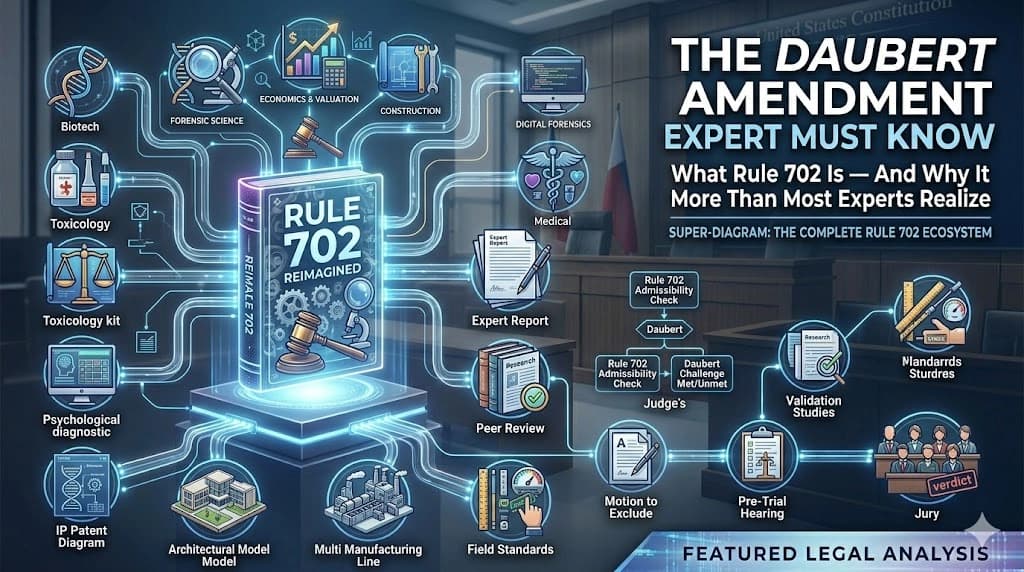
Every expert witness with a long, credible career has a version of the same story: the case they should not have taken, the rush job that produced vulnerable work, the engagement where they stretched just slightly beyond their genuine expertise because the case needed them to go there. Those are the cases that generate Daubert rulings nobody wants on their record. Those are the cases opposing counsel cites years later when trying to establish a pattern.
The discipline of saying no is a business discipline, not just an integrity one. The most effective practitioners have internalized it as standing policy.
Leisner's rule is direct: if an attorney calls on a Friday with a stack of materials and needs a complete expert report by Thursday, the answer is not "I'll try." The answer is: I cannot help you. A rushed opinion, even an honest one, is a vulnerable one. Inadequate record review produces conclusions that opposing counsel can challenge not on their merits but on their foundation - and a foundation challenge in a Daubert hearing is just as damaging as a merits challenge, often more so, because it targets the expert's methodology and professional discipline.
■ Jonathan Klane | Certified Industrial Hygienist & Environmental Health & Safety Expert Witness | Season 3, Episode 11
Jonathan Klane - thirty-five years in occupational health and chemical exposures - has developed what he calls the scope conversation, and it happens before he accepts any case. He sits down with the retaining attorney and describes, precisely, where his expertise runs and where it ends. "Here's where I think I can help. And here's where I want to tell you that I'm not this expert, I'm not that." He has told attorneys directly that a particular aspect of their case would be better served by a different expert.
Those conversations cost him engagements in the short term. They protect him from Daubert exclusions in the long term - because there is nothing to exclude when the opinion was always squarely within the expert's genuine domain. The Daubert record for experts consistently precise about where their expertise runs is, almost universally, clean. It is scope creep - the slight extension of opinion into adjacent territory the case needed covered - that generates the challenges.
Saying no to cases outside your expertise is not leaving money on the table. It is protecting the money you will earn on every future case by keeping your methodology unimpeachable.
Building the Pipeline: Business Development Without Compromising Objectivity
One of the questions new expert witnesses most frequently ask - and most rarely get a straight answer to - is how cases actually come to them. The answer is less mysterious than it appears, and more dependent on integrity than most people expect.
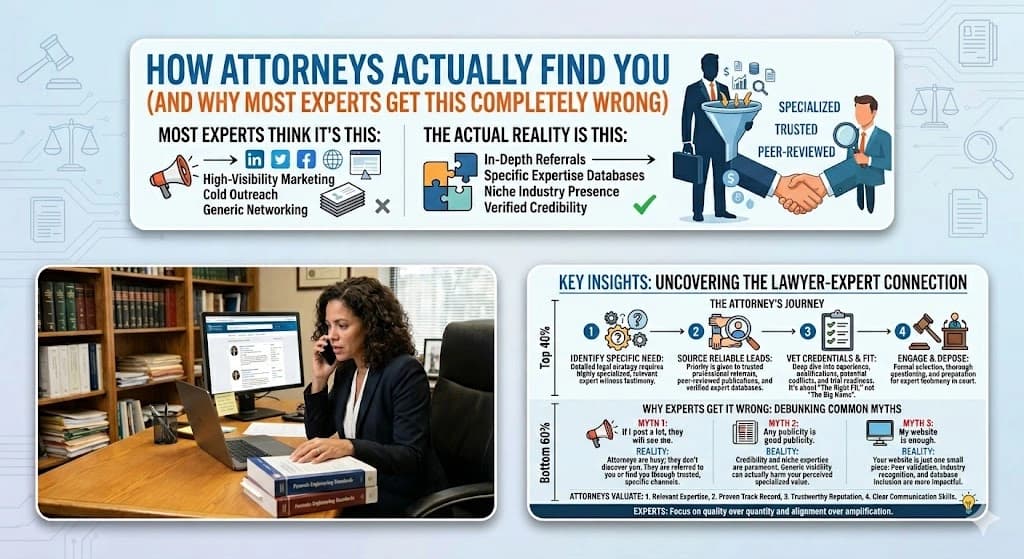
The expert witness market is built almost entirely on reputation and referral. Attorneys talk to other attorneys. Opposing counsel who encounters an expert in one case may retain that same expert - or refer them - in a future case. The expert who loses their retaining party's case but does it with methodological rigor and honest testimony that impresses opposing counsel becomes a stronger business development asset than the expert who wins through advocacy.
■ Jon Groth | Personal Injury & Vaccine Litigation Attorney | Season 2, Episode 14
Jon Groth - a personal injury and vaccine litigation attorney who has worked with dozens of expert witnesses across his career - is direct about what he looks for: "Find a physician who enjoys the process, is committed to the truth, and won't disappear when the courtroom gets real. They're worth their weight in gold." He has settled cases for less than they were worth because an expert got cold feet days before trial. The attorney's memory for that experience is long, and the word travels efficiently through the legal community.
The business development implication is direct: the expert who is reliable, prepared, honest, and composed under pressure gets called back. Expert witness directories and LinkedIn profiles matter, but they are the initial introduction. The referral - from an attorney who has seen you work, or from opposing counsel who encountered you across the table - is what builds a sustainable practice.
■ Marilyn McCullum | Triple Board-Certified Emergency & Trauma Nurse Expert Witness | Season 3, Episode 14
Marilyn McCullum - triple board-certified, working thirty-two clinical hours a week in an active emergency department - takes approximately one case day per week. That structure is not a business limitation. It is a business strategy. Staying in active clinical practice maintains the currency of knowledge that makes her testimony credible in current-standards cases, provides an automatic answer to the hired gun framing, and ensures her referral base includes working clinicians and hospital administrators - not just attorneys who already know her name.
The breadth of your pipeline is a function of professional identity. If your only identity is "expert witness," your pipeline runs through attorney referrals exclusively. If your primary identity is your professional field - and your expert work is what you do on the side - your pipeline runs through your entire professional network, which is almost certainly larger and more diverse.
Billing Discipline: Protecting Yourself Financially
The financial mechanics of expert witness work create risks that most new practitioners do not anticipate until they have been burned by them.
The most significant is non-payment. Attorneys - even reputable ones - sometimes settle cases quickly, lose cases they expected to win, or face client payment problems that ripple outward. An expert who has delivered a complete report and prepared extensively for a deposition that was suddenly cancelled may find themselves holding a substantial unpaid invoice with limited leverage to collect.
■ Dr. Robert Belfer | Pediatric Emergency Medicine Expert Witness | Season 3, Episode 5
Dr. Robert Belfer - more than thirty years in pediatric emergency medicine, specializing in the complex presentations that end up in litigation - has seen the full range of billing arrangements across his expert career. His approach: a retainer up front, paid before review begins, applied against the final invoice. Not as a sign of distrust, but as a professional standard that sets the tone for the engagement. An attorney who balks at a reasonable retainer is providing useful information before you invest significant preparation time.
The retainer structure also creates a natural moment, early in the engagement, to have an explicit conversation about scope, timeline, and what the work will actually require - how many records need review, how much preparation the deposition or trial testimony will need, and what the total fee is likely to be. That conversation prevents the disputes that arise when attorneys receive invoices larger than they anticipated for work they did not fully understand.
Beyond the retainer, billing discipline means invoicing regularly - not in one large sum at the end of a long engagement - and including sufficient detail to make the work visible. An itemized invoice showing hours spent reviewing specific records and preparing specific sections of the report is harder to dispute than a lump-sum invoice with a single line description. A clear written engagement agreement specifying the fee, retainer, billing cycle, and termination conditions is not adversarial infrastructure. It is professional infrastructure that protects both parties.
The Long Game: Reputation Is the Real Asset
■ Pavithra Kumar | Finance, Securities & Damages Estimation Expert Witness | Season 3, Episode 2
Pavithra Kumar - a principal at AACG whose practice spans complex financial disputes, securities cases, and damages estimation - describes her approach with a precision that cuts through most of the noise around billing: "Nothing terribly fancy - it just comes down to simply and clearly delivering your point." The practice that has grown around that principle is built on referrals from attorneys who know her work will be rigorous, her methodology explainable, and her testimony durable. That reputation, compounded over years, is worth more than any individual billing optimization.
The long-game perspective changes how you think about the cases you decline. Saying no to a case that does not fit your genuine expertise, or that you cannot work properly given your current commitments, does not cost you that case's fee. It protects every future case you will take by keeping your record clean.
It changes how you think about the attorneys you work with. The attorney who pushes you to stretch your opinion, creates unrealistic timelines, or seems more interested in your conclusion than your analysis is not just a difficult client. They are a risk to the professional record you are building. The fee on one case is not worth the Daubert ruling that follows you into the next twenty.
It changes how you think about opposing counsel. The opposing attorney who cross-examined you aggressively and came away impressed by your composure and methodological honesty is a future referral source. The legal world is smaller than it appears, and its information flows are efficient. Your reputation - positive or negative - travels through networks you cannot see.
And it changes how you think about the fee itself. The expert who charges a consistent professional rate - one that reflects the genuine cost of rigorous preparation - and who maintains that rate regardless of who is asking is making a statement about professional identity: I am worth this, the work is worth this, and the integrity of my analysis is not adjustable based on the size of your budget.
Conclusion
The best expert witnesses do not separate the business of their practice from the integrity of their analysis. They understand, at a level that becomes automatic over time, that every decision they make about fees, billing, case selection, and business development is an expression of their professional credibility - not a separate administrative matter.
The expert who charges a rate that allows them to do the work properly, who declines cases where they cannot, who works from a clear engagement agreement, and who builds their pipeline through honest and rigorous performance is doing something more than running a business. They are building the professional infrastructure that allows integrity to hold under pressure.
Because the pressure will come. It comes in every career, eventually: the case where the fee is significant and the opinion the attorney needs is just slightly beyond where the evidence goes. The expert whose business is structured to support honest work - financially stable, with enough in the pipeline to decline this one - can answer that pressure with a clear no.
The expert whose business has been built on chasing fees, stretching scope, and accommodating timelines they cannot meet has no such stability. When the pressure comes, the business cannot support the integrity.
Set your rate to reflect the actual cost of rigorous work. Build your pipeline through performance, not marketing. Protect your financial position with clear agreements and appropriate retainers. Say no to cases that do not fit. And understand, clearly, that every business decision you make is also a statement about what kind of expert witness you are.
The price of opinion is not just what you charge. It is everything you have built - professionally, methodologically, financially - to ensure that when the opinion is finally delivered, it is genuinely yours.
Experts Featured in This Article
Expert | Discipline | Episode |
Insurance Claims Expert Witness | Season 1, Ep. 1 | |
Pain Management & Anesthesiology Expert Witness | Season 2, Ep. 13 | |
Corporate & Securities Law Expert Witness | Season 2, Ep. 11 | |
Professional Liability Insurance Expert Witness | Season 3, Ep. 13 | |
Certified Industrial Hygienist & EHS Expert Witness | Season 3, Ep. 11 | |
Personal Injury & Vaccine Litigation Attorney | Season 2, Ep. 14 | |
Triple Board-Certified Emergency & Trauma Nurse Expert Witness | Season 3, Ep. 14 | |
Pediatric Emergency Medicine Expert Witness | Season 3, Ep. 5 | |
Finance, Securities & Damages Estimation Expert Witness | Season 3, Ep. 2 |