

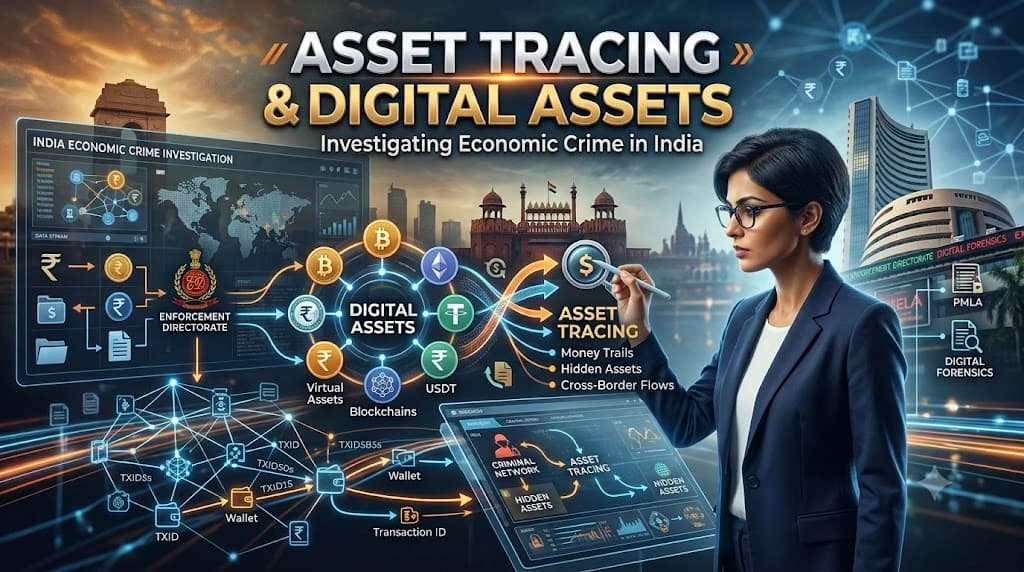
The trail has moved on-chain
For two decades, asset tracing in Indian economic-crime cases meant much the same thing: pull the bank statements, map the shell companies, follow the round-tripping through non-banking finance entities, and build a paper trail thick enough to survive cross-examination. That toolkit still matters. But it is no longer sufficient on its own.
Every large Indian fraud investigation opened in the last two years has had a digital-asset dimension somewhere in it - a diverted amount moved through a crypto exchange, a shell entity that took payment in tokens rather than rupees, or a promoter who converted siphoned funds into stablecoins the moment a probe was rumoured. The Enforcement Directorate's own public disclosures reflect this shift: its director has named cryptocurrency fraud, cyber-enabled terror financing and cross-border narcotics trafficking as the agency's current strategic priorities, alongside its traditional banking-fraud and money-laundering caseload.
The scale of enforcement activity has grown with it. In the 2025–26 financial year, the ED filed 812 chargesheets and 155 supplementary filings - nearly double the volume of the previous comparable period - and reported a conviction rate of 94 per cent. Over the same period, the agency secured the restitution of ₹32,688 crore to victims across 38 cases, spanning individual citizens, banks and institutional investors (Outlook India). None of that recovery is possible without first tracing where the money went - and increasingly, where it went is a wallet address, not a bank account.
What asset tracing means in an economic-crime case
Asset tracing is the process of reconstructing the movement of value from a point of loss - a diverted loan, a fraudulent invoice, a Ponzi collection, a bribe - through however many layers of accounts, entities and instruments it passes, to the point where it can be identified, frozen and ultimately recovered or restituted. It sits at the intersection of forensic accounting, cyber-forensics and law: the accountant establishes the flow of funds, the digital forensics expert establishes the flow of data and code, and the lawyer turns both into an evidentiary record a court or tribunal will accept.
In a purely fiat-currency fraud, that reconstruction relies on bank statements, KYC records, registrar filings and interviews. Where digital assets enter the picture, the exercise changes character. A blockchain ledger is public and permanent - every transaction is visible to anyone who looks - but the identities behind wallet addresses are not, unless and until a wallet touches a regulated exchange or an off-ramp that captures identity information. Tracing therefore becomes a matter of following a pseudonymous ledger until it intersects with an identifiable person, account or institution, and doing so before the trail is deliberately obscured.
India's legal architecture for tracking digital assets
The legal footing for this work has firmed up considerably since 2023. On 7 March 2023, the Finance Ministry notified that entities dealing in virtual digital assets exchanges, custodians, and platforms facilitating transfer or exchange of VDAs - are “reporting entities” under the Prevention of Money Laundering Act, 2002. That single notification did more to make asset tracing possible in India than any single enforcement action since: it obliged VDA service providers, domestic and foreign, to register with the Financial Intelligence Unit-India, run customer due diligence, monitor transactions and file suspicious transaction reports (KYC Hub). In December 2023, FIU-IND used that authority to issue show-cause notices to several major offshore exchanges operating in India without registration - a signal that the obligation would be enforced against platforms regardless of where they were incorporated.
The Insolvency and Bankruptcy Code supplies a parallel track, aimed less at fraud in the criminal sense and more at value stripped out of a company before or during insolvency. Sections 43, 45, 49, 50 and 66 of the IBC allow a resolution professional or liquidator to have preferential, undervalued, fraudulent or extortionate transactions set aside, and a forensic or transaction audit is now close to standard practice in any insolvency where diversion is suspected. The gap between what has been claimed and what has actually been clawed back is instructive: as of September 2025, avoidance-transaction applications worth roughly ₹3.90 lakh crore had been filed before the National Company Law Tribunal, against actual recoveries of about ₹7,516 crore. That gap is not a failure of law so much as a demonstration of how hard tracing and proving a deliberately concealed transfer actually is - which is precisely why the quality of the underlying forensic audit tends to decide these applications.
On the evidentiary side, the Bharatiya Sakshya Adhiniyam, 2023, which came into force on 1 July 2024 and replaced the Indian Evidence Act, 1872 in its entirety, carries forward and tightens the regime for electronic evidence. Section 63 deems an electronic record admissible without production of the original device, provided the conditions in the section are met - but it now requires a certificate not only from the person responsible for the device but also from a technical expert, a dual-certification requirement that did not exist under the old Section 65B (Live Law). In practice, this raises the bar for how a blockchain trace, a wallet screenshot or an exchange transaction log needs to be captured, hashed and certified before it can safely be tendered in an Indian proceeding - and it puts a premium on engaging a forensic expert early, not after the fact.
A further widening is due from 1 April 2026: under the Income Tax Bill, 2025, tax authorities gain the power to search emails, social media accounts, cloud storage and cryptocurrency wallets during investigations, extending search-and-seizure powers into virtual spaces that the older statute did not contemplate (CryptoTimes). Taken together, these changes mean an Indian asset-tracing exercise today is built on a genuinely multi-statute foundation - PMLA for the money-laundering charge, the VDA notification for exchange-level records, the IBC for corporate-value stripping, the BSA for evidentiary admissibility, and now the income-tax code for search powers over virtual spaces.
How investigators actually trace a digital asset
Tracing a fiat transaction and tracing a crypto transaction both start from the same question - where did the value go next - but the methods diverge quickly.
On the fiat side, the exercise is anchored in bank statements, RTGS/NEFT records, registrar of companies filings for shell entities, and increasingly, UPI transaction logs. Investigators build a fund-flow chart, identify layering entities (frequently shell companies with no real operations, common directors and address overlaps), and look for the point at which value re-enters a legitimate account - the classic round-tripping pattern that Indian forensic accountants have specialised in identifying for years.
On the digital-asset side, the starting point is the blockchain itself, which is a public and immutable ledger. Forensic analysts use blockchain-analytics tools to cluster wallet addresses controlled by the same actor, flag addresses associated with known exchanges, mixers, darknet markets or sanctioned entities, and follow a transaction as it hops across wallets, tokens and even different blockchains through cross-chain bridges. The objective at each stage is the same: find the point where a pseudonymous wallet touches a regulated, identity-verified off-ramp - typically an exchange that follows KYC norms - because that is where a subpoena or a PMLA summons can convert an address into a name.
The difficulty is that bad actors know this too. Privacy-focused mixing services deliberately break the link between a sender and a receiver by pooling funds from many users before redistributing them, and tumblers compound the problem by splitting a single sum into smaller amounts routed through numerous addresses before recombining it downstream. Cross-chain bridges add another layer of obfuscation by moving value between blockchains that use different tracing tools and conventions. India's regulatory response has been to restrict the on-ramp side of this problem: FIU-IND guidelines curb the use of anonymity-enhancing tools by regulated entities, and reporting obligations that went live in 2026 mean a much larger share of domestic crypto activity is now already inside the compliance system by the time an investigation opens.
None of this replaces old-fashioned forensic accounting - it supplements it. The strongest asset-tracing product in a live case combines an on-chain fund-flow analysis with off-chain corroboration: bank records showing the fiat that funded a wallet in the first place, KYC data from the exchange where it was cashed out, and device or communication evidence tying a specific individual to the wallet's control. A blockchain chart alone rarely persuades a court; a blockchain chart cross-checked against bank and KYC records usually does.
The cases that are writing the playbook
Two exchange hacks, eighteen months apart, illustrate both the promise and the limits of digital-asset tracing in India. In July 2024, WazirX - then India's largest crypto platform - suffered a hack of roughly $235 million, later attributed by investigators to North Korean state-linked actors, who exploited weaknesses in the exchange's multi-signature wallet arrangements (CoinDesk). The stolen funds were moved through a series of cross-chain bridges and mixing services specifically designed to break the audit trail, and recovery has remained partial and slow - a reminder that even sophisticated blockchain analytics cannot fully undo laundering once assets have exited into non-cooperative jurisdictions and services.
Almost exactly a year later, in July 2025, CoinDCX suffered a separate breach of about $44 million, this time through a compromised backend server rather than a wallet exploit. CoinDCX opted to cover user losses from its own reserves and launched what it described as India's largest crypto recovery bounty, offering a share of any recovered funds to those who could help trace the stolen assets (Sumsub) - an implicit acknowledgment that tracing crypto theft increasingly requires crowdsourced blockchain expertise alongside formal law-enforcement channels. Notably, the ED subsequently engaged CoinDCX itself to help manage and custody crypto assets it had seized in unrelated cases, an indication of how closely exchanges and enforcement agencies are now expected to work together on the tracing and custody problem.
Investment fraud tells a parallel story. In December 2025, the ED uncovered a pan-Indian syndicate operating at least 26 fake cryptocurrency investment websites, built to resemble legitimate platforms and promising implausibly high returns to draw in retail investors (CryptoTimes). Cases of this kind - closer in structure to a classic Ponzi scheme than to a technical hack - are where fund-flow tracing across bank accounts, payment gateways and exchange on-ramps tends to do most of the evidentiary work, with blockchain analysis confirming rather than leading the investigation.
On the corporate side, NCLT and NCLAT rulings on IBC avoidance applications continue to turn on the quality of the underlying forensic audit. Where a forensic audit has identified a prima facie fraudulent or preferential transaction with clear documentary support, adjudicating authorities have shown a consistent willingness to examine the substance of the allegation rather than dismiss it on technical grounds - reinforcing that a well-constructed forensic report, not just the allegation itself, is what moves these applications forward.
Where the trail crosses a border
Digital-asset fraud rarely stays within one jurisdiction, and Indian agencies have been building out cross-border tools accordingly. The ED and other agencies can and do use India's mutual legal assistance treaty network to seek asset freezes and evidence from foreign jurisdictions, including data from offshore crypto exchanges, even where the underlying assets sit behind nominee structures or in wallets with no obvious India connection, provided an Indian bank account or victim is part of the chain (Bitget News).
A newer instrument entered use in May 2025, when India issued its first-ever INTERPOL Silver Notices, applying the relatively new mechanism to two high-value crypto fraud cases. Silver Notices are designed specifically to help trace and freeze proceeds of crime across borders - real estate, corporate interests, bank accounts and digital assets such as crypto wallets and NFTs - by formalising international cooperation on asset identification well before a full extradition or prosecution request is ready (Quastels). For attorneys advising victims of cross-border crypto fraud, this is a meaningful addition to the toolkit - it can move faster than a traditional MLAT request when the priority is freezing an identified wallet or account before it is emptied.
A longer-term structural fix is also on the calendar. India is among 52 countries committed to implementing the OECD's Crypto-Asset Reporting Framework, which will enable automatic exchange of transaction data on Indian residents' holdings at foreign exchanges starting from FY 2027–28. Once live, CARF should narrow one of the most persistent gaps in Indian asset tracing today - the fact that a wallet cashed out on an exchange with no India presence is currently far harder to attribute to an Indian resident than one cashed out domestically.
What this means for attorneys and expert witnesses
For counsel handling a fraud, insolvency or arbitration matter with a digital-asset dimension, a few practical implications follow from all of this.
• Engage a forensic or blockchain-analytics expert early, not after pleadings are drafted. Under the BSA's dual-certification requirement, the manner in which electronic evidence is captured - hashing, chain of custody, device certification now matters as much as what it shows. Evidence gathered without this discipline is far more exposed to a challenge on admissibility.
• Treat a blockchain trace as a starting point, not a finished product. Tribunals and courts respond best to tracing evidence that is corroborated off-chain - bank records, exchange KYC data, device evidence rather than a wallet-clustering chart presented in isolation.
• Where the trail crosses a border, consider the full range of mechanisms available MLAT requests, INTERPOL Silver Notices, and direct engagement with cooperative exchanges rather than defaulting to the slowest option by habit.
• In insolvency matters, commission the forensic or transaction audit early enough that it can genuinely inform the choice of which avoidance applications to pursue under Sections 43, 45, 49, 50 and 66 of the IBC, rather than using it purely to support conclusions already reached.
These are precisely the judgment calls that separate a forensic accountant or digital-forensics expert who can withstand cross-examination from one who cannot. Attorneys assembling a team for a matter with an asset-tracing component should look for experts who can speak to both the technical methodology and its evidentiary limits and who have a track record of their findings surviving scrutiny before a tribunal or court, not just producing an internal report.
The road ahead
The direction of travel in India is toward more visibility, not less. Reporting obligations on VDA service providers are now several years old and increasingly enforced; the Income Tax Bill's expanded search powers take effect in 2026; CARF brings automatic cross-border data exchange from 2027-28; and enforcement agencies are visibly investing in blockchain-analytics capability rather than treating it as a specialist add-on. None of this will make asset tracing simple mixers, cross-chain bridges and jurisdictions with weak cooperation will keep working against investigators for the foreseeable future. But the gap between what a determined trace can uncover and what a launderer can hide is narrowing, and it is narrowing from the investigators' side.
For attorneys, expert witnesses and the institutions that rely on them, the practical takeaway is straightforward: the difference between a case that recovers value and one that does not increasingly comes down to how early and how rigorously the tracing work begins.
TAKEAWAYS
• Asset tracing in India now runs on two parallel tracks - traditional fund-flow forensic accounting and blockchain analytics - and the strongest cases combine both rather than relying on either alone.
• The legal foundation has matured fast: the 2023 PMLA notification on virtual digital assets, IBC avoidance provisions, the BSA's Section 63 evidentiary regime, and 2026's expanded income-tax search powers together give investigators more reach than at any point before.
• Cross-border recovery tools - MLAT requests, India's first INTERPOL Silver Notices in 2025, and the OECD's CARF from 2027-28 - are closing the jurisdictional gaps that have historically protected offshore-parked proceeds.
• For attorneys, the decisive factor is timing: engaging a forensic or blockchain expert early, with proper evidentiary discipline, does more for a case's outcome than any single tracing technique.
Position yourself where the legal industry looks for expertise - sign up on exlitem.com to get discovered by leading lawyers and high-value clients.