

The Scale of the Problem
India is spending over ₹11 lakh crore annually on infrastructure - roads, highways, ports, railways, energy. Behind every mega-project is a contract, and behind almost every contract is a dispute waiting to happen. Delay and disruption claims now constitute the largest category of construction arbitration in India by volume and by value.
Yet the gap between what contractors claim and what tribunals award remains enormous. The reason is not the law - India's Arbitration and Conciliation Act 1996 provides a workable framework. The reason is methodology. Indian construction disputes are routinely advanced on reconstructed narratives rather than contemporaneous analysis, and tribunals have grown impatient with guesswork dressed as forensic evidence.
Delay and Disruption: Not the Same Thing
These two concepts are frequently conflated, to the detriment of both claims.
A delay claim concerns time. The contractor alleges that a qualifying event - employer-caused variation, late site access, force majeure, ground conditions - pushed the completion date beyond the contractual milestone. The remedy is an extension of time (EoT), which typically removes exposure to liquidated damages.
A disruption claim concerns efficiency. The contractor alleges that employer actions caused it to do the same work less productively than planned - more labour hours per unit of output, more plant standing time, repeated remobilisation. The remedy is compensation for additional cost, not necessarily more time.
Both can arise from the same event. A late employer instruction may delay the critical path (a delay claim) while simultaneously forcing the contractor to resequence non-critical work at higher cost (a disruption claim). Treating them as a single claim with one causation argument is a persistent mistake that weakens both.
The Five Methods Tribunals Evaluate
The Society of Construction Law (SCL) Delay and Disruption Protocol (2nd edition) identifies the principal methods used in practice. Indian tribunals familiar with international construction arbitration recognise these frameworks even where they are not expressly cited. The choice of method shapes what documentary records you need - and where the claim will stand or fall.
1. As-Planned versus As-Built
The simplest approach: compare the original programme with what actually happened. The difference in completion date is treated as employer-caused delay. This method is quick and transparent but routinely challenged because it conflates cause and effect - the as-built sequence reflects everyone's decisions. Tribunals have awarded on this basis where records are strong, but have equally rejected it where the contractor's own defaults are visible in the as-built picture.
2. Time Slice / Windows Analysis
The project is divided into windows (slices of time), and delay causation is assessed within each window using the programme as it stood at the start of that window. This is significantly more sophisticated than as-planned versus as-built. It also demands contemporaneous programmes - revised baselines, progress records, correspondence logs - for each window. Without those records, windows analysis collapses into retrospective reconstruction and loses most of its credibility.
3. Impacted As-Planned (prospective)
The analyst inserts delay events into the original programme and measures the theoretical effect on completion. This is most useful for contemporaneous extension-of-time assessments. Used retrospectively - as it often is in Indian disputes - it ignores everything that actually occurred during the project and is vulnerable to attack as hypothetical.
4. Time Impact Analysis (TIA)
The most rigorous prospective method. At the point of each delay event, the analyst assesses its impact on the current critical path using the programme as it stood then. TIA is the SCL Protocol's preferred approach for contemporaneous EoT assessment, and international tribunals regard well-executed TIA evidence as the gold standard. In India, it is rarely deployed because it requires programmes to have been regularly updated throughout the project - something most Indian infrastructure contractors do not do in practice.
5. Collapsed As-Built (‘But For’ Analysis)
The analyst starts from the as-built programme and removes the delay events to show what completion would have been ‘but for’ the employer's defaults. This retrospective method works where as-built records are detailed and reliable. Its weakness: it can omit contractor delays and present an artificially clean picture of employer responsibility.
No single method is inherently superior. Tribunals are persuaded by whichever method is best supported by the documents - which brings us to the real problem.
Why Most Indian Claims Fail: The Evidence Problem
The Supreme Court in McDermott International Inc. v. Burn Standard Co. Ltd. stated plainly that arbitral findings must be based on evidence and cannot rest on conjecture. That is easy to state and hard to meet.
Indian construction contracts routinely see delay claims assembled years after the project closes, from whatever records survive. The contemporaneous record is almost always incomplete: programmes were not maintained, site instructions were oral, correspondence files are partial, daily reports were never created or have been lost.
The result: delay claims are presented as narrative. Events are reconstructed from memory and selected documents, causation is asserted rather than demonstrated, and the quantum is calculated on assumptions about productivity that cannot be tested against actual data.
Tribunals are not blind to this. Where two competing reconstructions are placed before a tribunal, neither supported by a properly maintained contemporaneous record, the outcome is unpredictable - and arbitrators are increasingly inclined to reject both or award significantly less than claimed.
FIDIC Contracts and the Notice Trap
A large proportion of Indian infrastructure contracts adopt FIDIC or FIDIC-derived conditions. Under the FIDIC Red and Yellow Books, Clause 20.1 (now Clause 20.2 in the 2017 editions) requires a contractor to give notice within 28 days of becoming aware of a delaying event. Failure to give timely notice is expressed as a condition precedent to entitlement.
Indian practice has long treated these notice obligations as procedural formalities. Notice is given late, in bulk, or manufactured retrospectively at the time of claim. Employers have become better at citing time-bar provisions - and some tribunals, particularly in institutional arbitrations before the MCIA or SIAC, are enforcing them.
NHAI's standard highway contracts go further, requiring notice within 15 days of the event. Several Dispute Review Board decisions and arbitral awards have given weight to this provision, declining to award EoT where timely notice was not given.
The lesson is structural: notice obligations cannot be addressed at the point of claim. They must be managed from mobilisation as part of routine contract administration - a function most Indian infrastructure contractors have historically under-resourced.
Concurrent Delay: India's Most Contested Issue
Concurrent delay arises when employer-caused and contractor-caused delays operate on the critical path simultaneously. It is among the most litigated issues in construction arbitration globally, and India is no exception.
The legal treatment of concurrent delay in India is not yet settled by binding precedent in the way English law has developed the malmaison approach. Indian tribunals have considerable discretion, and outcomes vary significantly.
In practice, tribunals faced with concurrent delay tend to: (a) reduce the EoT awarded pro-rata to reflect the contractor's contribution; (b) deny additional cost while granting time; or (c) where the records cannot distinguish the causes, refuse to apportion and dismiss the claim for want of sufficient proof. Option (c) is the most common outcome where neither party has maintained adequate contemporaneous records.
A contractor who cannot demonstrate, on a period-by-period basis, which activities were on the critical path and which party was responsible for delay to each, is unlikely to win a concurrent delay argument.
Disruption Claims: The Hardest Cases to Win
Disruption claims are significantly harder to establish than delay claims. They require the claimant to prove not only that disruption events occurred, but that those events caused a measurable loss of productivity, and to quantify that loss on a defensible basis.
The methods used to quantify lost productivity include: the measured mile (comparing productivity in disrupted periods against undisrupted periods on the same project); industry studies and benchmarks; project-specific analysis of output records; and total cost claims (generally disfavoured by Indian tribunals as a last resort).
The measured mile is the method most likely to persuade a tribunal because it is project-specific and data-driven. But it requires daily output records - work completed per day, by trade, by location - that allow disrupted and undisrupted periods to be compared. Very few Indian infrastructure contractors maintain records at this level of granularity.
Without contemporaneous productivity records, disruption claims typically fail or are awarded at a fraction of the amount claimed. As arbitral practice has made clear: losses on account of disruption are not awarded unless established by reference to actual impact on resources, not by assertion.
What the Courts Have Said
Supreme Court of India, operating under the restricted Section 34 review jurisdiction confirmed in Ssangyong Engineering & Construction Co. Ltd. v. NHAI (2019), do not second-guess tribunals on fact or evidence. Interference is limited to awards based on no evidence, irrelevant evidence, or omission of vital evidence.
This means a tribunal's evidential findings on delay causation are largely insulated from challenge on appeal. The corollary: getting the evidence right in the arbitration itself - not on appeal - is where the case is won or lost.
The Supreme Court in NHAI v. Gwalior Jhansi Expressway Ltd. emphasised that Section 20-A of the National Highways Act reflects a public interest imperative to protect infrastructure timelines. Courts have shown increasing reluctance to permit procedural challenges that delay infrastructure arbitrations.
A New Complication: NHAI's Retreat from Arbitration
In a significant policy shift, NHAI issued guidance in 2024 effectively excluding arbitration for highway disputes exceeding ₹10 crore without senior officer approval and recorded reasons. For large delay and disruption claims - which routinely run to hundreds of crore - this pushes disputes toward litigation in civil courts.
The practical effect: litigation timelines are longer, disclosure practices differ, and the pool of decision-makers who regularly engage with forensic delay analysis is narrower than in institutional arbitration. Contractors and employers with NHAI contracts need to factor this into their dispute strategy from the outset.
What Attorneys and Contractors Must Do Differently
The single most important shift is temporal. Delay and disruption claims cannot be built retrospectively from incomplete records. They must be built contemporaneously - through rigorous site record-keeping, timely contractual notices, regularly updated programmes, and real-time productivity tracking.
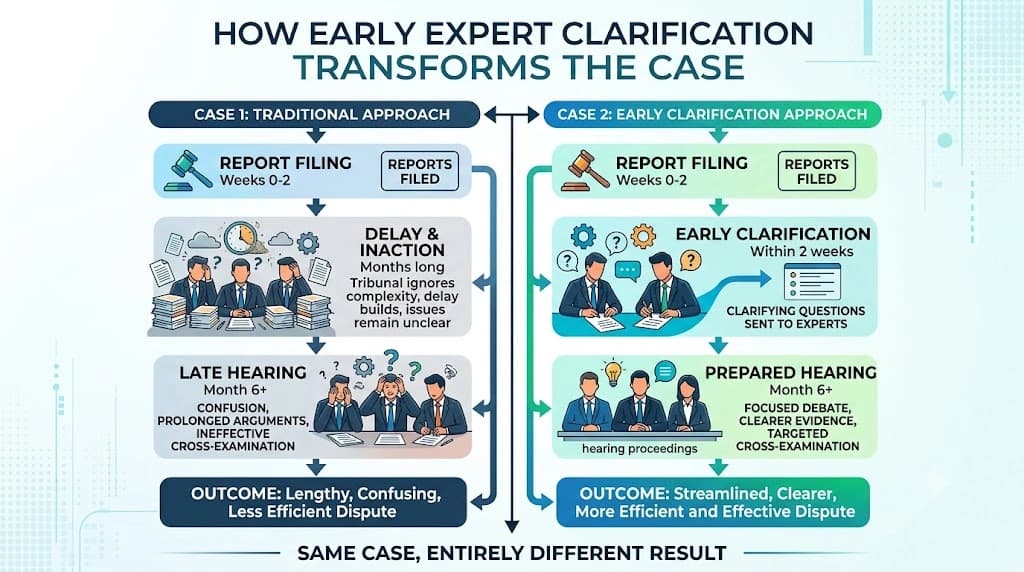
For attorneys instructed in active infrastructure projects, that means advising clients on contract administration from mobilisation, not just when the dispute has crystallised. For those dealing with existing disputes, engage a forensic delay analyst and quantum expert early - before the pleadings are fixed - to determine which method the documents can actually support.
A delay claim built around a method the documents cannot sustain will fail on evidence, regardless of how persuasive the narrative. The method must follow the records, not precede them.
Takeaways
Indian tribunals are increasingly demanding methodological rigour in delay and disruption claims - imprecise or unsupported analyses are rejected outright. Whether you rely on the Time Impact Analysis, As-Planned vs As-Built, or Windows Analysis, the method must match the facts, the data must be contemporaneous, and expert opinion must be clearly reasoned. Counsel who brief quantum experts early - and align on methodology before the claim is filed - consistently achieve better outcomes.
Position yourself where the legal industry looks for expertise — sign up on exlitem.com to get discovered by leading lawyers and high-value clients.