
The Numbers Tell the Story
India's fraud problem is not a niche concern. Cyber fraud incidents rose from 2.6 lakh reported cases in 2021 to nearly 28 lakh by 2025 - an increase of close to tenfold in four years - involving losses of ₹22,931 crore. UPI fraud cases nearly doubled between FY23 and FY24, with FY25 recording 12.64 lakh incidents at ₹981 crore. The Reserve Bank of India's MuleHunter AI platform, deployed across more than 15 Indian banks, has achieved reported accuracy rates of 95 per cent in detecting mule accounts - accounts used to launder fraud proceeds through layered transfers.
Corporate fraud tells a parallel story. The ABG Shipyard case - involving alleged fraud of ₹22,842 crore across 28 banks - became one of India's largest bank fraud prosecutions, with the Serious Fraud Investigation Office (SFIO) tasked to investigate after forensic audits revealed falsified accounts and fund diversion. IL&FS's ₹91,000 crore default in 2018 took years of forensic unwinding before the scale of evergreening loans and intra-group diversions became clear. These are not outliers. SEBI Chairman Tuhin Kanta Pandey, speaking at ICAI's Future Proof Forensics event in 2025, specifically warned of round-tripping through subsidiaries, circular transactions with dummy entities, and misleading disclosures becoming endemic among listed companies.
"Fraud has industrialised. The question for forensic practitioners is no longer whether AI is relevant - it is whether they have deployed it in time."
Why the Old Playbook Is No Longer Sufficient
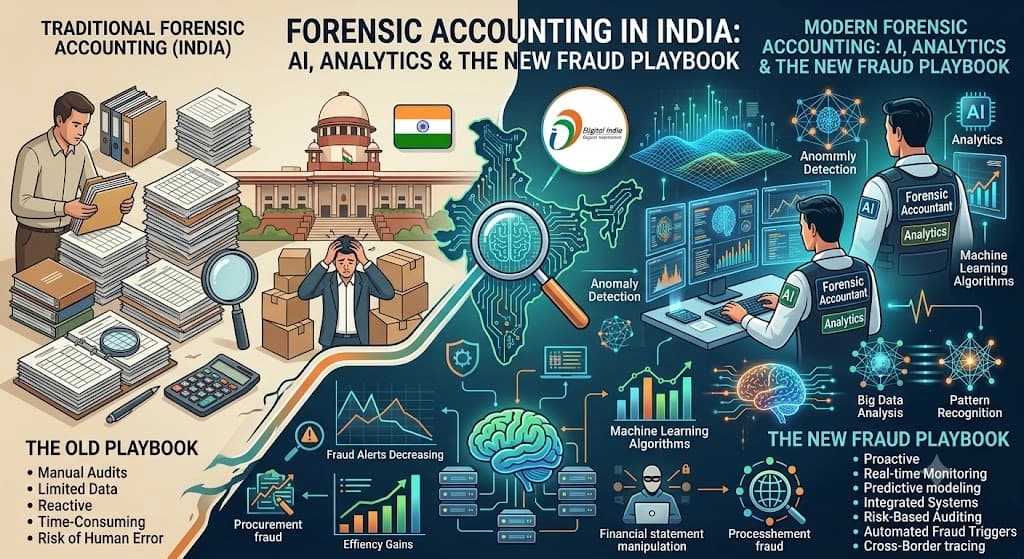
Traditional forensic accounting relied on a sequence most practitioners know well: identify the allegation, request documents, apply sampling techniques, interview witnesses, reconstruct the transaction trail manually. That methodology is still necessary - but it is no longer sufficient.
The sheer volume of data in a modern corporate fraud investigation has outpaced human capacity for manual review. A mid-sized corporate dispute can involve millions of transactions, thousands of inter-entity transfers, and digital communications across multiple platforms. Sampling - the statistical bedrock of traditional audit - creates coverage gaps that sophisticated fraudsters have learned to exploit. Transactions are structured just below materiality thresholds, spread across entities and time periods specifically to avoid pattern detection.
The second problem is speed. By the time a forensic team arrives, assets may have moved through multiple shells, been converted into crypto, and exited the jurisdiction. Real-time detection is no longer a luxury; it is the only mechanism that preserves recovery options.
The New Arsenal: AI, Analytics and Blockchain
Machine Learning in Transaction Monitoring
Machine learning models now deployed by Indian banks under PMLA compliance frameworks are capable of ingesting entire transaction histories and surfacing anomalies in real time - not through rigid rules, but through pattern recognition trained on historical fraud data. Unlike traditional rule-based systems that generate high volumes of false positives, ML-driven models reduce false alerts by 90-95 per cent in reported deployments, directing investigator attention to genuine risk signals.
KPMG India's November 2025 paper on machine learning in financial crime compliance describes the transition from transaction monitoring to Monitoring of Suspicious Activities (MSA) - a broader framework that considers customer behaviour, relationship networks and geographic risk alongside individual transactions. The practical implication: a series of individually unremarkable payments between related parties becomes visible as a pattern only when the network is mapped, not when each transaction is reviewed in isolation.
Explainable AI: Making Findings Court-Ready
One of the persistent challenges for forensic practitioners has been translating AI outputs into evidence that can withstand cross-examination. A black-box model that flags transactions without explanation is of limited use in litigation or arbitration. The developing standard in India, as elsewhere, is Explainable AI (XAI) - models that generate a narrative account of why a specific transaction or entity was identified as suspicious. This output can be presented in an expert report with the same rigour as a manually constructed analysis.
For disputes practitioners, this matters directly. A forensic expert appearing before an arbitral tribunal can now support their findings with an auditable, reproducible analytical methodology rather than an assertion that transactions "appeared unusual." The XAI output becomes part of the evidentiary chain.
Blockchain Analytics and Crypto-Asset Tracing
India's growing crypto fraud problem - investment fraud, NFT scams, and the conversion of corporate fraud proceeds into digital assets - has created demand for a specialist skill set that barely existed in Indian forensic practice five years ago. Blockchain analytics tools now used in Indian investigations can trace asset movement across wallets and exchanges, identify clustering of addresses linked to the same beneficial owner, and flag transactions routed through mixing services designed to obscure provenance.
The legal framework for crypto-asset tracing in India is still evolving - the ED has used PMLA powers to attach crypto assets in several high-profile cases, and SEBI's jurisdiction over digital assets continues to expand. Forensic practitioners who can bridge the technical analytics and the legal framework for freezing and recovering digital assets are operating at the frontier of the profession.
Continuous Forensic Monitoring
The next evolution - already in early deployment among larger Indian corporates - is what practitioners are calling Continuous Forensic Monitoring: AI systems that function as a permanent audit layer over financial systems, flagging anomalies in real time rather than waiting for a post-incident investigation. The model inverts the traditional reactive sequence. Instead of detecting fraud after the event, the system raises alerts as transactions occur - giving compliance teams and boards the option to intervene before losses crystallise.
The Regulatory Landscape: Stretched But Sharpening
India's regulatory response to corporate fraud involves multiple overlapping agencies - SFIO, the Enforcement Directorate, SEBI, CBI, FIU-IND, and state police - each with distinct jurisdictions, investigative powers and evidentiary standards. The coordination gap between these agencies is a structural weakness that sophisticated fraudsters routinely exploit.
SFIO, the specialist corporate fraud investigator under the Ministry of Corporate Affairs, faces serious capacity constraints. As of early 2025, approximately 47 per cent of its sanctioned positions remained vacant, and the office carried a backlog of 74 pending investigations. The agency's reach significantly exceeds its grasp - a problem that has persisted through multiple governments and budget cycles.
SEBI's April 2025 overhaul of its forensic auditor panel is a significant development - and a contentious one. The regulator reduced its empanelled forensic firms from 20 to nine, dropping Ernst & Young, KPMG and Grant Thornton Bharat from the list in favour of smaller, specialist firms including Deloitte Touche Tohmatsu India, BDO India, and several mid-tier practices. The stated rationale is quality and discretion in past work. The practical signal is that SEBI prioritises focused, accountable forensic capacity over brand recognition - and that the agency is tightening control over how investigations are conducted on its behalf.
The regulator's warnings are also becoming more specific. SEBI's current focus areas - as articulated publicly in 2025 - include circular transactions with dummy entities, diversion of shareholder funds through subsidiaries, round-tripping, and misleading disclosures. For attorneys advising listed companies under investigation, understanding the specific patterns SEBI is detecting matters for the quality of the forensic response.
Forensic Evidence in Disputes and Arbitration
The growth of forensic accounting in India's investigative and regulatory sphere has a direct corollary in dispute resolution. Commercial arbitrations increasingly involve forensic accounting evidence - particularly in disputes arising from M&A transactions, joint ventures, long-term supply contracts and financial service agreements where one party alleges fraud, misrepresentation, or accounting manipulation by the other.
The forensic expert's role in these proceedings has evolved. A well-constructed forensic expert report in arbitration today will typically include a quantified loss assessment, a transaction reconstruction, an identification of the specific accounting adjustments that support or undermine the claim, and - increasingly - an AI-supported analytical methodology that can be independently verified. Arbitral tribunals in India-seated proceedings are becoming more sophisticated consumers of forensic evidence: they expect methodological transparency, not just conclusions.
The Gayatri Balasamy judgment of April 2025 - which resolved the question of when Indian courts can modify arbitral awards - also has indirect implications here. Where a quantum finding in an award is challenged, the underlying forensic analysis becomes the focus of the Section 34 application. Awards that rest on robust, independently verifiable forensic methodology are more resistant to challenge than those built on opaque or contested expert opinion.
Attorneys briefing forensic experts in arbitration should push for analytical rigour from the outset: the methodology should be defensible, the data sources documented, and the AI tools used - if any - should produce explainable outputs. A forensic report that cannot withstand expert cross-examination is a liability, not an asset.
The Gaps That Still Need Closing
For all the advance in tools, India's forensic ecosystem has structural gaps that technology alone cannot resolve.
First, the regulatory coordination problem is acute. A corporate fraud investigation in India may simultaneously involve SFIO, ED, CBI and SEBI - with each agency working from different evidentiary standards, on different timelines, with limited information-sharing. The result is sometimes contradictory investigative findings and jurisdictional disputes that delay prosecution and asset recovery.
Second, the supply of forensic practitioners with the combined skills - accounting, technology, and legal - needed to deploy AI tools in an evidentiary context is thin. The profession in India is growing, but demand significantly outpaces supply. Firms that have invested in analytics capability have a genuine market advantage.
Third, the legal framework for digital evidence in India is still catching up. The admissibility standards for AI-generated forensic outputs, blockchain analytics reports, and electronic transaction records are not yet settled in arbitral or court practice. Practitioners are operating with significant interpretive uncertainty - and that uncertainty will eventually need to be resolved, either by the courts or by institutional arbitration rules.
Takeaways
Forensic accounting in India has entered a new phase. The fraud typologies are more complex, the digital trail more convoluted, and the investigative tools more powerful than at any point in the profession's history. For disputes lawyers and in-house counsel, three practical conclusions follow.
Engage forensic expertise early. Whether the matter is a regulatory investigation, a commercial dispute, or an internal inquiry, the window for preserving digital evidence and transaction data is narrow. Forensic teams equipped with analytics capability can secure and process data that manual review would take months to examine.
Demand methodological transparency from your expert. In arbitration, forensic evidence is only as strong as the methodology that produced it. AI tools that generate unexplained outputs create cross-examination risk. Ensure your expert can narrate the analytical process, not just the conclusion.
Watch the regulatory signals. SEBI's specific warnings about circular transactions, round-tripping and dummy-entity structures are effectively a road map of what investigators are looking for. Companies that self-assess against these patterns before regulators arrive are in a materially better position than those that wait.
The fraud is more sophisticated. The tools are more powerful. The practitioners who command both — and can translate between technical analysis and legal evidentiary standards — will define the next decade of forensic practice in India.
Position yourself where the legal industry looks for expertise - sign up on exlitem.com to get discovered by leading lawyers and high-value clients.