
The Moment the Jury Checked Out
Picture two forensic accounting experts testifying in the same multi-million dollar breach of contract case. Both are equally qualified. Both have impeccable credentials. Both are explaining the exact same set of complex damages calculations to the same twelve jurors.
The first expert begins presenting her analysis. Numbers scroll across a projected spreadsheet. She explains depreciation schedules, amortization tables, and net present value formulas. Three minutes in, a juror in seat four starts doodling on his notepad. A woman in the back row rubs her eyes. The jury has, collectively, left the building.
The second expert walks to the front of the courtroom, looks directly at the jury, and says: “Imagine your favorite superhero. Now imagine someone has been stealing that hero’s powers, piece by piece, for three years, and we’re here today to figure out exactly what those powers were worth.” The jurors lean forward. They want to know the answer.
Both experts are testifying about the same underlying facts. One is a scientist. The other is a scientist who has mastered something far more powerful: the ability to teach.
This is the central insight shared by expert witnesses across dozens of fields, from cybersecurity and supply chain management to colorectal surgery and industrial safety: technical knowledge gets you hired; communication skill wins cases. And according to the experts who have spent decades on the witness stand, most of their colleagues have never figured this out.
Why Most Experts Fail at Communication — And Don’t Know It
There is a seductive assumption that runs through virtually every technical profession: if the science is right, the audience will understand. This assumption, according to multiple expert witnesses, is demonstrably false — and the cost of believing it is often the case itself.
Ed Cheng, an evidence law professor and guest in Season 2, Episode 15 of On The Stand, has studied empirically how judges and jurors actually process expert testimony. His findings are sobering. Judges, Cheng observes, often avoid engaging with complex scientific and statistical testimony, preferring instead to “punt to the jury” — essentially treating difficult technical evidence as someone else’s problem. Jurors, meanwhile, frequently lack the baseline knowledge to evaluate competing expert claims on their merits, and so they fall back on proxies: How confident does this expert seem? How clearly did they explain themselves? Do they feel like someone I can trust?
“Juries often decide how much weight to give an expert before cross-examination even begins — based purely on how understandable the expert was in direct examination.”
— Michael G. Kaplan, Forensic Accounting Expert
Michael G. Kaplan, a forensic accounting expert and guest in Season 1, Episode 3 of On The Stand who has spent decades teaching what he calls “The Art of Storytelling in the Courtroom,” puts it even more directly. By the time opposing counsel rises for cross-examination, he argues, the jury has already made a preliminary judgment about the expert. That judgment is based overwhelmingly not on the expert’s methodology, but on how easy they were to follow. An expert who communicates poorly may never recover from the credibility deficit they created in the first fifteen minutes of their own direct testimony.
Dr. Eric Cole, a cybersecurity expert and guest in Season 2, Episode 8 of On The Stand who has built one of the most recognized expert witness practices in his field, traces the same phenomenon in his own domain. Cybersecurity cases involve concepts that are genuinely foreign to most jurors — packet captures, intrusion signatures, malware attribution. An expert who leads with jargon immediately signals to the jury: this is going to be confusing and uncomfortable. And once jurors feel that way, they stop listening.
The tragedy, as several experts note, is that the experts most likely to overwhelm jurors with complexity are often the most technically accomplished — because they are the least accustomed to explaining their work to non-specialists. A researcher who has spent thirty years mastering a subject has, in some ways, forgotten what it felt like not to know it. That knowledge, counterintuitively, becomes a liability.
The Teaching Mindset: How Elite Experts Think About Their Role
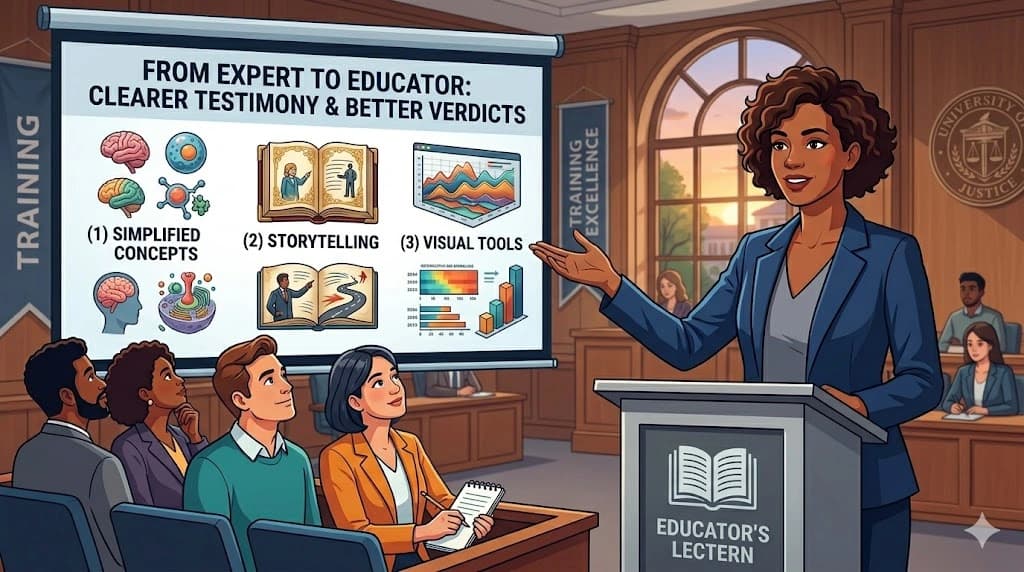
The experts who consistently perform best on the witness stand share a mental model that reframes their entire purpose in the courtroom. They are not there to demonstrate their expertise. They are not there to impress opposing counsel. They are not even primarily there to advocate for the side that retained them. They are there to teach.
Dr. Cole articulates this philosophy with characteristic clarity: “The courtroom is a classroom with very high stakes.” His guiding principle, honed over years of explaining network intrusions and data breaches to non-technical juries, is deceptively simple: if you truly understand something, you can explain it so that non-technical people understand it. If you cannot do that, the problem is not with your audience — the problem is with your understanding.
“Someone who truly understands something can explain it so non-technical people can understand it.”
— Dr. Eric Cole, Cybersecurity Expert
Dr. Stephen Cohen, a colorectal surgeon and guest in Season 3, Episode 1 of On The Stand who has built a substantial expert witness practice, credits his mother — a schoolteacher — for shaping this philosophy. “If I can’t explain it to you in a way that you understand it,” he says, “then I don’t understand it.” This standard, he notes, applies equally whether he is speaking to medical residents, colleagues at a conference, or a jury with no medical background whatsoever.
Robert Handfield, a supply chain management expert and guest in Season 2, Episode 10 of On The Stand who spent years as a professor before transitioning to expert witness work, brings a formal educator’s toolkit to the stand. What his academic background gave him, he explains, is the habit of starting from first principles and building toward complexity — rather than assuming a baseline of shared knowledge. A professor who walks into a classroom on the first day of a semester does not assume her students already know the material. She begins where they are and takes them where she needs them to go. This is exactly what the most effective expert witnesses do.
Jordan Redavid, a plaintiff trial attorney and guest in Season 1, Episode 2 of On The Stand, frames the expert’s teaching role from the other side of the table. The expert, he argues, is “the real conduit” through which an attorney conveys the substance of a case to a jury. An attorney can argue all day, but jurors know attorneys are advocates. When an independent expert explains something clearly and convincingly, it carries a weight that no closing argument can replicate. But when an expert fails to communicate, the attorney loses their most powerful asset. “If the expert can’t communicate clearly,” Redavid says, “the attorney loses their most important weapon.”
Specific Techniques That Work: From Boot Camps to Visual Aids
Teaching philosophy is important. Specific, repeatable techniques are what actually change performance. Across dozens of conversations with expert witnesses, a consistent toolkit of communication strategies emerges — methods that have been tested in real courtrooms and refined through hard experience.
The Twelve-Year-Old Test
Michael Kaplan has a deceptively simple method for stress-testing expert testimony: explain it to a twelve-year-old. Specifically, he advises experts to go home after preparing their testimony and try to explain it to their children or grandchildren. If a young person with no domain knowledge cannot follow the explanation, it is not ready for a jury.
This is not about dumbing down testimony — it is about forcing the expert to identify the precise points where their explanation relies on unstated assumptions or domain-specific shortcuts. Every gap in a twelve-year-old’s comprehension is a potential point of confusion for a juror. Finding those gaps before trial is far better than discovering them during cross-examination.
Visual Aids as a Primary Language
Robert Handfield is emphatic about the power of charts, graphs, and third-party data as communication tools. Numbers presented in tables are abstract. The same numbers rendered as a bar chart showing a supply chain’s disruption over time are immediately intuitive. A photograph of an empty warehouse shelf says something in an instant that three paragraphs of text cannot convey.
Handfield makes particular use of government data and industry reports as visual anchors. When an independent, authoritative source already visualizes the relevant data, an expert who incorporates those visuals into their testimony is not just making their testimony clearer — they are borrowing the credibility of the source.
The Power of Analogies
Dr. Cole’s primary technique for cybersecurity testimony is the strategic use of analogies. When explaining how a network intrusion works, he does not lead with technical terminology. He leads with something familiar: a locked door, a security camera, a forged key. He then builds the technical concept onto that familiar framework, so that jurors feel they are extending their existing knowledge rather than acquiring alien concepts from scratch.
The superhero analogy in our opening scene is exactly this technique applied to financial damages. The moment the jury understands that the case is about someone stealing something valuable that belonged to someone else — a concept as old as human society — they are ready to evaluate the specific details of how it was stolen and what it was worth.
The Storytelling Framework: Structure That Makes Testimony Stick
Communication techniques are powerful on their own. But the experts who perform at the highest level do something more: they organize their testimony within a narrative structure that gives individual facts emotional and logical coherence.
Kaplan teaches a framework built on the oldest story structure in human culture: “once upon a time, in a land far, far away.” Every case, he argues, can be translated into this structure. There was a state of affairs that existed before the harm. Something changed — a decision was made, a product failed, a professional fell short. The plaintiff suffered consequences. And now the jury will hear what those consequences are worth.
“Every expert’s job is the same: take the jury on a journey from confusion to clarity, and let them feel the satisfaction of understanding something they didn’t before.”
— Michael G. Kaplan, Forensic Accounting Expert
What this narrative structure does is give individual pieces of testimony a place to live. A depreciation schedule, presented in isolation, is an abstraction. A depreciation schedule presented as one part of the answer to the question “how much was the hero’s stolen power worth?” is a clue. And jurors who feel they are solving a puzzle alongside the expert are engaged, attentive, and inclined to trust the expert who is guiding them toward the answer.
Jonathan Klane, an industrial hygiene and safety expert and guest in Season 3, Episode 11 of On The Stand, brings academic rigor to this intuition. With a PhD focused on narrative and risk perception and a master’s degree in adult education, Klane is perhaps the only expert witness whose formal academic training is specifically about why stories work better than statistics for lay audiences. The research is clear: humans process information in narrative form. Facts presented without narrative context are processed by the analytical brain and quickly forgotten. Facts embedded in stories are processed emotionally, associated with meaning, and retained.
The practical implication for expert witnesses is significant. It is not enough to present accurate information. The information must be organized so that each fact answers a question the jury has already formed — so that every new piece of evidence feels not like a burden, but like a revelation.
Dr. Jordan Romano, a physician and guest in Season 2, Episode 12 of On The Stand who built his expert witness communication style through direct feedback from the attorneys who retained him, describes this as the “Eureka moment” in expert testimony: the instant when a juror’s expression shifts from uncertain concentration to the quiet satisfaction of understanding. Experienced expert witnesses learn to engineer that moment deliberately, timing their most important conclusion to arrive just when the jury has accumulated enough context to fully appreciate it.
What Juries Actually Remember: The Psychology of Expert Communication
Understanding how juries process expert testimony requires grappling with some uncomfortable realities about human cognition — particularly as it applies to long, complex trials.
Financial and technical experts often face the hardest communication challenge of any witnesses in a trial, for a reason that has nothing to do with the complexity of their subject matter: they frequently testify last. By the time a damages expert takes the stand, jurors may have been in that courtroom for days or weeks. Their attention resources are depleted. Their patience for complexity has been exhausted. The expert who walks in at four o’clock on a Thursday afternoon with a stack of spreadsheets is fighting against the accumulated fatigue of everything that has come before.
This reality makes the communication imperative even more urgent for experts in quantitative fields. A surgeon explaining anatomy at nine in the morning has a different audience than a forensic accountant explaining lost profits calculations at the end of a long trial. Techniques that help manage juror fatigue — shorter sentences, more frequent pauses, visual anchors, strategic humor, direct eye contact — are not embellishments. They are essential tools.
Ed Cheng’s research introduces another sobering concept: the “mark of exclusion,” the formal adverse ruling that results when an expert’s testimony is found inadmissible. Such rulings, Cheng notes, can follow an expert for the rest of their career, appearing in every background check conducted by every attorney who considers retaining them. And while exclusion rulings can arise from genuine methodological problems, they often trace back to something more preventable: an expert who could not explain their methodology clearly enough for the court to evaluate it.
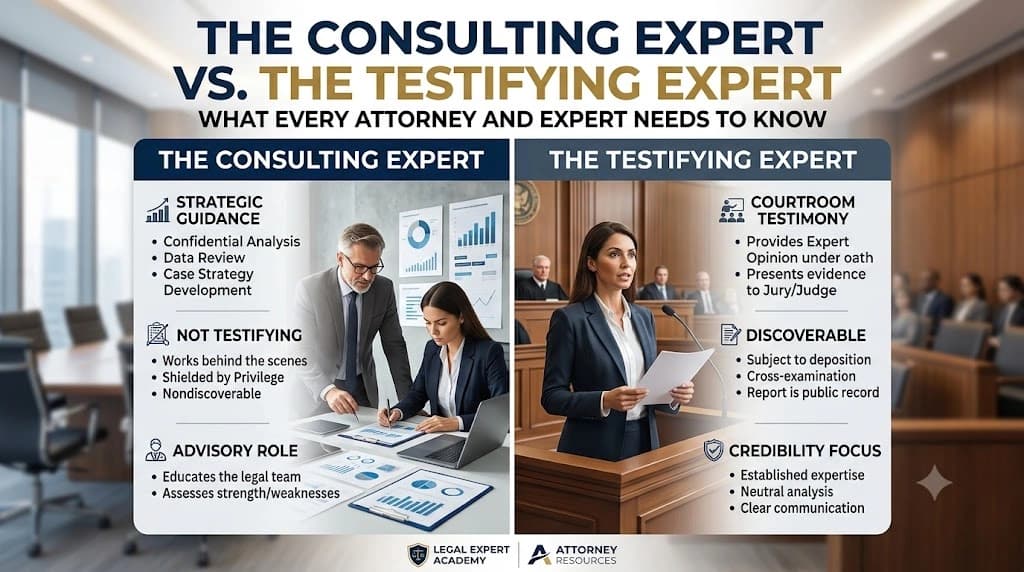
“A credibility problem is rarely about the science. It’s almost always about the communication.”
— Ed Cheng, Evidence Law Professor
Beyond content, demeanor matters enormously. Both experts and the attorneys who work with them describe the same phenomenon: jurors evaluate expert witnesses the way they evaluate any new acquaintance — through a rapid, largely unconscious assessment of confidence, warmth, and honesty. An expert who maintains eye contact with jurors rather than with their notes signals confidence in their conclusions. An expert who speaks in conversational rhythms rather than reading from a report signals that they actually understand what they are saying. An expert who smiles appropriately and acknowledges the difficulty of complex concepts signals respect for the jury’s effort.
These are not superficial concerns. They are the substrate through which all technical content is filtered. A juror who does not like or trust an expert will discount their testimony regardless of its technical merit. A juror who likes and trusts an expert will work harder to follow complex concepts and give the benefit of the doubt when something is unclear.
Training Resources and How to Get Better
The good news embedded in all of this is straightforward: communication skill is learnable. None of the expert witnesses described in this article were born with the ability to hold a jury’s attention through a three-hour technical presentation. They developed that ability through deliberate practice, formal training, honest feedback, and a genuine commitment to improvement.
Structured Training Programs
Michael Kaplan’s Courtroom Boot Camp is perhaps the most intensive structured training program available specifically for expert witnesses. The program combines presentation technique, cross-examination preparation, and storytelling workshops — and crucially, Kaplan insists that both the expert and the retaining attorney attend together. The dynamic between expert and attorney in the courtroom is its own performance, he argues, and training that ignores that dynamic is training only half the team.
The SEAK Expert Witness Conference, referenced by multiple experts across different fields, provides continuing education specifically tailored to expert witnesses — covering not just communication skills but business development, report writing, and the evolving legal standards that govern expert testimony.
Learning Through Continuous Practice
Dr. Cole’s approach to communication improvement is more diffuse but equally intentional. He teaches in schools. He coaches cybersecurity teams. He creates free educational content on YouTube. Every one of these activities, he notes, sharpens a different dimension of communication skill — explaining concepts to teenagers is different from explaining them to experienced professionals, which is different from holding the attention of a casual online audience. The breadth of teaching contexts makes each one stronger.
Dr. Romano describes a different path to the same destination: iteration guided by feedback. He paid close attention to which explanations worked and which ones lost jurors, sought post-trial debriefs with attorneys who could tell him what the jury had responded to, and adjusted his approach accordingly. This feedback loop, slow and sometimes uncomfortable, produced a communication style that he could not have designed in advance.
The Unexpected Power of Theater
Several experts and the attorneys who work with them point to an unconventional resource: theater and improvisational performance training. The skills that make a stage performer effective — presence, vocal variety, the ability to stay in the moment when unexpected things happen, comfort with silence, the capacity to read an audience in real time — map directly onto the skills that make a witness effective under pressure.
Improv training, in particular, develops exactly the skill that cross-examination demands: the ability to respond authentically and confidently to unexpected inputs without becoming defensive or rattled. An expert witness who has trained in improv has learned that “I don’t know, but here is what I do know” is a perfectly effective response — and far more credible than a confident answer that overreaches.
The Standard That Changes Everything
The common thread running through all of these experts is not a shared technique or a particular curriculum. It is a standard — a non-negotiable benchmark that each of them applies to their own communication, in the courtroom and outside of it.
That standard is simple: if someone who knows nothing about your field cannot follow your explanation, the explanation is not good enough yet. Not the audience. The explanation.
This is a radical reframing of the expert’s responsibility. The traditional model of expert testimony places the burden of understanding on the jury — they are expected to follow the expert’s testimony as best they can, and the expert’s job is simply to present the truth as they know it. The model described by the experts in this article places that burden squarely on the expert. If the jury does not understand, that is a failure of preparation and communication, not a limitation of the audience.
Kaplan puts it simply: “If I can’t explain it to you in a way that you understand it, then I don’t understand it well enough yet.” That sentence — echoed in different words by experts in fields as varied as colorectal surgery, cybersecurity, and industrial safety — represents the professional standard that separates the expert witnesses who change outcomes from the ones who merely appear in cases.
The courtroom is a classroom. The jury is your class. The case is the lesson. Whether they leave understanding something they didn’t understand before — that is entirely up to you.
EXPERTS FEATURED IN THIS ARTICLE
Michael G. Kaplan — Forensic Accounting (S01E03)
Storytelling in the Courtroom; the 12-year-old test; Courtroom Boot Camp
Dr. Eric Cole — Cybersecurity (S02E08)
The courtroom as classroom; analogies; continuous learning through teaching
Robert Handfield — Supply Chain (S02E10)
Educator’s first-principles approach; visual aids and government data
Ed Cheng — Evidence Law Professor (S02E15)
How judges and jurors process scientific evidence; the mark of exclusion
Jordan Redavid — Plaintiff Trial Attorney (S01E02)
The expert as the attorney’s most important weapon; communicating to win
Dr. Jordan Romano — Physician (S02E12)
Feedback-driven communication refinement; the Eureka moment
Dr. Stephen Cohen — Colorectal Surgery (S03EP1)
The schoolteacher standard; explaining as understanding
Jonathan Klane — Industrial Hygiene/Safety (S03EP11)
PhD in narrative and risk perception; why stories outperform statistics for lay audiences