
The Case That Forced the Issue
The facts of Gayatri Balasamy are not themselves remarkable. Gayatri Balasamy, then Vice President at ISG Novasoft Technologies Limited, resigned in July 2006 alleging sexual harassment by the company's CEO. After contested criminal proceedings, the parties were referred to arbitration. The tribunal awarded Balasamy ₹2 crore.
What followed was a cascade of judicial interventions that crystallised the legal uncertainty. A Madras High Court single judge modified the award upwards by ₹1.6 crore, reading an inherent modification power into Section 34. A division bench of the same High Court confirmed the power but scaled the addition down to ₹50,000. Balasamy challenged this before the Supreme Court.
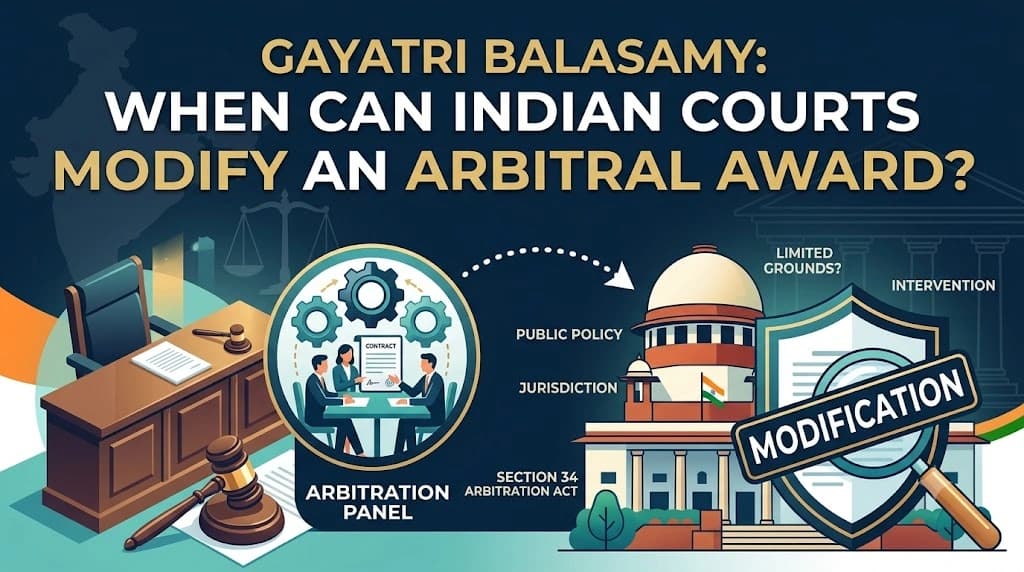
In February 2024, a bench of the Supreme Court, noting conflicting decisions across two decades, referred the central question to a five-judge Constitution Bench: does Section 34 of the Arbitration and Conciliation Act, 1996 permit courts to modify an arbitral award - and if so, to what extent?
Why the Question Had No Clean Answer
Section 34 empowers courts to “set aside” an award on limited grounds. It does not use the word “modify.” Prior benches had read this silence in opposite directions.
The restrictive view - most clearly stated in Project Director, NHAI v. M. Hakeem (2021) and McDermott International Inc. v. Burn Standard Co. Ltd. (2006) - held that Section 34’s language was exhaustive: courts could set aside or remit, nothing more. Modification was for the legislature to authorise, not the courts to imply.
The permissive view - seen in Vedanta Limited v. Shenzhen Shandong Nuclear Power Construction Company Ltd. (2018) and Tata Hydroelectric Power Supply Co. Ltd. v. Union of India (2003) - held that the power to vary was incidental to the jurisdiction under Section 34. Denying it would push parties back into fresh arbitration over correctable errors, defeating the purpose of arbitration as an efficient dispute resolution mechanism.
High courts across the country applied both lines. The Gayatri Balasamy reference gave the Constitution Bench a mandate to choose.
What the 4:1 Majority Decided
Chief Justice Sanjiv Khanna, writing for Justices B.R. Gavai, P.V. Sanjay Kumar and A.G. Masih, held that Section 34 contains an implied but strictly limited power of modification. The majority was careful to insist this is not appellate jurisdiction - courts cannot revisit the merits of an award. The power operates only in four defined circumstances:
1. Severance of an invalid portion
All five judges agreed that Section 34 allows courts to sever the invalid part of an award from the valid remainder, invoking the principle omne majus continet in se minus (the greater power includes the lesser). The majority went further - treating the power to partially set aside as, in effect, a power to modify. Where the valid and invalid portions are legally separable, and where the valid part can stand independently on liability and quantum, the court may preserve the valid portion while excising the rest.
2. Correcting manifest errors
Courts may rectify computational, clerical, or typographical errors that are apparent on the face of the record - analogous to the power under Section 152 of the Code of Civil Procedure to correct accidental slips in judgments. Critically, the error must be self-evident, not arguable. This is a procedural correction power, not a licence to review the tribunal’s reasoning.
3. Post-award interest
Under Section 31(7)(b) of the Act, post-award interest accrues from the date of the award until payment. The majority held that courts may modify this rate in both directions - upward or downward - where the arbitrator’s chosen rate is unjustified, particularly because arbitrators cannot anticipate future market movements. Pendente lite interest (interest during the arbitration itself) is off limits: if that component is flawed, the only options are set aside or remit.
4. Article 142 - the Supreme Court’s equitable jurisdiction
The Supreme Court may invoke Article 142 of the Constitution - its power to make any order necessary for complete justice - to modify an award where required. The majority stressed this must be exercised with “great caution” and within “narrowly defined limits.” It cannot be used to alter an award on its merits, and it is available only to the Supreme Court, not to High Courts acting under Section 34.
The Dissent: A Principled Warning
Justice K.V. Viswanathan’s 129-page dissent is the longest opinion in the judgment and deserves serious attention from practitioners. His core point: Section 34 was deliberately drafted to exclude modification power, and three rounds of parliamentary amendment in 2015, 2019 and 2021 left that exclusion intact. The majority, in his view, is doing what the legislature chose not to do.
Justice Viswanathan draws a sharp distinction between severance (separating parts of an award) and modification (changing an award’s substance). The majority collapses this distinction; he insists the two operate in different spheres. Severance removes an excess; modification rewrites.
He also raises the most practically significant concern: enforceability under the New York Convention. The Convention grounds enforcement on the original award. The UK, Singapore and New Zealand have express statutory provisions deeming a court-varied award to form part of the arbitral award itself. India has no such provision. A modified award may therefore face resistance in foreign enforcement proceedings - a risk the majority dismisses but which Justice Viswanathan argues remains live until Parliament acts.
His preferred mechanism: Section 34(4), which allows courts to remit an award to the tribunal so curable defects can be corrected at source. He would also allow Section 152 CPC to apply to clerical errors directly, without characterising the power as “modification.”
What This Means in Practice
For disputes counsel, the immediate takeaways from Gayatri Balasamy are concrete:
Section 34 applications can now explicitly seek modification as primary relief - not just set-aside. Parties with a severable grievance (say, an excess in one head of damages or a defective interest rate) should plead modification of that portion, rather than challenging the entire award. Pleadings should be structured accordingly.
Post-award interest is squarely arguable at Section 34 stage. If the tribunal’s rate appears unreasonably high or low in light of market conditions at the time of the award, courts can now be asked to adjust it. This is a new ground - particularly relevant where interest forms a material portion of the total sum in dispute.
Clerical error corrections no longer require full set-aside. Where an arithmetical slip or typographical error in an award has caused uncertainty, a Section 34 court can correct it directly, without routing through Section 33 (which requires the tribunal’s own cooperation).
The severability test is demanding. Courts will require that the portions to be severed are not “intrinsically intertwined” with those preserved. Where liability and quantum are interdependent, expect courts to decline modification and insist on full set-aside or remittal.
International awards: proceed with caution. Justice Viswanathan’s New York Convention concern is not academic. Where an India-seated award is likely to be enforced abroad, carefully consider whether seeking modification rather than remittal creates enforceability risk in the target jurisdiction. Until Parliament provides an express deeming provision - as the UK has under Section 71 of the Arbitration Act 1996 - the question will remain live.
Takeaways
Gayatri Balasamy is a significant but calibrated ruling. It does not open the door to appellate review of arbitral awards - the majority is emphatic on this. What it does is acknowledge the practical reality that parties should not be forced into fresh arbitration when the defect in an award is severable, clerical, or confined to interest. For counsel advising on Section 34 strategy, the question is no longer whether modification is available - it is when, and on what terms.
The dissent’s concerns about international enforceability and legislative intent will not disappear. Practitioners advising on cross-border arbitrations seated in India should monitor how foreign enforcement courts treat modified awards in the post-Balasamy period. Parliamentary amendment - on the lines of the UK’s Section 71 - may ultimately be required to close the gap Justice Viswanathan identifies. Until then, the majority view is the law, and practitioners must work within it.
Position yourself where the legal industry looks for expertise - sign up on exlitem.com to get discovered by leading lawyers and high-value clients.