
The Moment Everything Changed
It is the morning of trial. A forensic accounting expert has been asked to appear at a pre-trial Daubert hearing before the jury is seated. She has spent fourteen months on this case. She has built a model, reviewed thousands of pages of documents, and produced a 140-page report. She is, without question, an expert.
The judge leans forward and asks: “Can you explain to me, in plain language, why your methodology produces your conclusion? Not what the conclusion is. Why it follows.”
She pauses. In thirty years of expert witness work, she has never been asked to explain it this way. Not in a pre-trial hearing. Not out loud. Not to someone with no background in forensic accounting.
This is the moment the 2023 amendment to Federal Rule of Evidence 702 was written for.
The amendment did not invent a new rule. It clarified and enforced one that had existed since 1993. But that clarification has profound consequences for every expert witness who appears in federal court — and for the attorneys who retain them.
What Rule 702 Is — And Why It Matters More Than Most Experts Realize
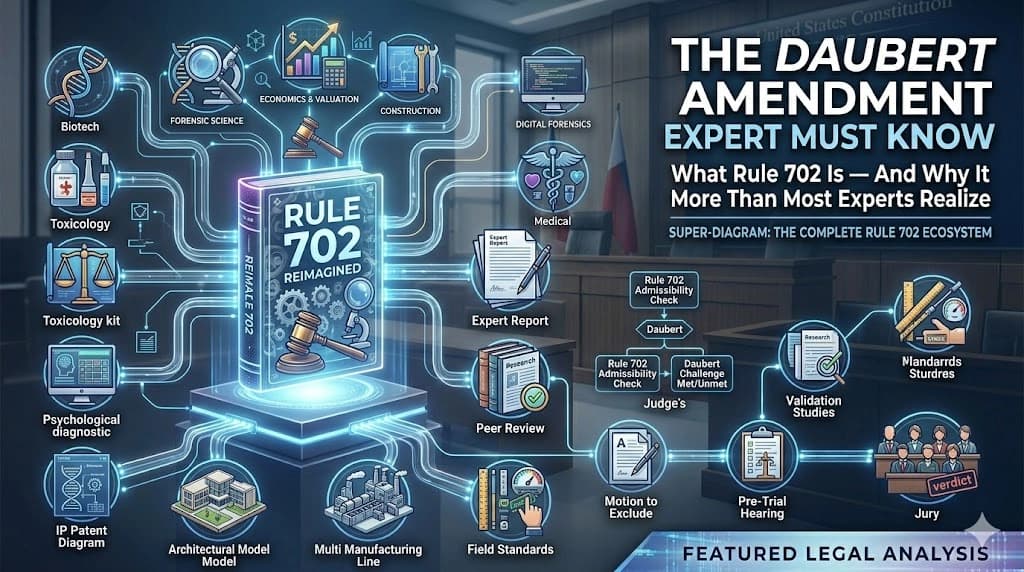
Federal Rule of Evidence 702 is the legal standard that governs whether an expert witness may testify in federal court. It has four requirements, and an expert must satisfy all four to be admitted. The first is qualification: the witness must have sufficient knowledge, skill, experience, training, or education in the relevant field. The second is helpfulness: the testimony must assist the trier of fact to understand the evidence or determine a fact in issue. The third is that the testimony must be based on sufficient facts or data. The fourth is that the testimony must be the product of reliable principles and methods, reliably applied to the facts of the case.
Michael G. Kaplan, a forensic accounting expert witness and guest in Season 1, Episode 3 of On The Stand with over 46 years of experience and approximately 300 expert witness appearances, breaks this down with unusual clarity. Qualification is only the beginning, he explains.
“Just because you are qualified and just because you have specialized knowledge does not mean your testimony is going to be admitted. There are four requirements and you have to meet all four.” — and the one that trips up the most experts is the last one: reliable application.
Rule 702 was codified following the 1993 Supreme Court case Daubert v. Merrell Dow Pharmaceuticals, which established the judge as a “gatekeeper” responsible for screening expert testimony before it reaches the jury. The intent was clear: judges would evaluate the reliability of methodology, not leave it for juries to sort out. But in practice, something went wrong.
For decades after Daubert, judges routinely declined to act as gatekeepers. When faced with a motion to exclude an expert, they would invoke a mantra that became endemic in federal courts: “This goes to the weight, not the admissibility.” The expert would be allowed in, the jury would hear the testimony, and the jury would decide what to make of it. The problem was that this was precisely what the rule was designed to prevent.
The 2023 amendment to Rule 702 was the advisory committee’s direct response to that decades-long pattern. It was not a change in principle. It was an instruction to judges: stop punting. You are the gatekeeper. Act like it.
What Actually Changed — The Two Critical Amendments
The amendment made two specific changes to the text of Rule 702, and understanding both is essential for any expert who plans to testify in federal court.
The first change establishes a burden. Under the amended rule, the proponent of expert testimony — the party calling the expert — must now demonstrate admissibility “by a preponderance of evidence.” This is not a trivial shift. It means that showing up with a credentialed expert and a long report is no longer sufficient. The party calling the expert must affirmatively prove that the expert’s methodology meets each of the four requirements of Rule 702.
The second change concerns the fourth requirement. The old language said the expert must have “reliably applied” their methodology to the facts. The new language says the expert’s opinion must “reflect” a reliable application. That word — reflect — is the operative change. The opinion itself must be the logical product of the methodology applied to the evidence. It is not enough to say “I used a reliable method.” The method must visibly produce the conclusion.
“The amendment is primarily a message to the judges — you cannot just kick it to the jury. You have to be the gatekeeper. That is the obligation.” — Michael G. Kaplan · Forensic Accounting Expert · On The Stand, Season 1, Episode 3 |
Kaplan is precise about what the amendment actually does: “The amendment merely clarifies the spirit of Rule 702 as it was originally.” The change is not new law. It is a correction of a practice that drifted from the law’s original intent. But for expert witnesses, the practical effect is significant: judges are now expected to apply the rule with rigor, and experts need to be ready.
Prof. Edward K. Cheng, the Hess Chair in Law at Vanderbilt University and one of the foremost scholars on evidence law, who appeared in Season 2, Episode 15 of On The Stand, frames the challenge from an academic perspective. His observation captures a structural tension at the heart of the entire Rule 702 enterprise: “People go to law school to avoid science and math. The judges don’t want to deal with these cases. And so, yes, they will take their responsibility seriously, but to the extent that they can punt it off to the jury, I think that’s going to be the inclination.”
The amendment, in Cheng’s view, represents a meaningful — if imperfect — step forward in how courts handle scientific evidence. It places the responsibility where it belongs. But it does not guarantee that judges will exercise it properly. The history of Rule 702 has been one of slow, uneven progress, and the 2023 amendment is the latest attempt to close the gap between what the rule says and how it is applied.
How This Changes What Experts Must Do in Their Reports and Testimony
For expert witnesses, the practical implications of the amendment begin with the report. Federal Rule of Civil Procedure 26(a)(2)(B) already requires expert reports to disclose the bases and reasons for opinions. What the amended Rule 702 adds is a substantive requirement: the report must make visible the logical connection between the methodology and the conclusion.
Kaplan is unusually specific about what good expert report writing looks like under the new standard. He teaches a framework that sounds disarmingly simple: “A good expert report starts with four words: ‘once upon a time.’ And it ends with four words: ‘they lived happily ever after.’” Tell it as a story. The expert’s job, in his view, is not merely to present data and a conclusion — it is to make the logical pathway from evidence to opinion visible, accessible, and compelling for the trier of fact.
This is not just a communication preference. Under the amended rule, it has legal necessity behind it. A judge evaluating admissibility will ask: Is this expert’s opinion the logical result of using that methodology and applying it to the evidence considered? If the report does not answer that question clearly, the judge now has explicit grounds and implicit instructions to exclude it.
“The judge will ask: is this expert’s opinion the logical result of using that methodology and applying it to the evidence? We are going to have to jump over some hurdles. The amendment is reminding the judge to put us through our paces.” — Michael G. Kaplan · Forensic Accounting Expert · On The Stand, Season 1, Episode 3 |
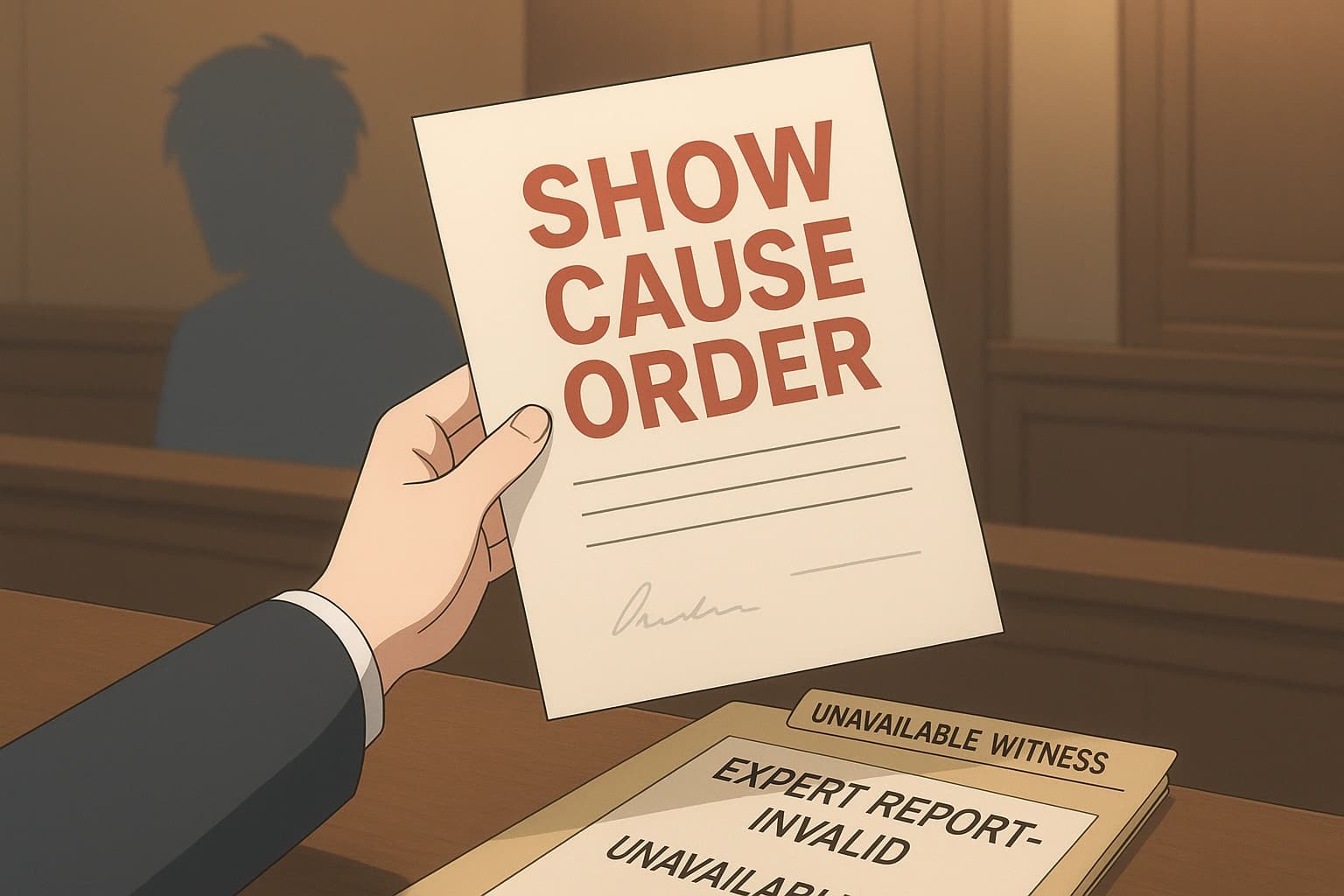
The amendment also elevates the importance of pre-trial Daubert hearings as strategic moments for expert witnesses. In cases where a motion to exclude is filed, the expert may be called to testify before the jury is seated — explaining their methodology in plain language, to a judge with no background in the expert’s field, and making the logical case for why their opinion follows from their method.
Kaplan, who has been through this process hundreds of times, notes that this double performance actually creates an opportunity: “There are more experts who are going to have to tell that story. And if you have the opportunity to persuade the judge even before the starting gun is shot, there is an advantage. Much of it hinges on your persuasive abilities.” An expert who performs well in a Daubert hearing has effectively previewed their testimony — and learned, before the jury is seated, which arguments land and which need refinement.
Dr. Robert Handfield, a supply chain management expert and guest in Season 2, Episode 10 of On The Stand, demonstrates the practical application of this standard. As the Bank of America University Distinguished Professor at North Carolina State University with multiple Daubert challenges filed against him — none of which resulted in exclusion — Handfield’s experience illustrates what it looks like when an expert’s methodology is genuinely defensible and consistently documented.
“I’ve never had a Daubert ruling against me,” Handfield notes. “And that is in my favor.” He attributes this clean record partly to his academic background, which provides independent validation of his methodology: “I’m able to pull from my own textbooks to say, look, this is a well-known principle. It’s taught to undergraduates and MBA students across the country. It’s standard practice.” When the principles underpinning an opinion are documented in peer-reviewed literature and widely accepted in the relevant community, the path to admissibility under the amended rule is substantially clearer.
Bench Trials vs. Jury Trials — Different Dynamics Under the New Rule
Rule 702 does not distinguish between jury trials and bench trials, but the amendment plays out quite differently in each context. In a jury trial, the judge makes an admissibility ruling before the jury hears anything. A pre-trial Daubert hearing is, in effect, a preliminary performance for the expert: the entire question of whether the jury will ever hear this testimony depends on how persuasively the expert can explain their methodology to a judge, in plain language, in advance of the main event.
In a bench trial, the dynamics are more complex. The same person who decides admissibility also decides the case on the merits. Kaplan identifies a consequence that most experts and attorneys do not fully appreciate: “You can’t get the toothpaste back in the tube.”
If a judge holds a Daubert hearing in a bench trial and determines that an expert’s testimony is inadmissible, the judge has still heard it. The excluded analysis has already landed, even if it has been formally struck. When that same judge later evaluates all the evidence and reaches a verdict, the excluded testimony may unconsciously inform the judgment — which means, as Kaplan puts it, the damage is done before the ruling is fully processed.
“In a bench trial, if the judge goes through the process and decides the expert’s testimony is not admissible — you can’t get the toothpaste back into the tube. The judge heard it already.” — Michael G. Kaplan · Forensic Accounting Expert · On The Stand, Season 1, Episode 3 |
Richard Leisner, a corporate and securities law expert witness and guest in Season 2, Episode 11 of On The Stand, brings more than 50 years of legal practice to this question. He has seen the dynamics of judicial gatekeeping evolve from the inside: “For the last 20 years, lawyers have used the Daubert standard as a way to try to get rid of what is pejoratively referred to as junk science.” In his field — securities law, IPOs, governance, and mergers — the standards are subtler because the expertise is less scientific and more interpretive.
Leisner’s observation points to a broader challenge embedded in the amended rule: not all expert testimony involves hard science. Much of what expert witnesses do — particularly in business litigation, securities law, and professional malpractice — is closer to “art than science,” as Leisner puts it. The amended rule applies equally to these fields, but the methodology is harder to document and harder to evaluate. The logical connection between an expert’s opinion and the evidence it is based on must still be visible — but what that looks like in a complex securities malpractice case is genuinely different from what it looks like in a pharmaceutical toxicology dispute.
Daubert vs. Frye — Why Different Standards Produce Different Outcomes
Rule 702 and the Daubert standard govern federal courts and many state courts, but not all. A significant number of states — including Washington, California, and Illinois — apply an older standard known as the Frye standard, which originated in a 1923 federal case. Under Frye, the key question for admissibility is not whether a judge finds the methodology reliable, but whether the methodology has been “generally accepted” by the relevant scientific community.
George Reis, a forensic imaging and video analysis expert and guest in Season 2, Episode 1 of On The Stand, operates primarily in Washington state — a Frye jurisdiction — and was drawn to the podcast to discuss a case that crystallizes the difference between the two standards with unusual clarity.
The case was State of Washington v. Joshua Puloka. A defense expert — who had a background in video production, not forensic science — used an AI enhancement tool to clarify surveillance footage that was critical to the defense. The tool produced a clearer image. The problem was that in the process of enhancing the video, it also introduced artifacts: visual elements that were not present in the original footage. The prosecution’s expert, a certified forensic video analyst named Grant Fredericks, identified the artificially introduced elements, and the prosecutor moved to exclude the AI-enhanced evidence under Frye.
The judge agreed. The AI tool had not been validated by the forensic imaging community. It was used for production purposes, not forensic ones. It had not been peer-reviewed for forensic applications. Under Frye, none of that required a judge to independently evaluate the science — it simply meant the tool lacked the general acceptance required for admission.
“The ruling was not against AI. It was against using a tool that hadn’t been validated by the relevant scientific community. That is a preview of many more AI-evidence disputes to come.” — George Reis · Forensic Imaging & Video Analysis Expert · On The Stand, Season 2, Episode 1 |
Reis is careful to distinguish what the ruling actually said. It was not a ruling against AI in forensics. It was a ruling against using an unvalidated tool in a forensic context. As he notes, “If an AI tool looks at an image and can determine the best filter to clarify it using set parameters that we can understand, then I think the community would accept that — and courts would accept it as well, as long as all the other criteria for Frye or Daubert are met.”
The comparison between Daubert and Frye is instructive for understanding both standards more deeply. Daubert requires the judge to evaluate reliability; Frye delegates that evaluation to the relevant scientific community. In practice, Frye exclusions often turn on whether the methodology is standard in the field, while Daubert exclusions often turn on whether the methodology was properly applied in this case. Under the amended Rule 702, Daubert has moved significantly closer to Frye in one respect: the judge must now make a substantive finding about whether the methodology was reliably applied, not simply defer to the expert’s credibility.
The Strategic Implications — How Smart Experts Are Adapting
For expert witnesses working in federal court, the amendment to Rule 702 creates both a challenge and a competitive advantage. The challenge is clear: the bar for admissibility is now explicitly higher, and judges are being instructed to enforce it. The advantage is equally clear: experts who understand the new standard, build their reports to meet it, and can articulate their methodology persuasively in a pre-trial hearing will have a decisive edge over those who do not.
The most immediate practical implication is report writing. Under the amended rule, every expert report should be treated as a document that will be scrutinized not just for what it concludes, but for why the conclusion follows from the methodology. The “bases and reasons” section of the report — the part required by Rule 26(a)(2)(B) — now carries more weight than ever. An expert who can write that section in a way that makes the logical pathway from evidence to opinion transparent and compelling is writing a report that is significantly harder to exclude.
Handfield articulates the standard that has kept him un-excluded throughout his career: “As an expert, the only asset you bring is your credibility and your integrity.” His preparation philosophy reflects this: look at each case and ask whether the position you are being asked to support is one you can genuinely defend, not just on the facts, but in terms of whether it reflects standard practice in your field. If you cannot defend it in plain language to a neutral judge, you should not be the expert on that case.
Kaplan’s practical advice for experts preparing for the new standard includes stress-testing testimony against non-expert audiences before appearing in court. His well-known method: explain your testimony to a twelve-year-old. Not as a performance exercise, but as a diagnostic. If the explanation requires assumptions or technical shortcuts that a non-expert cannot follow, the gap in the logical chain is there — and a judge at a Daubert hearing will find it.
Cheng offers a longer historical lens on what the amendment represents. The evolution of expert testimony law in American courts has been, in his view, a slow and imperfect process of getting better at screening scientific evidence. The Daubert decision in 1993 was one step. The codification of Rule 702 was another. The 2023 amendment is the latest correction — “a meaningful step forward,” as he describes it, even if the full effect depends on how judges choose to exercise their newly clarified authority.
For Leisner, who has practiced through every phase of this evolution, the fundamental lesson is unchanged: preparation is everything. The details of methodology documentation, report structure, and pre-trial advocacy matter more under the amended rule than they did before. “You need to be prepared to do something else,” he says, describing the unpredictability of trial. “Whatever you think you’re going to do, prepare to do something else.” That counsel applies with full force to the new Rule 702 landscape: experts who walk into a Daubert hearing thinking that their credentials and their report will carry them have not prepared for what a judge, armed with a new and explicit mandate, might actually ask.
“The courts are slowly, imperfectly getting better at screening scientific evidence. The 2023 amendment is a meaningful step forward.” — Prof. Edward K. Cheng · Evidence Law Professor, Vanderbilt University · On The Stand, Season 2, Episode 15 |
The bottom line is practical: the 2023 amendment to Rule 702 raises the floor for expert witness admissibility in federal court and reassigns to the judge the active gatekeeping role that Daubert originally envisioned but practice had eroded. Experts who build their methodology documentation, their reports, and their Daubert hearing preparation around this new reality are not just protecting their admissibility. They are developing the precise skills — clear reasoning, transparent methodology, persuasive narrative — that make expert testimony genuinely effective once it reaches the jury.
The toothpaste, as Kaplan reminds us, cannot go back in the tube. But that is precisely the point: the expert who understands this amendment will make sure the right things come out in the first place.
EXPERTS FEATURED IN THIS ARTICLE
Michael G. Kaplan — Forensic Accounting (S01E03) 46+ years in forensic accounting, business valuation & litigation consulting · ~300 expert witness appearances · Rule 702 analysis; the judge-as-gatekeeper principle; report writing as storytelling; the pre-trial Daubert hearing as strategic opportunity |
Prof. Edward K. Cheng — Evidence Law Professor, Vanderbilt University (S02E15) Hess Chair in Law, Vanderbilt · PhD Statistics, Columbia · JD, Harvard · Co-author, Modern Scientific Evidence · Academic authority on Rule 702; the judicial inclination to ‘punt’; the historical arc of scientific evidence law |
Dr. Robert Handfield — Supply Chain Management (S02E10) Bank of America University Distinguished Professor, NC State · Executive Director, Supply Chain Resource Cooperative · Zero Daubert exclusions across multiple challenges · How methodology grounded in peer-reviewed literature withstands scrutiny |
George Reis — Forensic Imaging & Video Analysis (S2E01) President & Owner, Imaging Forensics · 20+ years in forensic image/video analysis · Frye vs. Daubert comparative analysis; the Washington state AI video exclusion case; what courts actually require from AI-assisted evidence |
Richard Leisner — Corporate & Securities Law (S02E11) 50+ years in corporate, securities & transactional law · Fellow, American Bar Foundation · Life Member, American Law Institute · The evolution of Daubert challenges in business litigation; the line between science and ‘art’ in expert testimony |