
What "Your Lane" Actually Means - A Practical Definition
Federal Rule of Evidence 702 qualifies an expert by "knowledge, skill, experience, training, or education." What it does not say is that qualification in one domain automatically extends to adjacent ones. The rule creates a gate - but a gate with surprising precision, and many experienced experts misread where it sits.
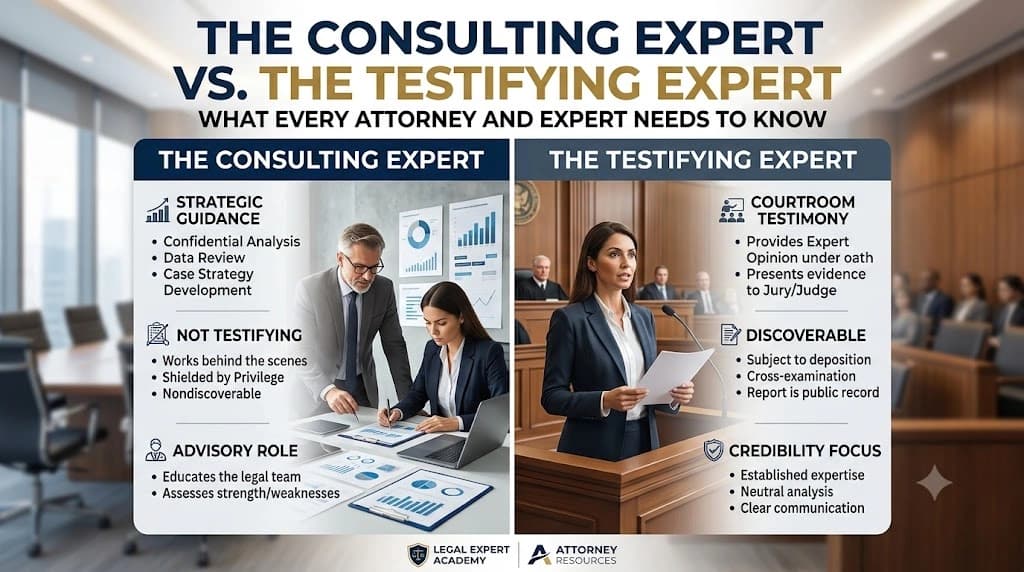
The practical definition of an expert's lane operates on three levels. The first is subject matter: what field of knowledge does this testimony require? The second is methodology: does the expert's approach to analyzing this specific problem meet the Daubert standard of reliability? The third - and most overlooked - is scope of retention: what questions was this expert specifically hired to address in this case? That third layer is where most scope problems begin.
An expert may be unimpeachably qualified in their field and still find their testimony excluded because they answered questions they were never retained to analyze. Few experts in any discipline illustrate this distinction more clearly through deliberate professional choice than those who made early decisions to specialize narrowly and never waver.
That kind of early resolve is what defines the career of Jerry Birnbach, a retail design and commercial injury expert with over 50 years of experience and more than 650 cases - including engagements for Fortune 500 retailers such as Walmart, Target, and Macy's - who appeared on Season 2, Episode 2 of On The Stand. At the very beginning of his career, he made a decision that shaped everything that followed. "I directed myself very early in life that I was going to stay in retail, remain in retail, and die in retail," he says. "And as a result, I'm the retail expert." That precision - not "commercial spaces" or "premises liability," but retail, specifically - is what gives Birnbach unassailable authority when opposing counsel comes probing.
The same instinct for definition governs the practice of Eric P. Rose, a product design and manufacturing expert with over 40 years of experience and more than 50 patents across healthcare devices, consumer products, and industrial safety equipment, who appeared on Season 2, Episode 9 of On The Stand. Rose states his lane with equal precision: "My lane is product design and manufacturing and everything around it - product-market fit, product testing, product quality, material selection." When a case involving product warnings crossed his desk, he declined that portion of the work and referred it out. "I have people I can refer out to," he says simply. "But I want to stay in my lane."
Notice what both experts are describing. Not a limitation. A definition. The precision of their self-description is itself a professional asset - it tells retaining attorneys exactly what they are buying, and it tells opposing counsel exactly where a challenge will and will not land.
How Scope Creep Happens - The Predictable Paths to Overextension
Scope creep rarely announces itself. It does not arrive as a temptation to lie or overstate. It usually arrives as helpfulness - the natural instinct to be as useful as possible to the attorney who retained you. The attorney needs an opinion on design defect, and that opinion leads naturally into questions about product warnings. If the expert knows something about warnings, the temptation is to include it. Why not? The attorney needs it. The expert has a view. What could the harm be?
The harm is that a view and a qualified expert opinion are not the same thing. Opposing counsel knows the difference even when the expert does not.
Few experts articulate that line more precisely than Seth Miller, a battery technologist and patent expert who appeared on Season 3, Episode 7 of On The Stand, and who has testified in patent disputes involving multi-billion-dollar stakes - including a Samsung OLED display case that settled for $1.8 billion. Miller's deep expertise is in battery cell chemistry and cell construction. When he receives calls about large-scale utility battery installations involving system-level failures, he declines. "I'm not the right guy for that bigger project-level thing," he says, "but I get a lot of calls for it." The chemistry knowledge overlaps. The qualified expertise does not.
"Sometimes it's not obvious," Miller concedes. "If what was important about a fire was understanding cell chemistry, then I can be more useful. So I'll have a conversation and say: here are the kinds of projects I work on, here's where I'm most useful, and here's where I'm not." That conversation - honest, transparent, conducted before a retainer is signed - is what separates a durable expert career from a fragile one.
Specializing early and holding that line with discipline is equally central to the practice of John Puls, a licensed clinical social worker and addiction specialist who appeared on Season 2, Episode 4 of On The Stand, and who focuses exclusively on substance use disorder and severe mental illness in particularly challenging populations. He could have positioned himself as a broad mental health expert - a larger market, more early cases. Instead, he chose depth over breadth. The result? Attorneys regularly tell him: "You were the only person I found who was able to do this type of work." By narrowing his lane, Puls removed himself from competition entirely.
There is also the deposition drift problem - the moment when an attorney, often with the best of intentions, starts asking questions that pull an expert into territory the report does not cover. The instinct is to answer. The discipline is to stop. The complete, professionally appropriate, and ultimately protective answer is simply: "That falls outside the scope of my analysis." Not hedging. Not apologizing. A full stop.
Miller adds another dimension worth sitting with: "The things that you write in your expert report at some level set the boundaries on what it is that you can express later on in the matter." The report is not merely a document - it is a commitment. Everything outside it is territory that has not been staked, and staking new territory in the middle of a deposition is exactly how experts become vulnerable.
The Consequences - How Overextension Gets Punished in Court
When an expert ventures outside their documented expertise, opposing counsel has a precise legal mechanism to respond: the Daubert motion to exclude. Under the 2023 amendment to Federal Rule of Evidence 702, the burden rests on the proponent of expert testimony to demonstrate admissibility by a preponderance of evidence. This means the retaining attorney must show not just that the expert is generally qualified, but that this expert is qualified to render this specific opinion - and that their methodology was reliably applied to these specific facts.
An opinion that strays outside the expert's documented expertise fails on the first prong - qualification - and potentially on the third as well. Courts have been consistent in striking testimony on these grounds, and the consequences run far beyond the individual opinion being excluded.
Zeirke is unusually direct about what follows when experienced experts overreach: "That is where the most experienced and qualified experts get attacked and butchered." The severity of that language is intentional. This is not a mild professional setback. It is the kind of challenge that gets discussed in attorney networks, that follows an expert into future vetting calls, and that can permanently reshape how a community perceives them.
There is also a credibility dimension that operates well below the formal exclusion threshold. Even when testimony is not struck, a jury or judge who senses that an expert has reached beyond their authentic expertise registers that reach - and weighs all remaining testimony accordingly. The courtroom is not a blind forum. Decision-makers are acutely attuned to the difference between earned authority and claimed authority.
The qualification challenge cuts both ways, as Kevin Quinley, an insurance and claims expert with decades of experience who appeared on Season 1, Episode 1 of On The Stand, observes. How an expert positions their expertise shapes not only how attorneys vet them initially, but how they perform under cross-examination. The expert who has positioned themselves narrowly and authentically arrives at cross-examination with something the overreaching expert fundamentally lacks: a position they can defend completely, because they have never drifted from it.
And then there is the long tail. An expert who has faced a successful Daubert exclusion - even once - carries that history into every subsequent engagement. Opposing counsel will find it. Attorneys vetting new experts will ask about it. A single overreach, in a single report, in a single case, can reverberate for years.
The Discipline Beneath the Discipline - Staying in Your Lane as a Professional Value
There is a more fundamental dimension to scope discipline that goes beyond legal strategy. For the best expert witnesses, staying in their lane is not primarily about avoiding Daubert challenges. It is about what kind of professional they choose to be.
That ethos is central to the practice of Dr. Robert Belfer, a pediatric emergency medicine physician with over 30 years of clinical experience at leading children's hospitals who appeared on Season 3, Episode 5 of On The Stand. Belfer draws his scope boundaries at the outset of every engagement - publicly, clearly, and as a signal of his integrity rather than a hedge on his qualifications. His expertise sits at a precise intersection: pediatric emergency medicine, evidence-based clinical protocols, and the standard of care applicable to emergency physicians treating children. When cases require the perspective of a different kind of physician - an adult emergency doctor, a general surgeon, a radiologist - he defers without hesitation.
"My opinions need to incorporate evidence-based literature," Belfer explains. "I can't just say they deviated because I think they didn't do the right thing because there was a bad outcome." This is the discipline beneath the discipline: the recognition that an expert opinion is not a feeling, an impression, or a confident extrapolation - it is a defensible position grounded in documented expertise and reliable methodology. The moment an expert begins offering opinions that their documented training cannot fully support, they cross from expert witness to advocate. Credibility, once that crossing is visible, is almost impossible to recover.
Eric Rose makes the same point from the product side. When a case requires an opinion on the adequacy of product warnings - a field with its own standards, its own literature, and its own professional community - he does not improvise. He refers out. This is not a concession of weakness. It is a demonstration of professional judgment: the capacity to recognize the edge of one's expertise and honor it, even when doing so costs a billing opportunity.
The flip side of this principle carries equal weight. When an expert renders an opinion within their documented lane, grounded in reliable methodology, the force of that opinion is substantially greater than the opinion of someone who routinely stretches. The narrower the claim, the harder it is to attack. An expert who has never been excluded, who has never overreached, and whose opinion sits squarely within their documented expertise arrives at cross-examination with something that is nearly impervious to attack - because there is nothing to exploit.
Drawing Boundaries Clearly - From Retainer to Report to Testimony
Scope discipline is not a single decision made at the outset of a case. It is a practice that runs from initial engagement through the final word of testimony, and it requires active management at every stage.
At the retainer stage, the critical move is to define - in writing, before any analysis begins - exactly what questions the expert is being asked to address. When the agreed-upon questions are documented, the expert has a reference point that governs both their analysis and their testimony. Questions that fall outside those four corners have a built-in answer: "That was not part of my retention."
In the report itself, Miller's observation sets the standard: the report establishes the boundaries of what can be expressed at trial. Writing with scope precision - stating explicitly what the analysis does and does not address - serves two functions simultaneously. It protects the expert from being pulled outside their lane during deposition, and it signals to opposing counsel exactly how narrow the attack surface is.
During testimony, the defense is a reflexive, professionally automatic response to out-of-scope questions. Zeirke uses a phrase that captures the sensation of overextension viscerally: he never wants to "get out over his skis." Overextension, even slight, changes the physics of your professional position. You lose stability. You lose control. And in an adversarial proceeding, lost control is exactly what opposing counsel is waiting for.
For experts who encounter questions drifting into adjacent expertise, the formula is straightforward: name the limit, then offer a referral. Zeirke makes a compelling case for the referral economy: "Nobody wants to pay $2,000 or $3,000 to a third party to find an expert witness. If an expert can be found through a referral from another expert, I can only imagine attorneys being grateful for that lead." The expert who refers out builds goodwill, builds a network, and builds a reputation for honesty about the edges of their knowledge. The expert who stretches builds vulnerability.
Rose lives this principle daily. He has built a network of specialists - warnings experts, regulatory compliance professionals, manufacturing engineers in subfields beyond his own. When a case includes elements outside his lane, he makes the call, provides the name, and lets that act of professionalism become part of the relationship with the retaining attorney. That attorney remembers. And they call again for the next case that fits precisely.
Building a Reputation for Disciplined Expertise
Here is the counterintuitive truth that separates the long-career experts from those who flame out: the expert who says no most often - to cases outside their lane, to questions beyond their scope, to retentions that require expertise they cannot fully deliver - builds the strongest practice.
Jerry Birnbach's testimony career spans more than 650 cases. He works for both plaintiffs and defendants. He is called repeatedly by attorneys who know exactly what they are getting: the definitive retail design and retail safety expert. That precision did not limit his market. It defined the market - and in defining it, protected him from the diluted competition that would have existed in a broader but shallower positioning. He is not "a commercial premises expert." He is the retail expert. Those are meaningfully different positions, and only one of them is unassailable.
John Puls's specialization in addiction and severe mental illness made him, in attorneys' own words, "the only person I found who was able to do this type of work." There is no stronger market position than scarcity through genuine expertise. An attorney who cannot find anyone else for a case does not price-negotiate. They do not comparison-shop. They call you, and they are grateful you exist.
Zeirke, still in his first year of independent expert witness practice, already grasps the geographic implication intuitively: "The more specialized something gets for me, the more likely I am to fly anywhere in the country." Specialization does not confine an expert geographically. It liberates them professionally - because the more specific the expertise, the smaller the qualified pool, and the wider the territory a given expert can credibly serve.
Dr. Belfer's three decades in pediatric emergency medicine illustrate another dimension of this dynamic. His clinical practice, his protocol expertise, and his track record of opining only on cases firmly within his documented specialty have created a profile that is both specific enough to attract exactly the right cases and authoritative enough to be nearly unassailable in them. When opposing counsel challenges his qualifications, the answer is complete and clean: this is precisely the intersection of clinical experience, evidence-based literature, and specialty training that was retained.
The practical implications of these career paths converge on a single insight: your lane is your asset. Not a constraint. Not a hedge. An asset. The expert who knows it precisely, defends it consistently, and communicates it clearly to every attorney who calls - that expert's credibility rests on a foundation that opposing counsel simply cannot dig under.
Every case declined outside your lane protects your reputation in the cases you accept. Every referral made when a case does not fit is a relationship investment that returns. Every time opposing counsel brings a Daubert motion and fails - because your lane is exactly what you say it is, and your opinion is exactly what your lane supports - your value to the attorneys who retained you grows.
Conclusion: The Discipline That Holds Everything Together
The experts who last decades in this field share many qualities: deep credentials, impeccable methodology, exceptional communication skills, continuous learning. But beneath all of it, there is a simpler practice that holds the whole structure together — a practice that is easier to describe than to sustain under the pressure of a retaining attorney who needs one more opinion, or a case that seems almost within your expertise.
They know exactly where their lane is. They stay inside it. And they are never tempted to be something they are not.
Zeirke puts the professional logic plainly: if the case does not fit, refer it out. Because the case that is almost right - close enough to take but not close enough to defend completely — is the one that costs the most. Birnbach built 50 years in retail by deciding at the very start that retail was the only place he would ever work. Rose passes on warnings cases not because he does not understand warnings, but because his documented expertise is in product design - and the difference between knowing something and being qualified to opine on it in court is the difference between a useful expert and a reliable one.
That discipline - saying no with precision, saying yes with complete authority — is what makes an expert witness not just useful, but irreplaceable.
Experts Featured in This Article
Jerry Birnbach - Season 2, Episode 2 | Retail Design & Commercial Injury Expert
Eric P. Rose - Season 2, Episode 9 | Product Design & Manufacturing Expert
Seth Miller - Season 3, Episode 7 | Battery Technologist & Patent Expert
John Puls - Season 2, Episode 4 | Licensed Clinical Social Worker & Addiction Specialist
John Zeirke - Season 3, Episode 12 | Accident Reconstructionist & Mechanical Failure Analyst
Dr. Robert Belfer - Season 3, Episode 5 | Pediatric Emergency Medicine Physician
Kevin Quinley - Season 1, Episode 1 | Insurance & Claims Expert