
Why the rulebook changed
MCIA has published only three editions of its Arbitration Rules since it was set up, and the 2025 edition is the most substantial rewrite of the three. The rulebook itself has grown, from 36 provisions under the 2016 Rules to 49 under the 2025 Rules - a sign of how much procedural ground the institution has chosen to cover this time around, from multi-party joinder to information security.
The rewrite lands on the back of a sharp rise in MCIA's own caseload. The institution's most recent annual disclosures show new case filings up by roughly half over the previous year, overall caseload growing even faster, disputes worth well over INR 2,180 crore (close to USD 258 million) referred to the institution, and nine in ten awards delivered within 18 months of a tribunal being formed. Its panel of arbitrators has also grown, to 25 members. More tellingly, over 90% of MCIA-administered arbitrations now arise from arbitration clauses that parties wrote into their contracts at the drafting stage - not disputes redirected to MCIA after already starting elsewhere. That is a strong signal that Indian and cross-border parties are choosing MCIA by design, not by accident.
The timing is not incidental either. The 2025 Rules arrive alongside the Arbitration and Conciliation (Amendment) Bill, 2024, as it moves through the legislative process, and alongside the launch of the Arbitration Bar of India - both part of a broader push to make Mumbai a credible seat for institutional arbitration, in the same conversation as Singapore and Hong Kong.
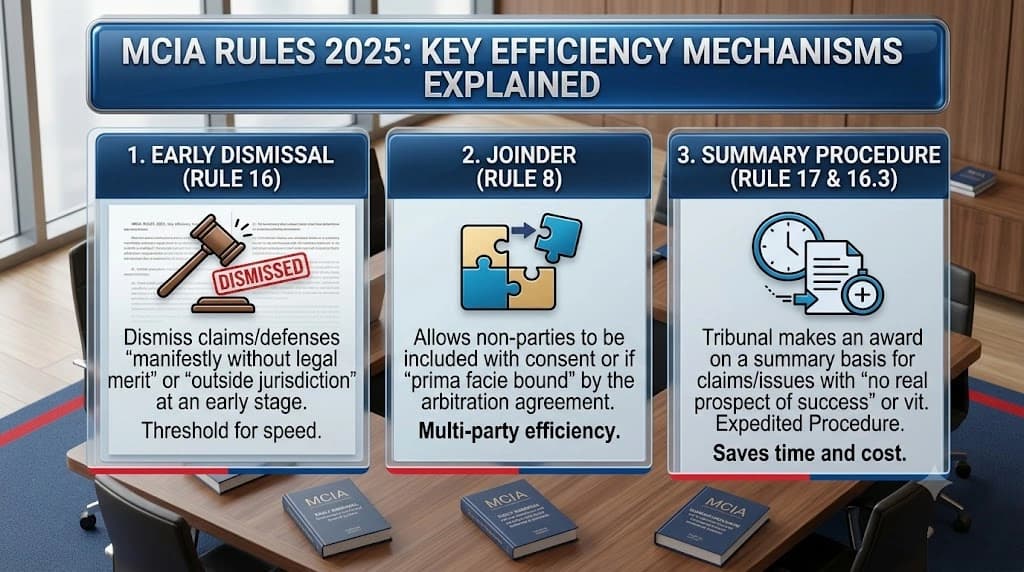
Two provisions do the heaviest lifting for practitioners: Rule 16 (Early Dismissal and Summary Procedure) and Rule 8 (Joinder). Neither existed in any developed form under the 2016 Rules. Both can now be triggered by either side in a dispute, which means both need to shape how a case is planned from the outset - not just how it is defended.
Rule 16: Early Dismissal and Summary Procedure
Rule 16 addresses a longstanding complaint about arbitration: that even a claim with no realistic chance of succeeding has to be carried, at real cost, all the way to a final hearing. Under Rule 16.1, a party can now apply in writing to the tribunal for early dismissal of a claim or defence, or for summary determination of a specific issue, on one of three grounds set out in the rule text: that a claim or defence “is manifestly without legal merit”; that it “is manifestly outside the jurisdiction of the Tribunal”; or that “even if the facts alleged by the other party are assumed to be true, no award could be rendered in favour of that party under the applicable law.”
Rule 16.2 goes further than dismissal alone: it allows any issue of fact or law to be determined by summary procedure, and that determination can dispose of some or all of the case. In practice, a tribunal can now decide a limitation defence, a jurisdictional objection, or a question of contractual interpretation on the papers, without waiting for a full merits hearing, where doing so resolves the dispute or narrows it substantially.
The rule is not a free-for-all, and tribunals retain full control over it. An application under Rule 16.3 must set out, in detail, the facts and legal basis supporting it, the procedure the applicant proposes, and why that procedure would produce a faster, more efficient resolution than a full hearing. The tribunal does not have to grant it. Under Rule 16.4, it must first invite comments from the other side, and only then decide, having regard to all the circumstances of the case, whether the application should proceed at all. If it does proceed, the tribunal sets its own procedure, and both sides get an equal and reasonable opportunity to be heard on the issues in play.
This puts MCIA in step with the early-dismissal mechanisms that Singapore's SIAC and Hong Kong's HKIAC have offered in their own rules for several cycles now. For attorneys advising Indian parties choosing between institutions, that comparison matters commercially as much as procedurally: a claimant weighing MCIA against SIAC or HKIAC no longer has to accept a slower, costlier route to disposing of a hopeless counterclaim, or to defending against one.
There's a strategic dimension worth planning for from the first pleading. Because a Rule 16 application can be brought by either side, a respondent facing a claim built on a shaky jurisdictional hook - an arbitration clause that arguably doesn't cover the dispute, for instance - now has an early, cheaper route to test that objection instead of litigating it through a full hearing. A claimant, in turn, should expect that thin causes of action, pleaded without a clear legal basis while facts are still being gathered, are more exposed than they were under the 2016 Rules. That exposure is sharpened by another change in the 2025 Rules: tribunals are now expressly empowered, in line with Section 23 of the Arbitration and Conciliation Act, 1996, to direct parties to file documentary evidence and expert reports together with their Statement of Claim or Defence, rather than later in the process. Read alongside Rule 16, the strength of a party's evidence at the pleading stage now carries more early weight than it used to.
Consider how this plays out in a typical Indian construction dispute. A contractor refers a delay and disruption claim to MCIA arbitration under an EPC contract; the employer's defence rests heavily on a limitation argument that the claim was time-barred under the contract's notice provisions before the Request for Arbitration was even filed. Under the 2016 Rules, that limitation defence would ordinarily have been argued at the final hearing, alongside quantum, causation and every other disputed issue, often 18 months or more into the case. Under Rule 16.2, the employer can now ask the tribunal to determine the limitation question summarily, early in the proceedings. If the tribunal agrees the issue is genuinely dispositive and can be fairly decided on the papers or a short hearing, the entire dispute may be resolved or narrowed to quantum alone - well before either side has spent on full document production and witness evidence. The same logic runs in the other direction: a contractor facing a counterclaim it considers manifestly outside the arbitration clause's scope now has a comparably fast route to knock it out.
Rule 8: Joinder
The second major reform closes a gap that attorneys handling multi-party Indian disputes have dealt with for years. The 2016 Rules had no developed joinder mechanism; a non-party the claimant believed was bound by the arbitration agreement, or genuinely necessary to resolve the dispute, could not easily be pulled into a pending MCIA arbitration. Rule 8 fixes that, and does so in step with the Supreme Court's ruling in Cox & Kings Ltd v. SAP India Pvt Ltd, which recognised that non-signatories can, in appropriate circumstances, be bound by an arbitration agreement under Indian law.
Joinder can now be initiated from either direction. Under Rule 8.1, an existing party can apply to the MCIA Council before the tribunal is appointed, or to the tribunal itself once constituted to have a non-party joined as an additional party. Under Rule 8.2, the non-party can apply to join itself, using the same two-track route. Either way, the Council or tribunal has the power, but is not obliged, to grant joinder, on either of two grounds under Rule 8.3: that the proposed additional party is “prima facie bound by the arbitration agreement” under which the arbitration was commenced, or that all existing parties and the proposed additional party have consented.
The procedure itself is detailed. A written Request for Joinder must be filed with the Registrar, served on all existing parties, the proposed additional party, and the tribunal if one has been appointed, and must include the MCIA case reference, the basis for joinder, identifying details for the proposed party and, where joinder rests on the “prima facie bound” ground, a statement supporting that assertion. All other parties and the proposed additional party then have 15 days from service to respond, or such other period as the tribunal directs; if nobody responds in time, the Council or tribunal can still rule on the request. The decision to grant or deny joinder is made without any obligation to give reasons - so attorneys should not expect a reasoned order they can later pick apart on the merits of the joinder decision itself.
One procedural detail is worth flagging to clients early: under Rule 8.5, a non-party joined after the tribunal has already been constituted waives any right it would otherwise have had to help select that tribunal. That creates a real incentive to raise a joinder application with the MCIA Council before the tribunal is appointed, rather than waiting particularly in disputes involving group companies, guarantors, or subcontractors who may later need to be pulled in.
Once joinder is granted, the newly added party becomes a party to the arbitration for all purposes: the tribunal resets or amends the procedural timetable as needed, and can eventually issue either a single final award covering all parties or separate awards. A rejection by the Council does not close the door permanently the right to apply again to the tribunal, once it is constituted, is preserved, and a tribunal's grant of joinder does not stop it from later revisiting its own jurisdiction over the joined party.
Joinder under Rule 8 should not be confused with two related, but distinct, multi-party tools the 2025 Rules also introduced. Combined Requests under Rule 5 let a claimant file a single Request for Arbitration to commence multiple arbitrations arising from related but separate arbitration agreements. Consolidation under Rule 6 expanded and clarified in the new Rules allows genuinely separate arbitrations to be merged into one, where the parties agree, the claims arise under the same agreement, or the arbitration agreements are compatible and connected by a shared legal relationship or transaction. Concurrent Proceedings under Rule 7 let the same tribunal, once appointed across related cases, run those cases side by side without formally merging them. Joinder is the narrower tool: it adds a person or entity to a single, existing arbitration, and is the one attorneys are most likely to reach for in disputes involving parent-company guarantees, EPC consortiums, or corporate-group structures common in Indian infrastructure and construction contracting. Attorneys assessing non-signatory exposure or preparing a joinder or early-dismissal strategy in a complex, multi-party dispute can search Exlitem's directory of arbitration and quantum experts for specialists who have advised on comparable Indian matters.
How this fits with MCIA's other efficiency reforms
Rules 8 and 16 do not operate in isolation. They sit alongside a broader set of changes aimed at the same target: cutting the time and cost of an MCIA arbitration without sacrificing due process. The monetary threshold for the Expedited Procedure under Rule 17 has been raised from INR 10 crore to INR 13 crore (roughly USD 1.5 million), calculated across the aggregate of claims, counterclaims, cross-claims and set-off defences, and a new “exceptional urgency” ground now qualifies a dispute for the fast track regardless of value. Cases on the Expedited Procedure are generally decided by a sole arbitrator, largely on documentary evidence, with an award due within six months of the tribunal's constitution. Rule 21 lets a tribunal order a claimant to post security for costs - a deterrent to speculative claims that pairs naturally with Rule 16's early-dismissal power. And Rule 28 gives tribunals express authority to decide preliminary issues, bifurcate liability from quantum, or stage a case for hearing - another route to disposing of dispositive issues without a full hearing on everything at once.
Taken together, these are new powers, and untested ones at MCIA specifically. Attorneys should not assume tribunals will apply Rule 16 aggressively simply because the power now exists; the experience of equivalent provisions at SIAC and HKIAC suggests tribunals tend to use early-dismissal powers cautiously, reserving them for genuinely hopeless claims rather than treating them as a routine skirmish at the start of every case.
The India angle: why this matters beyond MCIA's own caseload
The 2025 Rules also correct a discrepancy Indian counsel have flagged for years. Under the 2016 Rules, the award timeline ran from the date the tribunal was constituted; the Arbitration and Conciliation Act, 1996 measures the statutory 12-month timeline from the date pleadings are completed. The 2025 Rules now track the statutory position, mandating that awards be made within 12 months from completion of pleadings rather than tribunal constitution removing a source of ambiguity that could otherwise expose an award to a timeliness challenge in an Indian court. The Rules also now expressly include interim awards within the definition of “award,” and incorporate the statutory grounds for terminating proceedings withdrawal, settlement, impossibility, non-payment of costs directly into the rule text, both changes designed to keep MCIA awards on firmer footing when they reach an Indian court for enforcement or challenge under Sections 34 and 36 of the Act.
That alignment feeds directly into the institutional-arbitration push happening across India's arbitration hubs - MCIA in Mumbai, IAMC in Hyderabad, IIAC, and the emerging GIFT City ecosystem - all competing, in different ways, to keep high-value Indian and cross-border disputes out of court and inside efficient institutional processes. A rulebook that both closes procedural gaps with the Arbitration Act and imports globally recognised tools like early dismissal and joinder strengthens MCIA's pitch relative to ad hoc arbitration, and relative to rival seats abroad.
There is also a narrower, but very practical, payoff for Indian courts. One of the recurring justifications Indian courts have given for intervening in arbitrations - whether on interim relief, tribunal composition, or post-award challenge is that ad hoc and lightly administered arbitrations lack the institutional guardrails that a well-run seat abroad would provide. A rulebook with a functioning early-dismissal mechanism, a real joinder procedure, and award timelines that track the statutory 12-month clock gives Indian courts less reason to view MCIA-administered proceedings as needing close supervision. For attorneys structuring high-value contracts infrastructure concessions, EPC packages, shareholder and JV agreements that is a genuine argument for choosing an MCIA clause over an ad hoc arbitration clause with an Indian seat, quite apart from any preference for MCIA's panel of arbitrators or case management support.
What attorneys should do now
For attorneys already advising on MCIA-seated matters, or drafting new MCIA clauses into commercial contracts, a few practical steps follow directly from Rules 8 and 16:
• Review pending MCIA arbitrations for claims or defences that may now be vulnerable to or capable of supporting an early dismissal application, particularly on jurisdiction.
• Map non-signatory exposure at the drafting stage of complex, multi-entity contracts (EPC consortiums, group-company guarantees, parent-subsidiary structures), since Rule 8 makes it realistic to bring in a related entity mid-arbitration rather than starting fresh proceedings.
• Where joinder is a live possibility, raise it with the MCIA Council before the tribunal is constituted, to preserve the client's role in selecting the tribunal.
• Front-load documentary evidence and expert reports with the Statement of Claim or Defence tribunals can now compel this, and Rule 16 puts a premium on demonstrable merit from the outset.
One change is worth flagging with a note of caution rather than celebration. The 2025 Rules quietly drop a provision that existed under the 2016 Rules requiring that all statements and documents supplied to the tribunal and Registrar be simultaneously served on the other party a change that could, in practice, reintroduce the very delay disputes that provision was designed to prevent. The 2016 Rules' express clarification that a tribunal is not bound by formal rules of evidence has also been dropped, though this is unlikely to matter much in practice given how well-settled that position already is in arbitral jurisprudence. Attorneys drafting procedural orders under the new Rules should consider asking tribunals to reinstate a simultaneous-service requirement by consent, rather than assuming it still applies by default.
Takeaway
• Rule 16 gives either side a genuine, cost-effective route to dispose of a manifestly weak claim, defence, or jurisdictional objection before a full hearing — but tribunals retain full discretion and are likely to use it cautiously.
• Rule 8 closes a real gap from the 2016 Rules: non-signatories can now be joined to a pending MCIA arbitration on a prima facie or consent basis, which matters most in group-company, guarantee, and EPC consortium disputes common in Indian infrastructure and construction work.
• Raise joinder applications before the tribunal is constituted wherever possible — joining after constitution costs the new party its say in who hears the case.
• Both reforms reward early, well-evidenced pleadings; the “wait and see” approach to drafting a Statement of Claim or Defence is now riskier under MCIA's 2025 Rules than it was in 2016.
Position yourself where the legal industry looks for expertise - sign up on exlitem.com to get discovered by leading lawyers and high-value clients.