
The Persuasion Gap: Why Facts Alone Don't Win Cases
There is an assumption embedded in the culture of expert witness work that shapes how thousands of experts approach the stand: the idea that the job is to present accurate information and let the jury decide. Bring the facts. Let the trier of fact do the rest.
This assumption, as Professor Edward K. Cheng (S02E15, Evidence Law Scholar and Hesburgh Chair, Vanderbilt University Law School) observes, fundamentally misunderstands how human decision-making works. "People go to law school to avoid science and math," Cheng notes bluntly. Judges - the very gatekeepers of expert testimony - carry their own discomfort with technical evidence. Cheng's research shows that when given the opportunity, they will often "punt" complex scientific questions to the jury rather than grappling with them directly. The jury, meanwhile, is not a panel of scientists. They are twelve people drawn from everyday life, asked to evaluate expert claims in fields they have never studied.
The result is what might be called the persuasion gap: the distance between what an expert knows to be true and what a jury is actually able to absorb, retain, and act on. Technical accuracy alone does not close that gap. Narrative does.
Michael G. Kaplan (S01E03, Forensic Accounting Expert Witness and Co-Founder of Courtroom Boot Camp), who has spent nearly half a century as a forensic expert and testimony trainer, puts the challenge directly: the expert's job is not merely to present opinions - it is to persuade the jury that those opinions are correct. He describes the moment a juror makes up their mind about an expert - not during cross-examination, not after deliberations, but during direct examination, based almost entirely on how understandable and human the expert appears.
Trial attorney Jordan Redavid (S01E02, Plaintiff Trial Attorney and Founding Partner, Fisher Redavid Trial Lawyers) states the attorney's version of this truth without equivocation. "Credibility is the Alpha and the Zeta," he says. "I don't care how long their resume is - if they can't walk into a courtroom, sit in a chair, swear to tell the truth, and convincingly tell the truth in a very honest and forthright and understandable way, I don't want them." The credential is the entry ticket. The story is the performance.
The jury also forms impressions almost instantaneously. Dr. Stephen Cohen (S03EP1, Surgical Expert Witness with over 30 years of clinical and medical-legal experience) describes the phenomenon from the stand: "Within the first 90 seconds of me being on the stand, they've already determined that they like me or not." This is not about credentials or methodology - it is about whether the jury feels that this person is genuinely trying to help them understand something. Everything else follows from that first impression.
The 'Once Upon a Time' Framework: Narrative Structure for Technical Testimony
If storytelling is the key to expert persuasion, the next question is what storytelling actually means in a courtroom. Michael Kaplan has spent decades answering that question, and his answer is disarmingly simple.
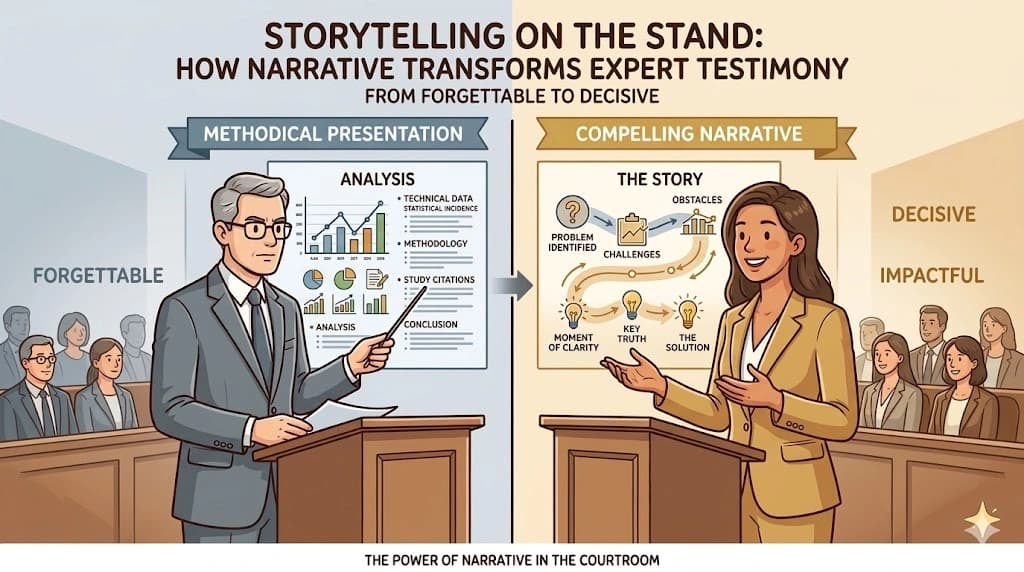
"A good expert report starts with the following four words: once upon a time. And it ends with the following four words: they lived happily ever after."
This is not a metaphor. Kaplan means it as a structural principle. Every technical case, no matter how complex, contains a story: a problem that existed, obstacles that were encountered, an investigation that was conducted, and a conclusion that resolved the mystery. The expert's job is to find that arc and tell it in a way that makes the jury feel they are discovering the answer alongside the expert.
The power of this structure lies in how it engages the emotional and cognitive systems that human beings use to process information. When technical information arrives without narrative shape - as a list of findings, a series of charts, a methodological walkthrough - it fails to activate the meaning-making systems that allow people to absorb, retain, and act on what they hear.
Dwayne King (S03EP9, Financial Crime and Anti-Money Laundering Expert Witness), who regularly explains highly technical financial crime patterns to juries, articulates the structural principle from practice: "There's a story always fascinating to tell... tell the backstory and then get into the opinion." In King's experience, the expert who begins by laying out context - who establishes the why before the what - gives the jury the frame they need to receive the technical material that follows.
Kaplan's framework also captures something most experts overlook: the importance of showing your work, including the difficulties. When an expert describes the problems he encountered during investigation - the data that didn't fit, the alternative hypotheses ruled out, the moment of clarity - jurors don't disengage. They lean in. They have become invested in the problem. The obstacles are not weaknesses to be minimized. They are the plot points that turn a presentation into a story.
The Hero's Journey: Borrowed Frameworks That Transform the Witness Stand
George Reis (S2E01, Forensic Imaging Expert Witness and Owner, Imaging Forensics), one of the country's leading forensic video and photographic analysis experts, has built his entire approach around a framework drawn from narrative theory. Reis follows the work of author Donald Miller, whose "hero's journey" model identifies the two central figures of every compelling story: the hero and the guide.
In Miller's framework, the hero faces a challenge and the guide helps them understand how to navigate it. Crucially, the guide is never the protagonist - the guide's job is not to be impressive, it is to be useful.
Reis applies this with deliberate care. "I try to always make the attorney - my client - the hero," he explains. "I just want to help them understand the Visual Evidence as best as they can so that they can use it for the benefit of their clients or their case." The expert, in this model, is not the star of the courtroom drama. The expert is the trusted advisor who equips the hero with knowledge. This reorientation - from authority figure to guide - changes not just how Reis presents himself, but how jurors receive him.
Kaplan offers a parallel framework drawn from popular culture. Experts, he suggests, can think of their testimony as the plot of a superhero movie. "Every superhero is a relatable person, but then they have some powers. They get problems. And that's where the audience can relate - they're rooting for them to overcome those problems." When the superhero solves the problem, the audience cheers. When the expert resolves the analytical challenge in a way the jury has been following step by step, the same psychological mechanism activates: the jury becomes emotionally engaged participants rather than passive recipients of information. And engaged participants reach verdicts.
The Human Element: How Emotional Connection Changes the Dynamics of a Case
Alvin Wolff (S02E05, Personal Injury Trial Attorney with over 40 years of experience and 7,000+ cases) offers a perspective that most expert witness training programs overlook: the jury is not an institution or a mechanism of justice. It is a room full of human beings - each with their own emotional responses, instincts, and life experiences - and everything about how an expert presents themselves either reaches those human beings or it doesn't.
Wolff is not a sentimentalist. He is blunt, experienced, and deeply practical. In over four decades of trying complex injury cases, he has watched the same dynamic play out repeatedly: the experts who change the fundamental dynamics of a case are the ones who connect with the jury as people, not just as information sources.
"Trial by human trial ERS" is how Wolff describes the jury system - an acknowledgment that no amount of technical precision can insulate a case from the reality that human beings are deciding it. Jurors bring their intuitions, sympathies, and gut judgments into the deliberation room. An expert who seems remote, rehearsed, or more interested in displaying expertise than communicating it will lose those jurors regardless of how rigorous the underlying analysis.
Toni Elhoms (S03EP6, Expert Witness Consultant and Billing & Coding Expert) makes the same point from a different angle. "At the end of the day, when you're going in front of a jury, the only thing that they know about you is what you're telling them verbally and non-verbally" - and what the retaining attorney is able to put in front of them. Everything else: the publications, the credentials, the years of experience - none of it reaches the jury unless the expert's presence on the stand makes it land. The story the expert's body and voice tells is just as important as the one their words convey.
Wolff has seen cases pivot not on technical superiority but on narrative control. In one striking example, an opposing defense expert took the stand and bragged extensively about his credentials and training - which opened the door for Wolff to demonstrate to the jury that this same expert had perforated three other patients' aortas during similar procedures. The expert's overconfident narrative invited scrutiny of his actual record. The verdict followed the story the jury believed, not the story the expert told about himself.
The conclusion both Wolff and Elhoms point to is that authentic presence is not optional. "You still have to be yourself when you do this stuff," Wolff says. "If you go and try to be someone you're not, you're going to fail." Authenticity is the frame inside which all storytelling skill must operate - because juries are, above all else, remarkably good at detecting when someone is performing rather than communicating.
Practical Storytelling Techniques From the Witness Stand
The Educator's Instinct: Visual Storytelling in the Courtroom
Robert Handfield (S02E10, Supply Chain Management Expert Witness and University Distinguished Professor at NC State), whose testimony helped secure a $51 million jury award in the Lindt chocolate supply chain case, brings his classroom instincts directly to the courtroom. "One of the things that helped me, being an educator," Handfield explains, "is I've become very good at explaining complex topics." His method: spend the majority of his time on the stand facing the jury, looking at them, explaining - not reciting from a report.
For Handfield, the most powerful storytelling tools are visual - charts, graphs, and government data that allow jurors to see the logic of the case for themselves rather than being told what to conclude. "The jury can clearly observe for themselves and make their own decision." Visual evidence, in Handfield's framework, is not mere illustration. It is the moment where the abstract claim the expert has been describing becomes concrete, visible, and undeniable.
Radical Simplification: If You Can't Explain It Simply, You Don't Understand It
Dr. Eric Cole (S02E08, Cybersecurity Expert Witness and former CIA Security Expert) works in one of the most technically demanding fields in litigation. His governing principle is simple: "Somebody who truly understands something can explain it so non-technical people can understand." Cole's approach begins from absolute first principles - "Let me explain to you what the internet is," he tells a jury - not to condescend, but because he refuses to assume shared vocabulary.
Dr. Stephen Cohen (S03EP1, Surgical Expert Witness) has internalized the same philosophy after 30 years of teaching medical students and residents. "If I can't explain it to you in a way that you understand it, then I don't understand it," he says. "To me, if I'm talking to an attorney on the phone about the initial consultation about a case, or I'm in front of a jury, it's no different than what I do on an everyday basis when I'm talking to the residents and medical students." The discipline of teaching - of genuinely trying to transfer understanding rather than just display it - is the exact same discipline expert testimony demands.
Seth Miller (S03EP7, Forensic Technology Expert Witness) takes simplification one step further by actively seeking the right analogy for each audience. His approach: "How would a truck driver understand this? How would a nurse understand this?" By mentally placing the explanation in front of the specific person who needs to grasp it, Miller zeroes in on the language and frame that will actually land. This is the storyteller's version of audience awareness - the recognition that the same explanation does not work for everyone, and that the expert who adapts their communication to their audience is demonstrating both intelligence and respect.
The Science Behind the Story: Why Narratives Outperform Statistics
While many expert witnesses arrive at storytelling intuitively, Jonathan Klane (S03EP11, Industrial Hygiene and Safety Expert Witness) has made narrative the subject of rigorous academic investigation. Klane holds a PhD from Arizona State University's Human and Social Dimensions of Science and Technology program, with a dual focus on risk communication and narrative theory - providing the empirical foundation for what other experts practice by instinct.
Klane's core finding is stark: "Numbers are never going to convince a jury. Feelings do. And stories do." This is not a statement of preference but of cognitive science. Human beings process narrative and statistical information through fundamentally different systems, and the narrative system is both faster and more emotionally compelling. An expert who presents only data and methodology - however rigorous - is communicating through a channel that does not reliably reach human decision-makers.
"No data without narrative and no narrative without data." - Michael Quinn Patton, as cited by Jonathan Klane
This maxim captures the balance every expert must strike. The expert who tells a story without evidence is spinning a yarn. The expert who presents data without a story is producing what Klane calls an "opaque" document - technically accurate, humanly inaccessible.
Klane also makes a distinction that is rarely articulated in expert witness training: chronologies are not stories. A report that lists events in sequence is a timeline. A story requires causation, stakes, and resolution - it requires the listener to care about what happens next. Many expert reports are organized as chronologies and their authors believe they are "telling the story" of the case. Klane's research shows this is a critical error that leaves enormous persuasive power on the table.
Human beings are, as a species, neurologically wired for narrative. "Stories are sense-making and meaning-making tools," Klane observes, "and very likely a tool for survival." From cave paintings to modern cinema, story is the original technology of human understanding. An expert who taps into that wiring is not just communicating more effectively - they are speaking in the language the brain most readily receives.
When Stories Break Down: The High Cost of Overreach
Storytelling is not a shield against error. A compelling narrative can actually make overreach more dangerous, because it draws sharp attention to any moment where the story fails to hold.
Robert Handfield experienced this directly in the Lindt supply chain case. His narrative of the defendant's software failures was compelling and ultimately successful - but it nearly unraveled on a single point. Handfield had testified that the software platform was "not recognized by Gartner," the well-known technology research firm. Opposing counsel responded: the platform ran on Infor software, which was in the Gartner Magic Quadrant. Handfield's testimony was struck on that specific aspect. A crack in the story is more damaging than a crack in a list of findings, because jurors who have been following a narrative notice the moment it becomes unreliable.
Michael Kaplan offers a related warning about the relationship between written reports and live testimony. Most experts invest enormous energy in their written reports. But Kaplan is direct: jurors almost never read the report. The testimony is all they hear. If the testimony does not stand on its own as a coherent, compelling narrative, the most thorough written analysis will not save the case.
Jargon is perhaps the most pervasive way stories break down. Klane is frank: most expert reports are written for other experts, not for juries. The lingua franca of a technical field is "rather arcane" and "opaque" to the non-expert reader. "If I can't understand this," Klane says of some opposing experts' reports, "how the heck are the people directly involved going to understand it?" Every piece of technical language that goes untranslated is a missed connection with the jury - a moment the story stops and the presentation resumes. And presentations don't win cases.
Building Your Storytelling Skills: A Practical Roadmap
The experts across On The Stand are unified in one conviction: storytelling is a learnable skill. The question is how to develop it.
Michael Kaplan's answer begins with structured, expert-specific training. His company, Courtroom Boot Camp, offers workshops and intensive two-day programs - and, critically, Kaplan insists that the expert and the attorney must train together. An expert who has learned to tell a story, working with an attorney who still structures questions in a way that breaks the narrative, will not perform at full effectiveness. "The workshops and boot camps are for expert witnesses and the attorneys who present them," he explains, because the story requires collaboration at every level.
Alvin Wolff endorses the value of performance training for anyone who stands before a jury. His prescription is broader than the formal: take acting classes, attend workshops, observe the best advocates in the room and develop your own style. Wolff practiced stand-up comedy for a stretch of his career. "It gave me an opportunity to get up and do some public speaking" - and standing before an audience that judges you in real time, with no safety net, builds the improvisational confidence a witness stand demands. He notes approvingly that some of the best expert witness coaches now work with Broadway actors, bringing theatrical craft directly to testimony preparation.
Jonathan Klane points to a complementary training path: the discipline of writing for a non-expert audience. He recommends William Zinsser's On Writing Well - not a legal text, but a guide to clear, direct, human prose. The habit of writing for a general reader, explaining technical concepts without jargon, practicing the translation of complexity into clarity - these exercises build precisely the muscles that storytelling in the courtroom demands.
Eric Cole's model is perhaps the most accessible: continuous public teaching. Cole is a perpetual educator - writing, speaking, and explaining his field to non-technical audiences on a regular basis. This is not separate from his expert witness work. It is his ongoing training program. Every time he explains a cybersecurity concept to a non-technical colleague or conference audience, he rehearses the same skill he will use in front of a jury. Storytelling is not something he turns on for trial. It is how he communicates.
Underlying all of these paths is a principle Kaplan articulates after nearly half a century in the field. He has come to embrace expert testimony as "an art form - an art form revolving around communication." Not credentials. Not methodology. Communication. The science is the substance. Communication is the form that carries that substance to the people who must understand it.
Conclusion: The Story Is the Testimony
There is a version of expert witness work that treats the courtroom as a venue for the delivery of technical findings - a one-way channel through which expertise is transmitted to the trier of fact. The experts, attorneys, and scholars who appear on On The Stand have collectively dismantled this model.
Juries are not passive data processors. They are human beings, neurologically wired for story, making decisions through emotional and narrative systems that operate largely below the level of conscious reasoning. An expert who ignores this reality is not being rigorous - they are being ineffective. The most technically accurate testimony, delivered without narrative structure, without emotional resonance, without the basic humanity of someone who genuinely wants the jury to understand - that testimony will not move people. A story that is equally accurate, structured as a narrative, and delivered by someone who communicates as a teacher rather than an authority figure changes verdicts.
The facts of a case are fixed. The story of those facts is yours to tell.
Featured Experts
Michael G. Kaplan - Forensic Accounting Expert Witness, Co-Founder of Courtroom Boot Camp (S01E03)
Jordan Redavid - Plaintiff Trial Attorney, Founding Partner Fisher Redavid Trial Lawyers (S01E02)
Robert Handfield - Supply Chain Management Expert Witness, NC State University Distinguished Professor (S02E10)
Dr. Eric Cole - Cybersecurity Expert Witness, former CIA Security Expert (S02E08)
Alvin Wolff - Personal Injury Trial Attorney, 40+ years | 7,000+ cases (S02E05)
Prof. Edward K. Cheng - Evidence Law Scholar, Hesburgh Chair, Vanderbilt University Law School (S02E15)
Jonathan Klane - Industrial Hygiene & Safety Expert Witness, PhD Human & Social Dimensions of Science & Technology (S03EP11)
George Reis - Forensic Imaging Expert Witness, Owner, Imaging Forensics (S2E01)
Dr. Stephen Cohen - Surgical Expert Witness, 30+ years clinical and medical-legal experience (S03EP1)
Toni Elhoms - Expert Witness Consultant and Medical Billing & Coding Expert (S03EP6)
Dwayne King - Financial Crime & Anti-Money Laundering Expert Witness (S03EP9)
Seth Miller - Forensic Technology Expert Witness (S03EP7)