
Why Cross-Examination Feels Terrifying - and Why the Fear Is Mostly Misplaced
The folklore of expert witnessing is full of cautionary tales. New experts are warned that attorneys will try to bait them, to broaden their statements, to pin them into positions they never intended to take. The warnings are not wrong. But they describe tactics, not outcomes - and there is a profound difference between being a target and being vulnerable.
Eric P. Rose, a product design and manufacturing expert with more than thirty years of experience who appeared on Season 2, Episode 9 of On The Stand, describes the psychology with unusual clarity. Before his first deposition, he says, he knew he was technically strong and he was comfortable speaking publicly - he had been teaching product innovation since 2009. What he did not know was what it felt like to “get in the sharks tank.” His first deposition, in the 3M earplug multidistrict litigation, ran ten hours, seven of them on the record. The attorneys, he recalls, were “tough as you might imagine - that’s their job.” At the end of the day, he was pleased. The redirect was short. Nothing unraveled. The reason nothing unraveled is the same reason it rarely unravels for well-prepared experts: he had done the homework.
This is the paradox at the heart of cross-examination dread. Experts imagine an improvisational battle - a rhetorical duel where the quickest tongue wins. In practice, the duel was already decided in the report-writing room. The stand is a performance venue for work that either holds up or does not.
The Deposition Trap: Why Opposing Counsel Is Shopping for Soundbites
If there is a single lesson the experts in this article return to over and over, it is that depositions are not rehearsals for trial. They are the first act of trial. Opposing counsel is not there to understand your opinions; they are there to collect quotes. Every sentence you utter in deposition becomes a potential exhibit - a piece of videotape or a paragraph of transcript that can be played back to the jury if your trial testimony does not perfectly align with what you said months earlier.
Pavithra Kumar, a principal at boutique consulting firm AACG whose specialties include securities, valuation, and damages estimation, and who appeared on Season 3, Episode 2 of On The Stand, has made scope discipline the organizing principle of her practice. She has supported experts on some of the most high-profile financial disputes of the last decade, including the Cerberus Bank vs. CIBC case that produced an 856-million-dollar judgment and the S&P ratings agency investigation that settled for 1.3 billion dollars. When she looks back at what made her side’s analysis bullet-proof, she points to a single habit: “not making overly aggressive assumptions that can be critiqued by the other side.”
Kumar frames this as a positive discipline rather than a defensive one. In the MAPS Hotels vs. AB Stable COVID litigation, she and her team “critiqued the other experts for kind of stepping out of bounds and making somewhat unjustified assumptions.” Their own analysis stayed inside its lane - conservative, transparent, supported by flow charts and clear tables rather than rhetorical flourishes. When the other side tried to expand the fight, there was nothing to grab onto.
The same discipline applies in product liability. Rose describes a moment during trial when his own retaining counsel led him, on direct examination, toward a statement that was broader than his report would support. “Mr. Rose,” the attorney said, “you would agree then all of the products that are competitive include this feature, except for the defendant’s?” Rose pushed back - in real time, on the record, to the attorney who was paying him. “No, counselor. That’s not what I said. What I said was that all of the products I reviewed and included in my report included that feature, but I cannot speak to every single product that may exist in the industry.”
That correction was not an act of disloyalty. It was an act of self-preservation. A broader statement would have been technically unsupportable, and opposing counsel would have struck it on cross. By holding the line in direct, Rose removed the ammunition before cross-examination even began.
“I Was Not Asked to Opine on That”: The Most Powerful Sentence in Expert Testimony
Every experienced expert eventually discovers that the most valuable phrase in their vocabulary is a version of “I don’t know,” delivered without apology. For some it is “I was not retained to opine on that.” For others it is “That is outside the scope of my analysis.” The specific wording matters less than the posture. The expert is not obligated to have an opinion on every question opposing counsel chooses to ask.
John Zeirke, a licensed professional engineer in six states, an ACTAR-certified accident reconstructionist, and the founder of JZ Engineering, appeared on Season 3, Episode 12 of On The Stand after a career that included design ownership at Caterpillar, chassis engineering on the Polaris Slingshot, and seven years at Rimkus Consulting. He makes the point technically: in forensic engineering, there is rarely a single cause of failure. There are contributing factors - mechanical, human, environmental - and premature certainty is a cross-examination liability. Experts who comprehensively consider every factor and document how they weighted each one find that opposing counsel has nowhere to pry. Experts who jump to a single cause leave a dozen open doors.
Zeirke also stresses the discipline of data transparency. He processes gigabytes of case files with clear naming conventions and a documented analytical trail. When a cross-examiner asks how he got from raw evidence to stated opinion, he can retrace every step. The absence of black boxes in his workflow removes one of opposing counsel’s favorite attack surfaces: the suggestion that the expert has cherry-picked or manipulated the data.
The same logic applies in softer sciences. Dr. Simon Dardashti, a double board-certified anesthesiologist and pain medicine specialist featured on Season 2, Episode 13 of On The Stand, faces a distinctive cross-examination problem: pain itself is subjective. It does not show up on a scan or a lab panel the way a broken bone or an infection does. Opposing counsel will try, again and again, to frame his opinions as unscientific - “where is the data, doctor?”
His answer is to shift the battlefield from pain to function. Rather than arguing about whether a patient’s self-reported pain is real, he documents what the patient can and cannot do: range of motion, capacity for activities of daily living, ability to return to work. These are measurable. They can be compared against pre-injury imaging, pre-injury records, and independent observations. “I find pre- and post-injury imaging to be very, very helpful,” Dardashti says, “because there’s something that you can objectively discuss and point to.” When cross-examined, he does not defend the subjective. He stands on what can be observed and measured - and lets the attorney try to cross-examine reality.
Handling the Aggressive Attorney: Composure as a Competitive Advantage
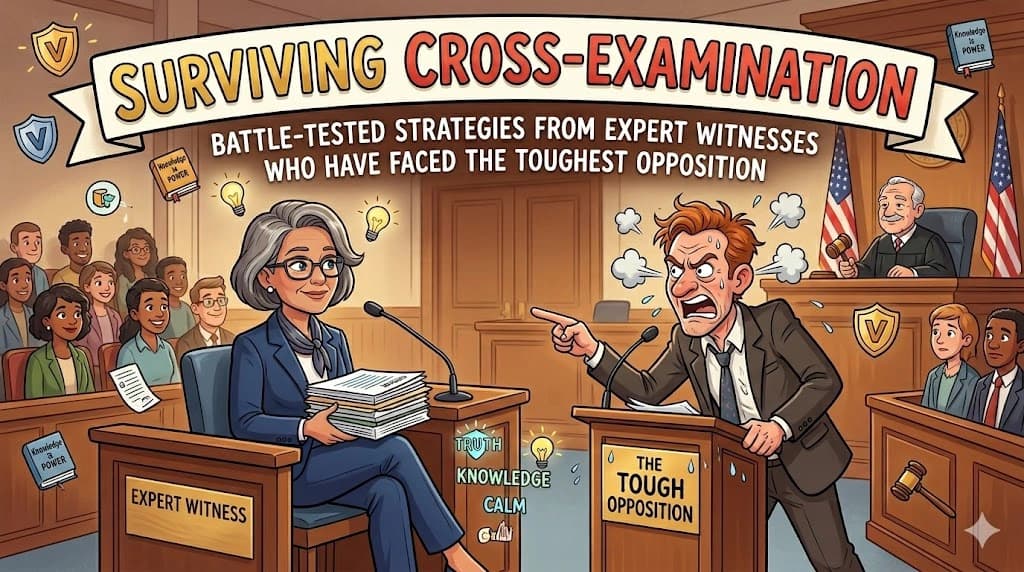
Every expert eventually meets the attorney who seems to be auditioning for a legal thriller - voice raised, finger pointing, question rephrased five ways in search of a different answer. The first instinct of many experts is to match the aggression. This is almost always a mistake.
Dardashti describes attorneys who press hard on the distinction between a bad outcome and a breach of the standard of care: “Some attorneys can be a little aggressive when you tell them that there’s an undesirable outcome but there was no malpractice. They would try to pressurize the expert or go at the expert from different angles.” His approach is not to push back harder. It is to return to the record. “If you make your opinion about the facts and you point to different areas of the records, then the record speaks for itself.” When the expert is merely pointing at documents that are already in evidence, the attorney is no longer attacking the expert’s opinion - the attorney is attacking the record. Juries notice the difference.
Dr. Robert Belfer, a pediatric emergency physician with more than thirty years of clinical experience who appeared on Season 3, Episode 5 of On The Stand, brings another instinct to the stand - one borrowed directly from his day job. As an ER doctor, he points out, he has minutes to establish trust with frightened parents who have just handed him their sick child. “I have to within minutes gain their trust, gain their confidence. And I think I do the same thing when I’m talking with lawyers,” he says. “I speak confidently. I will speak sometimes in medical terms, although explaining those, because not all medical malpractice lawyers are facile, of course, not to the clinician’s degree.” The habit of quick, calm, confident explanation under clinical stress translates directly into the courtroom.
Composure, in short, is not the absence of emotion. It is the decision to meet aggression with evidence and with steady explanation. A jury watching an aggressive attorney go at a calm, well-prepared expert will almost always side with the expert - because juries recognize bullying when they see it, and they instinctively reward witnesses who refuse to be destabilized.
The Literature Foundation: Why Cited Authority Is the Best Armor
If there is one cross-examination technique that opposing counsel deploys with relentless consistency, it is the citation trap. “Doctor, you cited this article by Dr. Smith. So you agree with everything she says?” “Mr. Expert, do you consider this publication to be authoritative in your field?” Each question is designed to convert a piece of cited literature into a leash that can be yanked to pull the expert somewhere they did not intend to go.
The defense against the citation trap is not to avoid citations. It is to cite carefully, cite current work, and never cite a paper you have not actually read and understood. Nobody in this cohort has thought more about this problem than Michael Graham, a medical librarian and litigation research consultant with two decades of experience who appeared on Season 3, Episode 4 of On The Stand. Graham is the rare expert witness figure whose entire value to a case is making sure the literature cited is the right literature - current, comprehensive, properly contextualized, and not taken from a predatory journal.
Graham’s first retained case involved more than a thousand published studies. A boutique law firm with only three attorneys had realized they could not possibly sort through the volume on their own, and they called him in to conduct exhaustive literature searches across more than a hundred databases. His warnings apply to any expert in any field. Cherry-picked studies that support the expert’s conclusion while ignoring contradictory evidence are a cross-examination time bomb. Misused sources taken out of context - where the cited paper actually says something different, or narrower, than the expert claims it says - are devastating when opposing counsel produces the original and reads the abstract aloud. Citations to predatory journals, with no real peer review, can sink an expert’s credibility in a single question.
Graham’s quiet discipline - reading every cited paper, checking the journal, verifying the claim, confirming that nothing contradictory has been published since — is the kind of work that experts are often tempted to skip under deadline pressure. It is also the work that determines whether cross-examination feels survivable or catastrophic.
Belfer brings the same instinct to pediatric emergency cases. He describes one recent case in which he was defending a toddler presentation: “I tried to emphasize that the risk of a serious infection in this toddler was less than 0.5 percent, supported by the literature. The experts on the other side were asked, what’s the chance that this child had a bacterial serious infection? They said it’s about 20 percent. That’s a huge difference.” The difference was not rhetorical; it was citable. When the expert can point the court to a published base rate, the opposing expert’s unsupported number looks like an opinion, not a fact.
Belfer is also careful about a subtler cross-examination trap: testifying to a standard of care that did not exist at the time of the incident. “I’ve been involved in a handful of cases,” he notes, “where the opposing side is using literature that was published after the case occurred.” He insists on apples-to-apples comparisons: the standards, pathways, and published evidence that were in effect when the care was rendered, not the refined consensus that emerged years later with hindsight. Experts who test their opinions against the literature of the time, rather than the literature of the moment, are rarely trapped by the temporal gotcha.
The Preparation Protocol: What Great Experts Do in the Weeks Before Testifying
If cross-examination is won or lost in preparation, then preparation deserves its own protocol. The experts profiled here do not agree on every detail, but a remarkably consistent playbook emerges from their practices.
Read your report line by line. Rose attributes the survivability of his 3M deposition to one discipline: before testifying, he reviewed every sentence of his report with retaining counsel and identified exactly what he had been retained to opine on. Anything outside those lines was met during deposition with a variation of “That’s outside the scope of my analysis.” Kumar describes the same preparation in the financial damages context. Before any high-stakes deposition, she rehearses not only her conclusions but the specific assumptions underlying them, so that she can explain on demand why she chose each one and what would happen to her conclusions if a different assumption were applied.
Rehearse the hostile hypothetical. Opposing counsel’s favorite technique is the cascading hypothetical: “Assume that x is true. Would that change your opinion?” Experts who have not rehearsed hypotheticals freeze or, worse, agree to premises that contradict their own analysis. Kumar describes running these drills with retaining counsel before every major deposition, practicing responses to each likely attack vector.
Know the record cold. Dardashti observes that a prepared expert disarms an aggressive attorney simply by being more familiar with the file than the attorney is. When questioned about a clinical detail buried in a nursing note from day three of a hospitalization, the expert who can identify the note, the context, and the treatment plan around it is almost impossible to rattle. The expert who is fumbling through a binder is already losing.
Retain the independent posture. Rose reminds experts that their job on the stand is not to advocate for retaining counsel. “You cannot be seen as an advocate.” When his own retaining attorney’s phrasing drifted toward advocacy, he corrected it. That correction, Rose notes, was not only the right move; in hindsight the retaining attorney was grateful - because the broader claim would have been struck, and a stricken answer is worse than a narrower one.
Separate bad outcomes from breach of duty. Belfer emphasizes this especially for medical experts. “A bad outcome is not the same as malpractice.” The entire cross-examination frame in a medical case is often designed to collapse that distinction. Experts who can clearly articulate what a breach of the standard of care would look like - and then explain why the facts of this case do or do not meet that standard - make the distinction survive contact with opposing counsel.
Pick collaborators who sharpen your process. Zeirke argues that the experts he respects most are the ones who actively invite review of their work by peers and opposing specialists. The expert who welcomes scrutiny, who stress-tests every assumption with a colleague before it is published in a report, is the expert whose testimony is almost impossible to shake. The expert who hides their work from other practitioners is the expert who discovers their blind spots in deposition, in front of a videographer.
Why These Lessons Converge
Read these six experts’ practices side by side and a surprising pattern emerges. The fields could hardly be more different - an earplug designer, a pain physician, a damages economist, a medical librarian, a pediatric emergency physician, and a mechanical engineer. Yet their cross-examination disciplines are near-identical. Stay inside the scope you were retained to opine on. Cite current literature and be able to defend every citation. Document every analytical step so that opposing counsel can retrace the work and find nothing to exploit. Meet aggression with composure and with a return to the record. Prepare until the record feels like a familiar room you can walk through in the dark.
The convergence is not coincidence. It is a consequence of the fact that cross-examination, across every field, tests the same thing: whether the expert’s opinion can be separated from the expert’s ego, and whether the opinion can stand on independent evidence after the expert stops speaking. Opinions that depend on the expert’s personal authority are vulnerable. Opinions that rest on scope discipline, documentable methodology, and current literature are not.
This is the quiet lesson underneath the dread. Cross-examination is not a test of courage. It is a test of whether the work behind the testimony was done with integrity - whether the scope was honestly defined, whether the assumptions were justifiable, whether the literature was current, whether the record was mastered, whether the expert was willing to say “I was not retained to opine on that” to the attorney who was paying the bill. When that work has been done, cross-examination becomes, as Rose puts it, a short redirect at the end of a long day. When it has not been done, no amount of courage on the stand can save the testimony.
The experts who survive the toughest opposition, in the end, are not the ones who are best at the fight. They are the ones who have prepared so thoroughly that there is nothing left to fight about.
Experts Featured in This Article
Eric P. Rose - Product Design & Manufacturing (S02E09)
Dr. Simon Dardashti - Pain Management & Anesthesiology (S02E13)
Pavithra Kumar - Securities, Valuation & Damages (S03EP2)
Michael Graham - Medical Librarian & Litigation Research (S03EP4)
Dr. Robert Belfer - Pediatric Emergency Medicine (S03EP5)
John Zeirke - Mechanical & Forensic Engineering (S03EP12)