
The Career No One Plans For - And Why That Makes Perfect Sense
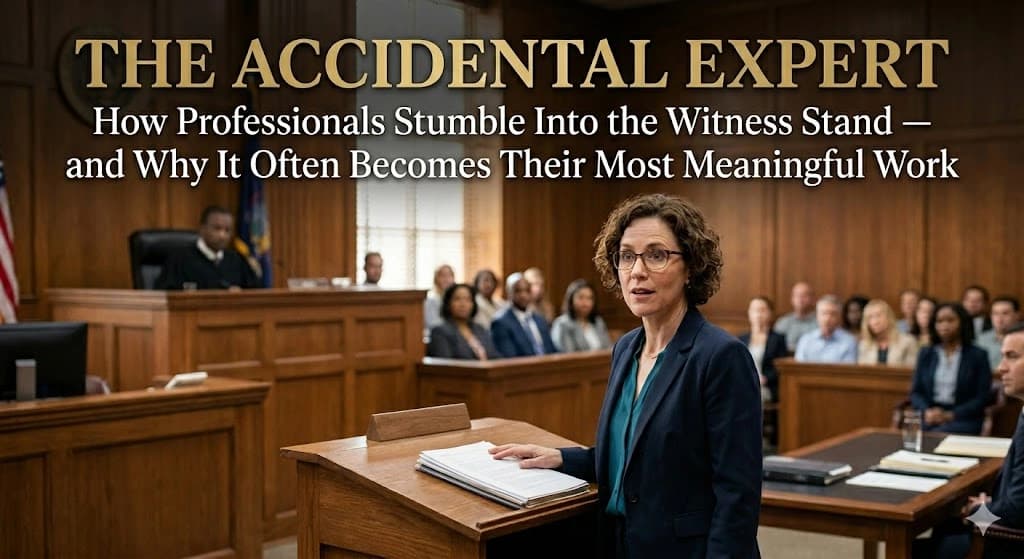
There is a logic to why expert witnesses arrive at the profession accidentally. The most valuable thing an expert witness brings to a legal dispute is not knowledge of legal procedure. It is not familiarity with Rule 702 or deposition dynamics or Daubert standards. Those things can be learned. What cannot be learned quickly - and cannot be faked at all - is the kind of deep, operational, field-tested expertise that comes from spending twenty or thirty years actually practicing in a profession.
A physician who has treated ten thousand patients knows something a medical school graduate does not. A property manager who has spent three decades navigating housing codes, tenant disputes, and building regulations across hundreds of properties knows something no textbook captures. A forensic accountant who has untangled complex financial fraud for half a career has pattern recognition that cannot be replicated by someone who simply studied the field.
This is precisely why the most compelling expert witnesses tend to be those who came to the role late - after having built something substantial in their primary field first. The legal system does not need people who planned to be expert witnesses. It needs people who became the best in their field at something else, and whose expertise then turned out to be exactly what some courtroom somewhere required.
The First Case Stories - Five Accidental Beginnings
The origin stories of expert witnesses are among the most varied in any profession. They share almost nothing in common structurally - except the element of surprise.
The story that opened this article belongs to Dr. Jordan Romano, a physician and medical expert witness who appeared on Season 2, Episode 12 of On The Stand. Romano had been out of residency for a few years when his colleague handed him that first case. "I wasn't even thinking I would be in this position," he says now, looking back more than a decade later. "I was helping a colleague with one case." He did that case and found it interesting. Then he wondered what it would look like to do more. "Over the first couple of years it was a slow start," he recalls. The turning point came not from aggressive marketing or a strategic plan, but from the moment he received what he calls "the first unexpected referral" - a phone call from an attorney he had never met, who had heard his name from someone Romano had worked with before. "You're like, how did you find me?" he says. "And they said, oh, a friend of mine said you were doing this." That call signalled something important: the work was good enough that people were talking about it without being asked.
In India, the path of Amit Bansal, a forensic finance and dispute-resolution expert with nearly 30 years of experience who appeared on Season 2, Episode 16 of On The Stand, began with almost deliberate resistance. "My entry into the forensic space was by accident," he says plainly. "When I entered this forensic space, I did not even know that such a service area existed." A forensic consultant reached out to him and attempted to persuade him to join the field. Bansal was skeptical. He was "pretty circumspect and quite cynical" about whether it was the right move. The consultant kept trying. "He kept on chasing me for almost a year," Bansal says, "before I agreed to meet." That meeting changed everything. One conversation led to another engagement, which led to another, and now roughly half of Bansal's career - across international arbitration forums including the LCIA and SIAC - exists because someone would not stop asking.
The path of Dr. Simon Dardashti, a pain management and anesthesiology physician with over a decade of clinical practice who appeared on Season 2, Episode 13 of On The Stand, was shaped not by a single phone call but by accumulated feedback he almost did not act on. For years, Dardashti was deposed as a treating physician - not as an expert - and the lawyers he encountered kept giving him the same observation. "A lot of the lawyers would give me feedback saying that I was able to explain difficult medical concepts very clearly," he recalls. He received that feedback repeatedly across multiple depositions, across multiple cases, over several years. Then one specific lawyer said something that stopped him. "You should consider going into the legal field," the lawyer told him. "We could really use somebody who can explain these types of concepts the way you do." He had been building the skills for expert witness work throughout his clinical career without realizing it. The lawyers saw it before he did.
Perhaps the purest expression of the accidental entry is the story of Michael Graham, a medical librarian and litigation research consultant with 20 years of experience who appeared on Season 3, Episode 4 of On The Stand. In 2018, an agency contacted him without warning. "I wasn't listed anywhere," he says. "I didn't know that this was a need that was out there." The agency told him about a boutique law firm - three attorneys - that was handling a complex medical malpractice case involving a failed medical device. The firm was drowning in research: over a thousand different studies and publications related to the technology and procedure at the center of the dispute. They did not know what literature to look at, were not sure they were finding everything, and feared the case might expand into a multi-district litigation. They needed someone who did nothing but navigate medical research databases at the highest level. They needed a medical librarian. "I worked with them and had a great time," Graham says. "I loved the challenge. It was a blast." He had spent 20 years meeting the information needs of clinicians and pharmacists. He had no idea that the legal system had the same need and no one to meet it.
Of all the accidental origin stories in expert witnessing, few begin as early - or as personally - as that of Maria Babinetz, a vocational rehabilitation expert and American Board of Vocational Experts president-elect who appeared on Season 2, Episode 7 of On The Stand. Babinetz did not stumble into expert witness work through a professional contact or an unexpected call. She stumbled into it through her childhood. When she was ten years old, her father - a welder by trade - suffered a brain aneurysm that led to a stroke, paralysis on one side of his body, and aphasia. He had already, in the 1970s, suffered an industrial injury that cost him two fingers on his dominant hand. He navigated the disability system, attempted to return to work, and ultimately never could. "I saw at the time moving through that disability system," Babinetz says. "That did leave a very lasting impression on me." Her father passed away during her sophomore year of college. By the time she graduated from university, she had chosen a career in vocational rehabilitation - and accepted a position at a private rehabilitation company that included expert witness work from her very first day. "I think it started at an early age," she says of her calling, "just not knowing it at the time."
The Serendipity Factor - What These Stories Have in Common
On the surface, these five paths look nothing alike. One began with a stressed colleague passing off a case. One began with a consultant who would not stop calling. One began with a decade of unrequested feedback finally crystallizing into action. One began with an email from an agency about a law firm drowning in research. One began with a childhood wound that took thirty years to become a career.
But look more carefully and the common thread becomes visible. In every case, the legal system found the expert - not the other way around. The profession came looking for the expertise, rather than the expert setting out to build a legal practice. And it found them because their excellence in their primary field had already become visible enough to attract attention from outside their industry.
Romano was known as a physician who could explain complex medicine clearly. Bansal was known in financial circles for a rare combination of forensic and finance experience. Dardashti was known in deposition rooms for making pain management concepts comprehensible to lawyers. Graham was known in medical library circles as someone who could navigate a thousand studies and surface the ones that mattered. Babinetz had lived the rehabilitation system from the inside, at an age when no one was watching, and built a career around what she had seen.
The first case in each career came, essentially, as a referral from someone who had already seen the expert at work - even when that work had nothing to do with litigation. This pattern has a direct implication for professionals who wonder whether expert witnessing might be for them: the most important preparation is not learning the rules of court. It is doing excellent work in your field, consistently, visibly, and for long enough that someone in legal services eventually notices.
Why Experts Call This Their Most Meaningful Work
Something unexpected happens to many professionals when they take their first expert witness case. They find that it is not just interesting - it is among the most engaging and purposeful work of their careers. The reasons vary by person and by field, but the pattern is consistent enough to deserve attention.
For Romano, who built a practice mentoring other physicians into expert witness work, the intellectual dimension is central. The combination of clinical medicine and legal analysis feels like "a fascinating offshoot of being a physician" - a second context in which his expertise is tested, explained, and applied, but with stakes of a different and clarifying kind. He now runs a platform specifically to help other physicians understand how to do this work well, because he sees how much the field benefits from doctors who take it seriously.
For Graham, the appeal was immediate from the first case. "There's a human being on the other end of this information that I'm providing," he says, "and there's a story there." After 20 years of meeting the information needs of clinicians, pharmacists, and nurses, the discovery that the same skill - systematic, exhaustive, precision medical research - could serve a legal dispute involving a patient who had been permanently harmed felt like a natural extension of a career already built around helping people navigate complex information at high stakes.
For Babinetz, the meaningfulness was never in question. The profession was always personal. What changed over the course of her career was simply the sophistication of her understanding of what her father's experience had meant - and what the rehabilitation system owed to injured workers and how often it failed to deliver. Expert witness work became a professional vehicle for an advocacy that had been emotional long before it became analytical.
And for Bansal, operating in a market where the expert witness profession was, when he entered it, still in its infancy in India, the meaningfulness came partly from scale. "Fifteen years back we had only one or two experts in the country," he observes. Today that number has grown to twelve or more. He has been part of building something that did not fully exist before - a professional discipline in his country that now serves courts and arbitration tribunals in ways they previously could not access.
The Second Career Framework - Why Expert Witnessing Suits Later-Stage Professionals
One of the structural advantages of the expert witness profession - one that is rarely discussed in career advice circles - is that it defies the normal logic of professional aging. In most fields, more years of experience eventually become a liability. Technology changes, physical demands shift, and the energy required for certain types of work declines. Expert witnessing moves in the opposite direction.
The more years of field experience an expert brings, the more authoritative their testimony. A physician who has practiced for thirty years has seen cases a physician with five years of experience simply has not encountered. A vocational rehabilitation counselor who has worked with thousands of injured workers across multiple decades has a pattern-recognition capacity that no textbook or training program can replicate. An international forensic accountant who has worked across multiple arbitration regimes over a thirty-year career brings a contextual understanding of financial dispute that is genuinely irreplaceable.
This is one of the reasons why expert witness work functions so naturally as a second-career or late-career complement to primary professional practice. It is flexible enough to work part-time alongside an active clinical or business practice. It draws on accumulated expertise rather than requiring new credentials. And it provides intellectual challenge, financial reward, and a sense of professional purpose that many professionals find increasingly difficult to locate as their primary careers mature.
The property management expert K. David Meit, who appeared on Season 2, Episode 3 of On The Stand and who brings more than three decades of experience managing complex residential and commercial properties, discovered the profession through a colleague who had been doing it for 25 years - and found that the professional community of property management expert witnesses was both small and aging. "The experts that are in the business of expert work in property management are graying quickly," he says. "I'm actually one of the more younger guys in his 50s doing this right now." He now actively encourages other property managers with deep experience to consider the path: "Build up your resume, build up your expertise, build up your designations - because there's no reason somebody who has been in the business for 20 years shouldn't start thinking about this now." The field, in his area of expertise, has more demand than qualified supply. That gap exists in many specialties, and most professionals who could fill it have no idea.
What You Can Do If You Want to Find Your Way In
For professionals who hear these stories and begin to wonder whether expert witness work might have a place in their own careers, the practical question is where to start. The origin stories above suggest that the most common entry point - a colleague, a client, an unexpected referral - cannot be engineered. But the conditions that make those moments possible absolutely can.
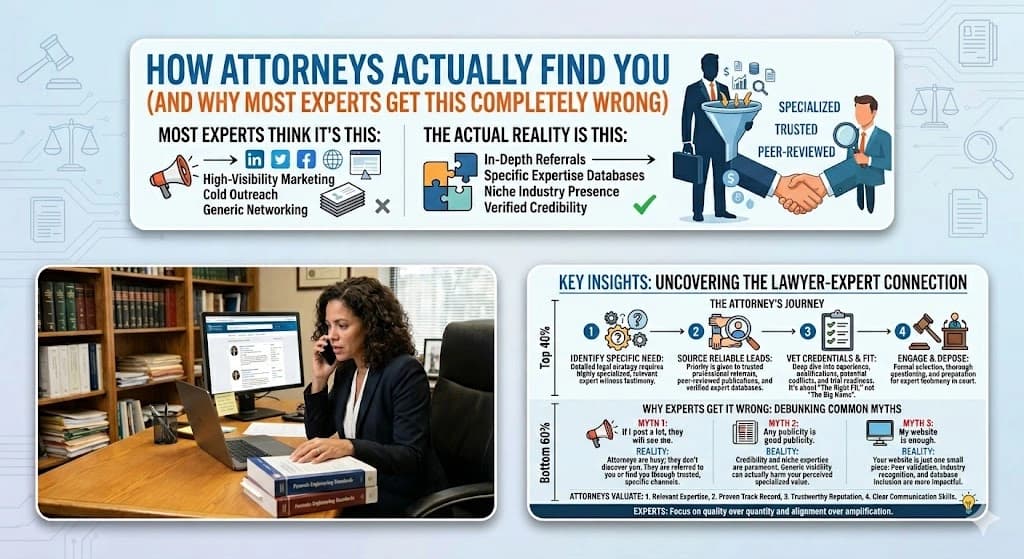
The first and most important condition is also the simplest: be excellent at your primary work, and be visible. Michael Graham was not listed on any expert database when the agency found him. He had simply built a reputation as one of the best medical librarians in his field, and someone who needed exactly that skill eventually asked around until they found his name. Babinetz had not positioned herself as a potential expert witness when she accepted her first job out of university. She joined a firm that included expert witness work as part of its practice, and her ability to do the clinical and analytical work was immediately apparent.
The second condition is receptivity. When Amit Bansal was first approached, he was skeptical. He could have said no. Many professionals say no to the first inquiry, or the second, and never revisit it. What made the difference in his case was a consultant patient enough to keep asking. Not every professional will have that advocate. The implication is that when the inquiry arrives - whether from a colleague, a client, an agency, or an attorney - the instinct to defer it or dismiss it is worth examining carefully.
Once an initial case is taken, the practical infrastructure for expert witness work is more accessible than it was even a decade ago. Professional organizations including SEAK, the National Association of Forensic Economics, and field-specific associations offer training programs in report writing, deposition preparation, and courtroom testimony. Meit credits SEAK specifically with giving him the foundational knowledge he needed to translate his property management expertise into a legal context. Understanding Rule 26 report requirements, Federal Rule of Evidence 702, and the basics of Daubert admissibility standards is not difficult - it simply requires the decision to invest the time.
For physicians, Dr. Dardashti's path offers a particularly instructive model. He did not take a training course before his first case. He was already being deposed as a treating physician - which meant he was already learning, in real time, what the legal system needed from medical experts. Every deposition taught him something. Every attorney's feedback refined his communication. By the time he began actively pursuing expert witness work, he had already developed the most important skill the field requires: the ability to make complex medical concepts comprehensible to people with no medical training.
Romano's advice to physicians considering the path is direct: "You're good when work begets more work." The signal that an expert is doing this well is not an award or a credential. It is the phone call from opposing counsel - not the retaining attorney, but the other side - who wants to retain you on a future case. That call means the testimony was not just technically sound. It was so clear and credible that the lawyers on the losing side decided they wanted that voice working for them next time.
Conclusion: The Career That Finds You
There is something both humbling and instructive about the consistent pattern in these origin stories. The legal system does not recruit. It does not post job listings or hold career fairs. It finds expertise through networks, through reputation, through the invisible circulation of professional word-of-mouth that happens when someone does excellent work and someone else needs exactly that excellence to resolve a dispute.
The professional who plans to become an expert witness is, in a sense, approaching the profession backward. The professionals who build the most durable and meaningful expert witness practices are almost universally those who focused first on becoming genuinely excellent at something else - and then answered the phone when the legal world called.
For Maria Babinetz, that call was embedded in a childhood wound. For Michael Graham, it came from an agency in 2018 that had no particular reason to believe he would say yes. For Amit Bansal, it came after a year of being chased by someone who recognized potential that Bansal himself did not yet see. For Simon Dardashti, it came as the cumulative weight of years of feedback from lawyers who kept telling him the same thing.
In every case, the profession arrived. The expert's job - the only real preparation that was possible - was to be ready when it did.
Experts Featured in This Article
Dr. Jordan Romano - Season 2, Episode 12 | Physician & Medical Expert Witness
Amit Bansal - Season 2, Episode 16 | Forensic Finance & Dispute Resolution Expert, India
Dr. Simon Dardashti - Season 2, Episode 13 | Pain Management & Anesthesiology Physician
Michael Graham - Season 3, Episode 4 | Medical Librarian & Litigation Research Consultant
Maria Babinetz - Season 2, Episode 7 | Vocational Rehabilitation Expert
K. David Meit - Season 2, Episode 3 | Property Management Expert