
Why Expert Witness Marketing Is Unlike Any Other Kind
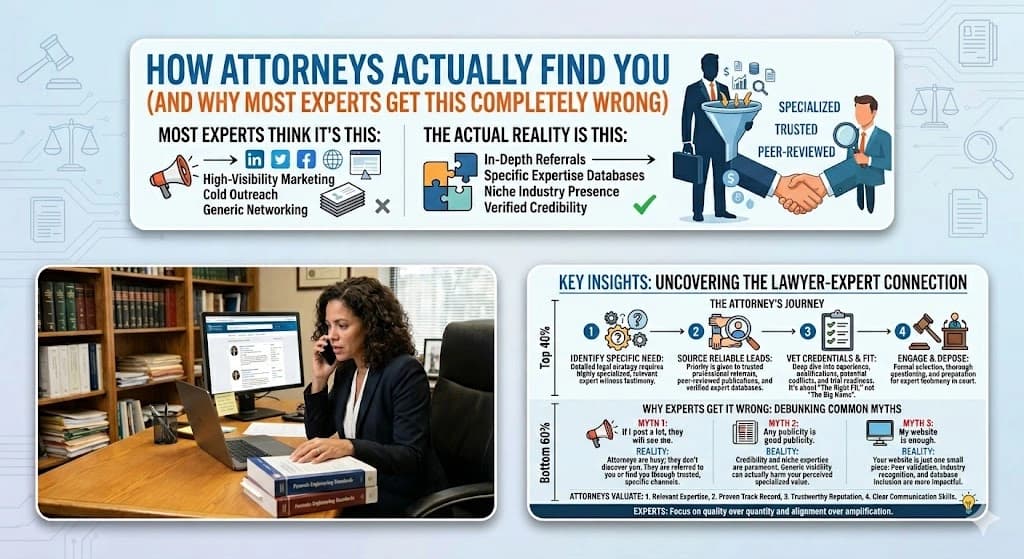
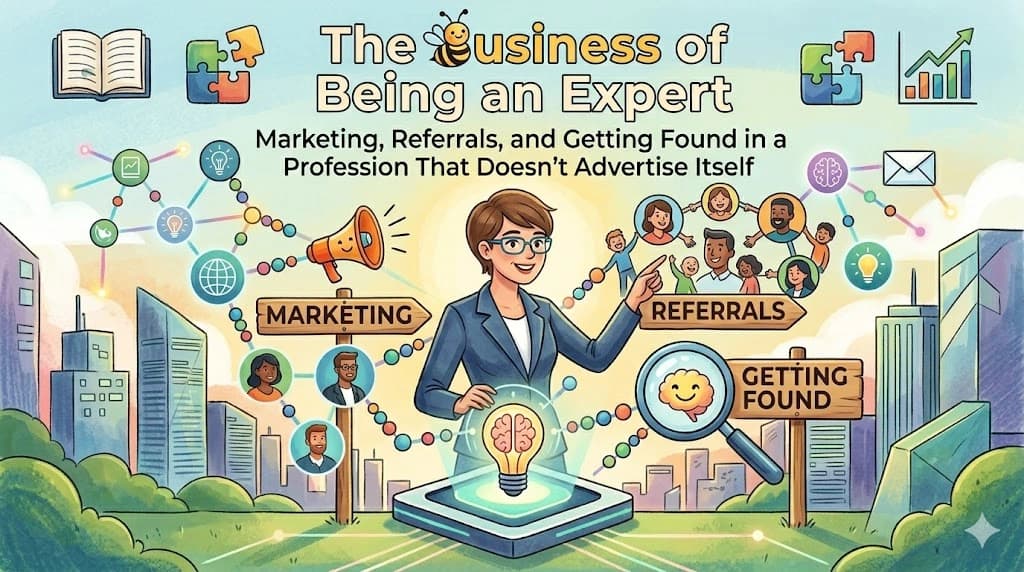
The first thing to understand about marketing in this profession is why ordinary marketing approaches fail. Experts cannot cold-call attorneys. They cannot advertise their services to plaintiffs or defendants directly. They cannot promise outcomes. They cannot publicly signal allegiance to one side of a legal dispute. The constraints are significant, and they exist for good reason: the entire value of expert testimony depends on its perceived impartiality and credibility. Aggressive self-promotion, or any promotional strategy that suggests a hired-gun mentality, destroys that credibility before an attorney ever picks up the phone.
The implication is that effective expert witness marketing must operate indirectly, through signals of competence and integrity rather than through direct solicitation. An attorney looking for an expert is not looking for someone who wants the work. They are looking for someone who is so clearly excellent at what they do that retaining them will make the attorney look like they did their homework.
The challenge of marketing tastefully in this space is real, and attorneys notice when experts get it wrong. A personal injury and vaccine litigation attorney who appeared on Season 2, Episode 14 of On The Stand, Jon Groth, makes this point from his perspective on the retaining side. "Everybody's advertising," he observes. "That's just the way it is nowadays." But the best expert advertising, in his experience, carries a specific quality: it communicates genuine expertise and honest evaluation rather than side-dependent availability. The advertisement that says "I will give you an honest answer, I am a leader in X, Y, and Z" is entirely different from the one that winks at which side it prefers. The first builds confidence in a potential retaining attorney. The second raises immediate red flags about whether the expert's testimony will survive cross-examination.
Getting Found: The Discovery Problem for New Experts
For an expert starting out, the first and most acute problem is simply being discoverable. The attorney who has never heard your name cannot retain you. The attorney who has worked with you before will call again. But the first call - the one that starts the relationship - requires that something bridge the gap between your expertise and their awareness of it.
The most straightforward solution is listing services. Platforms like SEAK, JurisPro, the Expert Institute, and others allow experts to create searchable profiles that attorneys can browse when looking for a specific type of expertise. These directories serve a simple but essential function: they make the invisible visible.
The value of listing services in the early stages of a practice is well documented by experts who have used them. The summer of 2016 marked the beginning of an expert witness career for a chiropractor and forensic evidence specialist who would go on to publish 14 peer-reviewed studies and review 54 cases in a highly specialized area. Dr. Steven Brown, who appeared on Season 3, Episode 8 of On The Stand, received his first case through a recruiter at the Expert Institute - a large agency that connects attorneys with qualified experts across hundreds of specialties. The agency could not find a chiropractor willing to review the specific case type involved. They called Brown. "It took her half an hour to convince me that this wasn't a scam or something," Brown recalls. He took the case, found it interesting, and immediately listed himself on several platforms. "I took out an ad on the SEAK Expert Witness website. I have a free listing with the Expert Institute. I have a listing with JurisPro. And a few years ago, I made a dedicated website for expert work." After that, he says simply: "Word of mouth." That two-part strategy - initial visibility through listing services, sustained growth through reputation - is among the most common and durable paths in the profession.
A professional website is not optional in this environment. Jerry Birnbach, a retail design and commercial injury expert with more than 50 years of experience who appeared on Season 2, Episode 2 of On The Stand, credits his website - and his visibility in search results - with extending his practice across 48 states. "I'm highly visible," he says. "I'm on page one of any Google search." That page-one position was not accidental: it reflects the compounding effect of decades of professional activity, a well-maintained web presence, and consistent delivery of work that generated reviews, referrals, and citations. For newer experts, the lesson is that the website is not just a brochure. It is the first thing an attorney sees when they search for you after getting your name from a colleague - and if it does not convey immediate professional credibility, it costs you the call.
Building Credentials That Market Themselves
Listing services create discoverability. But the experts who build truly durable practices understand that the most powerful marketing tool in this profession is not a directory listing or a website. It is a professional record so well-documented that it does the marketing automatically.
Designations, certifications, published work, awards, and formal credentials create what might be called third-party validation - external evidence of expertise that is far more credible to an attorney than any self-promotional claim. An expert who holds a recognized professional designation has demonstrated competence to someone other than themselves. An expert whose work has been published in peer-reviewed journals has had their analysis reviewed and validated by other experts in the field. An expert who has won professional awards has been recognized by their community. All of these signals translate directly into attorney confidence.
The importance of building this credential base before seeking expert work - not after - is a point made with particular clarity by property management expert K. David Meit, who appeared on Season 2, Episode 3 of On The Stand. Meit entered the expert witness field after decades of building a comprehensive professional record: licenses, designations, accreditations, awards, and a reputation built across hundreds of managed properties. "Build up your resume, build up your expertise, build up your designations - because that does become important to your CV," he advises colleagues considering the path. "That's your prima facie as an expert. Not just that you've been in business for 30 years, but that you have third-party acknowledgment of your expertise." He is direct about the investment required: "It took me 30 years to earn all of those things." But he is equally direct about the opportunity it creates: "There's no reason that somebody who has been in the business for 20 years shouldn't start thinking about this now."
Meit also points to the infrastructure of professional education as an underused resource for experts at any stage of their career. He took his introductory expert witness training through SEAK, a professional development organization focused specifically on expert witness work. He reads expert witness newsletters, maintains an active presence on LinkedIn, and engages with colleagues across disciplines. "I'm on LinkedIn," he says. "I talk to plenty of my colleagues that are expert witnesses, be it doctors or engineers, allied or not allied, because we all share the same requirements to be able to appear effectively in our area of expertise." This cross-disciplinary engagement creates informal networks that generate referrals - the primary currency of a mature expert witness practice.
The Content Marketing Approach: Building Visibility Through Thought Leadership
A growing number of expert witnesses have discovered that the most efficient path to visibility is not directory listings or networking events but the consistent publication of substantive professional content. Articles, white papers, webinar presentations, conference talks, and LinkedIn posts all accomplish the same thing: they make an expert's knowledge visible to people who are actively searching for that knowledge.
The content marketing model is particularly well-developed among experts in fields where the professional community includes a high density of potential retaining attorneys. A finance and securities expert who appeared on Season 3, Episode 2 of On The Stand, Pavithra Kumar, has built her practice at a boutique consulting firm partly through exactly this approach. "Networking with attorneys, putting out thought leadership, publications, presentations," she describes. "I recently did a couple of sessions of a crypto litigation webinar that we publicized on LinkedIn and they were well attended." She has also joined the Securities Expert Roundtable - a professional organization in her field - and attends and speaks at conferences. The goal of each activity is the same: to make her name and expertise visible to attorneys who are already trying to solve the problem she specializes in solving.
Kumar's model reflects a broader insight about content in expert witness practice: the best content does not announce that you are available for hire. It demonstrates that you understand the problem at a level most people cannot match. An attorney reading a clear, technically precise webinar on crypto litigation securities analysis does not think "this person wants work." They think "this person knows things my client's case depends on." That is the distinction between marketing and advertising - and it is why thought leadership works in a profession where advertising does not.
There is, however, a legitimate debate within the expert witness community about how aggressively experts should publish and maintain a public profile. Dr. Chris Daft, an AI and medical device technology expert who appeared on Season 3, Episode 10 of On The Stand, describes two schools of thought that exist among experienced practitioners. "Some experts believe that you should not write anything in the public domain," he explains. "Don't publish any blogs or articles. Don't have a website. Don't go on podcasts." The logic of this position is that anything published can be used in cross-examination - any public statement becomes material that opposing counsel can cite, challenge, or take out of context. Daft himself has experienced this firsthand, with patent applications and published papers raised during depositions. But his conclusion is the opposite of avoidance: "That doesn't trouble me at all," he says. "If the attorney wants me to explain what my patent was, I could spend the whole deposition doing that, because that's very easy for me." The expert who has published extensively is not vulnerable in cross-examination because of those publications. They are credible because of them. The publications are evidence of deep knowledge, not exposure.
Daubert Survival as Marketing Capital
Among the most powerful and least discussed marketing assets available to an experienced expert witness is a track record of surviving Daubert challenges - formal judicial rulings that an expert's methodology is scientifically reliable and that their testimony is admissible. Attorneys do not want to hire experts who will be excluded at trial. The expert who can demonstrate that their methodology has been tested in court and survived that test offers something no directory listing or content piece can replicate: judicial validation.
This dynamic is described with particular precision by Toni Elhoms, a medical coding and healthcare compliance expert who appeared on Season 3, Episode 6 of On The Stand. Elhoms has been challenged under Daubert on multiple occasions - and those challenges, in her experience, have become assets rather than liabilities. "I have lots of orders that I can share," she says. "They know: Daubert tested, judge approved, and you can withstand that." The judicial order that documents a successful Daubert challenge is a marketing document. It is evidence, produced by a neutral party with judicial authority, that the expert's methodology passes legal scrutiny. "Those are great marketing tools," Elhoms says. "I don't really have to do anything but say, okay, here's my orders." An expert who has survived an aggressive Daubert hearing - and can document it - carries a credential that no listing service can create and no amount of self-promotion can replicate.
The implication for newer experts is worth sitting with. Every case is a marketing opportunity, not just for the direct referral it might generate, but for the professional record it creates. An expert who writes thorough reports, gives clear and well-supported deposition testimony, and survives challenges to their methodology accumulates a case history that speaks for itself. The attorney who experienced that performance will call again. The attorney who hears about it from a colleague will call for the first time. And the judicial record that documents it becomes evidence of reliability that marketing cannot manufacture.
The Referral Economy: How Word-of-Mouth Actually Works
The most successful expert witness practices are almost universally built on referrals rather than advertising. This is not a coincidence. It reflects the nature of the decision attorneys are making when they retain an expert. Hiring an expert for litigation carries real risk: if the expert performs poorly under cross-examination, if their report is excluded, if their credibility is successfully attacked, the attorney and their client bear the consequences. This is not a purchasing decision that an attorney makes lightly on the basis of a web search alone. It is a trust decision - and trust is built through personal knowledge or personal endorsement.
The mechanics of attorney referral networks are informal but remarkably efficient. Attorneys talk to each other about experts the same way they talk about anything else - at bar association events, at conferences, over lunch, in casual conversation. An expert who performs well on a case is likely to be discussed. An attorney who found a reliable expert in an unusual specialty is likely to share that name when a colleague faces a similar case. These conversations happen constantly, they happen without the expert's knowledge, and they are the primary engine of practice growth for experts who have been in the field for more than a few years.
Jerry Birnbach's practice - 650 cases, Fortune 500 clients, 50 years of continuous work in retail commercial injury - represents what word-of-mouth looks like at scale. No single attorney relationship built that practice. It was built one case at a time, across plaintiff and defense work, in 48 states, by delivering expert analysis that made the attorneys who retained him look like they had made a smart decision. Each of those experiences became a data point in a referral network that now operates largely without his direct involvement. The cases come. The website maintains his page-one visibility for new attorneys who hear his name and search it. The referrals handle the rest.
Pavithra Kumar describes the same dynamic from the perspective of building a newer practice. Referral development, in her model, is partly a function of conference participation and professional community engagement. "Networking with attorneys," she explains - not in the abstract sense of attending events and handing out cards, but in the substantive sense of presenting on topics where her expertise is directly relevant to the work attorneys are doing. A webinar on crypto litigation reaches exactly the attorneys who have crypto litigation cases. A panel presentation at a finance law conference reaches exactly the attorneys who handle the disputes where her expertise applies. The network is built by being visibly present where the potential client base already gathers.
The Long Game: Building a Practice That Sustains Itself
The most important single insight across all of these marketing and business-development strategies is that none of them work quickly. Expert witness practice is a long-horizon investment. The credentials take years to build. The directory listings generate inquiries, but converting those inquiries into a relationship that produces repeat work takes time. The content piece published today may generate an attorney inquiry two years from now. The case taken on modest terms early in a practice may produce three referrals five years later.
K. David Meit took his SEAK training, joined professional networks, maintained his LinkedIn presence, built his credentials, and entered expert witness work after three decades in property management. He is explicit about the timeline: "There's no reason somebody who has been in the business for 20 years shouldn't start thinking about this now." The implication is that preparation for expert witness work should begin well before the first case arrives - not after.
Steven Brown's path illustrates what consistent, honest expert work does to a practice over time. He entered the field in 2016 through a recruiting agency that could not find anyone else to look at a difficult case. By listing himself on three platforms, building a dedicated website, writing articles, and giving every case his honest and evidence-based analysis - regardless of which side retained him - he built a practice that now operates largely by reputation. The good attorneys, he observes, "don't want yes men. They don't want to be told yes, there's a case here when there's not." An expert who delivers honest adverse opinions, even to retaining attorneys, builds something that strategic marketing cannot: a reputation for reliability. "I give an adverse opinion on almost all of my cases," Brown says. "And good attorneys appreciate that. And they continue to ask me for more opinions."
This, ultimately, is the business of being an expert witness. It is not a marketing challenge in the conventional sense. It is a performance challenge. The expert who performs well, consistently, across cases and years and jurisdictions, builds a practice without needing to advertise it. The directory listings and the website and the content pieces and the conference presentations all serve the same function: they create the initial conditions under which performance can be demonstrated. After that, the practice sustains itself.
What New Experts Should Do First
For professionals who are considering entering expert witness work and want to build a practice rather than simply respond to occasional inquiries, the practical sequence is fairly clear from these examples.
The foundation comes first: credentials, designations, publications, and a professional record that documents expertise at a level a court would recognize. This is not something that can be rushed. It is built through years of practice in a primary field, and it is the non-negotiable prerequisite for everything that follows.
Discoverability comes next: a professional website that accurately represents areas of expertise, a presence on the major listing services relevant to the specialty, and an active LinkedIn profile. These are the channels through which attorneys who do not yet know the expert's name can discover it.
Content and community engagement follow: articles, presentations, webinars, professional association involvement, conference participation. These activities are not primarily about self-promotion. They are about demonstrating knowledge publicly and consistently, in front of audiences that include potential retaining attorneys.
And then performance: every case handled with professionalism, every report written with care, every deposition given with clarity, every adverse opinion delivered honestly. This is the marketing that matters most in expert witnessing, and it is the only kind that compounds over time. Toni Elhoms can share a stack of Daubert orders not because she marketed herself as Daubert-proof, but because she did the work so well that the challenges filed against her became evidence of her reliability. Jerry Birnbach occupies page one of Google not because he ran an ad campaign, but because 50 years of consistent performance created a digital footprint that no advertising budget could replicate.
In a profession that does not advertise itself, the business is built by being excellent at the thing the business is supposed to do. Everything else - the listings, the website, the content, the network - is infrastructure for that excellence to become visible.
Experts Featured in This Article
Jon Groth — Season 2, Episode 14 | Personal Injury & Vaccine Litigation Attorney
Dr. Steven Brown — Season 3, Episode 8 | Chiropractor & Forensic Chiropractic Expert
Jerry Birnbach — Season 2, Episode 2 | Retail Design & Commercial Injury Expert
K. David Meit — Season 2, Episode 3 | Property Management Expert
Pavithra Kumar — Season 3, Episode 2 | Finance, Securities & Valuation Expert
Dr. Chris Daft — Season 3, Episode 10 | AI & Medical Device Technology Expert
Toni Elhoms — Season 3, Episode 6 | Medical Coding & Healthcare Compliance Expert