
The Question Every New Expert Dreads
Picture the moment: you are on the phone with a trial attorney. She is well-prepared, time-pressed, and looking for an expert to anchor a complex case. The conversation is going well — your credentials are strong, your field is exactly right, and you are genuinely enthusiastic. Then she asks the question.
"How many depositions have you given?"
If the answer is zero, the conversation usually ends there.
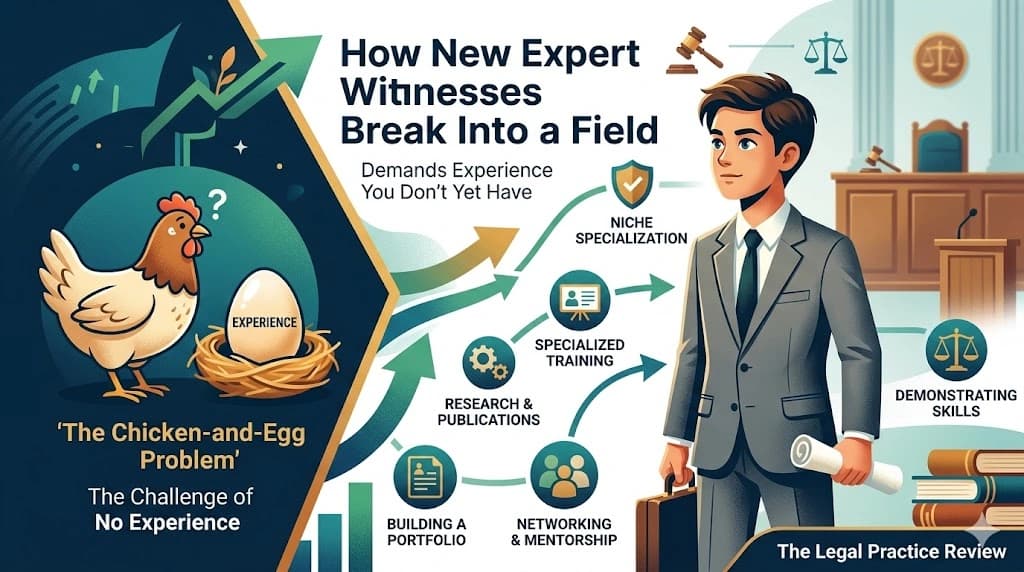
This is the wall that stops hundreds of highly credentialed professionals from ever building an expert witness career. It is not a wall built from lack of knowledge, lack of relevant experience, or lack of ability. It is built from a systemic paradox so common that the experts who have worked through it have a name for it.
"It can be a chicken-and-egg kind of dilemma in that retaining counsel will want to know, if they're doing due diligence, about the number of depositions that you've given, the number of your trial testimonies. And if you're just starting out, you may not have any. It's like an attorney who's trying to get trial experience — and the client wants to entrust the case to somebody who's got some seasoning in that arena."
— Kevin Quinley · Insurance Claims Expert · On The Stand, Season 1, Episode 1
Kevin Quinley (Season 1, Episode 1 — Insurance Claims Expert, 40+ years of experience, 140+ cases across federal and state courts) named this dynamic at the very opening of the On The Stand podcast series, and in doing so, named something that virtually every expert in the series has lived through.
The question is not just philosophical. It shapes careers, limits access to the legal system's most experienced practitioners, and costs attorneys the benefit of valuable expertise that simply hasn't yet accumulated a case history. Understanding how successful experts broke through this paradox — and what they did once they were through it — is the focus of this article.
The Paradox Explained — Why the Ecosystem Favors Experience
The expert witness vetting process is, by design, backward-looking. Attorneys conduct due diligence by examining an expert's deposition history, trial testimony record, and Daubert challenge outcomes. Every one of those metrics requires prior casework to generate. An expert without that track record isn't just at a disadvantage — they are functionally invisible to the attorneys who rely on that history as a proxy for reliability.
This is not arbitrary. Attorneys are risking their clients' outcomes on the experts they retain. A misstep — an unprepared expert, a flawed report, a failed Daubert hearing — can cost a case that took years to build. The instinct to look for demonstrated experience is rational. But the cumulative effect of that instinct is a system that struggles to incorporate new expertise, even from fields that desperately need representation.
The irony is that many professionals who would excel as expert witnesses never make the attempt because they do not know the path exists. And many who do attempt it underestimate how long the early phase can last.
"When you start out to get better, you need to do more cases. But to get more cases, you have to be good at what you're doing. It's kind of a catch-22."
— Dr. Jordan Romano · Physician & Medical Expert Witness · On The Stand, Season 2, Episode 12
Dr. Jordan Romano (Season 2, Episode 12 — Physician and Medical Expert Witness), who built his practice over a decade starting with a single case, describes this cycle with the specificity of someone who has navigated it directly. He is not describing a theoretical problem. He is describing the texture of his first several years.
The Accidental Beginnings — How Most Experts Actually Got Their First Case
Here is a pattern that emerges with striking consistency across the On The Stand series: almost none of the expert witnesses who built thriving practices planned to do so. The first case rarely came from a strategic marketing effort, a listing service, or a formal approach to attorneys. It came from a colleague, a referral, or an unexpected phone call.
Kevin Quinley, who ultimately served as an expert in more than 140 cases, describes his entry into the field as entirely unplanned. He had built a parallel career as a business writer, published hundreds of articles, and spoken at industry conferences — none of it with the intention of becoming an expert witness. The phone calls from law firms started arriving because of his industry visibility, not because he had set out to attract them. For the first decade, he worked cases on a moonlighting basis while holding a demanding corporate role.
Dr. Jordan Romano's entry was similarly accidental. About a decade ago, a colleague at his medical practice looked stressed at the end of the day. Romano asked what was wrong, offered to help with the patient, and learned there was no patient — it was a legal case. The colleague, recognizing that Romano had enough post-residency experience to handle it, handed it off over lunch. That single lunch transformed his professional life.
Robert Handfield (Season 2, Episode 10 — Supply Chain Expert, Bank of America University Distinguished Professor at NC State), who is now one of the leading expert witnesses in supply chain management, describes a nearly identical origin: he was working on a project for a large pharmaceutical company when the company's supply chain managers referred him to counsel. He had no idea how to write an expert witness report. His first case settled without trial. But it opened a door that has never closed.
Maria Babinetz (Season 2, Episode 7 — Vocational Rehabilitation Expert, 35+ years of experience, incoming president of the American Board of Vocational Experts) had an even earlier start: she was exposed to litigation work during her internship, straight out of graduate school, through a private rehabilitation firm. The exposure was early and formative. But she is quick to note that the slow trajectory of earning trust was universal, regardless of when the journey began.
The implication of all these stories is important: your existing professional network is almost certainly your most powerful and most underutilized asset as a new expert. The attorneys who will hire you often already know you — or know someone who does. Activating that network deliberately, while you are still building credentials, is the most reliable path to a first engagement.
The Sequential Credentialing Path — From Record Review to Trial
Understanding how expert witness careers actually progress — in sequence — is one of the most underappreciated pieces of knowledge a new expert can acquire. The profession does not require you to walk into a courtroom on your first engagement. In fact, for most experts, trial testimony comes years after their first case, if it comes at all.
The standard progression runs as follows: record review, written report, deposition, and finally trial testimony. Each stage builds the competency and the track record required to be trusted with the next. Most cases settle before trial, which means that for every expert who has testified before a jury, there are many more who have not — but who have still accumulated significant experience in reviewing documents, writing opinions, and navigating depositions.
Dr. Eric Cole (Season 2, Episode 8 — Cybersecurity Expert, Former CIA Cyber Expert and NSA Red Team Leader), who built one of the most prominent cybersecurity expert witness practices in the country, describes his own path with characteristic directness. When he was first asked to be an expert witness, he did not know what that meant. What he did was start with what he was good at: explaining complex technical concepts clearly. He built his reputation through report writing first, then depositions, then trial. The sequential credentialing was not just a strategy — it was a discipline.
"If you have a very unique skill set, you might be able to find a case where somebody could take you. Get very niched in your skill set — find a very, very narrow niche that is super hard to find, and then start introducing yourself. Because in that case, they might be willing to run the risk of taking somebody with no experience but who has the technical knowledge."
— Dr. Eric Cole · Cybersecurity Expert · On The Stand, Season 2, Episode 8
This insight — the power of hyper-specialization for new experts — is one of the most practical pieces of advice in the entire On The Stand series. In a market where seasoned general experts are available at competitive rates, an attorney with a genuinely niche technical question may be willing to take a chance on an unproven expert if that expert is the only one who truly understands the problem.
Dr. Cole also highlights another entry point that most new experts overlook: the supporting role. Before you can testify, you can help. Experienced expert witnesses often need research support, code review, document review, and technical analysis. Working in a supporting capacity for a more experienced expert in your field builds procedural knowledge, professional relationships, and early case history — even if your name never appears in a report.
Practical Strategies That Work — The New Expert's Playbook
The experts interviewed across the On The Stand series converge around a set of practical strategies for breaking into the field. None of them are magic. All of them require sustained effort. But taken together, they constitute a roadmap that most new experts — operating in isolation — simply do not have access to.
Listing services: valuable early, less so later. When George Reis (Season 2, Episode 1 — Forensic Imaging Expert, former Newport Beach Police Department crime scene investigator) started his practice in 2004, he signed up with forensic listing services from day one. "I thought every day I need to do something today that will generate work and generate income," he recalls. The listing services were part of that daily effort. Today, most of his work comes through word-of-mouth referrals, and he is listed with only one service. But in the early years, listing services provided the initial visibility that led to his first clients.
The lesson here is sequencing: listing services are a starting point, not a destination. They provide exposure to attorneys who are actively searching for experts, which is exactly what a new expert needs. As the practice grows and referrals accumulate, their importance diminishes naturally.
Dr. Steven Brown, DC, DIAMA (Season 3, Episode 8 — Chiropractic Expert Witness, Diplomate of the International Academy of Neuromuscular Skeletal Medicine, 54+ cases) offers one of the most instructive examples of how listing services and niche specialization work together. His first case came through the Expert Witness Institute — a recruiter called him because they had exhausted their entire network and could not find a single chiropractor willing to take a chiropractic stroke case. Brown had no expert witness experience at that point. He did not even know what expert witness work was. It took the recruiter half an hour to convince him the call was legitimate. But he said yes, reviewed the case, and the matter settled. He then immediately placed ads on the SEAK Expert Witness website, secured a free listing with the Expert Institute, listed with JurisPro, and built a dedicated expert witness website. His practice has been consistently busy ever since.
What makes Brown's story particularly instructive is the dynamic he describes — and that has not changed in nearly a decade of practice:
"Nobody wants these cases. Nobody wants to look at them. So if you're the one person who's willing to look at them, you're going to get that case."
— Dr. Steven Brown, DC, DIAMA · Chiropractic Expert Witness · On The Stand, Season 3, Episode 8
This is the niche specialization principle in its most concentrated form. In a field where seasoned generalists are abundant, the expert who occupies territory that others avoid — whether from professional hesitancy, political discomfort within a specialty, or simply a lack of willingness to engage with difficult subject matter — can build a practice faster than almost anyone else. Brown went further: he built the research infrastructure around his niche, publishing 14 peer-reviewed studies on chiropractic stroke causation, presenting at national conferences, and becoming the default resource attorneys turn to when they cannot find anyone else. The listing services opened the first door. The niche expertise — and the willingness to occupy it — kept the doors opening after that.
Publishing and thought leadership: the most durable marketing. Multiple experts across the series describe the same phenomenon: attorneys find them because of something they wrote. Kevin Quinley had published more than 700 articles and 10 books on insurance and claims management before he took his first expert witness case — none of it with the intention of building an expert witness practice. But that publication record made him findable and credible when attorneys went looking.
Robert Handfield makes a similar observation. He publishes books and peer-reviewed journal articles, runs a university research center, and speaks at industry events. That public presence attracts attorneys who are researching supply chain issues and need someone who can speak to both the academic literature and real-world industrial practice. "Publishing another article in a journal that a handful of people are going to read isn't as impactful as writing a really solid expert witness report that will determine the outcome of a major case," he notes — but the publications are what ensure the attorneys find him in the first place.
Digital content and social media: Dr. Cole's modern playbook. Dr. Eric Cole has updated this model for the digital era. He maintains active presences on YouTube, Instagram, and other social platforms, produces two podcasts per week, and speaks at conferences regularly. His approach is built around the same principle: put yourself out there, give freely, and let the volume of content create the visibility that leads to inbound inquiries. "When you share with others, you learn," he notes — but the sharing also builds the professional profile that attorneys discover when they search for an expert in his niche.
SEAK conferences and professional associations. Organizations like SEAK (the nation's leading expert witness training company) and field-specific professional associations provide a combination of training, peer networking, and early case opportunities that are particularly valuable for new experts. They connect practitioners who want to become experts with attorneys who need them, and they provide a structured education in the procedural and professional dimensions of expert witness work that most technical practitioners simply have not been exposed to.
Building Relationships Before You Need Them
One of the most consistent themes across the On The Stand series is that the experts who build the most durable practices do not wait until they need cases to build relationships. They build relationships first — with attorneys, with fellow experts in adjacent fields, and with the broader professional community — and the cases follow from those relationships.
George Reis has built what he describes as an informal expert roundtable: a network of experts in different specialties who refer cases to each other when they fall outside their primary area. "I get referrals because John Smith at one agency talks to Jane Doe at another agency — who did you use on that case? I used so-and-so, they did a great job." The referral network is the product of consistent excellent work and consistent relationship maintenance. It is not a strategy that produces immediate results. But after 20 years, Reis relies almost entirely on referrals and rarely needs listing services at all.
Kevin Quinley frames this as the essential mindset for early-career experts: "You're building your record, whether it's in publications, as a thought leader, in terms of a blog, developing top-of-mind awareness, and just having a systematic approach to approaching law firms and attorneys that you knew in a prior life." The prior life matters. The network built in the professional world before expert witnessing begins is not wasted — it is the starting point for the practice.
Maria Babinetz echoes this with equally practical advice. "Put yourself out there. Go to conferences. Start to make connections with other experts." She acknowledges that conferences can be expensive for professionals just starting out, and suggests advocating with employers to fund attendance as professional development. The investment in face-to-face relationships, she emphasizes, pays dividends that cannot be replicated by online profiles alone.
What the First Few Years Actually Look Like — And What to Avoid
One of the most valuable contributions the On The Stand series makes is a realistic portrait of what early-career expert witness work actually looks like in practice. Without it, new experts often carry expectations shaped by the most visible cases — complex, high-stakes, well-compensated engagements — rather than the slow, sequential, often unpredictable reality of building a practice from scratch.
Dr. Romano's trajectory is instructive. In his first year, he did a single case. In his second year, two or three. The growth was gradual, driven not by marketing but by the accumulation of satisfied attorneys who returned with new matters and referred colleagues. The referral flywheel, once it begins to spin, is extraordinarily powerful — but it takes time to start.
"The vast majority of expert witnesses are going to start slow and are just going to do a small handful of cases per year."
— Dr. Jordan Romano · Physician & Medical Expert Witness · On The Stand, Season 2, Episode 12
Dr. Romano says this plainly, and it is worth sitting with. Most new experts will not build a full practice in year one. They will do a handful of cases, learn an enormous amount from each one, and gradually attract more work as their reputation grows. The timeline is measured in years, not months. Experts who understand this from the outset are far better positioned to sustain the effort than those who expect faster results.
George Reis makes a complementary point about the importance of quality over volume in the early stages: "Always deliver more than they expect. Do an excellent job. Follow through. Keep communications open. And they'll remember you and they'll want to come back." The bar for retention does not require a long case history. It requires doing excellent work on the cases you have, and responding to clients in a way that makes them want to work with you again.
There are also common mistakes that new experts make and that the experienced practitioners in the On The Stand series have learned to avoid.
The most dangerous is scope creep: accepting cases at the outer bounds of your expertise in order to fill the pipeline. Kevin Quinley identifies this explicitly as a trap. An expert who overstates their credentials or takes cases they are not truly qualified to handle is not just risking a single engagement. They are risking the credibility that every future engagement will depend on. A Daubert challenge early in a career, Dr. Romano notes, can be particularly damaging — not just legally, but reputationally.
Robert Handfield adds a related piece of advice for new experts: understand the question before you agree to answer it. "Be sure to get the question right up front. Make sure you understand exactly what you're being asked to opine on and stick to those questions." Going off on tangents — opining on matters outside the scope of what the attorney needs — produces reports that require extensive editing and creates a reputation for being difficult to work with. The expert's job is to answer the question that was asked, precisely and completely, not to expand the inquiry to adjacent territory.
The Exit From the Catch-22
The chicken-and-egg problem is real. It is not a myth invented by discouraged professionals, and it is not solved by a single clever strategy. The experts who have built practices lasting ten, twenty, thirty years have done so by understanding the terrain they were entering, accepting the slow pace of the early years, and investing consistently in relationships, visibility, and quality.
The paradox cannot be bypassed. But it can be navigated — methodically, patiently, and with a clear-eyed understanding of what the first few years will actually require. The experience this profession demands at the outset must be earned one case at a time. But every case, however small, is a brick in a structure that, once built, will stand for a very long time.
As Dr. Romano puts it: the start is always a weird feeling. But for every expert who has worked through it, there is a moment on the other side — when a phone rings and the caller says "a friend told me I should reach out to you" — where the effort suddenly makes perfect sense.
Featured Experts in This Article
Kevin Quinley · Season 1, Episode 1 · Insurance Claims Expert · 40+ years of experience, 140+ cases
George Reis · Season 2, Episode 1 · Forensic Imaging Expert · President, Imaging Forensics (est. 2004)
Maria Babinetz · Season 2, Episode 7 · Vocational Rehabilitation Expert · 35+ years of experience, incoming ABVE president
Dr. Eric Cole · Season 2, Episode 8 · Cybersecurity Expert · Former CIA Cyber Expert, NSA Red Team Leader
Robert Handfield · Season 2, Episode 10 · Supply Chain Expert · Bank of America Distinguished Professor, NC State University
Dr. Jordan Romano · Season 2, Episode 12 · Physician & Medical Expert Witness · 10+ years of expert witness experience
Dr. Steven Brown, DC, DIAMA · Season 3, Episode 8 · Chiropractic Expert Witness · Diplomate of the International Academy of Neuromuscular Skeletal Medicine, 54+ cases, 14 peer-reviewed studies